

Why choose responsive websites for your business
June 4, 2026
Ecommerce best practices that drive sales in 2026
June 6, 2026
TL;DR:
- Effective digital campaigns require a clear, singular objective, a well-defined audience, and precise tracking before launch.
- Matching channels to funnel stage and continuously optimising through data insights maximises ROI for SMBs.
A digital marketing campaign is a time-bound, targeted online effort with defined goals, a specific audience, a set budget, and measurable KPIs. Knowing how to create digital campaigns that produce real results, rather than just activity, is the difference between spending money and making it. This guide walks you through every stage: setting SMART objectives, building buyer personas, selecting channels, creating assets, and tracking performance with tools like Google Analytics, Meta Pixel, and UTM parameters. Whether you are building online marketing campaigns for the first time or refining an existing approach, each step here is grounded in what works for SMBs in practice.
How to create digital campaigns with clear, measurable goals
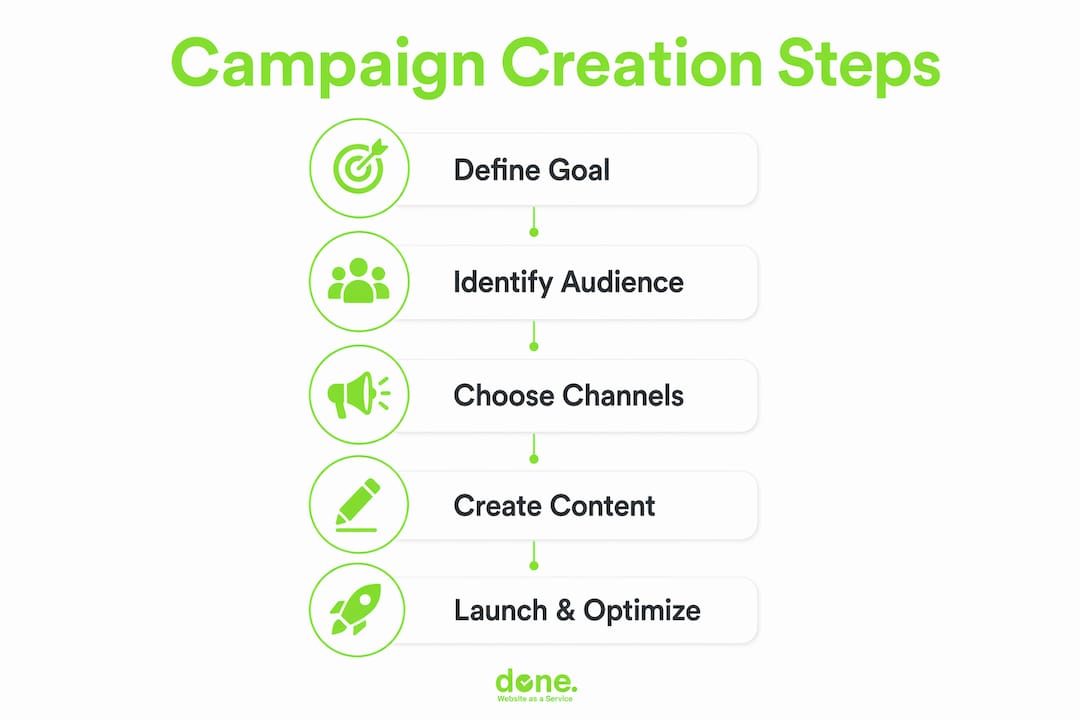
Every effective digital campaign starts with one question: what does success look like, and how will you measure it? Without a precise answer, you will spend budget across channels with no way to judge what worked.
The most reliable framework for setting campaign goals is SMART: Specific, Measurable, Achievable, Relevant, and Time-bound. A SMART goal does not say “increase website traffic.” It says “generate 200 qualified leads from Luxembourg-based businesses via Google Ads within 60 days.” That level of precision shapes every decision that follows, from channel selection to ad copy to landing page design.
Tying your campaign goal to a broader business objective is equally important. If the business needs to grow revenue by 20% this quarter, your campaign goal should connect directly to that number, whether through lead volume, conversion rate, or average order value. Goals that exist in isolation from business outcomes rarely receive the budget or attention they need to succeed.
Common campaign goals include lead generation, direct sales, brand awareness, event registrations, and email list growth. Each requires a different channel mix and a different definition of conversion. A brand awareness campaign measures reach and impressions; a lead generation campaign measures cost per lead and lead quality.
- Lead generation: Track form submissions, calls, and downloads as conversions
- Sales: Measure revenue, return on ad spend (ROAS), and cost per acquisition (CAC)
- Brand awareness: Monitor reach, impressions, video views, and share of voice
- Event registrations: Count sign-ups and measure cost per registration
The most common failure mode in digital marketing campaigns is the absence of a single, clear objective per campaign. When a campaign tries to generate leads, build awareness, and drive sales simultaneously, the media mix becomes diluted and performance measurement becomes impossible.
Pro Tip: Apply the “Rule of One” to every campaign: one primary objective, one core audience, one key message. This constraint forces clarity and makes optimisation far simpler.
Who are you actually talking to? Defining your audience
Defining your perfect customer before choosing channels is the single most effective way to prevent wasted budget. Yet most SMBs skip this step or rely on assumptions that turn out to be wrong.

A buyer persona is a detailed profile of your ideal customer, built from real data rather than guesswork. It covers demographics (age, location, job title, company size), psychographics (values, motivations, frustrations), online behaviour (which platforms they use, when they are active, what content they consume), and purchase triggers (what prompts them to seek a solution like yours).
Here is a practical process for building accurate buyer personas:
- Mine your CRM data. Look at your best existing customers. What do they have in common? Industry, company size, geography, and the problem they hired you to solve are all useful signals.
- Analyse Google Analytics. The Audience and Acquisition reports show you who is already visiting your site, where they come from, and which pages they engage with most.
- Review social media insights. LinkedIn, Meta, and Instagram all provide demographic breakdowns of your followers and page visitors. Compare these against your CRM data to spot patterns.
- Run short customer surveys. Ask five to ten existing clients why they chose you, what problem they were trying to solve, and where they looked before finding you. The language they use is gold for ad copy.
- Conduct competitor analysis. Look at the comments, reviews, and questions on competitor pages. Unmet needs and recurring complaints reveal gaps your campaign can address directly.
The risk of skipping this research is real. A Luxembourg-based B2B software company once ran a Facebook campaign targeting a broad 25 to 55 age range across all industries. The cost per lead was four times higher than their benchmark. After building a proper persona and narrowing targeting to finance and legal professionals aged 30 to 45 in Luxembourg City, cost per lead dropped by more than half. The audience was smaller but far more qualified.
Audience insight also determines channel selection. If your buyers are senior decision-makers in professional services, LinkedIn outperforms Instagram by a significant margin. If you are selling consumer products to under-35s, TikTok and Instagram Reels deserve serious budget. Matching channel to persona is not optional; it is the foundation of effective campaign design.
Pro Tip: Segment your audience into two or three distinct personas and create separate ad sets for each. Personalised messaging consistently outperforms generic messaging, even with a smaller budget.
Choosing the right channels and planning your campaign timeline
SMBs can mix paid and organic channels strategically based on buyer personas and funnel stages to maximise ROI. The key is not to be everywhere; it is to be exactly where your audience is, with the right message at the right moment.
Understanding the four channel types
Digital channels fall into four categories. Owned media includes your website, blog, and email list. You control these entirely, and they carry no per-click cost. Paid media covers Google Ads, Meta Ads, LinkedIn Ads, and display advertising. These deliver speed and scale but require ongoing budget. Earned media is coverage you did not pay for: press mentions, organic shares, and reviews. Shared media refers to social platforms where you publish content that can be amplified by others.
Most campaigns work best with a combination. A product launch might use paid social to generate awareness, a landing page (owned) to capture leads, and email (owned) to nurture those leads through to purchase. Relying solely on paid media is expensive; relying solely on organic is slow.
| Channel type | Typical cost | Audience reach | Best timing |
|---|---|---|---|
| Google Ads (paid search) | Medium to high | High intent buyers | Launch and conversion phases |
| Meta Ads (paid social) | Low to medium | Broad or interest-based | Awareness and retargeting |
| LinkedIn Ads | High | B2B professionals | B2B lead generation |
| Email marketing | Low | Existing contacts | Nurturing and retention |
| SEO / blog content | Time investment | Long-term organic | Pre-launch and ongoing |
| Social media (organic) | Time investment | Followers and shares | Awareness and community |
Structuring your campaign in three phases
A typical campaign timeline has three phases: pre-launch, launch, and post-launch. Each has distinct activities and responsibilities.
- Pre-launch (weeks 1 to 2): Create and approve all assets, build landing pages, set up tracking, brief your team, and run a pre-launch checklist covering mobile responsiveness, form functionality, and pixel verification.
- Launch (weeks 3 to 6 for a standard campaign): Activate paid channels, publish content, send launch emails, and begin daily KPI monitoring.
- Post-launch (weeks 7 onwards): Analyse results, run A/B tests, optimise underperforming ad sets, and nurture leads through the funnel.
Use a simple Gantt chart in Google Sheets or a project management tool like Asana or Notion to map these phases. Assign owners to each task and set hard deadlines. Campaigns that lack a structured timeline tend to launch late, miss optimisation windows, and produce inconclusive data.
For guidance on whether to complement your digital activity with offline channels, the analysis of combining digital and traditional marketing is worth reviewing, particularly for Luxembourg businesses with strong local community presence.
How to create campaign content that resonates and converts
Content is where strategy becomes visible. Every ad, email, landing page, and social post is a direct expression of your campaign goal and audience understanding. Generic content produces generic results.
The most effective way to plan content is to map it to the buyer’s funnel stage:
- Awareness stage: Blog posts, social videos, display ads, and podcast appearances. The goal is to introduce your brand and address a problem your audience recognises. Avoid selling at this stage; educate instead.
- Consideration stage: Case studies, comparison guides, webinars, and email sequences. The goal is to demonstrate why your solution is the right choice. Specificity matters here: use real numbers, named clients (with permission), and concrete outcomes.
- Conversion stage: Landing pages, free trial offers, demo requests, and promotional ads. The goal is to remove friction and make the next step obvious. One clear call to action per page, no distractions.
Brand consistency across all assets is not a design preference; it is a trust signal. Inconsistent fonts, colours, or tone of voice between your ads and your landing page creates a subconscious disconnect that increases bounce rates. Every asset should feel like it belongs to the same campaign.
Pro Tip: A/B test one element at a time: headline, image, CTA button text, or offer. Testing multiple variables simultaneously makes it impossible to identify what drove the improvement.
The two most common content errors are generic messaging that could apply to any business, and landing pages that do not match the promise made in the ad. If your ad says “Free 30-minute strategy session for Luxembourg SMEs,” your landing page must say exactly that, above the fold, with a form that takes under 60 seconds to complete.
For practical guidance on turning your website into a conversion asset, the advice on transforming your website for lead generation is directly applicable to campaign landing page design.
How to launch, track, and optimise your campaign
Launching without tracking in place is the single most expensive mistake in digital marketing. You cannot optimise what you cannot measure, and you cannot measure what you have not set up correctly before going live.
Here is the technical setup sequence every campaign needs before launch:
- Install and verify Google Analytics 4 (GA4). Confirm that pageviews, events, and conversion goals are firing correctly. Use GA4’s DebugView to check in real time.
- Set up UTM parameters for every paid link. Using UTM parameters correctly means tagging every ad URL with at minimum utm_source, utm_medium, and utm_campaign. Add utm_content to differentiate between creative variations.
- Configure Meta Pixel and Conversions API. Pixel-only tracking inflates or undercounts conversions on iOS devices due to Apple’s App Tracking Transparency framework. Combining Meta Pixel with the Conversions API (CAPI), and matching events using a shared event_id for deduplication, gives you far more accurate data for optimisation.
- Test every link and form. Complete the conversion journey yourself on both desktop and mobile before spending a single euro on paid traffic.
- Set up a reporting dashboard. Google Looker Studio connects to GA4, Google Ads, and Meta Ads to give you a single view of campaign performance. Automated daily reports remove the need to log into multiple platforms.
Real-time monitoring and daily KPI reviews allow swift reaction to underperforming ads, which is the difference between a campaign that recovers and one that burns through budget without results.
Once live, the metrics that matter most depend on your campaign goal. For lead generation, track cost per lead (CPL), lead quality score, and conversion rate by channel. For e-commerce, track ROAS, CAC, and average order value. For awareness, track reach, frequency, and click-through rate (CTR).
Optimisation is not a one-time event at the end of the campaign. It is a weekly process of pausing underperforming ad sets, increasing budget on what is working, refining audience segments, and testing new creatives. A/B testing headlines, creatives, and CTAs one at a time gives you clear, repeatable improvements rather than ambiguous results.
The pre-launch checklist must include testing links and forms, verifying mobile responsiveness, and confirming all tracking pixels are active. Skipping this step is how campaigns lose the first 48 hours of data, which is often the most valuable for early optimisation decisions.
Key takeaways
Successful digital campaigns require a single clear objective, a precisely defined audience, matched channels, and tracking infrastructure in place before launch.
| Point | Details |
|---|---|
| One objective per campaign | A single primary goal prevents budget dilution and makes performance measurement reliable. |
| Build personas from real data | Use CRM, Google Analytics, and social insights rather than assumptions to define your audience. |
| Match channels to funnel stage | Paid search suits high-intent buyers; paid social suits awareness and retargeting at lower cost. |
| Set up tracking before launch | UTM parameters, GA4, and Meta Pixel plus CAPI must be verified before any paid spend begins. |
| Optimise weekly, not once | Pause underperforming ad sets, test one variable at a time, and reallocate budget based on data. |
What I have learned from building campaigns for Luxembourg SMBs
After working with over 350 clients at Done since 2014, the pattern I see most often is this: businesses invest in the creative and skip the strategy. They spend weeks on ad design and five minutes on goal-setting. The result is a visually polished campaign with no clear direction and no way to judge whether it worked.
The “Rule of One” is the most underused principle in SMB marketing. I have seen clients run campaigns with three simultaneous objectives, two target audiences, and four different offers. Every metric looked mediocre because the budget was spread too thin to be decisive anywhere. When we stripped it back to one goal, one audience, and one offer, performance improved significantly within the first two weeks.
Local context matters more than most generic guides acknowledge. Luxembourg businesses operate in a multilingual market where French, German, Luxembourgish, and English all have a place depending on the sector and audience. A campaign targeting legal professionals in Luxembourg City performs differently in French than in English, even with identical targeting parameters. Language is not just translation; it is a signal of cultural relevance.
I am also cautious about over-reliance on Meta Pixel data alone. Since Apple’s iOS privacy changes, pixel-only attribution has become unreliable for many clients. We now recommend every client running Meta Ads implement the Conversions API alongside the pixel. The data quality improvement is substantial, and it directly affects how Meta’s algorithm optimises your ad delivery.
The businesses that get the best results from digital campaigns are not the ones with the biggest budgets. They are the ones that are most disciplined about their objectives, most honest about their audience, and most consistent about reviewing data and making changes. That discipline is learnable, and it is what separates campaigns that generate real pipeline from those that generate reports.
— Thomas
How Done helps SMBs build campaigns that generate real leads
Done works with SMBs across Luxembourg to design and execute digital marketing campaigns that are grounded in data, built around clear objectives, and managed for continuous improvement. From initial strategy and audience research through to technical tracking setup, content creation, and ongoing optimisation, the team handles the full campaign workflow so you can focus on your business.
If you are ready to move from ad-hoc marketing activity to a structured, measurable approach, explore Done’s digital marketing workflow for lead generation, or review the digital marketing strategy guide built specifically for Luxembourg SMEs. Both resources explain exactly how Done approaches campaign planning and what results clients typically achieve.
FAQ
What is a digital marketing campaign?
A digital marketing campaign is a time-bound, targeted online effort with defined start and end dates, a specific audience, a set budget, and measurable KPIs. It differs from general marketing activity in that it has a clear objective and a structured plan for achieving it.
How many objectives should a digital campaign have?
Each campaign should have one primary objective. Multiple conflicting objectives dilute budget and make it impossible to measure success accurately, which is why the Rule of One is a core best practice for campaign planning.
Which digital channels work best for SMBs?
The right channels depend on your audience and goal. Google Ads suits high-intent buyers actively searching for your solution; Meta Ads work well for awareness and retargeting at lower cost. LinkedIn Ads are most effective for B2B campaigns targeting professionals. For a detailed comparison, the guide on Google Ads vs Facebook Ads covers the decision framework clearly.
How do I track whether my campaign is working?
Set up Google Analytics 4 with conversion goals, tag all paid URLs with UTM parameters, and install Meta Pixel combined with the Conversions API for Facebook campaigns. Review your core KPIs, such as cost per lead, ROAS, and conversion rate, at least once per week during the campaign.
When should I start optimising a campaign?
Optimisation should begin within the first week of launch, once you have enough data to identify patterns. Pause ad sets with a high cost per result and no conversions after a statistically meaningful spend, and reallocate that budget to the best-performing variations.