

Content marketing strategies for SMBs: 2026 guide
July 3, 2026
Why use SEM for ecommerce: a practical 2026 guide
July 5, 2026
TL;DR:
- SEO offers small and medium-sized businesses a cost-effective way to build lasting digital assets, attract high-intent local customers, and gain valuable market insights.
- A well-executed SEO strategy, focusing on local profiles, reviews, technical fixes, and relevant content, can produce measurable results within a few months and significantly reduce lead costs over time.
Search engine optimisation (SEO) is the process of improving your website so it appears prominently in organic search results, and for small and medium-sized enterprises it is one of the most cost-efficient marketing channels available. Understanding why use SEO for SMEs comes down to one core fact: 70–80% of search users intentionally skip paid adverts and click only organic results. That behaviour means the businesses ranking on page one capture the majority of buyer attention without paying per click. Unlike a Google Ads campaign that stops the moment your budget runs out, SEO builds lasting digital assets that grow in value over time, improving your marketing ROI month after month.
Why use SEO for SMEs: the cost-efficiency case
The financial argument for SEO is straightforward once you compare the numbers directly.
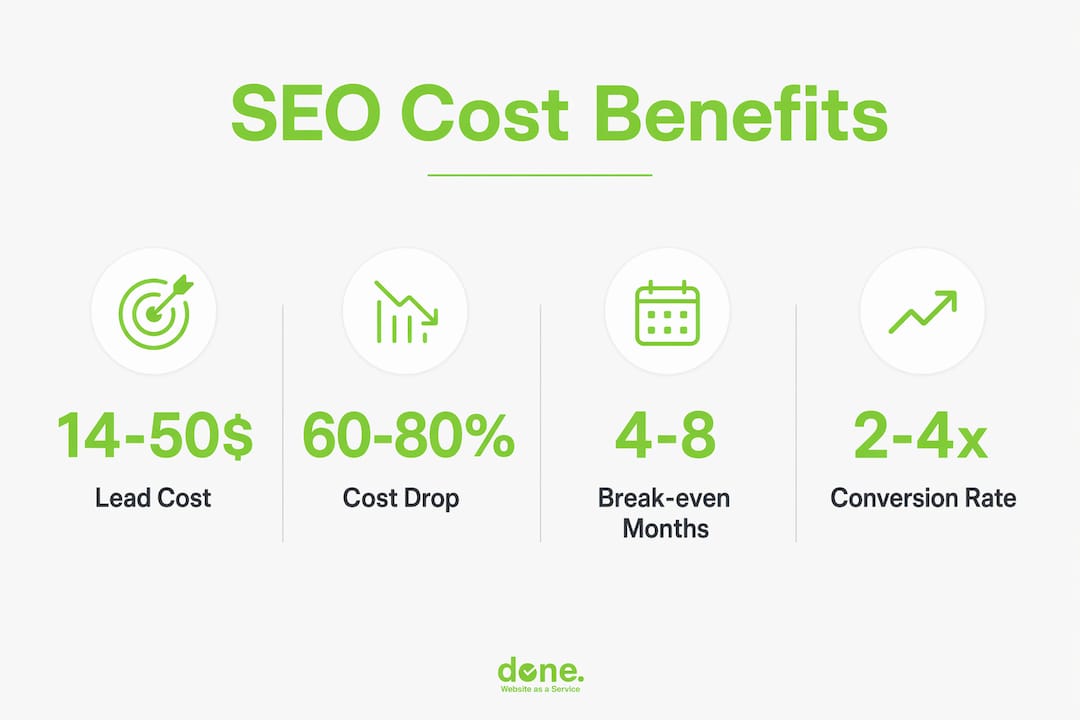
Mature SEO campaigns generate leads at an average cost of $14–$50, compared to Google Ads where the equivalent cost runs from $75 to over $300 per lead. That gap is not marginal. For a small business spending £2,000 a month on marketing, the difference in lead volume between those two channels is the difference between growth and stagnation.
The break-even point for a consistent SEO investment typically falls between four and eight months. That timeline surprises many business owners who expect immediate returns, but it reflects how search engines index, test, and rank new content. Once your pages pass that threshold, the economics shift decisively in your favour.
| Channel | Average cost per lead | Cost trend over time |
|---|---|---|
| SEO (mature campaign) | $14–$50 | Decreases significantly after year one |
| Google Ads | $75–$300+ | Flat or rising with competition |
| Social media paid | Variable | Dependent on ongoing spend |
The reason SEO becomes cheaper over time is structural. SEO cost per lead drops 60–80% after the first year as your existing content continues to attract traffic without additional spend. Paid advertising, by contrast, charges you the same rate for every click regardless of how long you have been running campaigns. SEO compounds; paid ads do not.
This logarithmic growth model is the core financial reason to invest in SEO rather than relying solely on paid channels. High-lifetime-value service businesses, such as accountants, legal firms, and specialist consultants, can see ROI of 15:1 to 30:1 from mature SEO campaigns. That figure reflects the compounding nature of organic rankings combined with high-value client relationships.
Pro Tip: Set a minimum 12-month horizon when evaluating SEO performance. Judging results at three months is like assessing a pension fund after one quarter. The real returns appear in months nine through twenty-four.
How does SEO build trust and attract higher-intent customers?
Organic search rankings carry implicit authority that paid adverts simply do not. When your business appears at the top of Google’s organic results, buyers interpret that position as a signal of credibility. No amount of ad spend replicates that perception.

The conversion advantage of organic traffic is measurable: organic results convert at two to four times the rate of paid clicks. Local intent keywords, such as “accountant in Luxembourg City” or “plumber near Esch-sur-Alzette,” convert 15–30% better still. The person searching with local intent has already decided they need a service. They are choosing a provider, not browsing.
Local SEO, in particular, gives SMEs a genuine competitive edge over larger national or international businesses. 98% of consumers have searched locally for a product or service in recent years. That figure confirms local search is not a niche behaviour. It is the default way people find businesses near them.
Key trust signals that local SEO builds for your business:
- Google Business Profile completeness. A fully completed profile with accurate hours, categories, and services ranks higher and converts better.
- Photos. SMEs that add photos to their profile receive 42% more direction requests than those without. That is a direct, measurable link between a simple action and foot traffic.
- Reviews. Consistent, recent reviews signal active trading and genuine customer satisfaction to both Google and prospective buyers.
- Local citations. Consistent name, address, and phone number listings across directories reinforce your geographic relevance to search engines.
- User engagement. Click-through rates, time on site, and low bounce rates all tell Google your content satisfies the searcher’s intent.
Stat to note: SMEs that add photos to their Google Business Profile receive 42% more direction requests. That single optimisation costs nothing except ten minutes of your time.
The trust advantage of organic rankings also extends to your website itself. A business that ranks well has, by definition, earned Google’s confidence through relevant content, quality links, and a good user experience. Buyers recognise this, even if they cannot articulate why they trust one result over another.
Which SEO strategies should SMEs prioritise in 2026?
The most effective SEO for small businesses in 2026 combines local fundamentals, technical site health, and content that reflects genuine local knowledge. Generic approaches produce generic results.
1. Claim and complete your Google Business Profile
Your Google Business Profile (GBP) is the single highest-impact local SEO asset available to an SME. Complete every field, select precise business categories, and post updates regularly. Read the GBP optimisation guide to understand which fields carry the most ranking weight.
2. Build a review generation process
Automated review requests sent within 24 hours of service completion significantly outperform requests sent later, as completion rates drop sharply after that window. Set up a simple post-service message via email or SMS asking satisfied customers to leave a Google review. Consistency matters more than volume.
3. Add schema markup to your website
Schema markup is underused by SMEs, yet it gives search engines precise information about your business type, location, services, and reviews. Only about a third of websites use it effectively. In AI-driven search results, schema markup helps your business appear as a clearly defined entity rather than an ambiguous web page. That distinction is increasingly important as Google’s AI Overviews and similar features reshape how results are displayed.
4. Fix technical site health
Site speed, HTTPS security, and mobile usability are direct ranking factors. A slow, insecure, or difficult-to-use website loses rankings regardless of content quality. Run a technical audit using Google Search Console and PageSpeed Insights. Address the issues flagged before investing heavily in content.
5. Create locally specific content
Generic templated pages do not rank in competitive local searches. Effective local content includes neighbourhood-specific details, references to local regulations or landmarks, and FAQs that reflect the actual questions your customers ask. A Luxembourg-based accountancy firm, for example, should publish content addressing TVA registration, the Registre de Commerce, and cross-border worker taxation. That specificity is what separates a page that ranks from one that does not.
Pro Tip: Treat SEO as a monthly discipline, not a one-time project. Publish one piece of locally relevant content per month, update your GBP weekly, and review your Google Search Console data fortnightly. That rhythm compounds into meaningful results within six to twelve months.
The table below shows how SME-focused SEO tactics compare in terms of effort and typical impact:
| Tactic | Effort level | Typical impact timeline |
|---|---|---|
| Google Business Profile completion | Low | 1–3 months |
| Schema markup implementation | Medium | 2–4 months |
| Technical site speed fixes | Medium | 1–2 months |
| Locally specific content creation | High | 4–9 months |
| Review generation process | Low | Ongoing, cumulative |
How can SMEs use SEO data to make better business decisions?
SEO analytics do more than track rankings. They reveal what your customers are actually searching for, which is market research you would otherwise pay a consultant to produce.
Google Search Console shows you the exact queries people type before landing on your site. That data tells you which problems your customers are trying to solve, which services they are comparing, and which questions they cannot find answers to elsewhere. A plumbing business that sees high impressions for “emergency boiler repair Luxembourg” but low clicks knows it needs a dedicated page for that service.
This intelligence feeds directly into sales and product decisions. If a keyword cluster around a service you offer generates thousands of monthly searches but you have no content addressing it, you have identified a gap that a competitor may already be filling. Closing that gap is both an SEO action and a business development action.
SMEs hold a genuine speed advantage over larger competitors here. A small business can publish a new page, update a service description, or respond to a trending local query within days. A large organisation with multiple approval layers takes weeks or months. That agility, combined with local knowledge, is a structural SEO advantage that no budget can fully replicate.
The benefits of SEO for SMEs extend beyond the website itself:
- Sales call preparation. Knowing which questions prospects search before contacting you lets your team address objections proactively.
- Pricing clarity. High search volume for “cost of X in Luxembourg” signals that price transparency on your site will convert more visitors.
- Service development. Consistent search demand for a service you do not yet offer is a low-risk signal to expand your offering.
- Content prioritisation. Search volume data tells you which topics to write about first, removing guesswork from your content calendar.
Pro Tip: Export your Google Search Console query report monthly and sort by impressions. Any query with over 100 monthly impressions and a click-through rate below 3% is a page that needs improving. That single habit identifies your highest-priority SEO work every month.
The SEO and user experience connection is equally important here. A website that ranks well must also convert well. If your analytics show strong organic traffic but weak enquiry rates, the problem is not SEO. It is the page experience. Modern SEO practices are inseparable from user experience improvements, creating websites that function better as sales tools and reduce customer friction.
Key takeaways
SEO is the most cost-efficient long-term marketing channel for SMEs because it builds compounding digital assets, attracts high-intent buyers, and generates market intelligence that improves every other part of your business.
| Point | Details |
|---|---|
| Cost advantage compounds over time | SEO cost per lead drops 60–80% after year one, unlike paid ads which remain flat or rise. |
| Organic results earn more trust | 70–80% of searchers skip paid adverts, making organic rankings the primary source of credible traffic. |
| Local SEO delivers measurable wins | Adding photos to your Google Business Profile alone increases direction requests by 42%. |
| Schema markup is an underused edge | Only about a third of websites use schema effectively, giving SMEs a clear technical advantage. |
| SEO data informs business strategy | Google Search Console reveals real customer queries that improve sales, content, and service decisions. |
The uncomfortable truth about SEO timelines
I have worked with SME owners in Luxembourg long enough to know the most common mistake: expecting SEO to behave like a paid ad. They invest for two months, see no dramatic spike in enquiries, and conclude it does not work. That conclusion is almost always wrong, and it is expensive.
SEO is not a tap you turn on. It is a foundation you build. The businesses I have seen get the best results from organic search are the ones that committed to a 12-month plan, published genuinely useful local content, and fixed their technical issues before worrying about rankings. They did not chase shortcuts or buy cheap links. They treated their website as a sales asset worth maintaining.
The other mistake I see regularly is treating SEO and user experience as separate concerns. They are not. A page that ranks but fails to answer the visitor’s question will see its ranking fall within months as Google measures engagement signals. The SEO best practices for SMBs that produce lasting results are the ones that start with the customer’s question and work backwards to the technical implementation.
My honest advice: if you are a Luxembourg SME with a service-based business and a reasonable website, SEO is almost certainly your highest-ROI marketing investment available right now. The local search market here is competitive but not saturated. Businesses that start building their organic presence in 2026 will hold a meaningful advantage over those that wait another year.
— Thomas
How Done can help your SME grow through SEO
Done has worked with over 150 SMEs across Luxembourg since 2014, building websites and digital marketing programmes that generate measurable organic growth. Every project starts with a technical audit, a local keyword analysis, and a clear plan tied to your business objectives.
Our approach combines web development optimised for SEO with ongoing local optimisation, Google Business Profile management, and content that reflects genuine Luxembourg market knowledge. We do not offer generic packages. We build the specific foundations your business needs to rank, convert, and grow. If you want to understand exactly where your current site stands and what it would take to improve your organic visibility, get in touch with the Done team for a straightforward conversation.
FAQ
What is SEO and why does it matter for small businesses?
SEO (search engine optimisation) is the practice of improving your website so it ranks higher in organic search results. It matters for small businesses because 70–80% of searchers skip paid adverts, making organic rankings the primary source of credible, cost-efficient traffic.
How long does SEO take to show results for an SME?
Most SMEs see measurable organic gains within three to six months for local SEO fundamentals, with the break-even on investment typically occurring between four and eight months of consistent effort.
Is SEO cheaper than Google Ads for small businesses?
Yes. Mature SEO campaigns generate leads at $14–$50 on average, compared to $75–$300 or more per lead through Google Ads. The cost advantage grows over time as SEO assets compound.
What is the most important local SEO action for an SME?
Completing and actively maintaining your Google Business Profile is the single highest-impact local SEO action. Adding photos alone increases direction requests by 42%, and consistent reviews improve both rankings and buyer trust.
Do SMEs need technical SEO knowledge to get started?
No. The highest-priority technical actions, such as fixing site speed, adding HTTPS, and implementing schema markup, can be handled by a web agency. Google Search Console provides clear guidance on issues without requiring deep technical expertise.