

Data sovereignty Luxembourg: your 2026 compliance guide
May 29, 2026
AI without cloud: a practical guide for SMBs in 2026
May 31, 2026
TL;DR:
- Most business leaders mistakenly believe their existing data policies cover AI privacy risks, which is not the case. AI data privacy requires distinct governance, especially concerning foundation models’ complex data collection and vulnerabilities. Regulator enforcement of GDPR obligations on AI tools prompts SMEs to focus on transparent, compliant data handling and proactive privacy-by-design measures.
Most business leaders adopting AI tools assume their existing data protection policies cover them. They are wrong. AI data privacy is a distinct discipline, and the gap between what companies think they are doing and what regulators actually require is widening fast. The Belgian Data Protection Authority’s 2026 awareness series on AI’s privacy impact makes this point directly: many businesses simply do not understand how AI systems collect, process, and retain personal data. This guide cuts through the confusion and gives you a clear framework for protecting your business.
Table of Contents
- Key takeaways
- AI data privacy risks with foundation models
- Regulatory expectations for UK and European SMEs
- Selecting AI vendors with privacy in mind
- Practical safeguards for SME AI workflows
- Balancing AI innovation with responsible governance
- My perspective on AI privacy for SMEs
- How Done can support your AI privacy compliance
- FAQ
Key takeaways
| Point | Details |
|---|---|
| AI creates unique privacy risks | Foundation models and agentic AI introduce vulnerabilities that standard data policies do not address. |
| Regulation applies now | UK and EU GDPR obligations cover automated decision-making and AI workflows, with active enforcement already underway. |
| Vendor scrutiny is non-negotiable | You must understand exactly how your AI vendors handle, store, and train on your data before signing any contract. |
| Practical safeguards are achievable | Data minimisation, access controls, and bias testing can be implemented without a dedicated compliance department. |
| Privacy protects, not prevents | Strong data governance makes AI adoption safer and builds customer trust, rather than slowing you down. |
AI data privacy risks with foundation models
The term “AI data privacy” describes the specific challenges that arise when artificial intelligence systems collect, process, store, or generate personal data. This goes well beyond traditional data protection. The stakes are higher because the systems are more complex, more autonomous, and often harder to audit.
Foundation models sit at the heart of most commercial AI tools your business is likely using today, from writing assistants to customer service chatbots. These models are trained on enormous volumes of data scraped from the web, which means personal information about real people may already be embedded in the model itself. According to Stanford HAI, foundation models carry higher privacy risks due to this vast data scraping and their vulnerability to adversarial attacks.
What does that look like in practice? Here are the specific technical threats SMEs need to understand:
- Prompt injection attacks: A malicious instruction hidden inside user input can manipulate an AI system into revealing data it should not, bypassing safety controls you believe are in place.
- Model inversion attacks: Researchers have demonstrated that attackers can query a model repeatedly to reconstruct fragments of the training data, potentially extracting personal details about individuals whose data was used.
- Data poisoning: If your AI system ingests external data, a bad actor can introduce corrupted inputs that subtly alter the model’s behaviour over time.
- Inadvertent output disclosure: AI systems can reproduce personal data from their training set in responses, even without any malicious intent. This is not hypothetical. It has happened with major commercial models.
The systemic dimension is just as concerning. Stanford HAI’s analysis confirms that governance of foundation models requires threat modelling for privacy across technical and systemic dimensions, not just runtime safeguards. In plain terms, you cannot simply bolt a privacy policy onto an AI tool and call it done. The risk lives inside the model’s architecture.
For SMEs, the most practical response is to prioritise privacy-by-design when selecting tools. Ask whether the model was trained on consented data, whether personal data can be removed from the training set, and whether the system’s outputs can be monitored for unintended disclosures. These questions are not easy to answer, but asking them is where responsible AI adoption begins.
Pro Tip: When evaluating any AI tool, ask the vendor specifically about data removal mechanisms. If they cannot explain how personal data can be identified and deleted from their training pipeline, treat that as a significant risk.
Regulatory expectations for UK and European SMEs
The legal framework governing artificial intelligence privacy is not waiting for AI to mature. Regulators are acting now. For SMEs operating in the UK and Europe, this means existing obligations under UK GDPR and EU GDPR apply directly to your AI deployments, and enforcement is already underway.
Here is what you need to get right:
-
Establish a lawful basis for every AI data processing activity. Consent, legitimate interest, and contractual necessity each carry different obligations. You cannot assume that because you have a general privacy policy, your AI tool’s data use is covered.
-
Apply data minimisation rigorously. The principle is simple: collect only what you need, for a specific purpose, and delete it when that purpose is served. AI systems have a tendency to ingest far more data than necessary. Audit what your AI tools are actually processing.
-
Document automated decision-making. If your AI system makes decisions that affect individuals, such as screening job applications, scoring leads, or assessing creditworthiness, you have specific obligations. The ICO requires SMEs using automated decision-making to implement demonstrable safeguards including bias testing, transparency, and human involvement.
-
Communicate rights clearly to data subjects. People whose data is processed by your AI system have the right to know. Your privacy notices must explain that AI is involved, what decisions it influences, and how individuals can challenge those decisions.
-
Prepare for agentic AI compliance demands. Agentic AI systems, those that can take autonomous actions across multiple steps, present particular challenges. The UK ICO’s 2026 guidance makes clear that agentic AI must comply with UK GDPR in full, including transparency about data processing, despite their dynamic and autonomous nature.
The Canadian enforcement action against OpenAI is the most instructive cautionary example to date. A joint investigation found that ChatGPT’s model training violated Canada’s federal and provincial privacy laws through non-consensual data collection and inadequate deletion policies. This was not a small business making a naive mistake. It was one of the world’s most sophisticated AI organisations, found wanting by regulators applying laws that closely mirror GDPR.
The lesson for SMEs is that “we used a reputable tool” is not a compliance defence. You are the data controller. You are responsible for how that tool processes personal data on your behalf.
Your GDPR compliance obligations do not disappear simply because an AI vendor is handling the data. Document your processing activities, record your legal basis, and keep those records current.
Selecting AI vendors with privacy in mind
Choosing an AI vendor is now a data governance decision, not just a procurement one. Many SMEs sign up for AI tools based on price and features without asking a single question about data handling. This is where the real exposure lies.
The questions you need answered before committing to any AI vendor:
- Does the vendor train on your input data? This is the most important question. Some vendors use your prompts, documents, and queries to improve their models. Others explicitly do not. Microsoft’s Azure AI Content Safety, for example, does not retain user inputs for training and stores blocklists encrypted regionally with no human review of content. That is the level of specificity you should expect.
- Where is your data stored? Data residency matters enormously under GDPR. If your vendor stores data outside the EEA or UK without an adequate transfer mechanism, you have a compliance problem.
- What are the data deletion policies? Ask how long inputs are retained, whether you can request deletion, and how deletions are verified.
- Who can access your data? Understand whether human reviewers can see your content, and under what circumstances.
- Is there a data processing agreement (DPA)? Any vendor acting as a data processor must have a signed DPA with you before you share personal data.
| Evaluation area | What to look for | Red flag |
|---|---|---|
| Training data use | Explicit opt-out or no training on customer data | Vague “may be used to improve services” language |
| Data residency | EEA or UK storage with documentation | No clear answer on storage location |
| Deletion policy | Clear deletion timelines and confirmation process | “We retain data per our policy” without specifics |
| Human review | No human review or explicit restrictions | Unrestricted access by vendor staff |
| Contractual basis | Signed DPA available on request | No DPA offered or required |
Pro Tip: Request the vendor’s DPA before your free trial ends, not after you have shared business data. If they do not have one ready, that tells you everything you need to know about their compliance posture.
Even well-designed AI services require customers’ active responsibility to maintain compliance with privacy policies and data residency needs. Choosing a trustworthy vendor is the starting point, not the end point. You need to monitor and audit that relationship regularly, particularly as vendors update their terms or model architectures.
Practical safeguards for SME AI workflows
Protecting data in AI workflows does not require a compliance department or a six-figure legal budget. It requires discipline and a clear process. Here is what that looks like in practice for most SMEs.
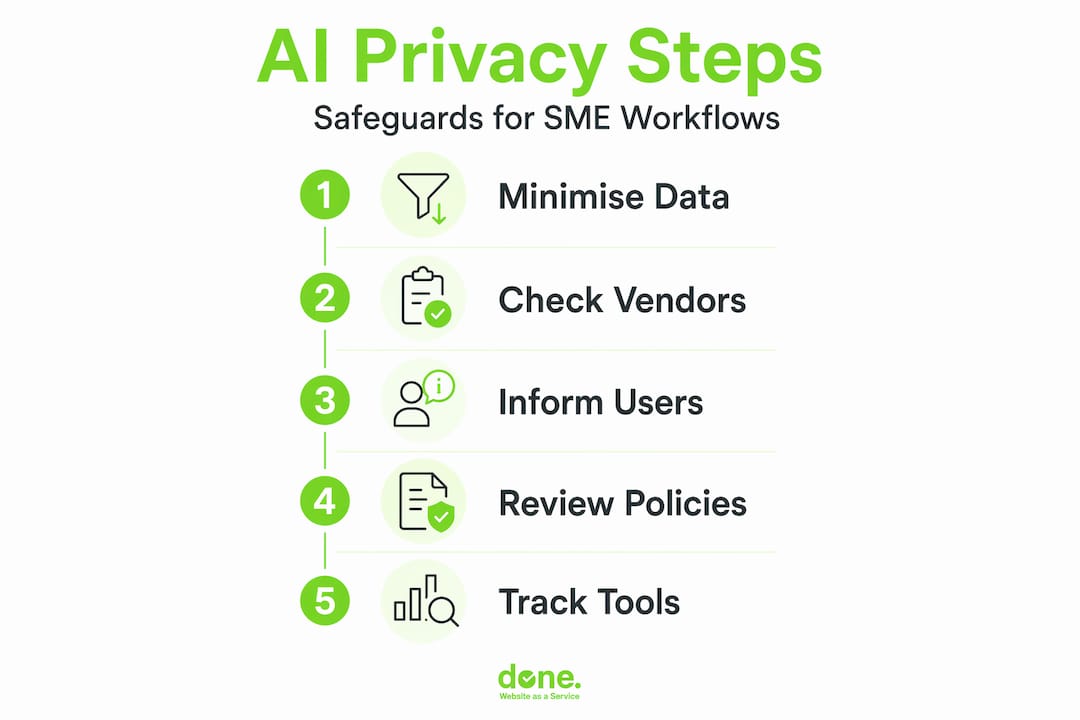
Start with data minimisation at the input stage. Before anything reaches your AI tool, ask whether all of that data is necessary. If you are using an AI assistant to draft client proposals, does it need the client’s full personal details, or can you work with anonymised references? Stripping out personal identifiers before they enter an AI system is one of the simplest and most effective controls available.

Set up transparency with users and employees. If your AI system interacts with customers, those customers have a right to know. A clear disclosure in your chat interface or email footer, stating that AI is involved in the response process, satisfies both the ethical and legal requirements. The ICO advises SMEs to communicate rights clearly to data subjects in all AI applications, and this applies whether the interaction is automated or human-assisted.
Test your AI systems regularly for bias and inaccuracies. This is not optional if you are using AI to make decisions that affect individuals. Bias testing does not require sophisticated tooling. It requires you to run representative sample inputs, review outputs systematically, and document what you find. For ongoing automated decision-making, regular bias reviews are a specific ICO requirement.
The remaining practical steps cover access and incident readiness:
- Restrict who in your organisation can access AI systems that process personal data. Apply role-based access controls and review them quarterly.
- Set clear data retention rules. If your AI workflow logs conversations or outputs, define how long those logs are kept and automate their deletion.
- Create a simple incident response plan for AI-related privacy events. Know who is responsible, how you will notify affected individuals, and whether you need to report to your data protection authority.
- Keep a record of your AI processing activities. This is your audit trail and your first line of defence if a regulator comes asking.
For a detailed look at protecting data in AI workflows, Done has put together a dedicated guide covering these controls in depth for SME environments.
Pro Tip: Create a one-page AI data inventory for your business. List every AI tool in use, what data it processes, who owns the vendor relationship, and when the DPA was last reviewed. Most SMEs have never done this, and it reveals gaps immediately.
Balancing AI innovation with responsible governance
The most common mistake SMEs make is treating data protection in AI as a blocker to progress. It is not. The businesses that build privacy governance into their AI adoption from the start move faster in the long run, because they avoid the costly rework that comes from getting it wrong.
The “black box” problem is worth confronting directly. Many AI tools offer no visibility into how they reach their outputs. That opacity is a compliance risk. If you cannot explain to a regulator, a customer, or a court how a decision was made, you are exposed. Transparency and explainability are not just ethical ideals. They are requirements under GDPR when AI is involved in consequential decisions.
| Governance approach | Short-term effort | Long-term benefit |
|---|---|---|
| Privacy-by-design in AI selection | High: requires vendor due diligence | Low compliance risk, faster scaling |
| Reactive fixes after incidents | Low: no upfront effort | High cost, reputational damage, regulatory risk |
| Ongoing bias and accuracy testing | Medium: quarterly process | Demonstrable compliance, reduced legal exposure |
| Documented data processing records | Medium: initial setup time | Audit readiness, regulatory confidence |
Proactive governance beats reactive fixes every time. The businesses we work with at Done that invest in upfront AI governance spend significantly less time and money dealing with compliance issues later. It is genuinely a better use of resources.
Strong privacy practice also builds trust. When customers and partners know you handle data responsibly, that confidence translates into commercial outcomes. Your AI compliance approach becomes part of your value proposition, not just a legal obligation. This is particularly true in sectors like finance, legal services, and healthcare, where data sensitivity is high and clients scrutinise vendors carefully.
My perspective on AI privacy for SMEs
In my experience working with SMEs across Luxembourg and Europe, the most dangerous moment in AI adoption is not the first deployment. It is six months later, when the tool is embedded in daily workflows, the team has stopped asking questions about it, and nobody has reviewed the vendor’s updated terms of service.
I have seen businesses invest genuinely in vendor due diligence at the start, then let the relationship drift. The vendor quietly changes their data retention policy in a terms update, and suddenly the SME is non-compliant without knowing it. Privacy compliance for AI is not a one-time task. It is an ongoing responsibility.
What I have also learned is that SMEs consistently underestimate how much control they actually have. You do not need to be a large enterprise with a dedicated DPO to manage AI privacy well. A clear data inventory, a signed DPA, quarterly bias checks, and honest transparency notices will put you ahead of the vast majority of your competitors. The gap between good and poor practice at the SME level is not about resources. It is about whether someone has made it their job to care.
The direction of travel on AI ethics and data privacy regulation is clear: more specificity, more enforcement, more accountability for the businesses that deploy these tools. The Canadian OpenAI investigation will not be the last major enforcement action. Prepare now, while the regulatory environment is still relatively forgiving, rather than after an incident forces your hand.
— Thomas
How Done can support your AI privacy compliance
Done has spent over a decade helping SMEs across Luxembourg and Europe adopt technology that works for their business without creating legal or operational risk. AI data privacy is now central to everything we do in the AI consulting space.

We help SMEs audit their current AI tool usage, identify compliance gaps, select vendors with the right data governance practices, and build workflows with privacy controls built in from day one. For businesses in data-sensitive sectors, we also deploy private on-premise AI solutions that keep your data entirely within your own infrastructure, removing third-party data handling risks altogether. Whether you are just starting to explore AI or are already using it and want to make sure you are doing so responsibly, we are here to work through it with you practically and without the jargon.
FAQ
What makes AI data privacy different from standard data protection?
Standard data protection covers how you collect and store data. AI data privacy adds the complexity of how AI systems train on data, generate outputs, and make decisions, each of which creates new obligations and risks that traditional policies do not address.
Does GDPR apply to AI tools used by SMEs?
Yes. If your AI tool processes personal data about individuals in the EU or UK, GDPR applies in full. This includes obligations around lawful basis, transparency, data minimisation, and individuals’ rights, regardless of whether the tool is supplied by a third party.
How do I know if my AI vendor is GDPR-compliant?
Ask for their data processing agreement, their data retention and deletion policies, and confirmation of where your data is stored. A GDPR-compliant vendor will have clear, documented answers to all of these questions and a signed DPA ready to provide.
What is automated decision-making and when does it apply to my business?
Automated decision-making occurs when an AI system makes a decision about a person without meaningful human involvement, such as scoring a job applicant or approving a loan. Under UK and EU GDPR, this triggers specific rights for individuals and obligations for your business, including the right to human review.
What should SMEs do first to improve AI data privacy?
Start by creating an inventory of every AI tool you use and what personal data each one processes. Then check whether you have a signed DPA with each vendor. These two steps will surface the most significant gaps quickly and give you a clear starting point for remediation.