

Top 7 Website Builders 2026
April 3, 2026
What is digital strategy? A guide for SME growth in Europe
April 5, 2026
TL;DR:
- Automation enhances SME efficiency, lead generation, and ensures consistent messaging.
- Proper preparation, data hygiene, and simple workflows are key to successful automation.
- Start small, focus on foundational tasks, and gradually incorporate AI to deepen personalization.
If you are running a small or medium-sized business in Luxembourg or Europe, you already know the feeling: too many campaigns to manage, too little time, and a growing sense that manual marketing is holding you back. Chasing leads through spreadsheets, sending one-off emails, and posting to social media by hand simply does not scale. Digital marketing automation works best when you start with clear goals and a simple plan, and that is exactly what this guide delivers. You will find practical steps, European best practices, and a realistic path to generating more qualified leads without burning out your team.
Table of Contents
- Why automate your digital marketing?
- What you need before you start: Preparation and prerequisites
- Choosing the right tools: Platforms, features, and budgeting
- Step-by-step setup: Building simple, effective workflows
- Optimising and personalising with AI: Balancing automation with the human touch
- What most automation guides don’t tell you
- How we help SMEs succeed with digital marketing automation
- Frequently asked questions
Key Takeaways
| Point | Details |
|---|---|
| Start with clear goals | Defining your objectives first sets the foundation for successful automation. |
| Prioritise data hygiene | Clean, compliant data is essential for effective, GDPR-ready automations in Europe. |
| Begin with simple workflows | Launching 1–2 basic automations prevents overwhelm and delivers quick wins. |
| Balance AI and human input | Leverage AI for personalisation but maintain human review for authenticity and compliance. |
| Evolve via review and optimisation | Ongoing monitoring and fine-tuning ensures your automations grow with your business. |
Why automate your digital marketing?
Automation is not a luxury reserved for large corporations with dedicated marketing departments. For SMEs across Luxembourg and Europe, it is increasingly a practical necessity. The core promise is straightforward: you set up a process once, and it runs reliably in the background, freeing your team to focus on higher-value work.
The benefits are tangible and well-documented. Automation tools grow businesses when paired with the right strategy, delivering improvements in efficiency, consistency, and lead generation simultaneously. Instead of manually following up with every enquiry, your system sends a timely, personalised message. Instead of guessing when to post on social media, a scheduler handles it based on audience data.
Here are the core advantages SMEs consistently report:
- Increased efficiency: Repetitive tasks such as email follow-ups, contact tagging, and lead scoring are handled automatically, saving hours each week.
- Greater consistency: Your messaging stays on-brand and on-schedule, even during busy periods or staff absences.
- Improved lead generation: Automated nurturing sequences keep prospects engaged until they are ready to buy, reducing drop-off.
- Better data: Every interaction is tracked, giving you clearer insight into what is working and what needs adjustment.
- GDPR-ready workflows: Modern platforms include consent management and data handling features built for European compliance.
For SMEs in Luxembourg specifically, integration with local SEO and PPC channels is a key factor in making automation genuinely effective rather than just administratively convenient. Connecting your automation platform to your Google Ads account or local directory listings means your campaigns respond to real-time signals rather than running on a fixed schedule.
“The goal of automation is not to replace your marketing team. It is to give them leverage, so that every hour of effort produces more measurable output.”
Understanding what marketing automation actually involves is the first step. It covers everything from email sequences and lead scoring to social scheduling and CRM synchronisation. Modern cloud-based tools have made these capabilities accessible at SMB-friendly price points, often starting at under €50 per month. Pairing automation with a clear digital marketing strategy ensures your efforts are directed where they matter most.
Now that you see the promise of automation, let’s clarify exactly what you need to get started.
What you need before you start: Preparation and prerequisites
Rushing into automation without preparation is one of the most common mistakes SMEs make. The tools are only as good as the foundation beneath them. Before you select a platform or build a single workflow, you need to do some groundwork.
Audit, goal-setting, and data hygiene are essential first steps that determine whether your automation delivers results or simply automates existing problems. Start by mapping your current marketing processes. Where do leads come from? Where do they drop off? Which tasks consume the most time for the least return?
Once you have that picture, clean your contact data. Outdated email addresses, duplicate records, and missing consent flags will undermine any campaign you run. Prioritise data hygiene and start simple to avoid the overwhelm that causes many SMEs to abandon automation projects halfway through.
Pre-automation checklist:
- Audit all current marketing channels and identify manual bottlenecks
- Clean and segment your contact list, removing duplicates and invalid addresses
- Confirm GDPR consent records for all contacts
- Define two or three specific goals (e.g., increase qualified leads by 20%, reduce email response time to under one hour)
- Gather your assets: existing email templates, landing pages, website access credentials, and budget
The table below summarises the key preparation areas and what each involves:
| Preparation area | What to do | Why it matters |
|---|---|---|
| Process audit | Map all marketing tasks and touchpoints | Reveals where automation adds most value |
| Data hygiene | Remove duplicates, validate emails, check consent | Prevents wasted sends and compliance risk |
| Goal definition | Set measurable KPIs before you begin | Keeps your automation focused and accountable |
| Asset inventory | Catalogue content, forms, and integrations available | Avoids delays once setup begins |
| Budget planning | Allocate monthly spend for tools and support | Ensures sustainability beyond the first month |
Pro Tip: Do not try to automate everything at once. Pick the single process that costs your team the most time each week and start there. A focused first win builds confidence and gives you real data to guide the next step.
Understanding how your website fits into the lead generation picture is equally important. If your site is not set up to capture and convert visitors, even the best automation will struggle to deliver results. Review your forms, calls to action, and landing pages before you connect them to any marketing automation platform.

With your goals and assets now clear, let’s review what platforms and tools suit your needs as an SME in Europe.
Choosing the right tools: Platforms, features, and budgeting
The market for marketing automation tools is broad, and the choice can feel overwhelming. The good news is that simple and scalable tools are widely available even for small teams, and you do not need an enterprise budget to access genuinely powerful features.
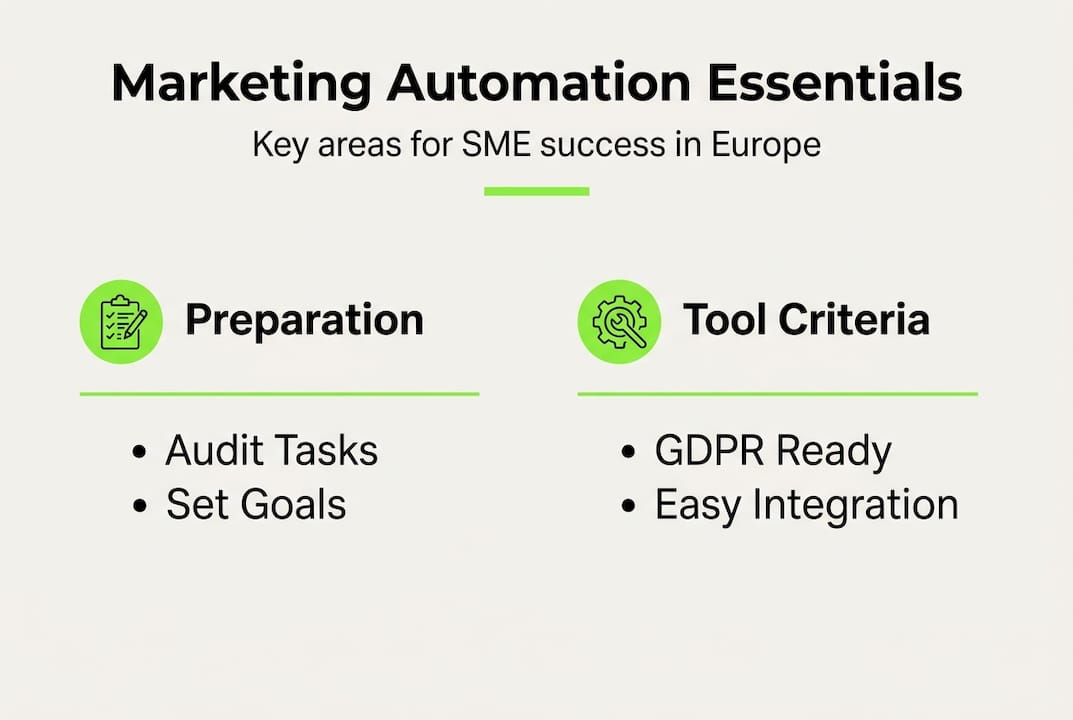
For European SMEs, the non-negotiable requirements are GDPR compliance, multilingual support, and reliable integration with the channels you already use. CRM integration and local channel connectivity significantly increase the effectiveness of any automation investment.
Here is a comparison of popular platforms suited to SMEs in Luxembourg and Europe:
| Platform | Starting price | GDPR tools | Multilingual | CRM built-in | Best for |
|---|---|---|---|---|---|
| Mailchimp | Free / €13+ per month | Yes | Yes | Basic | Email-first SMEs |
| HubSpot | Free / €45+ per month | Yes | Yes | Full CRM | Growth-focused teams |
| ActiveCampaign | €29+ per month | Yes | Yes | Yes | Advanced automation |
| Brevo (Sendinblue) | Free / €19+ per month | Yes | Yes | Basic | European-based SMEs |
| Zoho Marketing Plus | €25+ per month | Yes | Yes | Full CRM | Budget-conscious teams |
When evaluating any platform, work through this checklist of must-have features:
- Email automation: Sequences, triggers, and A/B testing capability
- Form and landing page builder: Capture leads directly without additional tools
- CRM integration: Native or via API connection to your contact database
- Lead scoring: Automatically rank contacts by engagement level
- Reporting and analytics: Clear dashboards showing open rates, conversions, and ROI
- GDPR compliance tools: Consent management, data export, and deletion workflows
- Multilingual content support: Essential for Luxembourg’s trilingual business environment
Pro Tip: Before committing to a paid plan, check whether your platform is eligible under programmes such as Fit 4 AI, which can subsidise digital transformation costs for Luxembourg SMEs. This can meaningfully reduce your first-year investment.
Understanding the basics of marketing automation will help you ask the right questions during any platform trial. And if you are still weighing up the broader case for digital investment, reviewing the digital marketing advantages for Luxembourg SMEs provides useful context for prioritising your budget.
With your chosen tool and budget in hand, you are ready to build actual workflows, the heart of marketing automation.
Step-by-step setup: Building simple, effective workflows
A workflow is simply a series of automated actions triggered by a specific event. Someone fills in a form, and your system sends a welcome email. A contact opens three emails in a row, and your CRM flags them as a warm lead. These are not complex processes. They are logical sequences that run without manual intervention.
Starting with one or two workflows produces faster, cleaner results than trying to build a full automation ecosystem from day one. Here is a practical sequence for your first build:
- Create a welcome email sequence. When a new contact subscribes or fills in a contact form, trigger an immediate welcome email. Follow it with two or three further messages over the next week, each adding value rather than pushing a sale.
- Set up a lead nurturing sequence. For contacts who have shown interest but not yet converted, build a sequence of four to six emails spaced over two to four weeks. Include case studies, useful tips, and a clear call to action in the final message.
- Define your triggers. Common triggers include form submissions, link clicks, page visits, and email opens. Start with the simplest trigger relevant to your business.
- Connect your CRM. Ensure every new contact and every interaction is logged automatically. This gives your sales team a complete picture without manual data entry.
- Link to your ad channels. Integrating CRM and ad channels for holistic data allows you to retarget warm leads on Google or social platforms, multiplying the value of each automation.
- Test before you publish. Send test emails to yourself, check all triggers fire correctly, and review the sequence on both desktop and mobile.
SMEs using automation report 25% more qualified leads within the first three to six months when they start with focused, simple workflows.
Pro Tip: Resist the temptation to build complex branching workflows early on. A simple linear sequence that runs reliably is worth far more than an elaborate system that breaks or confuses your contacts.
Once your basic workflows are live, connect them to your broader marketing workflow setup to ensure leads flow smoothly from first contact through to conversion. This is also the point at which digital marketing for lead generation really begins to compound, as each automated touchpoint builds on the last.
With core automations running, the next focus is making them smarter without losing the human touch.
Optimising and personalising with AI: Balancing automation with the human touch
Artificial intelligence adds a meaningful layer of capability to marketing automation, but it works best as an enhancement rather than a replacement for human judgement. AI can scale personalisation, but human review remains essential for best results, particularly in multilingual and culturally diverse markets like Luxembourg.
Here is a practical breakdown of where AI adds genuine value versus where human oversight remains essential:
Tasks well-suited to AI:
- Send-time optimisation, identifying the best moment to deliver each email
- Audience segmentation based on behavioural patterns
- Predictive lead scoring to surface the most sales-ready contacts
- Content performance analytics and A/B test interpretation
- Chatbot responses for common enquiries outside business hours
Tasks that benefit from human review:
- Writing and refining email copy, especially in French, German, or Luxembourgish
- Reviewing automated messages for tone and cultural appropriateness
- Responding to complex or sensitive customer enquiries
- Making strategic decisions about campaign direction
- Approving any AI-generated content before it reaches your audience
GDPR and cultural context must always be considered for European SMEs. An automated message that feels natural in English may read as awkward or overly formal in French. Review your sequences regularly, particularly after any platform update or language change.
“AI delivers at scale, but human touch keeps your marketing warm and compliant.”
For a practical overview of AI tools for marketing, there are now purpose-built solutions designed specifically for SME budgets and European compliance requirements. Platforms such as AlphaIQ offer AI-powered analytics and personalisation features that integrate cleanly with standard automation stacks. Understanding how AI boosts digital marketing for European SMEs gives you a clearer picture of where to invest as you scale.
Schedule a monthly review of all active automations. Check for error messages, unusually low open rates, or sequences that have not triggered correctly. Small issues compound quickly if left unaddressed, and a monthly check takes less than an hour once your system is established.
Now, let’s offer a candid perspective on what really works for SMEs on the automation journey.
What most automation guides don’t tell you
After working with dozens of SMEs across Luxembourg and Europe, we have noticed a consistent pattern. The businesses that struggle with automation are rarely struggling because they chose the wrong platform or skipped a technical step. They struggle because they tried to do too much, too fast, with data that was not ready.
The most common trap is overengineering. An SME owner reads about advanced behavioural triggers and dynamic content personalisation, then spends three months building a system so complex that no one on the team fully understands it. When something breaks, and it will, no one knows how to fix it. The whole project stalls.
The real key is clarity and iteration. Start with the simplest possible version of what you need. Run it for thirty days. Look at the data honestly. Then make one improvement. That cycle, repeated consistently, produces far better outcomes than any ambitious launch plan.
We also see SMEs underestimate the importance of data quality. A beautifully designed email sequence sent to a list full of outdated contacts or missing consent records is worse than no automation at all. It damages your sender reputation, risks regulatory issues, and produces misleading metrics that lead to poor decisions.
The digital marketing advantages available to Luxembourg SMEs in 2026 are real and growing. But they only materialise when the foundation is solid. Focus on that foundation first, and the results will follow naturally.
How we help SMEs succeed with digital marketing automation
At Done.lu, we specialise in building practical, GDPR-compliant marketing automation systems for SMEs across Luxembourg and Europe. We understand that you need solutions that work within your budget, fit your team’s capacity, and deliver measurable results without months of complexity.
Our approach begins with a free audit of your current marketing processes, identifying the highest-value automation opportunities specific to your business. We then guide you through platform selection, workflow setup, and team training, ensuring your system runs reliably from day one. Whether you are exploring AI consulting for your SME or looking for a proven path to 25% more leads for your Luxembourg business, we bring the expertise and hands-on support to make it happen. Ready to explore marketing automation with a team that knows the European market? Get in touch today.
Frequently asked questions
What is the first step to automate digital marketing in my SME?
Audit your current processes, define clear goals, and clean your contact data before selecting any tools. A solid foundation prevents wasted spend and ensures your first workflows deliver accurate results.
Which marketing automation tool is best for Luxembourg SMEs?
Select a platform that supports GDPR, multilingual communication, and local channel integration. Mailchimp, HubSpot, and Brevo are popular starting points, though a specialist agency can help you match the right tool to your specific needs.
How soon will I see results from marketing automation?
Most SMEs notice improved lead quality and efficiency within three to six months, particularly when they start with focused workflows and optimise based on early data rather than expanding too quickly.
Is AI necessary for marketing automation?
AI enhances personalisation and analytics but is not essential at the outset. Start with core workflows and introduce AI-powered features gradually as your data matures and your team grows comfortable with the fundamentals.
Are there grants for digital marketing automation in Europe?
Yes, programmes such as Fit 4 AI can help subsidise automation projects for eligible SMEs in Luxembourg, reducing the upfront cost of both platform licences and specialist implementation support.