

Why website maintenance matters for Luxembourg SMEs
March 23, 2026
How AI consulting helps SMBs transform operations and grow online
March 25, 2026
Many small business owners still view digital branding as an expensive luxury reserved for large corporations, yet empirical research reveals something entirely different. European SMEs implementing consistent digital branding strategies achieve 20-25% ROI gains whilst building sustainable competitive advantages in increasingly crowded markets. This article unpacks the concrete financial benefits of digital branding, explores common adoption challenges across Europe, and provides actionable steps for SMEs ready to harness branding’s measurable impact on customer engagement and revenue growth.
Table of Contents
- Key takeaways
- What is digital branding and why it matters for SMEs
- How digital branding drives measurable business results
- Challenges and disparities in digital branding adoption across Europe
- Practical steps to start or improve digital branding in your SME
- How Done can support your digital branding journey
- Frequently asked questions
Key Takeaways
| Point | Details |
|---|---|
| ROI uplift | European SMEs adopting consistent digital branding report a 20 to 25 per cent ROI uplift and sustainable competitive advantages in crowded markets. |
| Branding components | Digital branding combines website design, search optimisation, social media, content marketing, email communications, and visual identity to create cohesive brand experiences. |
| Brand orientation | A clear brand orientation guides every digital marketing action, building recognition and trust with customers over time. |
| Market relevance | In Europe, SME digital intensity is already high at around 73 per cent, making branding essential for maintaining relevance and competitive position. |
What is digital branding and why it matters for SMEs
Digital branding encompasses the strategic use of online channels to build, communicate, and strengthen your business identity with target audiences. It combines visual identity, messaging consistency, and customer experience across websites, social media platforms, search engines, and email communications. For SMEs competing in European markets, digital branding represents far more than aesthetic appeal or social media presence.
Empirical studies show branding positively impacts SME financial performance including sales, return on investment, and sustainable growth trajectories. The data challenges persistent misconceptions that branding delivers only intangible benefits or requires enterprise-scale budgets. Research tracking European SME performance demonstrates that businesses developing clear brand orientation and translating it into consistent digital marketing actions outperform competitors lacking this foundation.
The competitive landscape makes digital branding essential rather than optional. EU SMEs have 73% average basic digital intensity, with digitalisation proving essential for maintaining market relevance. Customers increasingly research purchases online, compare offerings across multiple touchpoints, and form brand perceptions through digital interactions before any sales conversation occurs. SMEs without coherent digital branding effectively surrender these critical first impressions to competitors.
Resource constraints typical for smaller businesses make strategic focus even more important. Digital branding offers cost-effective alternatives to traditional advertising whilst building assets that appreciate over time. Understanding digital marketing advantages helps SMEs recognise how targeted branding efforts generate compounding returns rather than the diminishing returns characteristic of purely tactical campaigns.
Key digital branding components include:
- Website design and user experience reflecting brand values and facilitating customer journeys
- Search engine optimisation ensuring brand visibility when prospects research solutions
- Social media presence building community and enabling direct customer dialogue
- Content marketing demonstrating expertise whilst addressing customer questions and concerns
- Email communications maintaining relationships and reinforcing brand positioning
- Visual identity systems ensuring recognition across all customer touchpoints
Each component serves specific functions within the broader branding ecosystem. Websites act as digital headquarters where prospects convert into customers. SEO ensures discoverability when potential clients search for solutions your business provides. Social platforms facilitate relationship building and word-of-mouth amplification. Together, these elements create cohesive brand experiences that drive measurable business outcomes.
How digital branding drives measurable business results
Digital branding translates into tangible performance improvements through several interconnected mechanisms. The process begins with brand orientation, where leadership defines core values, positioning, and differentiation. This foundation then informs every digital marketing action, ensuring consistency that builds recognition and trust over time. Customers encountering unified messaging across multiple touchpoints perceive greater credibility and professionalism compared to businesses presenting fragmented or inconsistent identities.

Storytelling represents a particularly powerful branding tool for SMEs. Whilst large corporations rely on massive advertising budgets, smaller businesses can leverage authentic narratives about their origins, values, and customer impact. These stories humanise your business and create emotional connections that purely transactional relationships cannot match. Customers increasingly choose brands aligning with their values, and digital channels provide cost-effective platforms for communicating these alignments.
European SME owners achieve 20-25% ROI gains via consistent digital branding and measurement practices. This performance improvement stems from multiple sources including higher conversion rates, increased customer lifetime value, and reduced acquisition costs as brand awareness grows. Strong branding also commands premium pricing, allowing businesses to compete on value rather than solely on price.
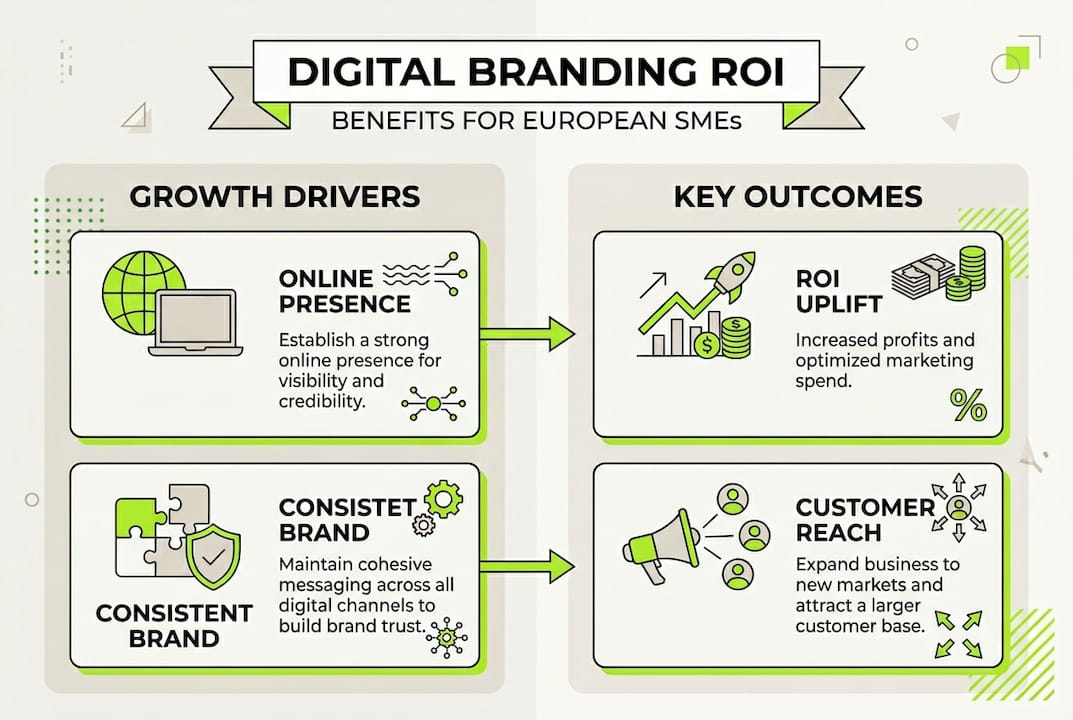
Measurement capabilities distinguish digital branding from traditional approaches. Google Analytics 4 provides SMEs with enterprise-grade tracking at no cost, revealing exactly how customers discover your business, which content resonates, and where conversion opportunities exist. This data enables continuous optimisation, ensuring branding investments generate maximum returns. Tracking customer engagement metrics, traffic sources, and conversion paths transforms branding from subjective art into measurable science.
Search engine optimisation exemplifies how branding and performance marketing intersect. Quality content addressing customer questions establishes thought leadership whilst improving search rankings. Social media engagement amplifies reach through shares and recommendations. Positive electronic word-of-mouth builds credibility far more effectively than paid advertising. Understanding digital marketing leads generation helps SMEs recognise how branding efforts directly impact revenue pipelines.
Key digital branding success factors:
- Consistent visual identity across all digital properties and communications
- Clear value proposition differentiating your business from competitors
- Regular content publication demonstrating expertise and building search visibility
- Active engagement with customers and prospects across chosen platforms
- Data-driven optimisation based on performance metrics and customer behaviour
- Integration between branding efforts and sales processes
Pro Tip: Focus your brand messaging on solving one specific customer problem exceptionally well rather than attempting to appeal to everyone. Narrow positioning strengthens rather than limits your market impact, as customers seeking that particular solution will perceive your business as the obvious choice.
Challenges and disparities in digital branding adoption across Europe
Whilst digital branding benefits are clear, adoption remains uneven across European SME populations. Uneven EU SME adoption of digital branding persists, with northern European businesses leading whilst southern and eastern regions lag behind. These disparities reflect differences in digital infrastructure, skills availability, and cultural attitudes towards technology adoption. SMEs in regions with lower digital maturity face compounding disadvantages as competitors in more advanced markets capture increasingly digital-first customers.
Skills gaps represent a persistent barrier preventing many SMEs from implementing effective digital branding strategies. Business owners excel at their core competencies but may lack expertise in content marketing, SEO, social media management, or analytics interpretation. Hiring specialists often exceeds SME budgets, whilst training existing staff requires time and resources already stretched thin. This skills deficit leads to inconsistent implementation where businesses start digital initiatives but fail to maintain them or measure results effectively.
Resource constraints extend beyond skills to encompass budget limitations and competing priorities. SMEs face immediate operational demands that can overshadow longer-term branding investments. When choosing between fulfilling current orders and developing brand assets, short-term revenue needs typically win. This pattern creates a vicious cycle where businesses remain dependent on expensive lead generation tactics rather than building brand equity that reduces future acquisition costs.
Tactical marketing without brand foundation leads to wasted resources and eliminates compounding growth potential. SMEs investing in paid advertising without underlying brand development see results evaporate the moment spending stops. Each campaign starts from zero rather than building on previous efforts. Conversely, businesses establishing strong brand foundations find each marketing initiative more effective as recognition and trust accumulate over time.
Common SME challenges in digital branding adoption:
- Limited internal expertise in digital marketing and branding strategy development
- Budget constraints preventing investment in professional services or comprehensive tools
- Difficulty maintaining consistency across multiple digital channels with small teams
- Insufficient time to create quality content whilst managing daily business operations
- Lack of clear metrics connecting branding activities to business outcomes
- Uncertainty about which channels and tactics will deliver best returns
- Technology overwhelm facing businesses with limited digital experience
Despite 73% average basic digital intensity across EU SMEs, significant implementation gaps persist between northern European leaders and businesses in other regions, creating competitive disadvantages that compound over time as customer behaviour becomes increasingly digital-first.
Understanding combining digital and traditional marketing helps SMEs recognise how to integrate branding efforts across channels rather than treating digital as completely separate from existing marketing activities. This integrated approach maximises limited resources whilst building cohesive customer experiences.
Practical steps to start or improve digital branding in your SME
Successful digital branding implementation begins with honest assessment of your current position. Evaluate existing digital assets including your website, social media presence, search visibility, and customer review profiles. Identify gaps between your current state and where competitors or industry leaders operate. This readiness assessment reveals whether you need foundational work or can focus on optimisation and expansion.
Start with readiness assessment and implement a 70/30 brand-to-advertising budget split, focusing resources on core channels like SEO, email marketing, and one carefully chosen social media platform. This allocation ensures you build lasting assets whilst maintaining some immediate lead generation. The specific channel selection should reflect where your target customers actively seek information and engage with businesses.
Resource allocation between brand building and advertising:
| Investment type | Recommended allocation | Primary benefits | Timeline for results |
|---|---|---|---|
| Brand building | 70% | Sustainable visibility, customer trust, reduced acquisition costs, premium positioning | 6-18 months for significant impact |
| Performance advertising | 30% | Immediate lead generation, market testing, campaign-specific promotions | Days to weeks for initial results |
This split recognises that SMEs need both immediate revenue and long-term sustainability. Pure brand building without any performance marketing leaves businesses waiting too long for results. Conversely, exclusive focus on paid advertising creates unsustainable cost structures and prevents the compounding benefits that branding delivers.
Steps to establish or improve digital branding effectively:
- Define your core brand elements including mission, values, positioning, and visual identity standards
- Audit current digital presence identifying strengths to leverage and gaps requiring attention
- Select two to three priority channels based on customer behaviour and competitive landscape
- Develop content calendar ensuring consistent publication addressing customer questions
- Implement tracking with Google Analytics 4 and establish baseline performance metrics
- Create standard operating procedures for maintaining brand consistency across touchpoints
- Schedule quarterly reviews assessing performance and adjusting strategy based on data
- Gradually expand channel presence as resources allow and initial efforts prove successful
European SMEs can access various funding programmes supporting digital transformation initiatives. The Digital Europe Programme provides grants for SMEs adopting digital technologies and developing digital capabilities. Many national governments offer matched funding or tax incentives for digital skills training and technology investments. Regional development funds frequently prioritise digitalisation projects that enhance SME competitiveness.
Understanding comprehensive digital marketing strategy guide principles helps SMEs develop integrated approaches rather than pursuing disconnected tactics. Strategy ensures all branding activities align towards common business objectives whilst maximising resource efficiency.
Search engine optimisation deserves particular attention as a foundational branding channel. SEO business growth impact compounds over time, with quality content attracting customers months or years after publication. Unlike paid advertising where visibility stops when spending ends, SEO investments create lasting assets that continue delivering returns.
Pro Tip: Resist the temptation to maintain presence on every possible digital channel. Consistent excellence on two platforms outperforms mediocre presence across six. Choose channels where your specific target audience actively seeks information, then dominate those spaces rather than spreading resources too thin.
How Done can support your digital branding journey
Building effective digital branding whilst managing daily business operations challenges even the most capable SME owners. Done specialises in partnering with European businesses to develop and implement comprehensive digital branding strategies that deliver measurable results. Our team combines web development expertise, search optimisation capabilities, and strategic marketing knowledge to create cohesive digital presences that attract customers and drive growth.
We understand the resource constraints facing SMEs and design solutions balancing immediate needs with long-term brand building. Whether you need a complete website overhaul reflecting your brand values, ongoing content creation establishing thought leadership, or integrated campaigns connecting branding with lead generation, Done provides the expertise and execution capacity most businesses lack internally. Explore how to invest in web development that serves both branding and conversion objectives, discover proven digital marketing workflow approaches that connect activities to revenue outcomes, and learn how strategic web design in branding creates customer experiences that differentiate your business from competitors whilst facilitating measurable business growth.
Frequently asked questions
What are the most common digital branding tools for SMEs?
Social media platforms, professional websites, search engine optimisation tools, and email marketing systems represent the most common digital branding tools for European SMEs. These channels provide cost-effective reach whilst enabling consistent brand communication. Electronic word-of-mouth through customer reviews and social sharing amplifies branding efforts, making reputation management essential for sustainable digital presence.
How much should SMEs invest in digital branding?
Recommended allocation splits approximately 70% towards brand building activities and 30% towards performance advertising for optimal results. This balance ensures immediate lead generation whilst creating lasting brand assets that reduce future acquisition costs. Investment amounts should align with business size and growth objectives, typically ranging from 5-15% of revenue for businesses serious about digital growth.
What are the main challenges SMEs face in digital branding adoption?
Skills gaps and uneven digital readiness hamper many European SMEs’ branding efforts, particularly in southern and eastern regions. Limited budgets and competing operational priorities often prevent consistent implementation. Pursuing tactical marketing without strong brand foundation wastes resources and eliminates the compounding growth benefits that cohesive branding delivers over time.
How long does digital branding take to show results?
Brand building initiatives typically require six to eighteen months before delivering significant measurable impact, though some metrics improve sooner. Search visibility and organic traffic build gradually as content accumulates and authority grows. Customer perception shifts occur over multiple touchpoints rather than single interactions. Patience combined with consistent execution separates successful digital branding from abandoned initiatives that never reach their potential.