

Why customer-centric design works for SMBs
July 26, 2026
A practical guide to inbound marketing for SMBs
July 26, 2026
TL;DR:
- A digital audit helps Luxembourg SMBs identify GDPR gaps, fix analytics, and optimize AI systems before problems occur. It provides compliance checklists, quick wins, and AI alignment assessments to recover performance and reduce risks. Following the audit with a clear remediation plan ensures ongoing improvement and compliance.
A digital audit pays for itself for a Luxembourg SMB the moment it surfaces a GDPR gap, a broken analytics setup, or an AI system quietly optimising for the wrong goal. The CNPD confirms that most Luxembourg SMEs must maintain a record of processing activities, yet many have never documented their data flows. Separately, forensic AI marketing audits routinely find recoverable performance in the 30–40% range where AI systems are learning from corrupted data or misaligned goals.
TL;DR — what a digital audit delivers immediately:
- A compliance checklist covering CNPD/GDPR obligations, records of processing, and consent settings
- Quick wins on tracking, attribution, and media ROI
- An AI alignment check to confirm your tools optimise for real business outcomes, not vanity metrics
Table of Contents
- Why digital auditing is the first step, not the last
- What does a practical digital audit actually cover?
- What concrete outcomes can you expect from an audit?
- What does GDPR mean for your audit in Luxembourg?
- What should a well-run audit deliver?
- How to prepare your business before the audit starts
- What questions should you ask a potential provider?
- What Done does for Luxembourg SMBs
- Key takeaways
- The audit findings that actually get acted on
- Done’s digital and AI audit service for Luxembourg SMBs
- Useful sources
Why digital auditing is the first step, not the last
A digital audit is a structured review of every system your business uses to attract, convert, and retain customers online. It covers your website, analytics, advertising accounts, CRM integrations, data flows, and any AI or automation tools in your stack.
Most SMB owners commission one after something breaks. That is the wrong trigger. The right trigger is before you increase a marketing budget, before you deploy an AI tool, or before a CNPD inspection. An audit done proactively gives you a baseline, a prioritised fix list, and evidence of compliance — three things you cannot produce quickly under pressure.
What does a practical digital audit actually cover?
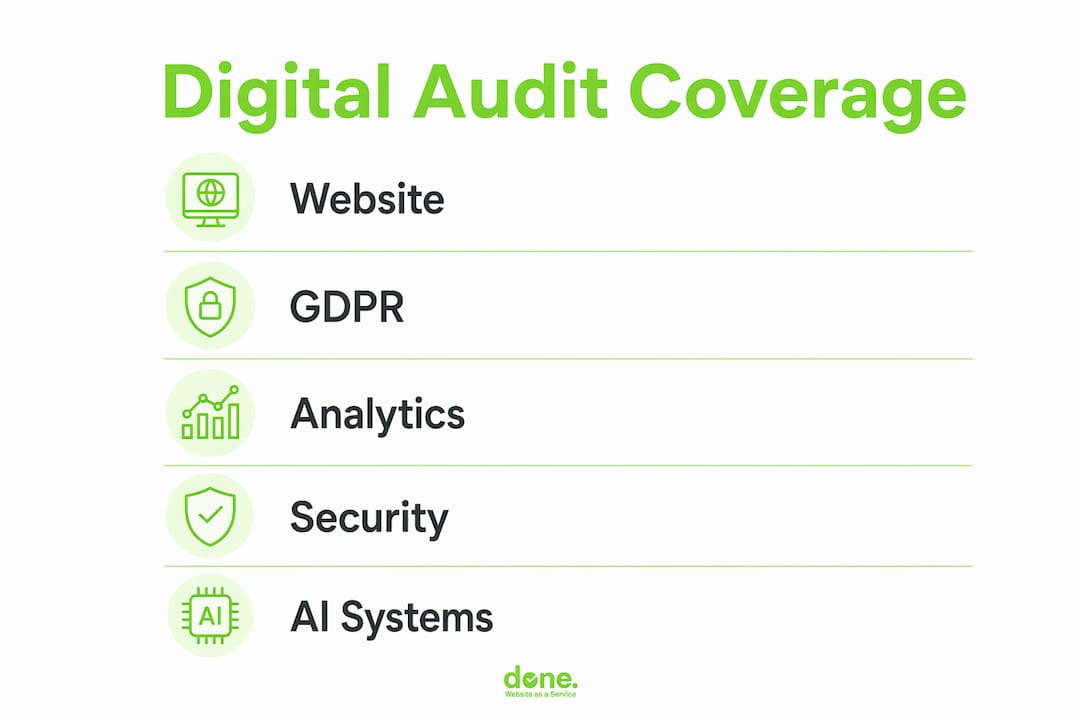
A well-scoped audit covers seven distinct areas. Use this table to compare any vendor proposal against it.
| Audit area | Must-have | Value-add |
|---|---|---|
| Website and CMS (performance, security, patching) | ✓ | |
| Technical SEO and crawlability | ✓ | |
| Analytics (GA4, server-side tagging, data layer) | ✓ | |
| Tag governance and consent mode | ✓ | |
| Ad accounts, creatives, and conversion APIs | ✓ | |
| CRM, integrations, and data flows | ✓ | |
| AI and automation systems review | ✓ | |
| Access controls and user permissions | ✓ | |
| GDPR records of processing and legal bases | ✓ | |
| Cross-border data transfers and processor contracts | ✓ |
Any proposal that omits the GDPR row or the analytics layer is incomplete. AI system reviews are optional for businesses without deployed AI, but they become table stakes the moment you use any AI tool for marketing or customer communication.
What concrete outcomes can you expect from an audit?
The business case for a digital audit is straightforward once you translate technical findings into money.
- Recovered media performance. AI marketing systems often appear functional while silently bleeding performance through attribution drift and mis-specified success signals. Correcting these typically recovers meaningful budget.
- Fewer data losses and breaches. Access control reviews routinely find former employees or contractors still holding admin rights.
- Faster issue resolution. Documented SOPs and clear ownership mean your team resolves incidents in hours, not days.
- Clearer ROI reporting. A clean analytics setup produces numbers you can actually trust in a board meeting.
Forensic AI marketing audits typically find 30–40% recoverable performance where systems are learning from corrupted data or misaligned goals. (Sagum)
Pro Tip: Once you receive the audit report, sort findings into three buckets: fix this week (access controls, broken tracking), fix this quarter (analytics rebuild, consent mode), and fix this year (AI governance, CRM integration). Assign an owner and a deadline to each. That 90-day plan is where the ROI actually comes from.
Luxembourg SME Packages for Digital and Cybersecurity can cover up to 70% of eligible project costs. Verify your eligibility before commissioning any audit work.
What does GDPR mean for your audit in Luxembourg?
Luxembourg’s CNPD applies a strict reading of the Article 30(5) derogation. The practical consequence: most Luxembourg SMEs must maintain a record of processing activities (RPA) because they engage in non-occasional processing of HR and client data. Failing to keep that record makes it impossible to demonstrate compliance under Article 5(2).
Your audit must verify the following:
- Where personal data is stored and whether processors are under a valid data processing agreement
- Legal bases for each processing activity (contract, legitimate interest, consent)
- Retention settings in your analytics platform and CRM
- Cross-border data transfers and the safeguards in place (Standard Contractual Clauses, adequacy decisions)
- Whether a Data Protection Impact Assessment (DPIA) is required for any profiling or large-scale processing
Under GDPR, businesses must be able to demonstrate compliance to the CNPD at any time. A well-kept record of processing activities is the primary evidence. The cost of maintaining it is negligible compared to the risk of an Article 83 fine for breach of the accountability principle.
Request these specific deliverables from your provider: a completed or reviewed RPA inventory, mapped data flows showing every processor, and a gap list against CNPD expectations. For AI deployments, also request a review against GDPR AI compliance requirements.
What should a well-run audit deliver?
Phases and timeline
- Scoping call (1–2 days): agree on systems in scope, access requirements, and success criteria.
- Data and access collection (3–5 days): analytics, CMS, ad platforms, CRM, server logs, AI vendor contracts.
- Automated scans and manual reviews (1–2 weeks): technical SEO crawl, tag audit, access log review, AI goal alignment check.
- Recommendations and prioritisation (3–5 days): findings ranked by risk and effort.
- Remediation support and follow-up check (ongoing or fixed sprint): vendor assists with fixes and confirms resolution.
| Scope | Typical duration | Effort split |
|---|---|---|
| Website and analytics only | 2–3 weeks | — |
| Full digital audit (all channels) | 4 weeks | — |
Deliverables to require in writing
- Executive scorecard (RAG status per area, suitable for a board meeting)
- Technical appendix with evidence screenshots and test results
- Prioritised remediation list with effort estimates
- Owner-facing SOPs for recurring tasks (consent checks, access reviews)
- Access log and RPA inventory
How to prepare your business before the audit starts
Getting your house in order before the vendor starts saves billable hours and produces better findings.
Access to gather in advance:
- Google Analytics 4 and Google Search Console
- CMS admin panel and hosting/DNS control
- All active ad platform accounts (Google Ads, Meta, LinkedIn)
- CRM and email marketing platform
- Server logs or CDN access
- AI tool vendor contracts and data processing agreements
Stakeholders to involve:
- Marketing owner or manager (campaign context and KPI definitions)
- IT contact or hosting provider (server access, patching history)
- Data protection officer or responsible person (GDPR documentation)
- Finance lead (for ROI alignment and budget sign-off on fixes)
Pro Tip: Create a shared folder with login credentials (use a password manager export, not a spreadsheet), existing GDPR documentation, and your current analytics configuration notes. Handing this to the vendor on day one typically cuts the data-collection phase by a third.

What questions should you ask a potential provider?
Before you sign anything, run through this checklist.
- Can you share a sample scope document from a comparable Luxembourg project?
- Who specifically will do the technical work — a senior analyst or a junior with an LLM tool?
- How do you connect directly to ad platform APIs for numeric findings, rather than relying on screenshots?
- How is our data handled during the audit, and where is it stored?
- Do you offer remediation support after the report, or only the report itself?
- Can you provide references from Luxembourg-based clients?
Red flags to watch for:
- Purely LLM-generated findings with no deterministic checks. Reputable audit processes target under 5% wrong findings; a pure LLM report cannot reliably hit that threshold for numeric or platform-specific data.
- Opaque or all-inclusive pricing with no itemised scope.
- No mention of CNPD or GDPR in the proposal for a Luxembourg client.
- No clear remediation plan or post-report support.
Pro Tip: Add three clauses to your contract: data residency (audit data stays in the EU), a non-training clause (your data cannot be used to train any LLM), and an SLA for critical fixes (e.g. broken conversion tracking resolved within five business days).
What Done does for Luxembourg SMBs
Done has completed over 150 projects for Luxembourg and European SMBs since 2014, covering web development, digital marketing, and AI implementation. Our AI readiness audits follow a GDPR-aware methodology that includes RPA review, data flow mapping, and AI goal alignment checks.
A typical engagement for a Luxembourg SMB looks like this:
| Deliverable | Included |
|---|---|
| Executive scorecard (RAG per area) | ✓ |
| Technical appendix with evidence | ✓ |
| GDPR/RPA gap list | ✓ |
| Prioritised remediation plan | ✓ |
| Follow-up check after fixes | ✓ |
In one recent engagement, we audited the analytics and AI marketing setup for a Luxembourg professional services firm. The top findings were: GA4 misconfigured with double-counting events, consent mode not implemented correctly, and an AI bidding system optimising for form submissions rather than qualified leads. Correcting those three items produced measurable improvement in cost per qualified lead within the first month.
Done brings CNPD-aware methodology, a prioritised remediation timeline, and hands-on support through the fix phase — not just a report.
Key takeaways
A digital audit is the single most cost-effective way for a Luxembourg SMB to close compliance gaps, recover wasted media spend, and confirm that AI systems are working for the business rather than against it.
| Point | Details |
|---|---|
| CNPD compliance is not optional | Most Luxembourg SMEs must maintain a record of processing activities; an audit surfaces gaps before an inspection does. |
| AI performance leakage is common | Forensic AI audits typically find 30–40% recoverable performance where systems are learning from corrupted data or misaligned goals. |
| Funding is available | Luxembourg SME Packages cover up to 70% of eligible digital and cybersecurity project costs. |
| Deliverables matter | Require a scorecard, RPA inventory, prioritised remediation list, and post-fix follow-up check in writing. |
| Done is a local option | Done has completed 150+ projects in Luxembourg with a GDPR-aware audit methodology and remediation support included. |
The audit findings that actually get acted on
Most audit reports end up in a shared drive, reviewed once and never opened again. We’ve seen this with clients across sectors in Luxembourg. The problem is rarely the findings — it is the absence of a named owner and a deadline for each item.
The audits that produce real change share one characteristic: the business treats the report as a governance document, not a technical deliverable. That means assigning the remediation list to a specific person, scheduling a 30-day check-in, and making the scorecard a standing agenda item in monthly management meetings. Quarterly re-audits of the highest-risk areas keep the gains from eroding.
The other common blocker is internal politics. A finding that implicates a marketing tool someone championed, or an access control issue that points to a process the IT contact owns, can stall for months. The fix is to frame every finding in terms of business risk and cost, not technical failure. That reframe is something a good audit provider should help you make.
Done’s digital and AI audit service for Luxembourg SMBs
Done offers a faster path from audit to fixed than a traditional agency model. There are no long retainers and no vague deliverables. You get a scoped engagement with a clear timeline, a GDPR-aware methodology, and a team that stays involved through the remediation phase.
A typical small-SMB package covers website and analytics, GDPR/RPA review, and one AI system check, delivered in four to six weeks with a scorecard, remediation plan, and a follow-up check included. If the audit surfaces web development needs, the web development service is a natural next step. For marketing gaps, the lead generation workflow service picks up where the audit leaves off.
Request a scoping conversation at done.lu to confirm what is in scope for your business and get a fixed-price proposal.
Useful sources
- CNPD — Records of processing activities: the primary reference for Luxembourg SME obligations under Article 30 GDPR.
- Guichet.lu — Processing personal data: practical guidance on GDPR requirements for businesses operating in Luxembourg.
- SME Packages — Digital (Guichet.lu): funding details for digital projects, including eligibility criteria.
- SME Packages — Cybersecurity (Guichet.lu): funding details for cybersecurity projects.
- Done — AI readiness audit guide: step-by-step approach to AI readiness for SMBs, including GDPR considerations.
- Done — GDPR AI compliance guide: practical compliance guidance for AI deployments in European SMBs.