

Why digital auditing matters for Luxembourg SMBs
July 26, 2026
Branding tips for businesses: your 90-day action plan
July 26, 2026
TL;DR:
- Inbound marketing focuses on creating content that answers buyer questions, attracting prospects without interruption. It builds trust through consistent, localized content and aligns marketing efforts with GDPR compliance and measurable KPIs.
Inbound marketing is a permission-based approach where you create content that answers your buyers’ questions, drawing them to you rather than interrupting them with cold outreach. To start today, do three things: (1) define one buyer persona based on your best current customers; (2) publish one cornerstone piece of content that addresses their most common question; (3) set up a single conversion point, such as a landing page with a form, and connect it to basic tracking. Before you send a single automated email, audit every capture point for GDPR-compliant consent — timestamp, policy version, and source logged.
Table of Contents
- What does inbound marketing mean for an SMB?
- How does the inbound Flywheel work in practice?
- Which inbound tactics should an SMB prioritise first?
- How do inbound and outbound work better together?
- How do you measure inbound marketing success as an SMB?
- What does a realistic 30/60/90-day inbound roadmap look like?
- What are the most common inbound pitfalls for SMBs?
- What GDPR steps do you need for inbound automation in Central Europe?
- Which tools work well for EU-friendly inbound marketing?
- What do successful inbound campaigns in Central Europe look like?
- How do you build buyer personas for Central European SMBs?
- How should your content strategy reflect local languages and preferences?
- What are the best practices for local SEO and geo-targeting in Central Europe?
- Key takeaways
- Why most SMBs get inbound wrong in the first 90 days
- How Done can help you build this in 90 days
- Useful sources and further reading
What does inbound marketing mean for an SMB?
Inbound marketing is a content-led, permission-based methodology that attracts qualified prospects by answering their questions at each stage of the buyer journey, then converts and retains them through relevant, helpful experiences. Unlike outbound, which pushes messages at people who did not ask for them, inbound earns attention and builds trust over time.

For an SMB, the practical appeal is the asset model. A well-written blog post or guide keeps generating traffic for months or years; a paid ad stops the moment the budget runs out. The ROI timeline is longer than paid search, typically three to six months before organic traction builds, but the compounding effect is real. We’ve seen this with clients across Luxembourg and Central Europe: the businesses that publish consistently and build a small library of useful content outperform those that rely entirely on paid acquisition once their ad budgets tighten.
Inbound and outbound are not opposites. Cold email, paid social, and display advertising all have a role, particularly in the early stages when organic reach is low. The practical distinction is this: use outbound to accelerate the distribution of inbound assets, not to replace them. A well-written guide promoted via a small LinkedIn campaign reaches an audience faster than waiting for organic ranking alone.
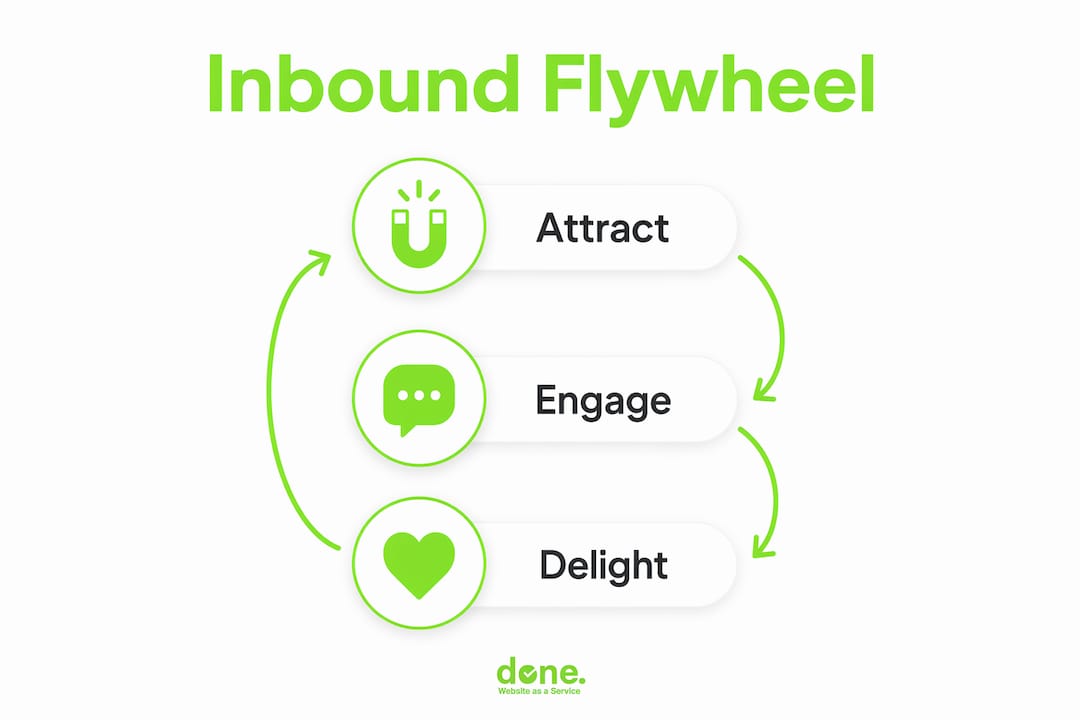
How does the inbound Flywheel work in practice?
The Flywheel replaces the old linear funnel with a self-reinforcing loop. Momentum builds across three stages: Attract, Engage, and Delight. When each stage works well, satisfied customers feed new prospects back into the top, reducing your cost of acquisition over time.

Attract
The primary goal here is visibility with the right people. You are not trying to reach everyone; you want the prospects most likely to become good customers.
- Blog posts and pillar pages optimised for the questions your buyers type into search engines
- Organic social content that shares expertise and builds familiarity
- Paid promotion used selectively to amplify content that has already shown organic engagement
Engage
Once someone finds you, the goal shifts to converting interest into a relationship. This is where lead capture and nurture begin.
- Gated content (guides, checklists, templates) exchanged for an email address and explicit consent
- Landing pages with a single, clear call to action that remove friction from the conversion step
- Email nurture sequences that deliver relevant content based on what the prospect downloaded or viewed
Delight
This stage is where SMBs most often underinvest. Keeping an existing customer costs far less than acquiring a new one, and a delighted customer refers others.
- Onboarding sequences and how-to content that help customers succeed with your product or service
- Proactive check-ins and satisfaction surveys that surface problems before they become churn
- Customer-only content or early access that rewards loyalty and deepens the relationship
Sales fits into the Engage stage, where qualified leads are handed off from marketing with context about what content they consumed. Customer service sits primarily in Delight, resolving issues quickly and feeding insights back into the Attract stage through FAQ content and product improvements.
Which inbound tactics should an SMB prioritise first?
With limited time and budget, the channel selection decision matters more than most guides admit. Start with the two channels where your buyers already spend time and where you can produce content consistently.
The channel checklist
- Website and landing pages: your conversion infrastructure. Every campaign needs a dedicated landing page with a clear headline, benefit-led copy, a single call to action, a trust signal (a client logo, a short testimonial, or a certification), and a short form. Conversion-optimised web development is the foundation everything else depends on.
- Blog and SEO: the long-term traffic engine. Focus on answering specific questions your buyers search for, not broad topics. Topical depth and content quality consistently outperform volume.
- Gated content: one well-researched ebook or checklist per quarter gives you a lead magnet and a reason to email.
- Email nurture: a three-to-five email sequence triggered by a download is sufficient to start. Keep it helpful, not promotional.
- Organic social: LinkedIn for B2B, Instagram or Facebook for consumer-facing SMBs. Post two to three times per week and engage with comments.
- Lightweight paid promotion: a modest budget on LinkedIn or Meta to promote your cornerstone content accelerates early results before organic ranking builds.
Content assets mapped to Flywheel stages
- Attract: a pillar blog post answering a high-volume question; a short explainer video shared on social
- Engage: a downloadable checklist or guide gated behind a consent-compliant form; a webinar recording
- Delight: a customer success guide; a monthly newsletter with tips relevant to existing clients
Pro Tip: If you can only pick two channels to start, choose the one where your buyers search for answers (usually Google, so blog plus SEO) and the one where they spend professional time (usually LinkedIn for B2B). Build your first three months around those two before adding anything else.
How do inbound and outbound work better together?
Inbound assets work best when they are both discoverable via search and actively promoted across channels. Waiting for organic traffic alone is a slow route, especially for a new domain or a new content topic.
A practical promotion plan for a single cornerstone asset looks like this:
- Week 1: publish the asset, share it organically on LinkedIn and in any relevant communities or forums
- Week 2: send it to your existing email list (with consent) and ask for shares
- Week 3–4: run a small paid social campaign targeting your defined persona; budget as little as €150–€300 to test reach and click-through
- Week 6: repurpose the asset into two or three shorter social posts, a short video summary, and a follow-up email for those who downloaded but did not convert further
Repurposing checklist for a single cornerstone asset:
- Extract three to five key points as standalone social posts
- Record a five-minute video walkthrough and post it natively on LinkedIn
- Write a shorter blog post that links back to the full asset
- Add the asset to your email signature for one month
- Pitch the core insight as a guest post or podcast contribution
This approach means one piece of well-researched content generates six to eight touchpoints without producing six to eight separate assets from scratch.
How do you measure inbound marketing success as an SMB?
Small teams should track a short, focused set of KPIs rather than building complex multi-touch attribution models they cannot sustain. The goal is clarity, not comprehensiveness.
| KPI | Why it matters | Where to measure |
|---|---|---|
| Organic sessions | Shows whether Attract content is gaining traction | Google Analytics 4 / Matomo |
| Landing page conversion rate | Reveals whether your Engage assets and forms are working | GA4 / your CMS analytics |
| Lead-to-MQL conversion rate | Confirms whether leads are qualified enough to pass to sales | CRM (HubSpot, Pipedrive, Brevo) |
| Cost per lead (when paid is used) | Keeps paid promotion honest and comparable to organic | Ad platform + CRM |
| Email open and click rate | Signals whether nurture content is relevant and well-timed | ESP dashboard |
| Churn or retention rate | Measures whether Delight is working | CRM or subscription platform |
For attribution, use UTM parameters on every link in every campaign. Last non-direct attribution, where credit goes to the last channel a visitor used before converting, excluding direct traffic, is sufficient for most SMBs. It is not perfect, but it is consistent and auditable. Avoid first-touch or linear attribution models until you have enough data volume to make them meaningful.
Pro Tip: Three signals that matter most for small teams: (1) landing page conversion rate, because it tells you whether your offer and copy are working; (2) lead-to-MQL rate, because it tells you whether your content is attracting the right people; (3) organic session growth month-on-month, because it tells you whether your SEO investment is compounding. Everything else is secondary until these three are stable.
Reporting cadence matters as much as the metrics themselves. A monthly one-page report covering traffic, conversions, and pipeline contribution is more useful than a weekly dashboard nobody reads. Set a fixed review date and compare against the same period last month and the same period last year.
What does a realistic 30/60/90-day inbound roadmap look like?
This timeline assumes a small team of one to two people and a modest budget. Effort estimates are indicative ranges, not quotes.
-
Days 1–30: Foundation. Define one buyer persona using interviews with three to five existing customers. Audit your website for conversion points and fix the most obvious gaps (missing CTAs, no landing pages, slow load times). Publish one cornerstone blog post targeting a high-intent keyword. Set up Google Analytics 4 or Matomo, install UTM tracking, and create a basic CRM record structure. Effort: roughly several hours per week. Budget: low (primarily time and minimal tool costs).
-
Days 31–60: First campaign. Produce one gated asset (a checklist or short guide) and build a landing page with a consent-compliant form. Write a three-email nurture sequence. Promote the asset via organic social and a small paid campaign to test reach and click-through. Publish two to three supporting blog posts that link to the cornerstone. Effort: 8–10 hours per week. Budget: medium, including paid promotion and any design support.
-
Days 61–90: Measure and iterate. Review landing page conversion rate, email open rates, and lead quality. Adjust the nurture sequence based on open and click data. Identify the best-performing social post and repurpose it. Publish a second cornerstone asset based on what the first campaign revealed about your audience. Effort: 6–8 hours per week. Budget: medium, allocated based on performance.
We’ve run this sprint structure with clients in Luxembourg and across Central Europe. The most common finding at day 90 is that the persona definition was slightly off, and the content needed to shift one level deeper into the buyer’s specific problem. That is normal and expected. The inbound marketing process is iterative by design.
What are the most common inbound pitfalls for SMBs?
Most inbound programmes that stall do so for predictable reasons. Knowing them in advance saves months of wasted effort.
- Inconsistent publishing: one blog post per quarter does not build authority or organic traffic. A minimum viable cadence is one quality post per month, with two being the practical target for most SMBs.
- Vague persona definition: “SMB owners in Central Europe” is not a persona. A persona names the role, the industry, the specific problem, and the objection they raise most often. Without this, content misses.
- Weak or missing CTAs: every page on your site should have one clear next step. If a visitor reads a blog post and has nowhere to go, the traffic is wasted.
- Fragmented tech stack: using five tools that do not share data creates blind spots in attribution and makes consent management nearly impossible to audit. Start with the minimum: a CMS, an ESP with consent features, and a CRM.
- Compliance gaps: sending automated emails without verifying consent status, or failing to log when and how consent was given, is both a legal risk and a deliverability risk.
Pro Tip: A minimum viable editorial process for one or two people: agree on one content topic per month at the start of the month, write a 300-word brief (audience, question answered, target keyword, CTA), publish by week three, and promote in week four. That is the entire process. Add complexity only when this is running reliably.
What GDPR steps do you need for inbound automation in Central Europe?
GDPR compliance for inbound marketing is mostly operational infrastructure, not just a consent checkbox. The checkbox is roughly 5% of the work; the rest is logging, retention, and workflow design.
Capture point audit checklist
- Website forms: log timestamp, policy version, and source URL for every submission
- Chat widgets: confirm whether the tool stores conversation data and where
- Social lead ads (LinkedIn, Meta): verify that the platform’s consent mechanism meets GDPR standards and that data is transferred to your CRM with consent metadata intact
- Event registrations: treat these as a separate consent purpose from marketing emails
Operationalising consent in automation
Automated workflows must only trigger for subscribers who gave consent for the specific topic or purpose. A preference centre, where subscribers choose which topics and frequency they want, is the most practical way to keep consent granular and auditable. Gate every automation on consent status: if a contact’s consent record is missing or expired, suppress them from the workflow.
B2B marketing in Central Europe must comply with both GDPR and national ePrivacy laws, which vary by country. Design for the strictest applicable rules by default. In practice, this means explicit opt-in for all marketing emails, regardless of whether the contact is a business or consumer.
Retention and SAR workflow essentials
- Set automated data retention periods (typically 24 months for marketing contacts who have not engaged)
- Build a Subject Access Request (SAR) workflow: a process for responding within 30 days with a full record of what data you hold
- Confirm that any data enrichment providers (tools that append firmographic or contact data) have signed Data Processing Agreements (DPAs) with you
Pro Tip: A simple preference centre does not need to be complex. A single page with three checkboxes (newsletter, product updates, event invitations) and a frequency selector (weekly, monthly) is sufficient for most SMBs. Sync consent status to your CRM and ESP daily so suppression lists stay current across tools.
Which tools work well for EU-friendly inbound marketing?
Tool selection for a Central European SMB has one constraint that most generic guides ignore: data residency and DPA availability matter as much as features.
Tool categories and EU-friendly options
- CMS/website: WordPress with a GDPR-compliant cookie consent plugin (Cookiebot, Complianz), or a hosted platform with EU data storage options
- Analytics: Matomo (self-hosted or EU-hosted cloud) avoids the data-transfer concerns of Google Analytics 4; GA4 is usable but requires careful configuration and a DPA with Google
- Email and ESP: Brevo (formerly Sendinblue, EU-based), Mailchimp (EU data processing addendum available), or ActiveCampaign with EU data residency selected. Choose an ESP that surfaces consent metadata, preference management, and audit logs as core features, not add-ons
- CRM: HubSpot (free tier is sufficient to start; EU data hosting available on paid plans), Pipedrive (EU-based), or Zoho CRM with EU data centre selected
- Content production: Notion or Airtable for editorial calendars; Canva for visual assets; a shared Google Drive or SharePoint for asset storage
- Lightweight automation: Brevo’s automation builder, HubSpot’s free workflows, or Make (formerly Integromat, EU-based) for connecting tools
Selection criteria checklist
- Consent metadata storage and export capability
- EU data residency or a signed DPA with the vendor
- Global suppression list management (one opt-out removes the contact from all campaigns)
- Pricing model that scales with contacts, not features, for SMB affordability
- API or native integration with your CRM to avoid manual data transfers
Templates to prepare before you launch
- Content brief: audience, question answered, target keyword, word count, CTA, internal links. One page, filled in before writing starts.
- Campaign workflow: asset name, channel plan, go-live date, consent check, UTM parameters, reporting date. One row per campaign in a shared spreadsheet.
- Landing page brief: headline, three benefit bullets, form fields, trust signal, thank-you page redirect, and the automation it triggers. Keeps design and copy aligned from the start.
For practical SEO and organic traffic growth techniques that complement these content assets, the tactical workflows are worth reviewing alongside your channel plan.
What do successful inbound campaigns in Central Europe look like?
Central European SMBs face a specific set of conditions that shape what works: multilingual markets, strong GDPR enforcement, and buyers who tend to research extensively before making contact. The campaigns that perform well share three characteristics.
First, they answer a question that is genuinely specific to the local market. A Luxembourg-based accounting firm that published a guide to VAT registration for newly arrived expat entrepreneurs generated consistent organic traffic because no competitor had addressed that exact question in English, French, and German. The content was not sophisticated; it was specific.
Second, they use gated content as a trust signal rather than a data grab. A mid-sized B2B services firm in Vienna produced a short benchmark report on IT procurement costs for Austrian SMBs. The report was downloaded by procurement managers who were already in the market. The conversion rate on the landing page was high because the offer was directly relevant to the buyer’s immediate problem.
Third, they treat email nurture as a conversation, not a broadcast. The campaigns that retain subscribers send fewer emails, each one tied to a specific topic the subscriber opted into. This is both a GDPR best practice and a deliverability strategy. For more proven inbound examples from SMB contexts, the pattern is consistent: specificity beats scale.
How do you build buyer personas for Central European SMBs?
A buyer persona for a Central European SMB is not a demographic profile. It is a decision-making map: who makes the buying decision, what triggers them to start looking, what objections they raise, and what they read before they contact you.
Start with three to five interviews with your best existing customers. Ask them what problem they were trying to solve when they found you, what other options they considered, and what almost stopped them from buying. Those answers contain the persona. Supplement with LinkedIn data (job titles, industries, company sizes of your existing contacts) and any CRM data you have on deal length and close rate by segment.
For Central Europe specifically, account for language preferences early. A persona in Luxembourg may research in French, German, or English depending on their background and the topic. A persona in Poland or the Czech Republic will almost always research in their native language first. Your content strategy needs to reflect this, which means either translating cornerstone assets or producing separate assets for each language market. Half-measures, such as a French landing page pointing to an English-only guide, consistently underperform.
How should your content strategy reflect local languages and preferences?
Content strategy for Central Europe is not one strategy; it is a set of decisions about which markets to serve and in which languages. Trying to cover all markets simultaneously with a small team is the fastest route to producing mediocre content in several languages rather than excellent content in one.
The practical approach is to pick one primary language market and build depth there first. Publish a pillar page and four to six supporting posts that cover the topic thoroughly. Once that cluster ranks and converts, replicate the structure in the next language. This is how content marketing for SMBs works at a sustainable pace.
Local market preferences also shape format. German-speaking markets tend to favour detailed, well-sourced content with clear structure. French-speaking markets respond well to editorial tone and argument-led writing. English content in Luxembourg and the Netherlands often competes with UK and US publishers, so local specificity (local regulations, local examples, local pricing) is the differentiator. Publish in the language your buyer uses when they search, not the language that is easiest for you to produce.
What are the best practices for local SEO and geo-targeting in Central Europe?
Local SEO for Central European SMBs starts with Google Business Profile, even for B2B companies. A complete, verified profile with accurate opening hours, a local phone number, and regular posts improves visibility in local pack results and builds trust signals for organic ranking.
For geo-targeting in content, use location-specific landing pages when you serve multiple cities or countries. A Luxembourg-based agency serving clients in Luxembourg City, Esch-sur-Alzette, and Differdange benefits from separate pages for each, each with locally relevant copy and schema markup. Generic “we serve all of Luxembourg” copy does not rank for local intent queries.
Technical local SEO checklist:
- Hreflang tags for multilingual sites (critical for Luxembourg, Belgium, and Switzerland where multiple languages are official)
- Local business schema on the homepage and contact page
- Consistent NAP (name, address, phone) across all directories and the Google Business Profile
- Citations in local directories relevant to your market (e.g., editus.lu for Luxembourg, Firmen.at for Austria)
- Country-code top-level domains (.lu, .at, .cz) where budget allows, as they send a strong geo-relevance signal
Paid geo-targeting on Google Ads and LinkedIn should mirror your organic strategy. If you are targeting Luxembourg and the Greater Region (Lorraine, Saarland, Wallonia), set radius targeting around Luxembourg City and adjust bids by distance. On LinkedIn, target by country and then layer on job title and company size to avoid wasting budget on irrelevant audiences.
Key takeaways
Inbound marketing produces compounding, measurable results for SMBs when built on a clear persona, consistent content, GDPR-compliant capture, and a short, focused KPI set.
| Point | Details |
|---|---|
| Define your persona first | Interview three to five existing customers before writing a single word of content. |
| Publish one cornerstone asset | One well-researched, specific piece outperforms ten generic posts every time. |
| Audit consent before automating | Log timestamp, policy version, and source for every capture point before triggering any email workflow. |
| Track three KPIs to start | Landing page conversion rate, lead-to-MQL rate, and organic session growth are sufficient for the first 90 days. |
| Done for implementation | Done provides audit-to-delivery inbound programmes for SMBs in Luxembourg and Central Europe, with GDPR-compliant automation built in from day one. |
Why most SMBs get inbound wrong in the first 90 days
The gap between what inbound marketing promises and what most SMBs actually experience in the first quarter is almost always a persona problem, not a content problem. Businesses publish content that describes their service rather than answering the question their buyer is actually typing into Google at 11pm when they realise they have a problem. The content is accurate; it is just not useful to someone who does not already know they need you.
The second mistake is treating GDPR compliance as a legal formality rather than an operational design decision. We’ve seen this with clients: a well-built nurture sequence that fires for contacts who never gave specific consent for that topic. The result is deliverability damage, unsubscribes, and occasionally a complaint. Building consent gating into the automation from the start takes an extra hour; retrofitting it after launch takes a week.
The third thing most guides understate is the value of the Delight stage for SMBs specifically. A small business with 50 active clients can generate more referral pipeline from those 50 people than from any paid campaign, if those clients feel genuinely supported. A monthly email with one useful tip, a proactive check-in call at the three-month mark, and a short customer satisfaction survey are not complex. They are just consistently skipped. The digital marketing strategy that works for Luxembourg SMBs is the one that runs reliably, not the one that is theoretically perfect.
How Done can help you build this in 90 days
Done is a Luxembourg-based digital and AI agency that has delivered inbound marketing programmes for SMBs across Central Europe since 2014, with over 150 completed projects. For an SMB that wants to move from zero to a functioning inbound programme without hiring a full marketing team, Done offers a structured audit-to-delivery approach: a discovery audit covering your current website, capture points, and consent infrastructure; a 30/60/90-day plan with defined deliverables; hands-on setup of your CMS, ESP, and CRM integrations; and team training so your staff can run the programme independently.
The audit covers what most agencies skip: GDPR capture point review, consent logging setup, and automation gating, alongside the standard persona, keyword, and content gap analysis. Deliverables are transparent and agreed upfront, with no long-term contract required. If you want a lead generation workflow that is compliant, measurable, and built for your market, book a short audit call with the Done team at done.lu.
Useful sources and further reading
- GDPR Email Marketing: The Complete Guide to Compliance — Sender.net’s operational guide to consent gating, preference centres, and suppression list management for email automation
- GDPR Lead Capture Automation: EU Compliance Guide — Practical infrastructure guide covering consent logging, SAR workflows, and retention design
- B2B Marketing and Data Protection Compliance (2025 Guidance) — Two-layer compliance framework (GDPR plus national ePrivacy) for B2B marketers in Europe
- GDPR and Email Marketing: How to Stay Compliant — CleverTap’s checklist of ESP features required for GDPR compliance, including consent metadata and audit logs
- What Is Inbound Marketing? Definition and Strategies — Salesforce EU’s framework for integrating inbound content with outbound promotion
- What Is Inbound Marketing? — HubSpot’s foundational explanation of the Attract, Engage, Delight Flywheel methodology