

Growth-driven design workflow: a step-by-step guide
August 2, 2026
Best branding agency for Luxembourg SMEs: a practical guide
August 4, 2026
A practical brand identity takes six steps: research and strategy, identity creation, visual system, brand guidelines, rollout, and governance. Do all six in sequence and you will have a working brand in a matter of weeks. Skip any step, and you will pay for it later in rework.
Here is the complete sequence at a glance:
- Research and strategy — audience, competitors, positioning
- Brand identity — name, slogan, story, voice
- Visual system — logo, colours, typography, imagery
- Brand guidelines — structure, hosting, versioning
- Rollout — website, social, print, sales materials
- Governance — KPIs, maintenance, rebrand triggers
- Multilingual and GDPR review — especially relevant for Central Europe
- Measure — track brand health and adjust
Must-have outputs from your first session: one confirmed persona, a one-line positioning statement, two or three logo variants, a five-colour palette with HEX codes, and a one-page living guide stored in a shared folder.
Pro Tip: Download a one-page brand guide template before your first session. Fill in the logo, palette, typography, and voice fields as you work through each step. A completed one-page guide is more useful than a 40-page PDF nobody reads. Kittl’s minimum-viable brand guide is a good starting point for the format.
Table of Contents
- What does a step by step branding guide actually cover?
- How do you research and define your brand strategy?
- How do you create a brand identity that actually sticks?
- What goes into a visual identity system?
- What should your brand guidelines document include?
- How do you roll out your brand across every touchpoint?
- How do you govern your brand and know when to refresh it?
- Which tools should you use for design and asset management?
- What does branding cost for an SME in Central Europe?
- How Done approaches branding for SMBs in Central Europe
- Key takeaways
- What most SMBs get wrong about branding
- Done can handle your branding from brief to live website
- Useful sources and template links
What does a step by step branding guide actually cover?
The table below maps each step to its deliverable and a realistic time estimate for an SME working with a mix of internal effort and light agency or freelancer support.
| Step | Deliverable | Realistic time (SME) |
|---|---|---|
| 1. Research and strategy | Persona, competitor map, positioning statement | 3–5 days |
| 2. Brand identity | Name confirmed, tagline, brand story, voice pillars | 2–4 days |
| 3. Visual system | Logo suite, palette, typography, imagery rules | 5–10 days |
| 4. Brand guidelines | One-page guide or starter portal, file index | 2–3 days |
| 5. Rollout | Website, social, sales docs updated | 5 days |
| 6. Governance | KPI dashboard, approval path, update rhythm | 1–2 days |
| 7. Multilingual review | Translated boilerplate, UX strings, GDPR check | 2–5 days |
| 8. Measure | Baseline metrics captured, review scheduled | Ongoing |
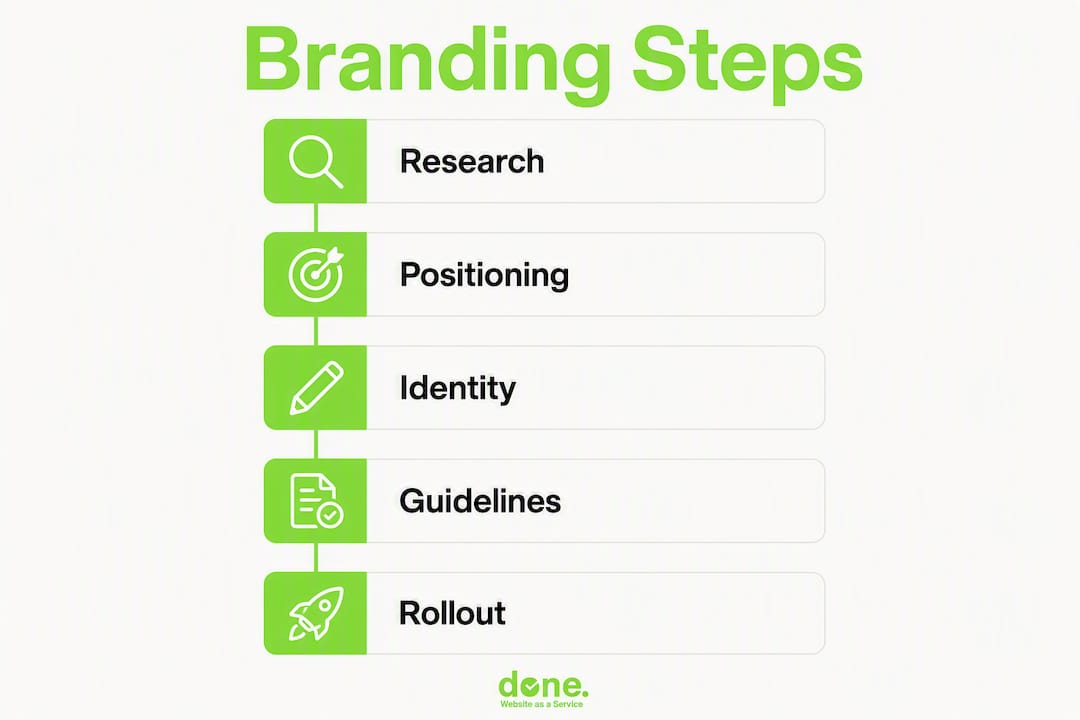
A minimum-viable brand, done properly, takes three to four weeks and a modest budget. A fuller project covering guidelines, web rollout, and multilingual assets typically takes about one to two months. Adobe’s brand-building guide confirms this sequence as the recognised standard across professional practice.
Who to involve at each step: the business owner drives steps 1 and 2. A designer or agency takes the lead on steps 3 and 4. Steps 5 through 8 are shared between the owner, any internal marketing resource, and whoever built the website.
How do you research and define your brand strategy?
This is the step most SMBs rush, and it is the one that determines whether everything else holds together. Get the positioning wrong here and no amount of good design will fix it.
Build your persona first
A persona is not a demographic profile. It is a decision-making portrait. Capture these fields:
- Role and context — job title, company size, sector
- Primary goal — what they are trying to achieve
- Biggest obstacle — what is stopping them
- How they find suppliers — search, referral, LinkedIn, trade events
- What makes them trust a new provider — proof, price, speed, credentials
- Language preference — critical for Central Europe; many buyers switch between French, German, Luxembourgish, and English
One persona is enough to start. Two is fine. Three or more usually means you have not made a choice yet.
Run a competitor sweep in a day
A brand foundation sprint can sharpen positioning quickly, but even without a facilitated workshop you can complete a useful competitor sweep in a single working day. For each of your three to five closest competitors, record:
- Their positioning headline (what they say they do)
- Their primary audience claim
- Their price signal (premium, mid-market, budget)
- Their dominant tone (formal, friendly, technical, bold)
- Their main channel (website, LinkedIn, print, events)
Look for the gap. If every competitor claims “quality” and “reliability,” those words are table stakes, not differentiators. Your positioning lives in the gap.
Write a one-line positioning statement
The template is simple: “For [audience], [brand name] is the [category] that [key benefit] because [reason to believe].” Test it with two or three stakeholders. If they nod and say “yes, that’s us,” it is working. If they say “but we also do X,” you have more scoping to do.
Pro Tip: Search Google for your three main service keywords and read the first five results. Note the language they use and the promises they make. Then check Google Reviews and Trustpilot for those same competitors. Customers’ own words in reviews are the most honest source of positioning gaps you will find.
How do you create a brand identity that actually sticks?
Strategy gives you the foundation. Identity gives it a voice people remember.
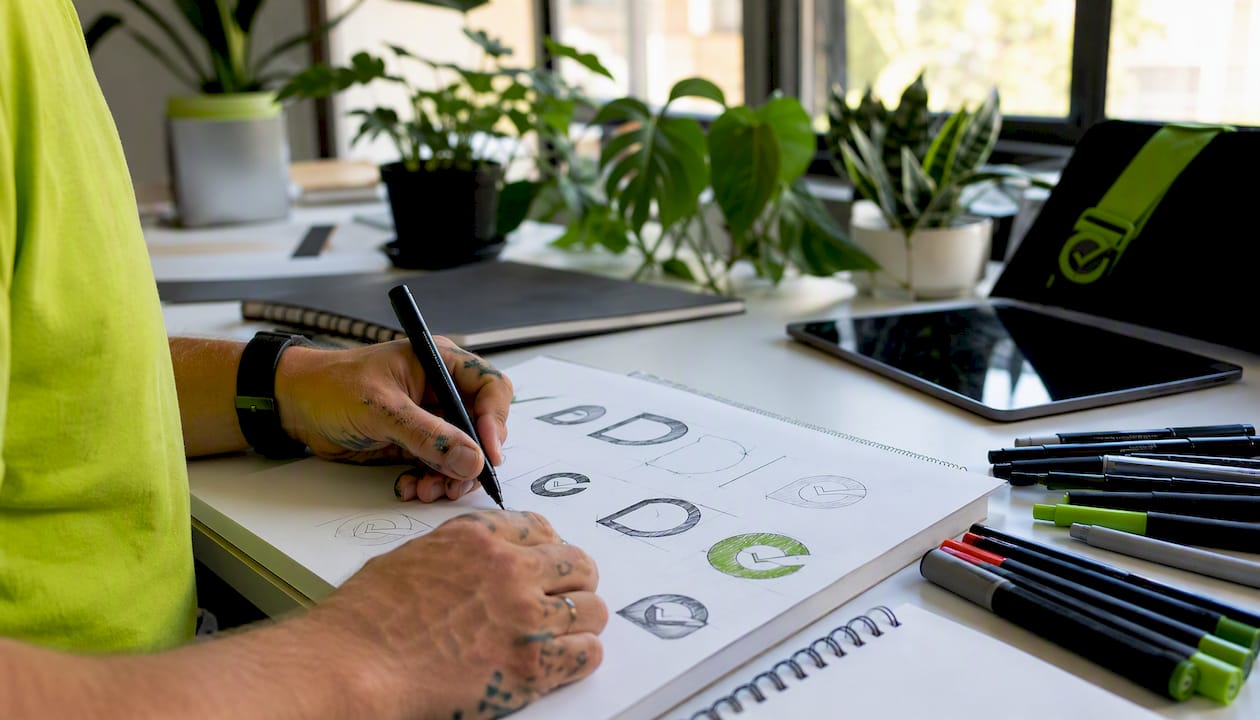
Naming checklist
Before you finalise a name, check every item:
- Pronounceable in the languages your customers speak (French, German, English at minimum for Central Europe)
- Fewer than three syllables where possible
- No awkward meanings in adjacent languages
- .com and .lu domain available (check Namecheap or your registrar)
- No existing trademark in your category (search the EUIPO eSearch database for EU marks)
- Works as a social handle across LinkedIn, Instagram, and Facebook
A brief trademark caution: searching EUIPO takes ten minutes and costs nothing. Registering a conflicting name and rebranding later costs far more. This is general guidance; consult a qualified IP professional for your specific situation.
Tagline: functional or emotional?
Functional taglines describe what you do: “Accounting software for freelancers.” Emotional taglines describe how you make people feel: “Built for the way you work.” For most SMBs in Central Europe, a functional tagline outperforms an emotional one in the first two to three years because buyers are still learning who you are. Switch to emotional once you have market recognition.
Brand story template
A brand story does not need to be long. Two paragraphs work well for a website About page or a proposal introduction:
Paragraph 1 — the problem you saw and why it mattered to you personally or professionally.
Paragraph 2 — what you built, for whom, and the difference it makes.
Keep it under 120 words. Anything longer gets skimmed.
Voice pillars
Choose three or four adjectives that describe how your brand sounds, then write one on-brand and one off-brand example for each. For instance:
- Direct — On-brand: “We build websites that generate leads.” Off-brand: “We craft bespoke digital experiences that resonate with your audience.”
- Practical — On-brand: “Here is what to do next.” Off-brand: “There are several considerations to bear in mind.”
- Confident — On-brand: “This approach works.” Off-brand: “This approach may potentially be beneficial.”
Pro Tip: Once you have your voice pillars, paste them into a shared document alongside your positioning statement. Every person who writes for your brand, including freelancers and agencies, should read this before they write a single word.
What goes into a visual identity system?
Visual identity is not just a logo. It is a system that must work across a website, a LinkedIn banner, a printed proposal, and a phone screen. Build it as a system from day one.
Visual asset checklist
- Primary logo (horizontal and stacked versions)
- Secondary logo or wordmark
- Icon or monogram (for favicon and app icon use)
- Monochrome version (black and white)
- Reversed version (white on dark background)
- Social avatar crop (400×400 px minimum)
- Export formats: SVG and PDF for print, PNG with transparent background for web, WebP where supported
Colour palette
Limit your primary palette to two or three colours plus one neutral. For each colour, record:
- HEX (web)
- RGB (screen)
- CMYK (print)
- Pantone reference (if you use physical print regularly)
Run every text-on-background combination through a contrast checker such as WebAIM’s Contrast Checker. WCAG AA compliance (a contrast ratio of at least 4.5:1 for body text) is the minimum standard for accessibility, and it is increasingly referenced in EU digital accessibility requirements. Getting this right at the design stage costs nothing; fixing it after a website launch is expensive.
Typography
Pick one headline font and one body font. They should be visually distinct but harmonious. Free options that work well together include Inter (body) with Sora or DM Sans (headline). For print-heavy brands, a serif headline paired with a sans-serif body is a reliable combination.

Define: size hierarchy (H1, H2, H3, body, caption), line height, and letter spacing for web. Add a fallback font stack for email and documents where custom fonts may not load.
Imagery and illustration
Decide on a style before you commission or buy any photography: documentary, studio, lifestyle, or illustration. Write two or three “do” rules and two or three “don’t” rules. For example: Do use natural light and real workspaces. Do not use stock images of people shaking hands in suits. This single decision prevents years of inconsistent imagery.
Pro Tip: For SMBs with limited photography budgets, a consistent filter preset applied to all images (in Lightroom, Canva, or a similar tool) creates visual coherence at near-zero cost. Decide on the preset in week one and apply it to every image you publish.
The link between visual identity and your website is direct. Web design and branding must be treated as one project, not two separate commissions, or the result will look inconsistent to every visitor.
What should your brand guidelines document include?
Brand guidelines for small businesses work best when they are written for non-designers: clear, short, and full of examples. A 40-page PDF that lives on someone’s desktop is not a brand guide. It is a filing cabinet.
Suggested structure
For most SMBs, a one-page guide plus a shared folder is enough to start. A starter portal becomes useful once you have more than five people producing branded content regularly.
| Format | Best for | Pros | Cons |
|---|---|---|---|
| One-page PDF | Solo founders, micro-businesses | Fast to produce, easy to share | No interactivity, version drift risk |
| Shared cloud folder (Google Drive, OneDrive) | Small teams (2–10 people) | Low cost, easy to update | Requires discipline to maintain |
| Living portal (Notion, Confluence) | Growing teams | Searchable, linkable, updatable | Requires setup time |
| Digital asset management (Bynder) | Larger SMEs, agencies | Full governance, permissions, versioning | Higher cost, overkill for micro-businesses |
What to include in every format
- Brand summary (one paragraph: who you are, who you serve, what makes you different)
- Logo rules: which version to use where, minimum sizes, clear space rules
- Colour palette with exact codes
- Typography hierarchy with size and weight guidance
- Imagery dos and don’ts
- Voice summary with on-brand and off-brand examples
- File index: where to find master files
Versioning
Name files with a date suffix: brand-guide-v1-2026-03.pdf. Store master source files (Figma, Illustrator, or equivalent) in a single location that only the brand owner or designer can edit. Distribute exported versions to everyone else. This single rule prevents the fragmentation that causes most brand inconsistency in small teams.
How do you roll out your brand across every touchpoint?
A brand that exists only in a guidelines document is not a brand yet. Rollout is where it becomes real, and sequencing matters. Fix the highest-visibility assets first.
Week 1 priorities
- Update website homepage hero, navigation logo, and favicon
- Update all social media profile images and cover photos
- Update email signature for every team member
- Update the main sales proposal or pitch deck template
Month 1 priorities
- Apply brand to invoice and quote templates
- Update LinkedIn company page and any active Google Business Profile
- Brief any freelancers or agencies who produce content on your behalf
- Replace any printed materials that are actively in use (business cards, brochures)
Quarter 1 priorities
- Audit all secondary web pages and update any off-brand elements
- Produce a set of social media post templates (Canva or Figma) for the team to reuse
- Create a short onboarding checklist for new team members covering brand basics
- Review any partner or supplier materials that carry your logo
For the website rollout specifically, applying brand identity to web assets is a distinct process with its own checklist. Treat it as a separate sub-project within the broader rollout.
Internal adoption checklist:
- Share the one-page guide with every team member on day one of launch
- Hold a 30-minute walkthrough session (in person or video call)
- Identify one person as the brand owner who approves new assets
- Create a simple “where do I find the logo?” FAQ document and pin it in your team chat
How do you govern your brand and know when to refresh it?
Most brand problems are not design problems. They are governance problems. Files get saved in the wrong place, a freelancer uses an old logo, someone creates a social post in the wrong font. A lightweight governance structure prevents all of this.
Governance template
- Brand owner: one named person with final approval on new assets
- Approval path: brand owner reviews any new template or external-facing asset before it goes live
- Asset storage: one canonical folder, clearly named, with subfolders for logos, fonts, templates, and photography
- Update rhythm: review the brand guide once per year, or after any significant product or market change
KPIs for brand health
You do not need a specialist brand tracker to measure brand performance. These proxies work well for SMBs:
- Direct traffic — people who type your URL directly are a proxy for brand recall
- Branded search volume — track your brand name in Google Search Console
- Enquiry quality — are inbound leads arriving with a clearer understanding of what you do?
- Social follower growth and engagement rate — a rough signal of brand resonance
- Net Promoter Score (NPS) — a single question asked to clients after project completion
Capture a baseline for each metric before you launch the new brand. Without a baseline, you cannot measure progress.
When does a rebrand make sense?
Ask these questions before committing to a rebrand:
- Has your audience or core service changed materially?
- Is the current brand actively creating confusion or negative associations?
- Are you entering a new market where the current brand does not translate?
- Has the visual identity become dated enough to undermine trust with new buyers?
If you answer yes to two or more, a refresh is worth planning. If you answer yes to only one, a targeted update (a logo refinement, a colour adjustment) is usually enough.
Multilingual and GDPR considerations for Central Europe
Central European markets often require brand assets in two or three languages. Plan translations as part of the asset list from the start: short brand descriptors, website boilerplate, and key UX strings. Store the authoritative version of each string in a single source document. When you update the brand, update all language versions at the same time.
For GDPR: if you collect customer data as part of brand research (surveys, interviews, analytics), you need a lawful basis under the GDPR and a clear privacy notice. Keep brand research data separate from marketing lists. This is general guidance; confirm your specific obligations with a qualified data protection professional or your national supervisory authority.
Which tools should you use for design and asset management?
Design tools fall into three tiers, and the right choice depends on your budget and team size.
| Tool | Best for | Cost (approx.) | Key use case |
|---|---|---|---|
| Figma | Professional design, collaboration | Free tier; paid from ~€10/month | Logo system, UI, brand guidelines portal |
| Adobe Creative Cloud | Full professional suite | From ~€60/month | Illustrator for logos, InDesign for print |
| Canva | Fast asset creation, non-designers | Free tier; Pro ~€10/month | Social posts, presentations, proposals |
| Bynder | Asset management, larger teams | Pricing on request | DAM, permissions, version control |
| Google Drive / OneDrive | Lightweight file sharing | Included in most plans | Starter asset storage for micro-businesses |
For a DIY brand project, Canva covers most needs. For a professional visual system you intend to scale, Figma or Adobe Creative Cloud is the right investment. Bynder becomes relevant once you have a team of ten or more people producing branded content, or when you need formal permissions and version control.
Starter templates to use
- Brand brief — one page covering audience, positioning, voice, and visual direction; share with any designer before briefing work
- Persona worksheet — five fields: role, goal, obstacle, discovery channel, trust signals
- Positioning line template — the “For [audience]…” structure described in the strategy section
- One-page brand guide — logo, palette, typography, voice; the minimum-viable deliverable
- Rollout checklist — the week 1 / month 1 / quarter 1 priority list from the implementation section
Standard branding templates reduce back-and-forth with designers and speed up approvals considerably. We have seen this with clients: a completed brief cuts the first design round by at least one revision cycle.
What does branding cost for an SME in Central Europe?
Budget expectations vary widely, and the honest answer is that the range is large. Here is a realistic breakdown.
-
DIY route (tools only): €0–€500 for Canva Pro, a domain, and stock imagery. You invest time rather than money. Suitable for pre-revenue businesses or very early-stage projects where speed matters more than polish.
-
Freelancer route: €1,500–€5,000 for a logo, basic visual system, and a one-page guide. Quality varies significantly. Ask to see three to five previous brand projects before commissioning. Expect two to four weeks of elapsed time.
-
Agency route (minimum viable): €4,000–€12,000 for a full brand project including strategy workshop, visual identity, guidelines, and web rollout. Timelines run several weeks to a couple of months. This range applies to Central Europe; prices in larger Western European markets tend to be higher.
-
Agency route (full brand + web): €10,000–€30,000+ when branding is combined with a new website build. The business case for investing in web development alongside branding is strong: a website built to the brand system from day one avoids the cost of retrofitting design changes later.
What drives price variance: the number of languages required, the complexity of the visual system, whether photography is commissioned, and how much strategic work (workshops, research, positioning) is included. A multilingual brand project for a Central European SME typically costs 20–40% more than a single-language equivalent, simply because of the additional asset production and review cycles.
Short RFP brief template: when requesting quotes, include: your sector, your audience, the languages you need, the assets you expect (logo, guidelines, web templates), your timeline, and your budget range. A designer or agency who cannot give you a clear scope against those inputs is not ready to work with you.
How Done approaches branding for SMBs in Central Europe
Done has been working with SMBs in Luxembourg and Central Europe since 2014, across more than 350 projects. The branding work we do sits at the intersection of strategy, design, and web delivery, which means we see the full picture from positioning to live website.
Our branding strategy services cover brand audits, identity creation, multilingual rollout, and web implementation. We also offer website as a service (WaaS) for clients who want a continuously improving web presence without a large upfront investment.
What we typically do for an SMB brand project
- Half-day brand foundation workshop to clarify positioning, audience, and voice
- One-page positioning and voice pillars deliverable, ready to brief a designer
- Two to three logo concepts with a full visual system on approval
- One-page living brand guide stored in a shared folder the client owns
- Web rollout applying the brand system to a new or existing website
- Multilingual asset production for French, German, and English where needed
- GDPR-compliant handling of any customer research data collected during the project
Two brief case examples
Case 1: A Luxembourg-based professional services firm had been operating for six years with a logo created in PowerPoint and no written brand guide. After a half-day workshop and a four-week brand project, they had a consistent visual system, a one-page guide shared with their team, and a refreshed website. Inbound enquiries from the website increased in the following quarter, and the team stopped asking “which logo do I use?” entirely.
Case 2: A Central European e-commerce business was running separate visual identities across their French and German market pages. We consolidated the brand into a single system with language-specific copy variants, stored in a shared Notion portal. The result was a consistent customer experience across both markets and a reduction in the time spent producing new marketing assets.
Pro Tip: Before briefing any designer or agency, complete the brand brief template yourself. Even a rough draft forces you to make decisions about audience and positioning that will save significant time and money in the design process. We’ve seen this with clients: a completed brief cuts the first design round by at least one revision cycle.
Client-ready brief checklist:
- Business name, sector, and founding year
- Primary audience (one persona, described in plain language)
- One-line positioning statement
- Three competitors and what makes you different from each
- Languages required
- Assets needed (logo, guidelines, web, print, social)
- Timeline and budget range
GDPR note: if you conduct customer interviews or surveys as part of brand research, you need a lawful basis under the GDPR (typically legitimate interest or consent), a privacy notice, and a clear data retention policy. Store research data separately from your marketing database. Confirm your obligations with your national data protection authority; in Luxembourg, that is the Commission Nationale pour la Protection des Données (CNPD).
Key takeaways
A working brand for an SME requires six sequential steps, a one-page living guide, and a named brand owner who keeps the system consistent over time.
| Point | Details |
|---|---|
| Start with positioning | Write a one-line positioning statement before commissioning any design work. |
| One-page guide beats a long PDF | A minimal, shared brand guide prevents inconsistency and is immediately usable by non-designers. |
| Sequence the rollout | Fix website, social avatars, and email signatures in week 1; everything else follows. |
| Plan for multilingual from day one | Central European SMBs need translated boilerplate and UX strings stored in a single source. |
| Done covers the full process | Done offers brand audits, identity design, web rollout, and WaaS for SMBs in Luxembourg and Central Europe. |
What most SMBs get wrong about branding
The most common mistake we see is treating branding as a design project rather than a strategy project. A business owner commissions a logo, receives a beautiful file, and then has no idea how to use it consistently because there was never a positioning conversation.
The second mistake is over-engineering the guidelines. A 60-page brand manual is not a sign of thoroughness. It is a sign that nobody made hard choices. The businesses we work with that maintain the most consistent brands are the ones with a one-page guide, a shared folder, and one person who owns the decisions.
Multilingual needs are consistently underestimated. A brand that works in English often needs more than a translation to work in French or German. Tone, formality, and even the length of key phrases change between languages. Planning this at the start costs a fraction of what it costs to retrofit later.
The gap between brand ambition and budget is real, but it is manageable. A minimum-viable brand, done properly, takes three to four weeks and a modest budget. The businesses that struggle are the ones who either spend too little (a logo with no system) or too much too early (a full brand manual before they have validated their positioning with real customers). Start with the minimum viable version, get it in front of customers, and iterate from there.
Done can handle your branding from brief to live website
If you would rather spend your time running your business than managing a branding project, Done handles the full process: strategy workshop, identity design, brand guidelines, multilingual rollout, and web implementation, all under one roof in Luxembourg.
Our model is straightforward. Brand projects are priced on a fixed-fee basis with no hidden costs. For clients who want ongoing design and web support, our website as a service subscription keeps your site and brand assets continuously updated without a large upfront commitment. There are no setup fees and no long-term lock-in on the WaaS option.
To get started, visit done.lu and send us a brief message describing your project. We will come back to you within one working day with a scope outline and a ballpark figure. From there, a 30-minute call is usually enough to confirm whether we are the right fit. If you are ready to move, we can typically begin a brand project within two weeks of receiving a signed brief.
Useful sources and template links
Branding process and guidelines:
- Adobe: Building a brand, a step-by-step guide — the recognised standard sequence for brand development
- Bynder: Brand guidelines definition and how to create them — authoritative reference on guidelines structure and digital asset management
- Kittl: Brand guidelines for small business — practical one-page guide format and rationale
- Canva: How to create a consistent brand style guide — visual style guide structure with examples
- Designlogo.uk: Brand guidelines for small business — plain-language structure and file format guidance
Luxembourg and Central Europe specific:
- Superblau: Brand workshop for science.lu — example of a brand foundation sprint format used in Luxembourg
- CNPD Luxembourg: Data protection authority — GDPR obligations for brand research and customer data
- EUIPO eSearch — free EU trademark search before finalising a brand name
Done resources:
- Done: Branding tips and 90-day action plan — practical branding steps mapped to marketing outputs for SMBs
- Done: What is branding strategy? — strategic foundations and positioning templates
- Done: Step-by-step website branding for business growth — applying brand identity to web assets