

Top 3 marketing automation AI tools 2026
April 24, 2026
Top 3 AI chatbot business tools 2026
April 26, 2026
TL;DR:
- AI has drastically shortened exploit timelines from months to less than a day, increasing risks for SMBs.
- Rapid patch releases challenge SMBs’ ability to test and deploy updates without operational disruption.
- Building layered defenses, automating patching, and reducing burnout are essential for resilience against AI-driven cyber threats.
Routine software updates used to feel like a low-priority chore. Patch Tuesday arrives, your IT contact clicks through a checklist, and life goes on. That assumption is now dangerously outdated. Exploit timelines have compressed from 2.3 years in 2019 to less than one day in 2026, driven entirely by artificial intelligence. For European small and medium-sized businesses (SMBs), this is not an abstract risk. It is a direct, immediate threat to your operations, your data, and your reputation. This guide explains exactly how AI has reshuffled the rules of cybersecurity, what software vendors are doing in response, and the practical steps you can take right now to stay protected.
Table of Contents
- Why AI has changed the rules of cybersecurity
- How software companies are responding: Rushing updates
- Managing the patch lag: What European SMBs can do now
- Beyond patching: Compensating controls and future-proofing your business
- A fresh perspective: Patch speed is not the full answer for SMBs
- Protect your business and stay ahead with expert digital solutions
- Frequently asked questions
Key Takeaways
| Point | Details |
|---|---|
| AI accelerates threats | Vulnerability exploitation now happens in minutes, making timely software updates critical. |
| Patch lag is risky | Even a few days’ delay can leave endpoint systems exposed to fast-moving AI exploits. |
| Automation is essential | SMBs must automate patching and layer defences to match AI-speed attacks. |
| Compensating controls matter | Using EDR and regulatory sandboxes provides backup while testing patches and protects legacy systems. |
| Holistic resilience beats speed | Vendor patch cadence alone is not enough—combine automation, compliance, and layered defence for best protection. |
Why AI has changed the rules of cybersecurity
Not long ago, a newly discovered software vulnerability followed a relatively slow and predictable path. Security researchers would find a flaw, report it, and vendors would release a patch over days or weeks. Attackers could exploit the gap, but the window was measured in months. That era is over.
Artificial intelligence has fundamentally rewritten this process. AI-powered systems can now scan millions of lines of code, identify weaknesses, and generate working exploits in a matter of minutes. The mean time to exploitation is now less than one day, forcing businesses to react at a speed that human-only security teams simply cannot match.
One of the most striking developments is the emergence of autonomous AI agents specifically designed for offensive security. AI agents like Mythos can autonomously explore vulnerabilities and generate exploits without human instruction. These tools are no longer confined to well-funded nation-state actors. They are increasingly accessible to organised criminal groups, which makes every unpatched system a viable target.
To understand the scale of the shift, consider how vulnerability discovery and exploitation have evolved:
| Era | Discovery method | Time to exploit | Primary threat actor |
|---|---|---|---|
| Pre-2015 | Manual research | 12 to 24 months | Nation states, elite hackers |
| 2015 to 2020 | Automated scanners | 2 to 6 months | Organised crime |
| 2021 to 2023 | ML-assisted tools | Days to weeks | Broad criminal ecosystem |
| 2024 to 2026 | Autonomous AI agents | Minutes to hours | Widely accessible |
The practical consequences for your business are significant. Key risks now include:
- Patch windows have collapsed. Traditional IT schedules assume you have days or weeks to respond to a new vulnerability. AI attackers do not wait.
- Legacy software is a prime target. Older systems with known but unpatched vulnerabilities are easily identified by AI scanning tools.
- Scale of attacks has grown. AI can target thousands of businesses simultaneously, making SMBs just as likely a target as large enterprises.
- Defensive AI must match offensive AI. Techniques such as patch-diffing (comparing patched and unpatched code to identify exploitable changes) are now performed by automated tools on both sides of the threat.
CrowdStrike’s chief executive has warned publicly that patch windows could shrink from five days to five minutes as AI becomes more capable. That trajectory should inform every technology decision your business makes in 2026 and beyond.
Understanding AI security risks for SMBs is the essential starting point. The businesses that take this seriously now will be far better positioned than those waiting for a breach to prompt action. Reviewing AI strategies for European SMEs can also help you build a proactive posture rather than a reactive one.
How software companies are responding: Rushing updates
Now that AI is compressing exploit timelines, let’s see how software companies and their clients are rushing to adapt.
Vendors including Microsoft, Google, and Adobe have significantly accelerated their patch release cycles. Where monthly or quarterly updates were once standard, critical patches now arrive within hours of a vulnerability being confirmed. This is a necessary response, but it creates its own complications for SMBs.
Software vendors now push critical updates rapidly to address AI exploits, but SMBs face serious dependency risks when those updates arrive faster than internal teams can safely test and deploy them. A patch released on a Monday morning may break a custom integration or conflict with legacy software that your business depends on. Speed creates its own category of risk.
Here is how the patching process typically unfolds from discovery to deployment:
- Vulnerability discovery. A flaw is identified, either by internal security teams, independent researchers, or increasingly by AI tools on the offensive side.
- Internal vendor assessment. The vendor analyses the severity using the Common Vulnerability Scoring System (CVSS), which rates vulnerabilities from 0 to 10 by impact.
- Patch development. Engineers write and test a fix, a process now compressed from weeks to hours for critical issues.
- Release and publication. The patch is released alongside a security advisory. Publishing this advisory also signals to attackers exactly where to look.
- Client-side deployment. Your business must identify affected systems, test the patch, and roll it out without disrupting operations.
- Verification and monitoring. Post-deployment checks confirm the fix is effective and no new issues have been introduced.
The problem is clearly visible in the numbers. The median time for SMBs to apply Microsoft patches is 7.7 days, but roughly 10% of businesses take 38 days or longer. In an environment where exploitation can occur within hours, that gap is simply unacceptable.
| Patching approach | Typical timeline | Risk level |
|---|---|---|
| Manual, ad hoc patching | 7 to 38+ days | High to critical |
| Scheduled maintenance windows | 3 to 7 days | Moderate |
| Automated patch management | Under 24 hours | Low |
| Automated with staged rollout | 12 to 48 hours | Very low |
Pro Tip: Implement an automated patch management tool and combine it with a staged rollout process. Apply updates to a small test group first, verify stability over a few hours, then deploy broadly. This keeps you fast without introducing new operational risks.
For European SMBs, improving patch speed also connects directly to productivity and regulatory compliance. Businesses that invest in automated workflows find they spend less time firefighting and more time growing. Exploring AI-driven strategies for SMBs can reveal how automation applies across your wider operations, not just security.

Managing the patch lag: What European SMBs can do now
With companies accelerating patch releases, what practical steps can you take as a European SMB to avoid getting left behind?
The statistics reveal a nuanced picture. SMBs in Europe patch 89% of critical vulnerabilities within 30 days, which sounds reassuring until you realise that AI weaponises older, unpatched flaws faster than any human team can respond. The remaining 11% of unpatched systems are effectively open doors.
It is also worth noting that AI-driven attacks do not exclusively target brand-new vulnerabilities. Older CVEs (Common Vulnerabilities and Exposures, meaning publicly catalogued security flaws) in legacy software and Internet of Things (IoT) devices are frequently targeted because they are predictable, numerous, and often overlooked by overwhelmed IT teams.
Legacy software and burnout are two of the most significant factors slowing patch adoption across SMBs. When your IT resource is stretched managing day-to-day operations, patching falls down the priority list. That is precisely when attackers strike.
Here is a practical action plan for European SMBs:
- Conduct a full asset inventory. You cannot patch what you do not know exists. Document every device, application, and system, including older machines and cloud services.
- Prioritise by CVSS score. Focus first on vulnerabilities rated 9.0 or above. These are critical severity issues that AI tools are most likely to exploit within hours of disclosure.
- Automate where possible. Use patch management platforms such as NinjaRMM, ManageEngine, or Microsoft Intune to reduce manual effort and speed up deployment.
- Establish compensating controls. When a patch cannot be immediately applied because of testing requirements, implement temporary protections such as network segmentation or firewall rules to limit exposure.
- Monitor continuously. Use vulnerability scanning tools to detect new exposures as they emerge rather than relying on periodic reviews.
- Review your supply chain. Many SMB breaches occur through third-party software. Ensure your vendors have robust patching policies and verify their security posture regularly.
Pro Tip: Audit every AI tool your business uses, including marketing platforms, customer relationship management (CRM) systems, and document processors. Each one represents a potential entry point. Aligning this audit with GDPR compliance requirements ensures you address both security and regulatory obligations simultaneously.
Thinking about which tools deserve your attention first? Reviewing the best AI tools for SMBs can help you identify well-maintained, security-conscious solutions. And if you use AI in your marketing stack, understanding AI in digital marketing for SMEs will highlight where additional security considerations apply.
Beyond patching: Compensating controls and future-proofing your business
Patch automation is critical, but it is not the only solution. Here is how to go further and build resilience against AI-driven threats.
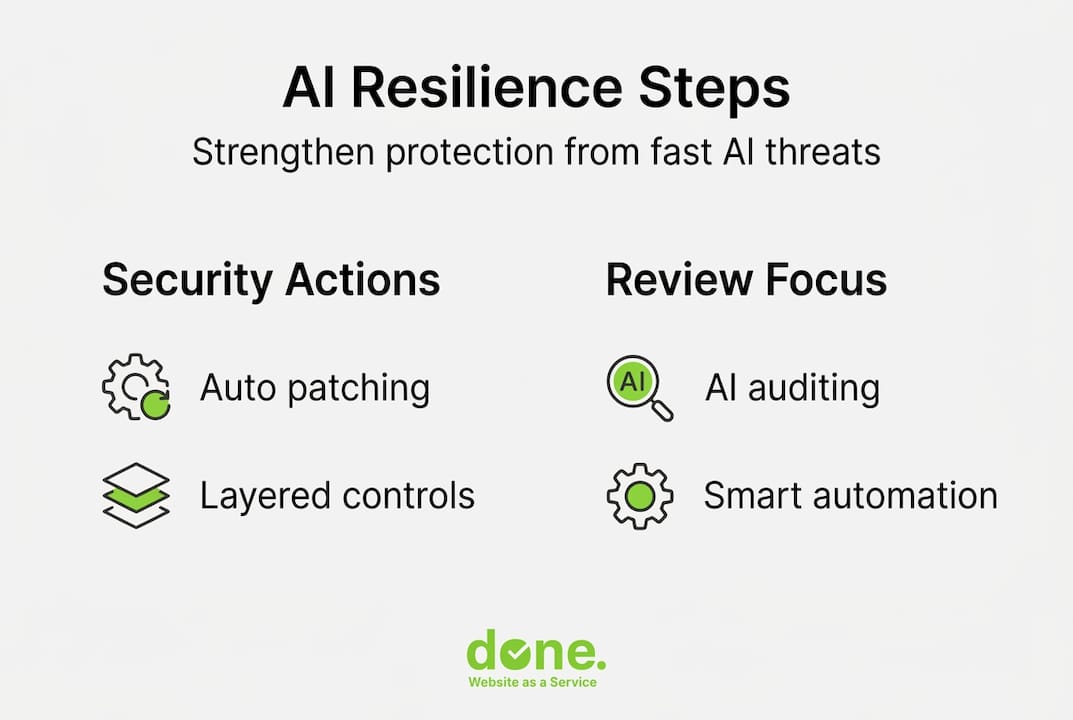
Even with excellent patch management, you will sometimes face scenarios where an update cannot be deployed immediately. A patch may conflict with a business-critical application, require extensive testing, or arrive during a period when your IT resource is unavailable. In these situations, compensating controls, meaning security measures that reduce risk without eliminating the underlying vulnerability, become essential.
Mitigating controls like EDR are essential while patches are being tested, and regulatory frameworks such as EU AI Act sandboxes offer additional layers of protection for businesses operating in sensitive sectors. EDR (Endpoint Detection and Response) tools monitor devices in real time, identifying and containing suspicious behaviour before it escalates.
Here are the compensating controls every European SMB should consider:
- Endpoint Detection and Response (EDR). Deploy EDR software across all endpoints. These tools detect abnormal behaviour patterns that indicate exploitation, even when no patch is yet available.
- Network segmentation. Divide your network into separate zones so that a compromise in one area cannot spread freely to others. This is particularly important for businesses with IoT devices or legacy systems.
- Application sandboxing. Run high-risk applications in isolated environments so that any exploit is contained and cannot reach your core systems.
- Zero-trust access controls. Apply the principle that no user or system is automatically trusted, requiring verification at every access point. This limits the blast radius of any successful attack.
- Threat intelligence feeds. Subscribe to real-time vulnerability intelligence services that alert you when new CVEs relevant to your software stack are published.
The table below summarises a best-practice framework for European SMBs managing AI-driven cybersecurity threats:
| Priority area | Recommended action | Review frequency |
|---|---|---|
| Critical patch deployment | Automated with staged rollout | Ongoing |
| Compensating controls | EDR, segmentation, sandboxing | Quarterly review |
| Regulatory compliance | GDPR, NIS2, EU AI Act alignment | Bi-annually |
| Asset inventory | Full audit of all devices and software | Every six months |
| IT team wellbeing | Manage workloads to prevent burnout | Monthly |
Looking at how AI transforms SMEs in Europe reveals how the same automation principles that accelerate marketing and operations can be applied to security workflows. If you are considering a structured approach to AI adoption, AI consulting for SMBs offers a pathway from initial assessment to full implementation. You may also find value in exploring AI tools for SME marketing, which highlights secure, well-supported platforms that combine growth with resilience.
A fresh perspective: Patch speed is not the full answer for SMBs
Everything we have covered so far points toward one imperative: patch faster. And that is genuinely important. But there is a harder truth that most guides in this space avoid.
Your patch cadence is not entirely in your hands. Vendor-controlled patch timing creates a dependency risk that no amount of internal automation can fully eliminate. When Microsoft or a SaaS vendor decides to release a critical update at 3am on a Friday, your options are limited. You either deploy immediately and risk operational disruption, or you wait and remain exposed.
This is why we believe the conversation needs to shift from “patch faster” to “build smarter resilience.” Speed matters, but it is only one variable in a much larger equation. The businesses that fare best under AI-driven threat conditions are not necessarily the fastest patchers. They are the ones with layered defences, clear asset inventories, tested incident response plans, and a team that is not running on empty.
Burnout is a real and underappreciated factor here. When IT teams are overwhelmed by the pace of AI-driven vulnerabilities, the quality of their decisions degrades. A panicked or exhausted team rushing a patch deployment is more likely to introduce new problems than a well-rested team following a structured process.
Our perspective is this: prioritise sustainable security practices over reactive speed. Automate intelligently, layer your controls, and stay aligned with European regulatory frameworks including NIS2 and the EU AI Act. Explore AI strategies for SME resilience to build a posture that holds up under pressure, not just during calm periods. That is where genuine competitive advantage lies.
Protect your business and stay ahead with expert digital solutions
The shift from slow, predictable threats to AI-driven, near-instant exploitation demands a different kind of response from European SMBs. Patching faster is necessary, but sustainable resilience comes from combining automation, layered security, and informed expertise.

At Done.lu, we help businesses across Luxembourg and Europe put these principles into practice. Whether you need guidance on the best AI tools for your business, a clear roadmap for AI transformation, or structured AI consulting support to navigate security, compliance, and digital growth, our team brings the expertise you need. We take a human-first approach to technology, ensuring your team is empowered rather than overwhelmed. Get in touch with us today to see how we can help you stay protected and move forward with confidence.
Frequently asked questions
Why are patch windows shrinking for software vulnerabilities?
AI-driven tools now find and exploit flaws within minutes of their discovery, making timely updates critical. The mean time to exploitation has dropped to less than one day, leaving almost no margin for delayed patching.
What is the biggest risk for European SMBs with slow patching?
Delayed updates leave endpoints exposed for extended periods, often longer than most businesses realise. Roughly 10% of SMBs take over 38 days to apply critical patches, a window far too wide in the current threat environment.
How can SMBs in Europe speed up patching and stay protected?
Automate patch management, prioritise vulnerabilities with high CVSS scores, deploy compensating controls such as EDR, and audit legacy systems regularly. Automated patching combined with EU AI Act sandbox frameworks provides a strong baseline of protection.
Will patching alone protect my business from AI-driven threats?
No. Patching is a critical component, but layered defence is essential. Compensating controls like EDR, alongside robust compliance practices and intelligent automation, are required to build genuine resilience against AI-powered attacks.