

Why integrated marketing matters for SMEs: a practical guide
July 30, 2026
SEO trends in 2026: the Central Europe playbook
August 1, 2026
TL;DR:
- Digital transformation improves resilience, productivity, and customer retention for Central European SMEs. Starting small on organizational change yields measurable results and supports gradual growth. Prioritizing pain points and setting clear KPIs helps ensure successful implementation and ROI.
For most Central European SMEs, the answer is yes — invest now, start small, and treat it as organisational change first and technology second. Businesses that have gone through this process show measurably stronger resilience to economic disruption, higher productivity, and better customer retention than those that have not. The EIB confirms that digitally advanced firms weathered the COVID-19 crisis and the war in Ukraine better than non-digital peers, and were more likely to engage in international trade and invest in climate measures.
The short version:
- Efficiency: automated workflows cut manual effort and reduce errors across finance, operations, and customer service
- Revenue growth: digital channels and e-commerce open new markets without proportional cost increases
- Customer experience: faster, more personalised service raises satisfaction and reduces churn
- Resilience: digital firms recover faster from supply chain shocks, staffing gaps, and market shifts
- Talent: digital firms pay higher wages and train more frequently, which helps attract and keep good people
The rest of this guide explains each of these points in practical terms, with a starter roadmap you could act on next week.
Table of Contents
- What does digital transformation actually mean for your business?
- Why choose digital transformation: the business benefits that matter
- Which business domains should you tackle first?
- Which technologies do you actually need?
- How do you measure ROI on a digital transformation project?
- Why do so many digital transformation projects fail?
- A practical 6–12 week starter roadmap for Central European SMEs
- Regional evidence and what we see in Central Europe
- Is digital transformation right for your company right now?
- Key takeaways
- What we actually see working with clients
- How Done can help you get started
- Sources and further reading
What does digital transformation actually mean for your business?
Digital transformation is the process of redesigning how your business creates and delivers value by embedding digital tools, data, and new ways of working across the whole organisation. The word “transformation” matters: this is not about buying new software. It is about changing processes, culture, and sometimes your business model itself.
Academic research is clear on this point: digital tools act as an enabling condition for business model innovation, but productivity gains require absorptive capacity and organisational change alongside the technology. Put simply, a new CRM does nothing if your sales process is broken.
The scope covers five areas:
- Processes: how work gets done (approvals, reporting, fulfilment, invoicing)
- Products and services: what you sell and how it is delivered
- Customer experience: every touchpoint from first contact to after-sales
- Business model: how you charge, who you serve, and through which channels
- People and culture: skills, decision-making, and how teams use data
What counts as transformation vs. a simple upgrade?
A simple upgrade is switching from paper invoices to a PDF template. Transformation is connecting your invoicing to your CRM, your stock system, and your accountant’s platform so that the whole order-to-cash cycle runs with minimal manual input. The difference is integration and process redesign, not the tool itself.
Why choose digital transformation: the business benefits that matter
The benefits of digital transformation are not abstract. Each one maps to a KPI your finance director or board already tracks.
Revenue and growth
Digital channels remove geographic limits. An SME in Luxembourg or Prague that builds a well-structured e-commerce presence can serve customers across the EU without opening a new office. Survey evidence shows that roughly half of SMEs cite improved market visibility as a primary motive for going digital, alongside cost reduction. That combination, more reach at lower cost per sale, is the core revenue argument.

Operational efficiency
Automating repetitive tasks, whether that is scheduling, data entry, document processing, or reporting, frees your team for higher-value work. The proxy KPI here is straightforward: hours saved per week multiplied by the average hourly cost of the staff involved. In our experience with clients, even modest workflow automation projects typically recover their cost within six months.

Customer experience
Customers expect fast, consistent responses across every channel. A business that can answer a query via chat at 10 PM, send an automated follow-up, and personalise the next offer based on purchase history will outperform one that relies entirely on manual processes. The KPI to watch is churn rate and Net Promoter Score, both of which tend to improve when response times fall and personalisation improves.
Resilience and risk management
“Digital firms are more resilient. They weathered the economic and trade disruptions unleashed by the COVID-19 crisis and the war in Ukraine better than other businesses, which suggests that they found more efficient ways of working.”
— European Investment Bank, Digitalisation in Europe 2022–2023
Resilience is the benefit that is hardest to quantify in advance and most obvious in hindsight. Cloud-based operations can continue when an office is inaccessible. Digital supply chain visibility lets you spot a problem before it becomes a crisis. This is particularly relevant for Central European SMEs exposed to cross-border trade volatility.
Talent and skills
Non-digital firms pay lower average wages and train their staff less frequently than digital ones. That gap compounds over time: the best candidates choose employers who offer modern tools and development opportunities. Investing in digital capability is therefore also an investment in your ability to hire and retain people.
Pro Tip: Start with the benefit that maps to your most pressing KPI. If cash flow is tight, target efficiency first. If you are losing customers to faster competitors, start with customer experience. Sequencing by urgency, not by what is technically easiest, produces faster internal buy-in.
Which business domains should you tackle first?
Choosing where to start is often harder than deciding to start at all. Paperjam research notes that managers are frequently too close to daily operations to spot where digital tools will deliver the most benefit. Here are the five domains most relevant to Central European SMEs, ordered roughly by speed of ROI.
-
Customer-facing processes (fastest ROI): online booking, live chat, automated follow-up emails, and digital quotation tools. These are visible to customers immediately and generate measurable conversion or satisfaction data within weeks. A typical first project: replacing a phone-only booking system with an online form connected to your calendar and CRM.
-
Internal operations and administration: automating approvals, expense reporting, HR onboarding, and invoice processing. The gains are internal but significant. A typical first project: a digital approval workflow that replaces email chains for purchase orders.
-
Marketing and customer acquisition: SEO, paid search, social media scheduling, and marketing automation. For SMEs with limited sales teams, this domain multiplies reach without adding headcount. A typical first project: an automated lead nurture sequence triggered by a website enquiry.
-
Products and revenue models: adding a digital product, a subscription tier, or an e-commerce channel alongside your existing offer. This takes longer to build but can open entirely new revenue streams. A typical first project: a simple online shop for your top ten products.
-
Employee tools and knowledge management: internal wikis, AI-assisted document search, and digital training platforms. These improve consistency and reduce the time new staff spend finding information. A typical first project: a shared knowledge base replacing scattered email threads and shared drives.
For most Central European SMEs, the customer-facing and internal operations domains deliver the fastest, most measurable returns. Start there, build confidence, then expand.
Which technologies do you actually need?
You do not need to adopt every technology at once. The following are the enablers that appear most frequently in SME transformation projects, with a plain-English description of what each one does.
-
Cloud hosting and SaaS tools: moving applications and data off local servers onto hosted platforms (Microsoft 365, Google Workspace, cloud-based accounting software). This reduces IT maintenance costs and enables remote working. For Central European SMEs, choose providers with EU data centres to satisfy GDPR data residency requirements.
-
APIs and system integration: APIs are the connectors that let your CRM talk to your accounting software, your website talk to your stock system, and your marketing platform talk to your customer database. Without integration, you end up re-entering data manually across systems. Most modern SaaS tools offer APIs; the question is whether you have someone to configure them.
-
Workflow automation: tools such as Make (formerly Integromat, widely used in Luxembourg and Central Europe) or n8n allow you to build automated sequences without writing code. A document arrives by email, gets processed, filed, and triggers a notification, all without human intervention.
-
CRM and data platforms: a Customer Relationship Management system is the single most impactful tool for most SMEs that do not yet have one. It centralises customer data, tracks interactions, and gives your team a shared view of every account.
-
AI for specific tasks: AI tools are most useful when applied to well-defined, repetitive tasks: drafting responses to standard enquiries, summarising documents, generating first drafts of marketing copy, or flagging anomalies in financial data. AI consulting for SMBs works best when the use case is narrow and the expected output is measurable.
-
Cybersecurity and GDPR compliance: every digital project increases your attack surface. For Central European SMEs, GDPR compliance is not optional. Minimum requirements include encrypted data storage, access controls, a data processing register, and a clear breach response procedure. For regulated sectors (legal, finance, healthcare), private on-premise AI deployment may be necessary to keep sensitive data off public cloud infrastructure.
Build vs. buy vs. partner: for most SMEs, buying a proven SaaS tool and configuring it with a partner is faster and cheaper than building from scratch. Custom development makes sense only when your process is genuinely unique and no off-the-shelf tool comes close. A digital strategy guide can help you map this decision before you commit budget.
How do you measure ROI on a digital transformation project?
Measurement is where most SME projects go wrong. Teams launch a tool, use it for a few months, and then cannot answer the question: “Was it worth it?” The fix is to baseline before you start and agree on a small number of KPIs before the project goes live.
| Project type | Primary KPI | Simple formula |
|---|---|---|
| Workflow automation | Hours saved per week | Hours saved × average hourly cost = weekly saving |
| CRM implementation | Lead-to-customer conversion rate | — |
| E-commerce launch | Online revenue as % of total revenue | — |
| Marketing automation | Cost per qualified lead | Total campaign spend ÷ qualified leads generated |
| AI document processing | Processing time per document | Average time before vs. after implementation |
| Customer self-service portal | Support ticket volume | Tickets per month before vs. after launch |
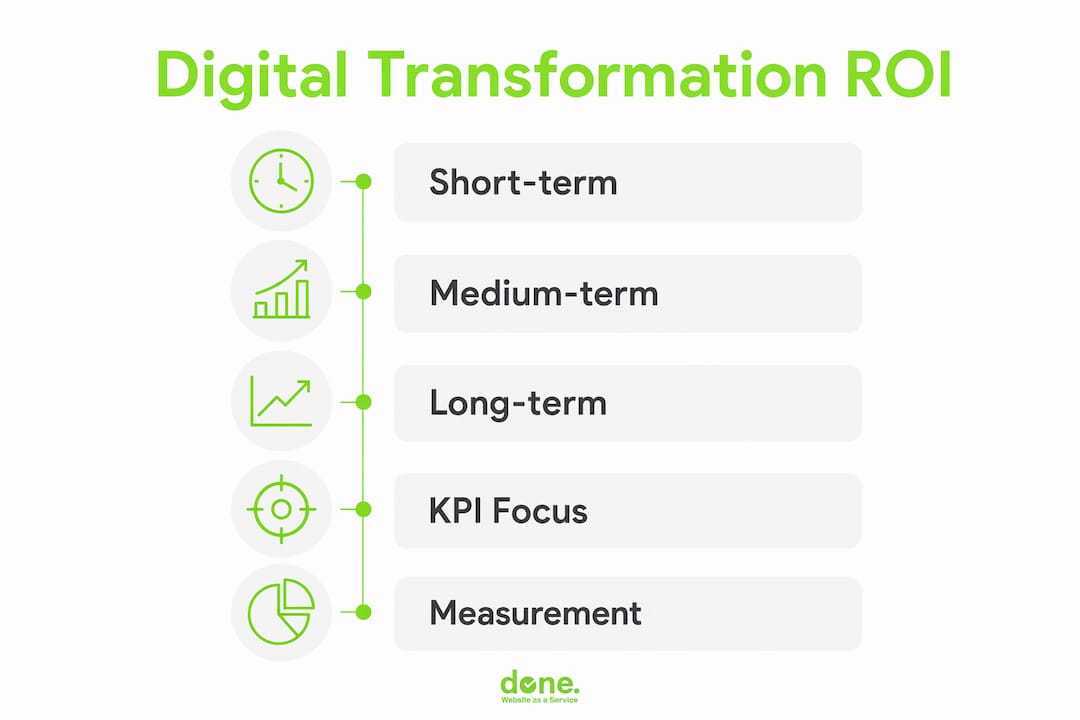
Short-term KPIs (0–3 months): time saved on specific tasks, error rates in automated processes, system adoption rates among staff.
Medium-term KPIs (3–12 months): conversion rate changes, customer satisfaction scores, cost per transaction, staff time redirected to higher-value work.
Long-term KPIs (12 months+): revenue from new digital channels, customer lifetime value, employee retention, and the ability to scale without proportional headcount growth.
Academic analysis is worth noting here: productivity improvements from digital transformation tend to be gradual and depend on complementary investments in skills and process redesign. Do not expect a single tool to transform your P&L in month one. Set realistic timelines and review KPIs quarterly.
Practical measurement tips:
- Baseline every KPI before the project starts, not after
- Limit yourself to three to five metrics per project; more than that and nobody tracks them
- Review monthly for the first quarter, then quarterly once the project is stable
- Assign one named person as the owner of each KPI
Why do so many digital transformation projects fail?
The failure rate for transformation initiatives is high across all business sizes. Understanding why is the fastest way to avoid the same traps.
Poor scoping. Projects that start with “we need to digitalise” rather than “we need to reduce invoice processing time from five days to one” almost always drift. Mitigation: write a one-page project brief with a specific problem, a measurable target, and a defined scope before any vendor conversation.
Lack of change management. Technology is the easy part. Getting your team to change how they work is harder. Projects that skip internal communication, training, and early involvement of the people affected by the change consistently underperform. Mitigation: identify a project champion in the affected team before you start, and involve them in tool selection.
Skills gap. Buying a sophisticated platform your team cannot use is a common and expensive mistake. Mitigation: assess your team’s current digital skills honestly before choosing a tool. Sometimes a simpler tool used well outperforms a powerful one used badly.
Treating technology as a silver bullet. A new CRM will not fix a broken sales process. A new website will not compensate for a weak value proposition. Mitigation: map the underlying process problem first, then choose the technology that addresses it.
Bad vendor selection. Choosing a vendor based on price alone, or on a slick demo, without checking references or understanding the support model, creates problems that surface six months after go-live. Mitigation: ask for references from clients of a similar size and sector, and clarify the support and SLA terms before signing.
Pro Tip: In our experience, the projects that succeed fastest are the ones that start with the most frustrating manual workflow in the business, not the most ambitious digital vision. Fix one painful thing well, and the rest of the organisation becomes a willing audience for the next project.
A practical 6–12 week starter roadmap for Central European SMEs
This roadmap assumes a small internal team (one project lead, one or two stakeholders) and a modest budget. It is designed to produce a working pilot, not a finished transformation.
-
Weeks 1–2: Discovery. Map your three most painful manual processes. Interview the people who do them daily. Document the current state: how long each task takes, how often errors occur, and what the downstream impact is. Deliverable: a one-page process map for each.
-
Week 3: Prioritisation. Score each process against two criteria: potential time saving and ease of change. Pick the one with the best combination. Involve your team lead and one senior stakeholder in this decision. Deliverable: a signed-off project brief with a specific target KPI.
-
Weeks 4–5: Tool selection and baseline. Research two or three tools that address the chosen process. Run a short demo or free trial. Measure your baseline KPI now, before anything changes. Deliverable: a tool decision and a documented baseline.
-
Weeks 6–8: Pilot. Configure the tool for your specific process. Involve two or three team members as early users. Keep the scope tight: one process, one team, one measurable outcome. Deliverable: a working pilot with real data flowing through it.
-
Weeks 9–10: Measure and review. Compare your pilot KPI against the baseline. Hold a short retrospective with the pilot team: what worked, what did not, what would they change. Deliverable: a one-page results summary with a go/no-go recommendation.
-
Weeks 11–12: Iterate or expand. If the pilot worked, document the process and plan the rollout to the wider team. If it did not, identify the root cause before investing further. Deliverable: a rollout plan or a revised project brief.
Who to involve: the project lead (0.5 days per week), a senior stakeholder for decisions (two to three hours per week), and the team members who do the work being changed (one hour per week for feedback). External support from a digital consultant is most valuable in weeks 1–3 (discovery and prioritisation) and weeks 6–8 (pilot configuration).
Pro Tip: Design your pilot so it can be switched off without disrupting the business. Running the old process in parallel for the first two weeks of the pilot removes the fear of failure and makes your team more willing to engage honestly with what is and is not working.
Regional evidence and what we see in Central Europe
Central Europe presents a specific context that generic transformation guides miss. Research on Luxembourg’s manufacturing SMEs finds that strategy and people, specifically digital business strategy and human-centric digitalisation, are stronger predictors of digital maturity than technical readiness alone. The practical implication: investing in a clear digital roadmap and upskilling your team will deliver more than buying the most sophisticated platform available.
Luxembourg’s situation is instructive for the broader region. Around 57.8% of Luxembourg’s SMEs have attained a basic level of digital intensity, on par with the EU average of 57.7%. That figure sits well below the frontrunners: roughly 90–93% of SMEs in Denmark and Finland have reached the same baseline. The European Commission has noted that at the current pace, neither Luxembourg nor the EU overall will reach the target of 90% SME digital adoption by 2030.
Research across ten Central and Eastern European countries confirms that the impact of digitalisation on SME performance is not uniform. It depends on the company’s starting point, its capacity to absorb change, and how well its digital investments align with its market and operational context. There is no single playbook that works for every business.
Done has completed over 350 projects with SMEs in Luxembourg and Central Europe since 2014, across web development, digital marketing, AI implementation, and workflow automation. Our work spans GDPR-compliant private AI deployments for legal and financial firms, multilingual marketing campaigns, and e-commerce builds for businesses entering new EU markets. The Luxembourg Digital Innovation Hub (L-DIH) and similar regional initiatives provide maturity assessments and advisory services that complement this kind of hands-on project work.
Is digital transformation right for your company right now?
A short checklist. If you answer yes to three or more of these, the case for starting is strong.
- Customers are asking for faster responses, online access, or self-service options you cannot currently provide
- Your team spends more than two hours per day on tasks that are essentially data entry, copying, or chasing approvals
- You are losing business to competitors who have a stronger online presence or faster processes
- You have growth ambitions that your current manual processes cannot support without hiring significantly
- You have experienced a disruption (staff absence, supply chain issue, office closure) that a more digital operation would have handled better
- You have budget for a small pilot (typically €5,000–€15,000 for a well-scoped first project) and a team member who can dedicate time to it
If you answered yes to three or more: start with the six-week roadmap above. Pick one process, set one KPI, and run a pilot. Do not wait for a perfect strategy document.
If you answered yes to fewer than three: the priority is probably to address the underlying business constraint first. If budget is the barrier, look at EU and national funding programmes for SME digitalisation before committing. If time is the barrier, a short external discovery audit (typically two to three days) can do the scoping work for you and return a prioritised list of projects with effort and impact estimates.
The one-line recommendation for Central European SMEs: the risk of moving too slowly now outweighs the risk of a well-scoped pilot going wrong. Start with one process, measure it honestly, and build from there.
This article provides general information about digital transformation for business planning purposes. For decisions involving significant investment, regulatory compliance, or sector-specific requirements, confirm the current rules and options with a qualified adviser for your specific situation.
Key takeaways
Digital transformation delivers measurable business value for Central European SMEs when it is treated as organisational change first and technology second, with a clear KPI baseline and a tightly scoped pilot.
| Point | Details |
|---|---|
| Start with organisational change | Strategy and people skills are stronger drivers of digital maturity than technical readiness alone. |
| Pick one painful process first | Automating the most frustrating manual workflow builds internal buy-in before larger projects begin. |
| Baseline before you launch | Measure your target KPI before the pilot starts; without a baseline, you cannot prove ROI. |
| Expect gradual productivity gains | Academic research confirms improvements accrue over time with complementary skills investment, not overnight. |
| Done can scope your first project | Done’s discovery audit identifies high-impact, low-effort projects for Central European SMEs in two to three days. |
What we actually see working with clients
The businesses that make the most progress are rarely the ones with the biggest budgets or the most ambitious plans. They are the ones that pick a specific, painful problem, fix it properly, and then use that success to build appetite for the next project.
What I see most often is a mismatch between expectation and sequencing. A business invests in a new platform, skips the process redesign, and then wonders why the results are disappointing. The technology was fine. The underlying workflow was not ready for it. The fix is almost always to slow down at the start, spend more time on discovery, and resist the pressure to go live before the team is genuinely prepared.
The other thing worth saying plainly: digital transformation does not require a large team or a large budget to start. Some of the most effective projects we have worked on at Done involved a single automated workflow, a well-configured CRM, or a multilingual website rebuild. The common thread was a clear problem, a measurable target, and a team that was genuinely involved in the change from day one.
How Done can help you get started
Done is a Luxembourg-based digital and AI agency with over 350 completed projects for SMEs across Central Europe. For businesses at the start of their digital journey, the most useful first step is usually a structured discovery audit: a two-to-three day engagement that maps your current processes, identifies the highest-impact digital projects, and returns a prioritised roadmap with realistic effort and cost estimates.
From there, Done can support web development, workflow automation, marketing automation, and AI consulting for SMBs on a project basis, with no long-term subscription required unless you choose the website-as-a-service model. Every project is scoped to your actual budget and team capacity, not a generic package.
If you are ready to identify your first high-value digital project, get in touch with Done for a no-obligation conversation about where to start.
Sources and further reading
-
Digitalisation in Europe 2022–2023, European Investment Bank: the primary source for resilience, productivity, and labour market evidence on digital firms in Europe. Use this for board-level justification of transformation investment.
-
DESI integration and enterprise productivity in the EU, MDPI Systems: academic analysis of how digital integration affects SME productivity across EU member states. Useful for understanding why results are gradual and what complementary investments matter.
-
Digital transformation and European SMEs: comparative study using DESI data, International Journal of Information Management: comparative research on SME digital adoption across Europe. Relevant for setting realistic ROI timelines.
-
Digitalisation: a difficult priority to grasp, Paperjam: practical reporting on how Luxembourg SMEs approach digitalisation, including survey data on motives and the role of external advisers. Directly relevant to Central European SME decision-makers.
-
Digital Maturity of SMEs in the EU: Leaders and Laggards of Luxembourg’s Manufacturing Ecosystem: empirical study of Luxembourg manufacturing SMEs using the EU Digital Maturity Assessment Tool. Provides the most current sector-specific evidence on what drives maturity in the region.
-
Digitalisation, Innovation, and Performance of SMEs in Central and Eastern Europe, Amfiteatru Economic: spatial and distributional analysis of how digitalisation affects SME performance across ten CEE countries. Useful for understanding regional variation and the conditions under which digital investment pays off.
-
2026 State of the Digital Decade package, European Commission: the EU’s current monitoring report on progress toward the Digital Decade 2030 targets. Relevant for understanding the policy context and available funding mechanisms for SME digitalisation.