

What is digital communication strategy: a 2026 guide
July 9, 2026
Why digital auditing matters for Luxembourg SMBs
July 26, 2026
TL;DR:
- Customer-centric design improves user experience, customer retention, and reduces rework costs by focusing on real customer needs. It offers measurable business benefits such as increased conversion, satisfaction, and loyalty, especially for SMBs. Implementing it involves a simple six-step process, starting with one customer journey and using lightweight feedback to make continuous improvements.
Customer-centric design reliably improves user experience, increases customer retention, and reduces the cost of rework by keeping real customer needs at the centre of every product and service decision. Research on MSMEs confirms that customer experience management significantly enhances strategic absorptive capacity, which in turn drives competitive intelligence and measurable business performance. The practical implication is direct: stop building features based on internal assumptions, and start running lightweight customer feedback loops this quarter.
Two figures worth holding in mind before reading further:
Customer experience is widely recognized by consumers as one of the important factors in purchasing decisions, with 73% of consumers considering it important—ranking just behind price and product quality.
- Organisations that fail to shift from feature-led to customer-led decision-making typically do so because of cultural inertia and governance gaps, not lack of research tools.
Table of Contents
- Why customer-centric design is the right starting point
- What are the concrete business benefits?
- How to implement customer-centric design in six steps
- What stops organisations from making the shift?
- Which KPIs actually tell you if it is working?
- How Central European SMBs put this into practice
- What should you do in the next 30–90 days?
- Does the ROI justify the investment for Central European SMBs?
- Key takeaways
- A practitioner’s view: what surprises leaders most
- Done’s six-week pilot for Central European SMBs
- Useful sources and further reading
Why customer-centric design is the right starting point
Customer-centric design is a principle and a practice: every design decision is grounded in evidence about real customer needs, tested with real customers, and refined through iteration. The three pillars are empathy (understanding the customer’s context and goals), evidence (replacing assumptions with observed behaviour and direct feedback), and iteration (treating the first version as a hypothesis, not a finished product).

The core process follows a recognisable loop: discover customer needs, define the problem clearly, prototype a minimum viable solution, test it with customers, iterate based on findings, and govern the changes so improvements stick.
Where this differs from feature-led or technology-led design is in the starting point. Feature-led teams ask, “What can we build next?” Technology-led teams ask, “What does our stack allow?” Customer-centric teams ask, “What problem does our customer need solved, and how do we know?” That shift in question changes everything downstream: prioritisation, sprint planning, budget allocation, and success metrics.
Pro Tip: Avoid the trap of commissioning a large, one-off customer research study and then acting on it for 18 months. Lightweight, continuous feedback, such as a monthly 30-minute call with three customers, gives you fresher signal at a fraction of the cost and keeps the team honest.
What are the concrete business benefits?
The benefits of customer-focused design are not abstract. They show up in specific, measurable outcomes that connect directly to profit and loss.
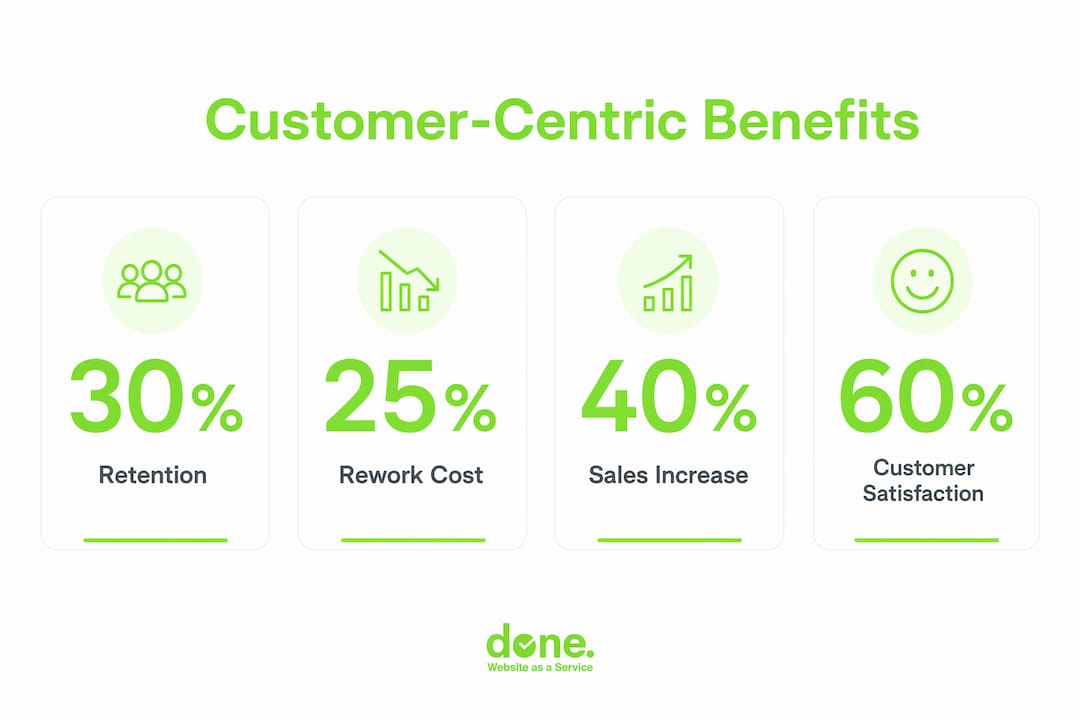
Improved user experience reduces friction at every touchpoint, which lowers bounce rates, shortens time-to-purchase, and increases task completion. For an SMB website, that often means fewer abandoned forms and more qualified enquiries, achievable with affordable website design and marketing services tailored to small businesses. Done’s work on SMB website UX consistently shows that small friction fixes, identified through customer observation, produce disproportionate gains in conversion.

Higher satisfaction and loyalty follow naturally. Customer-centric approaches reduce churn and lower acquisition costs by keeping existing customers engaged longer. NPS and CSAT scores improve when customers feel the product was designed with them in mind rather than at them.
Fewer costly reworks are perhaps the most underappreciated benefit for SMBs. Building the wrong feature and then rebuilding it is expensive in time and morale. Validating a concept with five customers before committing to a full build is not a luxury; it is risk management.
Statistic to share with your board: 73% of consumers rank customer experience as a key purchasing factor. For SMBs competing on service rather than price, that number represents a genuine structural advantage if you act on it.
For smaller organisations, the ROI framing is straightforward. The investment is modest: a few hours of structured customer conversations, a journey mapping workshop, and a short usability test. The return is a product or service that requires less support, generates more referrals, and retains customers longer. The business case for UX investment at SME scale is well established.
How to implement customer-centric design in six steps
This process is designed for an SMB with limited dedicated design resource. Each step has a clear owner, a realistic time estimate, and a minimum deliverable.
-
Set the outcome and governance. The leadership sponsor defines one measurable goal (e.g. reduce support ticket volume by 20% in 90 days) and assigns a cross-functional owner. Time: one half-day workshop. Deliverable: a one-page brief with success metrics.
-
Collect rapid customer insight. Run five 30-minute interviews or a short survey with existing customers. Focus on friction points and unmet needs, not feature requests. Time: one week. Deliverable: a short synthesis document with three to five key findings.
-
Map key customer journeys. Visualise the steps a customer takes from first awareness to post-purchase. Mark where friction, confusion, or drop-off occurs. A practical guide to ecommerce user journeys can help structure this step. Time: one workshop. Deliverable: a journey map with annotated pain points.
-
Prototype minimum viable solutions. Address the top two or three pain points with low-fidelity prototypes: wireframes, revised copy, or a revised process flow. Avoid building anything in code at this stage. Time: two to three days. Deliverable: testable prototypes.
-
Run short tests and iterate. Test prototypes with three to five customers. Lightweight usability testing at this scale surfaces the majority of friction points quickly and cheaply, without the overhead of a formal research programme. Revise and retest if findings are significant. Time: one week per round. Deliverable: a prioritised change list.
-
Operationalise changes and measure. Implement the validated changes, set up measurement (see the KPI section below), and schedule a monthly review. Assign a named owner for each metric. Time: ongoing. Deliverable: a live dashboard with agreed KPIs.
| Step | Owner | Time estimate | Minimum deliverable |
|---|---|---|---|
| 1. Outcome and governance | Leadership sponsor | Half-day | One-page brief |
| 2. Customer insight | Marketing or product lead | One week | Synthesis document |
| 3. Journey mapping | Cross-functional team | One workshop | Annotated journey map |
| 4. Prototype | Designer or product owner | 2–3 days | Testable wireframes |
| 5. Test and iterate | Designer + 3–5 customers | One week | Prioritised change list |
| 6. Operationalise | Named metric owner | Ongoing | Live KPI dashboard |
Pro Tip: For step 5, recruit customers who have used your product in the last 90 days and experienced the specific friction you are testing. Avoid power users who have adapted workarounds; they will not surface the friction a new customer hits.
What stops organisations from making the shift?
The most common failure mode is not a lack of research tools. Researchers Urbany and Dapena-Baron identify organisational complexity and cultural inertia as the primary obstacles to customer-centric transformation. In practice, this means siloed decision rights, where the person who owns the budget is not the person who talks to customers, and vanity metrics, where teams optimise for page views or feature count rather than customer outcomes.
Common pitfalls and how to address them:
- Organisational inertia. Counter it with short accountability loops: a fortnightly 15-minute review of one customer metric keeps the topic alive without requiring a cultural revolution.
- Siloed decision rights. Introduce a cross-functional ritual, such as a monthly “customer voice” meeting where support, sales, and product share one customer insight each.
- Over-reliance on vanity metrics. Replace page views with task success rate and CSAT as the primary reporting metrics for any design change.
- Poor customer selection for codesign. Research on codesign shows that including customers without managing internal team dynamics can reduce outcome quality. Select customers who understand the problem space and appoint a neutral facilitator.
Small teams have found practical workarounds. Rotating a “customer-facing duty” among engineers, where one engineer joins a support call each week, builds empathy without a dedicated research budget. We’ve seen this with clients in Luxembourg: once a developer hears a customer struggle with a form they built, the next form gets tested before it ships.
Pro Tip: When selecting customers for codesign sessions, aim for a mix of recent new customers and customers who churned. New customers remember their first friction; churned customers tell you what finally broke the relationship.
Which KPIs actually tell you if it is working?
Measuring the impact of customer-centric design requires a small, connected set of metrics rather than a long dashboard. The goal is to link UX changes to business outcomes within a reporting cycle short enough to act on.
| KPI | Source | Cadence | Suggested SMB target |
|---|---|---|---|
| Task success rate | Usability tests / analytics | Monthly | — |
| CSAT (Customer Satisfaction Score) | Post-interaction survey | Monthly | — |
| NPS (Net Promoter Score) | Quarterly survey | Quarterly | Positive trend |
| Conversion rate | Analytics platform | Weekly | Improve by 10% in 90 days |
| Customer effort score | Support survey | Monthly | Decreasing trend |
| Retention / churn rate | CRM | Monthly | Churn below baseline |
| Support ticket volume | Helpdesk | Weekly | Decreasing trend |
Early indicators, such as task success rate and customer effort score, tell you quickly whether a design change is working. Longer-term outcomes, such as NPS and retention, confirm whether the improvement is durable.
Support data is a strategic intelligence source, not just a cost centre. Integrating support ticket themes into your journey mapping process uncovers friction points that customers never articulate in surveys but always express when something goes wrong. Done’s AI-enabled customer service approach uses this principle to surface upsell and retention signals from support interactions.
How Central European SMBs put this into practice
Central Europe offers a specific context for customer-centric design. SMBs here often serve multilingual customer bases, operate under GDPR, and compete in markets where personal relationships and trust carry more weight than brand advertising. These conditions actually favour a customer-centric approach.
“Small businesses should use design-driven empathy and continuous feedback to avoid costly trial-and-error. Closer customer relationships let them test and iterate cheaply — a structural advantage over large firms.” — Maria Haubrich, Small Business Currents
In our experience with clients across Luxembourg and the broader Central European market, the most effective pilots share three characteristics: they start with a single, well-defined customer journey (not the whole product), they involve at least one customer-facing team member in the design process, and they measure one outcome metric before and after.
A staged adoption model works well for resource-constrained teams. Case research on a manufacturing firm describes a three-year university-industry partnership that introduced customer-centric innovation through pilot projects and reflective practice, with measurable culture change by year two. SMBs do not need three years; a six-week pilot with a defined scope produces enough evidence to justify a second round.
GDPR and multilingual notes for Central Europe:
- Collect customer feedback only with explicit consent and a clear data retention policy. GDPR applies to usability research as much as to marketing data. Done’s guide to GDPR-compliant automation covers the practical requirements.
- Run usability tests in the customer’s preferred language. A French-speaking customer in Luxembourg will surface different friction points on a German-language interface than a native German speaker would.
- Use anonymised journey maps when sharing findings across teams to avoid inadvertent personal data exposure.
Checklist for a first pilot in Central Europe:
- Define one customer journey to improve and one measurable outcome.
- Recruit three to five customers who have completed that journey in the last 60 days.
- Conduct interviews in the customer’s preferred language.
- Map the journey collaboratively with your support and sales teams.
- Prototype one change, test it, and measure the outcome before scaling.
What should you do in the next 30–90 days?
Customer-centric design delivers better UX, higher retention, and lower rework costs when it is adopted as a continuous practice rather than a one-off project. For an SMB leader, the decision is not whether to adopt it but how to start without overcommitting resources.
Three pragmatic next steps:
- Appoint a pilot owner this week. One person, with authority to convene a cross-functional team and report to leadership monthly, is enough to start. No new headcount required.
- Run your first five customer interviews within 30 days. Focus on one journey: the one where you currently lose the most customers or generate the most support tickets.
- Set two baseline metrics before you change anything. Task success rate and CSAT are the fastest to establish and the clearest to report. You cannot claim improvement without a baseline.
To present this to a board or senior stakeholder in one slide: frame it as a risk-reduction exercise. The cost is five customer interviews and one journey mapping workshop. The risk being mitigated is building the wrong thing and paying to rebuild it. The expected return is a measurable improvement in one customer outcome within 90 days.
Does the ROI justify the investment for Central European SMBs?
For most SMBs in Central Europe, the cost of a customer-centric design pilot is low and the potential return is concrete. The main investment is time: roughly 20–30 hours of staff time across a six-week pilot covering customer interviews, journey mapping, and one round of usability testing.
The return side of the equation has several components. Reduced support volume directly lowers operational cost. Higher conversion rates on a website or service flow increase revenue without additional marketing spend. Lower churn extends customer lifetime value, which is the single most important driver of SMB profitability in competitive markets.
Web design improvements linked to business outcomes show that even modest UX changes, when grounded in real customer insight, produce measurable gains in conversion and retention. For a Central European SMB with a modest customer base, a 10% improvement in retention can outperform a 20% increase in new customer acquisition in terms of net revenue impact, because acquisition costs in this market are rising.
The honest caveat: the ROI is not guaranteed and depends on execution quality. A pilot that produces no actionable findings, usually because the customer selection was too narrow or the scope too broad, will not deliver returns. The six-step process above is designed to avoid that outcome by keeping scope tight and measurement explicit.
Key takeaways
Customer-centric design produces measurable business results for SMBs when it is adopted as a continuous practice, not a one-off project, starting with a tightly scoped six-week pilot.
| Point | Details |
|---|---|
| Start with one journey | Scope your first pilot to a single customer journey to keep it manageable and measurable. |
| Use lightweight testing | Three to five customer interviews surface most friction points without a large research budget. |
| Measure before you change | Set CSAT and task success rate baselines before any design change so improvement is provable. |
| Governance matters most | Shared decision rights and a named pilot owner matter more than research tools for adoption success. |
| Done as your pilot partner | Done runs six-week customer-centric design pilots for Central European SMBs with defined deliverables and GDPR-compliant research. |
A practitioner’s view: what surprises leaders most
The most common surprise we see with clients is how quickly a small amount of direct customer contact changes internal priorities. A leadership team that has been debating a feature list for months will often reach consensus within a week of watching three customers struggle with the same screen. The evidence is not abstract; it is someone’s actual frustration, in real time.
What leaders tend to underestimate is the governance piece. The research tools are not the hard part. Deciding who has the authority to act on customer findings, and making sure that person is not overruled by the loudest voice in the room, is where most pilots stall. We recommend establishing a simple rule before the pilot starts: findings from customer testing take precedence over internal opinion for the scope of the pilot. That single agreement prevents most of the friction.
The trade-off between speed and completeness is real. A six-week pilot will not give you a complete picture of your customer base. It will give you enough to make one well-informed decision and build the habit of testing before building. That habit compounds over time in a way that a single large research project never does.
Low-cost experiments we run first with clients:
- A five-question post-interaction survey sent to customers 24 hours after a key touchpoint.
- A 30-minute screen-share session where a customer completes one task on the live website while thinking aloud.
- A review of the last 50 support tickets, categorised by the journey stage at which the issue occurred.
None of these require a research budget. All of them produce findings that change what gets built next.
Done’s six-week pilot for Central European SMBs
For SMB leaders in Central Europe who want a concrete starting point, Done offers a structured six-week customer-centric design pilot with defined deliverables: customer interviews, a journey map, a prototype addressing the top two friction points, one round of usability testing, and a measurement baseline for CSAT and task success rate.
The pilot is GDPR-compliant by design, conducted in the customer’s preferred language, and scoped to one journey so the investment stays proportionate. Done has completed over 350 projects with SMBs across Luxembourg and Central Europe since 2014, and the pilot format is built on what actually moves the needle for teams without dedicated design resource.
If you are ready to move from internal assumptions to customer evidence, the practical next step is a 30-minute scoping conversation. Visit Done’s web agency page to request one, or review the business case for web investment if you need to build the internal case first.
Useful sources and further reading
- What is Customer-Centricity, and Why Does It Matter? — Berkeley California Management Review; a rigorous academic grounding for the concept and its business implications.
- Urbany & Dapena-Baron — organisational complexity in customer-centric transitions — American Marketing Studies review; explains why governance and culture, not tools, determine success.
- Maria Haubrich — design-driven empathy for small businesses — Small Business Currents; practical argument for why SMBs have a structural advantage in customer-centric adoption.
- HubSpot — 5 rules of customer-centric design — practitioner guidance on lightweight usability testing and avoiding analysis paralysis.
- ScienceDirect — customer journey experiences and support data — academic research positioning support analytics as a strategic intelligence source.
- Sage Journals — codesign facilitation and customer selection — research on when codesign works and when internal team dynamics undermine it.
- Wiley — staged adoption of customer-centric innovation — case study of a three-year industry adoption programme; useful for leaders planning a phased rollout.
- Zenodo — customer-centered design and MSME performance — quantitative study linking customer experience management to competitive intelligence and business performance in SMEs.
- Done.lu — GDPR-compliant automation for SMEs — practical guidance on collecting customer data within GDPR requirements in Central Europe.
Author: Thomas, Done.lu. Done is a Luxembourg digital and AI agency founded in 2014 with over 350 completed client projects across web development, digital marketing, and AI consulting for SMBs in Luxembourg and Central Europe…
This article is general information for decision-makers and does not constitute professional legal, regulatory, or financial advice. Confirm current GDPR requirements and local regulations with a qualified adviser for your specific situation.