

Branding tips for online stores: your 2026 guide
July 8, 2026
Why customer-centric design works for SMBs
July 26, 2026
TL;DR:
- A digital communication strategy is a structured plan that guides an organization’s messaging across digital channels to build trust and meet business goals. It involves defining audiences, objectives, messaging, channels, and KPIs, with an emphasis on integration and consistency. For Luxembourg SMBs, addressing multilingual audiences and GDPR compliance is essential for effective local digital communication.
A digital communication strategy is a structured plan that defines how an organisation communicates across digital channels to engage its audience and meet business goals. It covers audience identification, objective setting, channel selection, message crafting, and performance measurement. Without this structure, businesses send inconsistent messages across email, social media, and their website, and customers notice. The result is lost trust and wasted budget. This guide explains what a digital communication strategy actually contains, how omnichannel consistency works in practice, and how SMBs in Luxembourg can build and measure one that delivers real results.
What is a digital communication strategy and what does it contain?
A digital communication strategy is the systematic plan an organisation uses to decide what to say, where to say it, and how to measure whether it worked. Industry practitioners often call this a “digital communications plan” or “integrated communications strategy,” and both terms describe the same structured approach. Effective digital communication requires clear strategy, content tailored to the right platforms, and consistent messaging across every touchpoint.
The strategy differs from a digital marketing strategy in one important way. A digital marketing strategy focuses on generating demand and leads. A digital communication strategy is broader. It governs every message your organisation sends, including internal announcements, customer service replies, and brand content, not just paid campaigns.
A well-crafted strategy document defines your target group, their communication needs, your tone of voice, the contact channels you will use, your publishing schedule, your budget, and your KPIs. That is the minimum. Businesses that skip even one of these elements typically find their messaging drifts over time, with different team members writing in different voices across different platforms.

A complete strategy also integrates content marketing, social media, SEO, email, and online advertising, calibrating each channel to the audience it serves. The importance of digital strategy lies precisely in this integration. Without it, you have tactics. With it, you have a plan.
What are the essential components of a digital communication strategy?
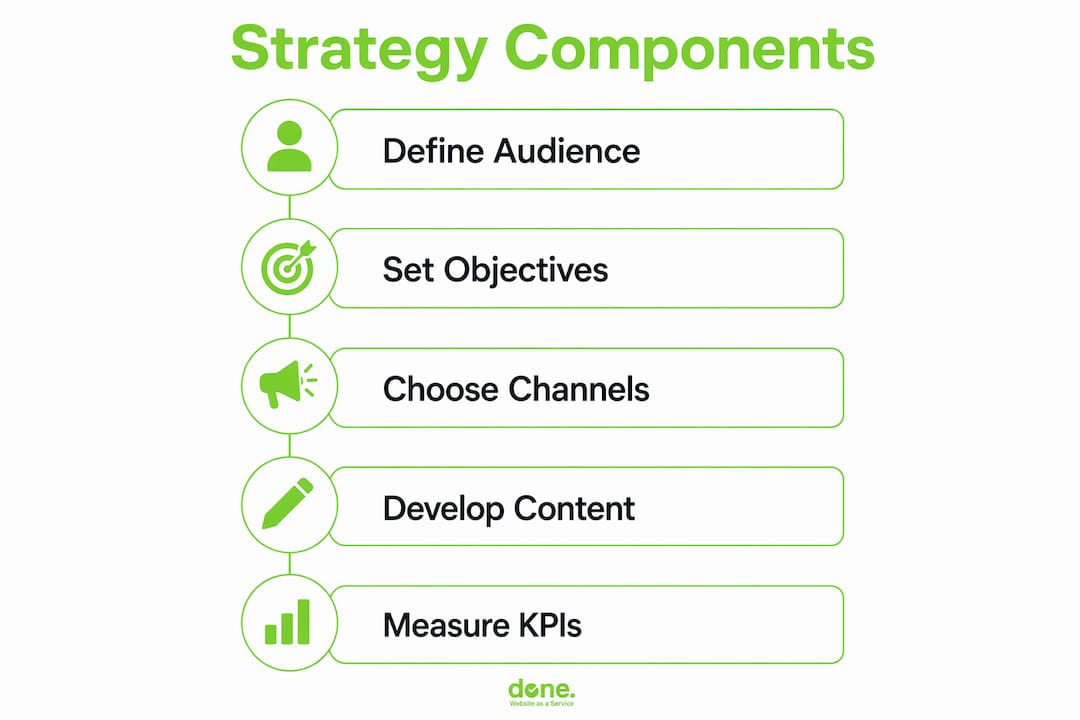
Every effective digital communication plan shares the same core building blocks, regardless of company size or sector. Getting these right at the start saves significant rework later.
- Audience definition. Identify who you are communicating with, what they need to know, and where they spend time online. In Luxembourg, this often means segmenting by language preference, since French, German, Luxembourgish, and English speakers may require different content approaches.
- SMART objectives. Set objectives that are Specific, Measurable, Achievable, Relevant, and Time-bound. “Increase website enquiries by 20% in Q3” is a SMART objective. “Improve our online presence” is not.
- Channel mapping. Match each message type to the channel where it performs best. LinkedIn works for B2B thought leadership. Email works for nurturing existing contacts. A well-structured website remains the anchor for all inbound traffic.
- Key messages and tone of voice. Define two or three core messages your brand repeats consistently. Agree on a tone of voice and document it so every team member writes in the same register.
- Content planning and scheduling. Build a content calendar that maps topics, formats, and publication dates. This prevents last-minute, off-brand content.
- KPIs and success metrics. Agree upfront on which numbers matter. Reach, engagement rate, website traffic, conversion rate, and follower growth are the standard set for most SMBs.
Pro Tip: Prioritise integration before you launch. Connecting your CRM, email platform, and social scheduling tool from day one prevents data silos that become expensive to fix six months later.
The most common mistake we see with clients is building a content calendar before agreeing on the audience and objectives. The calendar is the last thing you build, not the first.
How does omnichannel consistency enhance digital communication effectiveness?
Omnichannel communication means delivering a unified brand experience regardless of which channel a customer uses to interact with you. Customers do not distinguish between channels. They see a single brand. If your Instagram tone is playful but your email replies are formal and your website copy is technical, customers register the inconsistency even if they cannot name it.
The practical challenge is that most SMBs have different people managing different channels. The marketing manager writes the newsletter. A junior team member posts on social media. The owner replies to enquiries by email. Without a shared tone of voice document and agreed messaging framework, each person defaults to their own style.
Here is how to build omnichannel consistency in practice:
- Map the customer journey. Mapping customer paths and aligning tone across channels avoids content duplication and makes communication feel logical rather than repetitive.
- Create a shared messaging document. One document. Two or three core messages. One tone of voice description with examples of what to say and what to avoid.
- Introduce a shared data layer. Without a Customer Data Platform (CDP) or middleware, your marketing and sales tools cannot synchronise customer histories. A customer who complained last week should not receive a promotional email the next day.
- Use journey orchestration tools. Effective omnichannel strategies require orchestration tools and marketing automation to synchronise channels, not just consistent content.
- Run a quarterly channel audit. Check that the tone, visuals, and core messages on each platform still match. Channels drift when no one is watching.
Pro Tip: Before investing in new channels, audit the ones you already have. Inconsistent messaging on existing platforms does more damage than the absence of a new one.
The brands that build trust fastest are not the ones on the most channels. They are the ones that sound the same on every channel they do use.
What are the most effective methods to measure digital communication performance?
Measurement is where most digital communication plans fall apart. Businesses track vanity metrics like follower counts and page views, then wonder why the numbers do not connect to revenue.
Effective monitoring requires tracking specific KPIs including reach, engagement rate, website traffic, conversion rate, and follower growth, reported on a monthly or quarterly basis. Monthly reporting catches problems early. Quarterly reporting reveals trends.
| KPI | What it measures | Why it matters |
|---|---|---|
| Reach | How many unique people saw your content | Shows whether your audience is growing |
| Engagement rate | Likes, comments, shares as a percentage of reach | Reveals whether content resonates |
| Website traffic | Sessions and unique visitors from digital channels | Connects communication to commercial outcomes |
| Conversion rate | Percentage of visitors who take a desired action | The clearest link between communication and revenue |
| Follower growth | Net new followers per period | Indicates brand awareness momentum |
Regular reporting with data-driven insights allows businesses to allocate resources efficiently and improve communication effectiveness over time. That means stopping what does not work and doing more of what does, every quarter.
Digital communication strategies must be dynamically adjusted based on feedback and analytics. A post that underperforms tells you something about your audience. A landing page with a high bounce rate tells you something about your message or your offer. The data is always speaking. The question is whether you are listening.
Pro Tip: Set KPI targets before you launch any campaign. A 3% engagement rate means nothing without a baseline. Agree on what “good” looks like for your sector and audience size before you start measuring.
For Luxembourg SMBs, we recommend connecting your analytics platform to a simple monthly dashboard. You do not need a sophisticated tool. You need consistent data reviewed by someone with authority to act on it. Done’s guide on digital marketing trends 2026 covers the reporting tools worth considering this year.
How to create a digital communication plan for SMBs in Luxembourg
Building a digital communication plan for a Luxembourg SMB requires the same foundations as any strategy, plus three local considerations that most generic guides ignore.
- Define your objectives first. Tie every communication objective to a business goal. If the goal is to generate 50 new leads per quarter, the communication objective is to drive qualified traffic to a specific landing page. The digital marketing strategy guide for Luxembourg SMEs covers this objective-setting process in detail.
- Map your audience by language. Luxembourg’s market is genuinely multilingual. French dominates in the south and in professional services. German is strong in the north and in cross-border trade. English is the default for international B2B. A single-language strategy leaves a significant portion of your potential audience unreached.
- Build GDPR compliance into the plan from the start. SMBs in Luxembourg must address multilingual content and data privacy laws to engage and protect customers effectively. This means consent management on your website, compliant email marketing practices, and clear data retention policies. GDPR is not a legal afterthought. It is a trust signal.
- Integrate with your sales workflow. Your communication plan should feed leads into a defined sales process. If your marketing generates enquiries that disappear into an inbox, the plan is incomplete. Connect your contact forms, email campaigns, and social media enquiries to a CRM or a structured follow-up process.
- Budget realistically. A content calendar with five posts per week is unsustainable for a team of three. Build a plan you can execute consistently for twelve months, not a plan that looks impressive for six weeks.
- Review and iterate quarterly. The plan you write in january will need adjusting by april. Markets change, algorithms change, and your audience’s behaviour changes. Build the review into the plan itself.
The local context matters more than most guides admit. A Luxembourg business competing for French-speaking clients in the financial sector faces a completely different communication challenge than a retailer targeting German-speaking cross-border shoppers. The strategy must reflect that specificity.
Key takeaways
A digital communication strategy works when it connects clear objectives, consistent messaging, and regular measurement into a single integrated plan that the whole team follows.
| Point | Details |
|---|---|
| Define before you create | Set audience, objectives, and tone of voice before building any content calendar. |
| Omnichannel consistency builds trust | Customers see one brand, so every channel must carry the same core message and voice. |
| Integrate data systems early | A shared data layer prevents fragmented customer experiences across marketing and sales tools. |
| Measure the right KPIs | Track reach, engagement rate, website traffic, conversion rate, and follower growth on a monthly basis. |
| Localise for Luxembourg | Address multilingual audiences and GDPR compliance as core requirements, not optional extras. |
What I have learned from building these strategies with SMBs
The most common thing I hear from business owners is that they already have a strategy. When I ask to see it, they show me a content calendar. A content calendar is not a strategy. It is a schedule. The strategy is the thinking that sits behind it.
The second most common problem is siloed teams. The marketing person does not talk to the sales person. The social media posts do not reflect what the website says. The email campaigns use a different tone from the customer service replies. Customers experience all of these touchpoints, and the inconsistency registers as unprofessionalism, even when each individual piece of content is well-written.
What actually works, in my experience, is starting small and being ruthless about consistency. Pick two channels. Write one tone of voice document. Set three KPIs. Review them every month. That is a strategy. It is not glamorous, but it works. Businesses that try to be everywhere at once, with no shared messaging and no measurement, burn through budget and lose confidence in digital communication entirely.
The integration challenge is the one I would warn you about most seriously. Connecting your CRM to your email platform to your website analytics sounds straightforward. In practice, it requires decisions about data architecture that most SMBs have never made. Getting this right at the start, rather than retrofitting it later, saves months of frustration. We have seen this with clients across Luxembourg repeatedly. The businesses that invest in the plumbing early are the ones whose reporting actually tells them something useful twelve months later.
Start with the question: “What do we want someone to do after they encounter our brand online?” Work backwards from that answer. Everything else follows.
— Thomas
How Done supports SMBs with digital communication and web strategy
Done is a Luxembourg digital and AI agency with over 350 completed projects since 2014. We work with SMBs across Luxembourg and broader Europe to build digital marketing workflows that connect communication strategy to measurable business results.

Our work covers web development, SEO, social media management, marketing automation, and GDPR-compliant AI tools. We do not sell generic packages. We build plans that reflect your audience, your language requirements, and your commercial goals. If you are ready to move from scattered tactics to a plan that actually holds together, our team at Done is the right starting point. We offer a no-obligation initial consultation to assess where your current communication stands and what a structured plan would look like for your business.
FAQ
What is a digital communication strategy in simple terms?
A digital communication strategy is a written plan that defines what your organisation says online, which channels it uses, and how it measures success. It covers audience, objectives, messaging, channels, and KPIs.
How does a digital communication strategy differ from a digital marketing strategy?
A digital marketing strategy focuses on generating demand and leads. A digital communication strategy is broader. It governs every message your organisation sends across all digital touchpoints, including customer service and internal communications.
What KPIs should I track for digital communication?
The standard KPIs are reach, engagement rate, website traffic, conversion rate, and follower growth. Track these monthly and review trends quarterly to adjust your approach based on what the data shows.
How do I maintain consistent messaging across multiple channels?
Create a shared tone of voice document and a core messaging framework that every team member uses. Connect your tools through a shared data layer so customer histories are visible across marketing, sales, and service teams.
Do Luxembourg SMBs need a different approach to digital communication?
Yes. Luxembourg’s multilingual market and GDPR requirements mean that a standard single-language strategy leaves significant audience segments unreached and creates legal risk. Address language segmentation and data privacy compliance as core elements of the plan, not additions.