

How to improve user experience on your SMB website
July 6, 2026
Branding tips for online stores: your 2026 guide
July 8, 2026
TL;DR:
- Search engine marketing combines paid search and SEO to boost brand visibility quickly and sustainably. It offers precise targeting and immediate results, especially when integrated with organic strategies to optimize long-term growth. Managing SEM as a data-driven process with regular testing and adjustments enhances campaign effectiveness and stability.
Search engine marketing (SEM) is defined as a hybrid strategy that combines paid search advertising (PPC) with search engine optimisation (SEO) to increase a brand’s visibility across Search Engine Results Pages (SERPs). The role of SEM in digital campaigns is to deliver immediate, targeted traffic while building the conditions for longer-term organic growth. Unlike purely organic approaches, SEM gives campaign managers direct control over who sees their ads, when, and at what cost. For digital marketers working with finite budgets and measurable targets, that control is the core of its value. This guide covers how paid search works in practice, how to integrate it with SEO, and what it takes to run SEM campaigns that actually perform.
How does SEM enhance online visibility in digital campaigns?
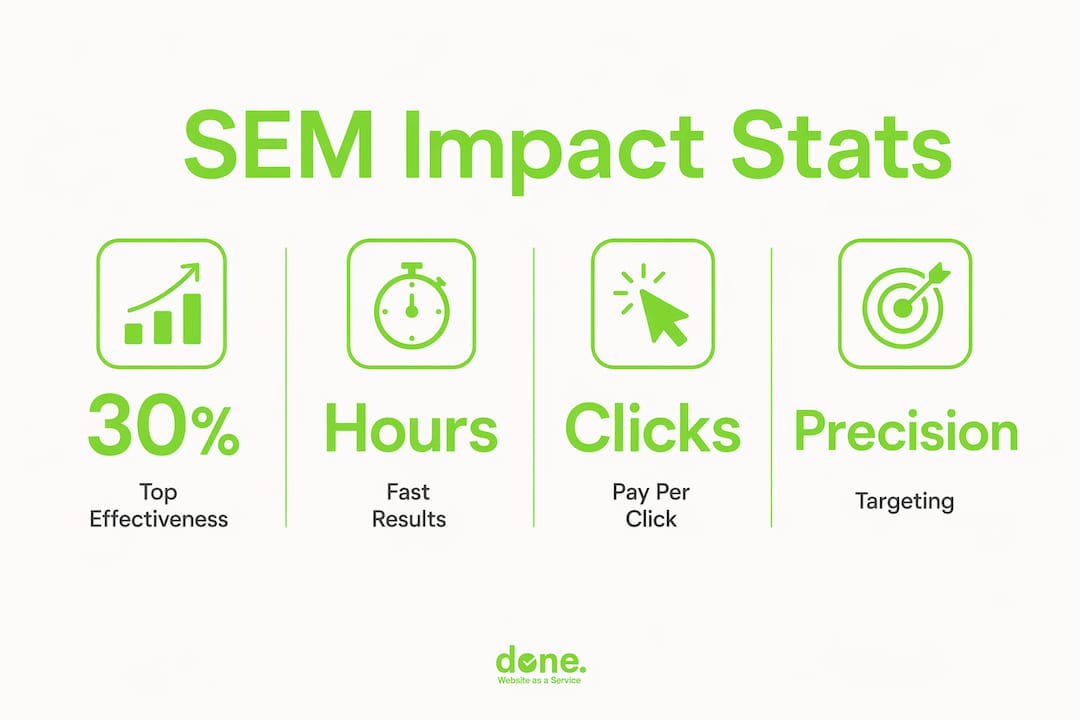
SEM enhances online visibility by placing paid ads at the top of SERPs the moment a campaign goes live. There is no waiting period. A well-configured PPC campaign can generate qualified clicks within hours of launch, which makes it the fastest route to visibility in any digital marketing mix.
The mechanism is straightforward. Advertisers bid on keywords that match their audience’s search intent. When a user types a matching query, the ad appears above or alongside organic results. The advertiser pays only when someone clicks, which means budget goes directly toward actual engagement rather than impressions alone.
Targeting options in paid search campaigns go well beyond keywords. Campaign managers can filter by:
- Location: target users in a specific city, region, or radius around a physical address
- Device type: separate bids for desktop, mobile, and tablet users based on conversion data
- Time of day: increase bids during peak buying hours and reduce spend overnight
- Audience segments: retarget previous website visitors or reach users who match a customer profile
This level of targeting precision means SEM uniquely enables audience reach by intent, paying only for clicks from users who are actively searching for what you offer.
30% of firms currently identify PPC advertising as one of the most effective tools in digital marketing. That figure reflects a consistent pattern: paid search delivers measurable, attributable results that justify budget allocation in ways that brand awareness channels often cannot.
Paid and organic listings also reinforce each other. When your brand appears in both the paid and organic sections of a SERP, click-through rates improve and brand credibility increases. Users see your name twice on the same page. That repetition builds trust before they even visit your site.
How does SEM work alongside SEO for better campaign results?
SEM is best defined as a hybrid strategy where PPC acts as the accelerator and SEO acts as the long-term capital. They serve different timelines and different purposes, but they work best when managed together.

SEO builds authority gradually. It earns rankings through content quality, technical site health, and backlink profiles. Results take months to materialise, but once established, organic traffic costs nothing per click. SEM, by contrast, delivers traffic on day one. The trade-off is that it stops the moment you stop paying.
| Characteristic | SEM (PPC) | SEO |
|---|---|---|
| Time to results | Hours to days | Weeks to months |
| Cost model | Pay per click | Investment in content and technical work |
| Traffic control | Immediate and adjustable | Gradual and cumulative |
| Keyword testing | Fast and direct | Slower feedback loop |
| Long-term cost | Ongoing spend required | Reduces over time |
| Best use case | New campaigns, product launches, seasonal peaks | Brand authority, sustained organic growth |
The practical benefit of running both together is that hybrid SEM campaigns achieve maximum visibility by dominating both paid and organic results. You can use PPC data to identify which keywords convert, then invest in SEO content for those same terms. This removes guesswork from your SEO strategy entirely.
SEO builds brand authority and reduces variable acquisition costs over time, while SEM provides rapid targeting and predictable scaling through paid bidding. The two must be coordinated for the best return on investment and campaign stability.
Pro Tip: Use your PPC campaign data as a keyword testing lab. Run ads on 10–15 candidate keywords for two to four weeks, identify the top converters, then build SEO content around those terms. You get validated data before committing to a long content programme.
A unified SEM and SEO approach also protects campaigns from volatility. If a Google algorithm update temporarily reduces your organic rankings, your PPC ads maintain visibility while you recover. If your ad budget is cut, existing organic rankings continue to deliver traffic. Each channel acts as a safety net for the other.
For Luxembourg SMEs looking to understand how SEO drives business growth alongside paid search, the coordination of both channels is where most of the long-term value sits.
What are the best practices for optimising SEM campaigns?
Effective SEM requires data-driven management, including ongoing testing, bid adjustment, keyword refinement, and use of automation tools. A campaign that is not actively managed deteriorates. Costs rise, Quality Scores fall, and conversion rates drop without regular attention.
The following steps form the foundation of a well-run SEM campaign:
-
Conduct thorough keyword research before launch. Use tools like Google Keyword Planner to identify search volume, competition level, and cost-per-click estimates. Group keywords by intent: informational, navigational, and transactional terms require different ad copy and landing pages.
-
Build and maintain a negative keyword list. Negative keywords prevent your ads from appearing for irrelevant queries. Without them, budget drains on clicks that will never convert. Review your search term reports weekly and add new negatives as patterns emerge.
-
Set bid strategies that match your campaign objective. Manual bidding gives you full control but demands time. Automated strategies like Target CPA (cost per acquisition) or Target ROAS (return on ad spend) use machine learning to adjust bids in real time. Start manual to gather data, then transition to automation once you have sufficient conversion history.
-
Align landing pages with ad copy. Every ad should lead to a page that directly fulfils the promise made in the headline. Mismatched landing pages increase bounce rates and reduce Quality Score, which raises your cost per click.
-
Implement server-side tracking for accurate measurement. The Sklik advertising system introduced a unified event measurement script to replace older retargeting codes, supporting server-side tracking, better dynamic retargeting, and automatic campaign optimisation. This shift reflects a broader industry move toward privacy-compliant measurement that does not rely on third-party cookies.
-
Test ad copy continuously. Run at least two ad variants per ad group at all times. Test one variable at a time: headline, description, or call to action. Let data determine the winner, then replace the underperformer with a new challenger.
Pro Tip: Do not wait until a campaign has spent its full monthly budget before reviewing performance. Set a weekly review cadence and check cost per conversion, impression share, and Quality Score. Small adjustments made early prevent large budget losses later.
Systematic approaches to SEM management improve campaign performance and cost efficiency. The marketers who get the best results treat SEM as an ongoing process, not a one-time setup.
What are the common challenges in SEM-focused digital campaigns?
SEM campaigns face predictable challenges. Knowing them in advance means you can build defences before they cost you money.
-
Budget wastage from irrelevant clicks. Neglecting negative keywords wastes budget on non-relevant clicks, reduces Quality Score, and hampers campaign efficiency. A campaign without a negative keyword list is effectively paying to advertise to people who will never buy. This is the single most common and most avoidable SEM mistake.
-
Privacy-compliant tracking gaps. Browser restrictions and cookie deprecation have made traditional client-side tracking less reliable. Conversion data becomes incomplete, which distorts bidding algorithms and makes ROI measurement inaccurate. Server-side tracking solutions, such as Seznam Event Measurement, represent the direction the industry is moving. Adopting these systems now puts you ahead of the compliance curve.
-
Overweighting short-term PPC results. Campaign managers under pressure to show quick wins sometimes pour budget into PPC while neglecting SEO entirely. Digital marketing budgets in 2026 are showing cautious growth, with 51% of firms expecting stagnation. In that environment, relying solely on paid traffic is a fragile position. SEO provides the organic baseline that keeps traffic flowing when ad budgets are reduced.
-
Measuring true ROI beyond click volume. Clicks and impressions are easy to report but rarely tell the full story. True ROI measurement requires tracking conversions, revenue, and customer lifetime value back to specific keywords and ad groups. Without this, you cannot identify which parts of your SEM spend are profitable and which are not.
-
Ad fatigue in competitive markets. When the same ads run for weeks without rotation, click-through rates fall and costs rise. Refreshing creative regularly and testing new messaging prevents this. Connecting your SEM data to marketing automation workflows can help schedule creative updates and flag performance drops automatically.
The marketers who manage these challenges well share one habit: they treat SEM as a system that requires regular input, not a set-and-forget channel.
Key takeaways
SEM delivers its strongest results when paid search and SEO are managed together as a coordinated system, not as separate channels competing for the same budget.
| Point | Details |
|---|---|
| SEM is a hybrid strategy | It combines PPC for immediate traffic with SEO for long-term organic authority. |
| Targeting precision is SEM’s core advantage | Paid search reaches users by location, device, time, and search intent, paying only for actual clicks. |
| Negative keywords protect budget | Maintaining an updated negative keyword list prevents spend on irrelevant queries and protects Quality Score. |
| Server-side tracking is now standard | Privacy-compliant measurement tools like server-side scripts deliver more accurate attribution than cookie-based tracking. |
| SEM and SEO must be coordinated | Running both channels together creates stability: PPC covers gaps when organic rankings dip, and SEO reduces long-term acquisition costs. |
SEM in practice: what a decade of campaigns has taught me
The conversation around SEM often gets stuck in a false choice between paid and organic. In our experience working with SMBs across Luxembourg and broader Europe, the businesses that grow fastest are the ones that stop treating PPC and SEO as rivals for the same budget line.
What I find most underappreciated is how much PPC data improves SEO decisions. When you run a paid search campaign properly, you get clean, fast feedback on which keywords actually convert, not just which ones attract clicks. That data is worth more than any keyword research tool. I have seen clients spend months building SEO content around terms that looked good on paper, only to discover through a two-week PPC test that those terms attract browsers, not buyers.
The other thing I would push back on is the assumption that SEM is only for businesses with large budgets. A tightly managed campaign with a modest daily spend, a solid negative keyword list, and a well-matched landing page will outperform a poorly managed campaign with ten times the budget. The discipline matters more than the spend level.
Automation is changing the day-to-day work of SEM management, and mostly for the better. Automated bidding strategies have become genuinely useful once a campaign has enough conversion data to learn from. But I would caution against handing over control too early. Automation amplifies whatever signal it receives. If your tracking is broken or your conversion data is thin, the algorithm will optimise toward the wrong outcomes. Get your measurement right first, then introduce automation.
The marketers who will get the most from SEM in 2026 are the ones who treat it as a data discipline, not an advertising discipline. The ads are just the output. The real work is in the structure, the measurement, and the ongoing refinement.
— Thomas
How Done supports digital campaign performance with SEM and SEO
Done works with SMBs across Luxembourg and Europe to build digital campaigns that combine paid search and organic growth into a single, measurable system. Whether you are launching a first PPC campaign or looking to improve the ROI of an existing one, the approach starts with the data: what is working, what is wasting budget, and where the real growth opportunity sits.

Done’s team handles campaign strategy, keyword architecture, landing page alignment, and tracking setup, including privacy-compliant measurement for GDPR-sensitive markets. For businesses ready to connect their SEM activity to a broader digital marketing workflow, Done builds the full system, not just the ads. If you want to understand how paid search fits into your wider digital marketing strategy, the team at Done is ready to walk through it with you.
FAQ
What is SEM in digital marketing?
SEM (search engine marketing) is a hybrid strategy that combines paid search advertising (PPC) with SEO to increase visibility on Search Engine Results Pages. It delivers immediate traffic through paid ads while building longer-term organic authority through optimisation.
What is the difference between SEM and SEO?
SEO builds organic rankings over months through content and technical improvements, while SEM uses paid bidding to appear in search results immediately. SEM costs per click; SEO requires upfront investment but reduces acquisition costs over time.
Why is SEM effective for digital campaigns?
SEM targets users by search intent, location, device, and time of day, paying only for actual clicks. This precision makes it one of the most measurable and controllable channels in a digital campaign.
How do negative keywords improve SEM performance?
Negative keywords prevent ads from appearing for irrelevant searches, which reduces wasted spend and improves Quality Score. Maintaining an updated negative keyword list is one of the highest-impact optimisations in any PPC campaign.
How should marketers measure SEM ROI accurately?
Accurate SEM measurement requires tracking conversions and revenue back to specific keywords and ad groups, not just clicks. Server-side tracking tools provide more reliable attribution in privacy-restricted environments, giving a clearer picture of true campaign return.