

Top 3 best web design agencies 2026
June 15, 2026
How to optimise digital campaigns for better ROI
June 17, 2026
TL;DR:
- E-commerce solutions enable businesses to sell products online, expanding market reach and automating operations. They deliver benefits like 24/7 sales, targeted marketing data, and reduced operating costs, essential for SMB growth. Choosing the right platform depends on revenue, technical capacity, and long-term business needs to ensure scalable success.
E-commerce solutions are software platforms that enable businesses to sell products and services online, managing everything from product catalogues and payments to order fulfilment and customer data. 93.5% of global internet users have purchased products online, and that figure alone explains why choosing the right e-commerce platform is no longer optional for SMBs. Platforms such as Shopify, BigCommerce, and WooCommerce have made it possible for businesses of any size to launch a fully functional online store, reach customers across borders, and operate around the clock without proportionally increasing headcount. The core case for adopting an e-commerce solution rests on four pillars: expanded market reach, 24/7 sales capability, operational automation, and measurable marketing performance.
Why choose e-commerce solutions: the core benefits for smbs
E-commerce solutions deliver measurable advantages that physical retail simply cannot match at the same cost. Understanding those advantages in concrete terms helps you decide which platform category fits your business model.
Reach customers beyond your postcode
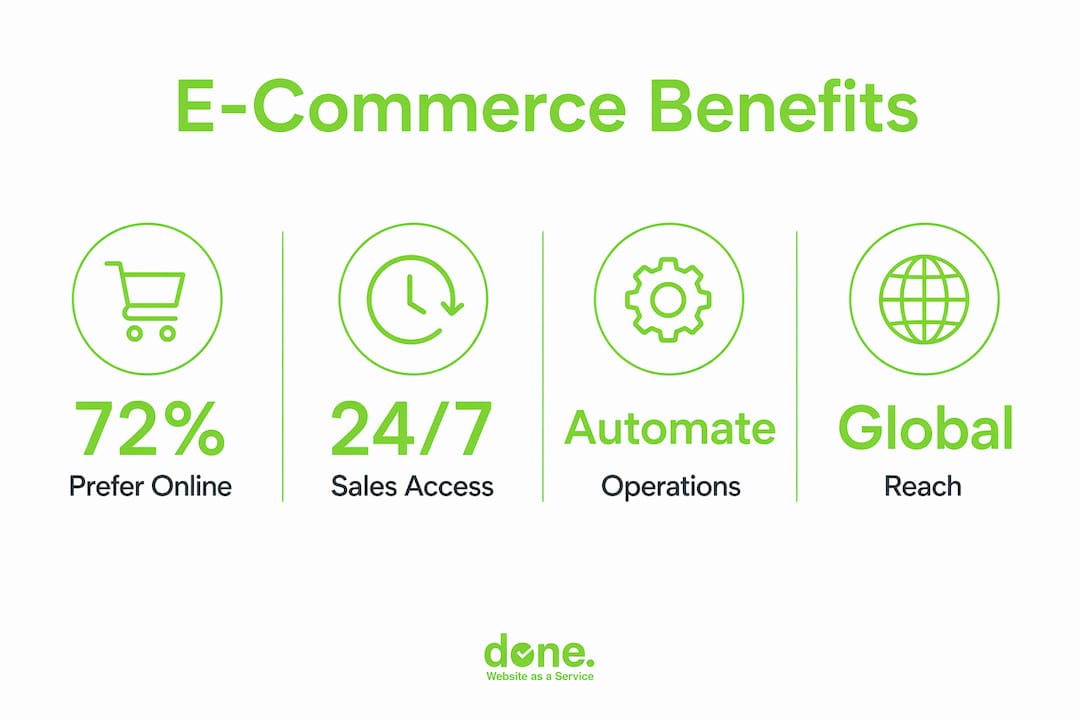
72% of consumers prefer shopping online over visiting a physical store. That preference is not a trend to watch. It is the current reality of buyer behaviour, and it means any business without an online sales channel is invisible to the majority of its potential customers. An e-commerce platform removes the geographic ceiling on your revenue without requiring a second premises or additional sales staff.

Operate and sell around the clock
A physical shop closes at 18:00. An online store does not. Your product pages, checkout process, and order confirmation emails work while you sleep, while you are on holiday, and while your team is in a meeting. For SMBs with lean teams, this is one of the most practical e-commerce solution advantages available.
Automate the operational work that slows you down
E-commerce software automates order fulfilment, inventory management, and marketing tasks, reducing manual effort and the errors that come with it. That means your team spends less time updating spreadsheets and more time on work that actually requires human judgement. Platforms like Shopify and BigCommerce include these automation features natively, without requiring custom development.
Gain data you can act on
Every transaction, abandoned cart, and product page visit generates data. E-commerce platforms aggregate this into dashboards that show you which products sell, which pages lose customers, and which marketing channels drive revenue. This is a direct advantage over physical retail, where customer behaviour is largely invisible.
“Treat your e-commerce platform not as a shop window, but as your most data-rich sales tool. The businesses that grow fastest are the ones that read and act on that data every month.”
Pro Tip: Set up Google Analytics 4 alongside your platform’s native analytics from day one. The two data sources together give you a far clearer picture of customer behaviour than either provides alone.
Here is a summary of the primary benefits:
- Global reach without additional premises or staff
- 24/7 trading with automated order processing
- Inventory and fulfilment automation reducing manual errors
- Behavioural data enabling targeted marketing decisions
- Lower operating costs compared to equivalent physical retail
How do different e-commerce solutions compare for smbs?
Not all e-commerce platforms are built for the same business. Choosing the wrong category is one of the most common and costly mistakes SMBs make, either paying for complexity they do not need or outgrowing a basic tool within 18 months.
The market broadly divides into four categories. Here is how they compare across the factors that matter most to SMBs:
| Category | Examples | Time to Launch | Monthly Cost | Technical Skill Required | Best Fit |
|---|---|---|---|---|---|
| Website builders | Wix, Squarespace | Under 2 weeks | Low (€15–€40) | Minimal | Micro businesses, side projects |
| SaaS platforms | Shopify, BigCommerce | Under 30 days | Medium (€30–€300) | Low to moderate | SMBs with €50K–€5M revenue |
| Self-hosted open-source | WooCommerce, Magento Open Source | 2–6 months | Variable (hosting + dev) | High | Tech-capable teams needing full control |
| Enterprise SaaS | Salesforce Commerce Cloud, SAP Commerce | 6–18 months | High (€1,000+) | Specialist | Large businesses with complex operations |
Matching platform tier to your revenue
Businesses with €500K–€5M GMV benefit most from mid-tier SaaS platforms. Above €5M, enterprise-grade solutions typically become necessary to handle catalogue complexity, multi-warehouse logistics, and advanced tax requirements. This is not a rule of thumb. It is a practical ROI calculation: the cost of a Shopify Plus subscription is justified at scale, but it is wasteful for a business turning over €80K per year.
The hidden cost of the wrong fit
Underestimating complexity leads SMBs to hit growth ceilings or overpay for unused features. A website builder like Wix will get you online quickly, but its inventory management, multi-currency support, and API integrations are limited. When you outgrow it, migrating to Shopify or WooCommerce takes time and money that could have been avoided with a better initial choice. Equally, adopting an enterprise platform too early means paying for infrastructure your business cannot yet use.
Pro Tip: Before comparing platforms, write down your three most critical integrations, such as your accounting software, your ERP, or your shipping carrier. If a platform cannot connect to those natively or via a reliable plugin, remove it from your shortlist immediately.
For a structured overview of platform types for European SMEs, Done has published a dedicated guide covering the specific regulatory and multilingual requirements that apply in Luxembourg and the broader EU market.
What should smbs consider when selecting an e-commerce platform?
Choosing the right e-commerce platform is a 5-year strategic commitment, not a feature comparison exercise. The businesses that get this right treat the decision with the same rigour they would apply to hiring a senior member of staff or signing a long-term lease.
Here are the six factors that consistently determine whether a platform choice succeeds or fails:
-
Revenue trajectory, not current revenue. Choose for where your business will be in three years, not where it is today. A platform that fits your current catalogue of 50 products may struggle when you reach 500.
-
Internal technical capacity. SaaS platforms with managed admin interfaces suit businesses without dedicated developers. Self-hosted solutions like WooCommerce require ongoing developer input for updates, security patches, and custom features. If you do not have that resource, do not choose a platform that depends on it.
-
Integration requirements. List every system your e-commerce store must connect to: your accounting software (such as Sage or Exact), your warehouse management system, your email marketing tool, and your tax compliance provider. Platforms that require custom development for these connections add cost and fragility.
-
Total cost of ownership. The monthly subscription fee is rarely the largest cost. Factor in transaction fees, plugin costs, developer time, hosting (for self-hosted options), and the cost of migration if you switch platforms later. Shopify, for example, charges transaction fees on its lower tiers that can become significant at volume.
-
Localisation and compliance. For SMBs operating in Luxembourg or across the EU, GDPR compliance, multi-currency support, and multilingual product pages are not optional extras. Confirm that your chosen platform handles VAT rules for cross-border EU sales natively or through a certified integration.
-
Support and community. When something breaks at 22:00 on a Friday before a major campaign, the quality of your platform’s support matters enormously. SaaS platforms like BigCommerce and Shopify offer 24/7 support. Self-hosted solutions rely on community forums and your own developer.
Pro Tip: Run a structured evaluation using a weighted scoring matrix. Assign a weight to each of the six factors above based on your business priorities, then score each platform candidate. This removes gut-feel bias and gives you a defensible decision.
For practical guidance on building your e-commerce site from the ground up, Done has a step-by-step resource covering architecture, platform setup, and launch strategy.
How does e-commerce improve customer engagement and marketing?
The importance of e-commerce extends well beyond the transaction itself. Modern platforms give SMBs marketing capabilities that were previously available only to large retailers with dedicated technology teams.
Personalisation at scale
E-commerce solutions enhance personalisation by using browsing history and purchase patterns to deliver targeted product recommendations. A customer who bought running shoes is shown running socks and sports nutrition on their next visit. This kind of behavioural targeting creates customer experiences that physical stores struggle to replicate, because the data simply does not exist in the same form offline.
Cart recovery and conversion optimisation
Abandoned cart emails are one of the highest-ROI marketing tools available to e-commerce businesses. Platforms like Shopify and BigCommerce include automated cart recovery sequences natively. A well-timed email sent one hour after abandonment, followed by a second at 24 hours, consistently recovers a meaningful share of lost revenue. This is marketing automation working in the background without any manual effort from your team.
Multichannel selling from a single platform
Modern e-commerce solutions connect your online store to social media channels, marketplaces, and physical point-of-sale systems from a single back-end. This means your inventory, pricing, and customer data stay consistent whether a sale happens through your website, an Instagram shop, or a pop-up event. For SMBs managing multiple sales channels, this consistency prevents the stock discrepancies and pricing errors that damage customer trust.
Here is how e-commerce platforms support marketing performance in practice:
- Automated email sequences for cart recovery, post-purchase follow-up, and re-engagement
- Segmented customer lists built from purchase and browsing behaviour
- SEO-ready product pages with structured data, canonical URLs, and fast load times
- Social commerce integrations connecting your catalogue to Facebook, Instagram, and Pinterest
- Affiliate and referral programme tools built into platforms like BigCommerce natively
Understanding the role of SEO in e-commerce success is particularly relevant here. Organic search remains the highest-volume, lowest-cost acquisition channel for most online stores, and your platform choice directly affects how well your product pages rank.
Key takeaways
Choosing the right e-commerce solution requires matching platform tier to your revenue trajectory, technical capacity, and integration needs, not simply picking the most popular option.
| Point | Details |
|---|---|
| Match platform to revenue tier | Businesses with €500K–€5M GMV get the best ROI from mid-tier SaaS platforms like Shopify or BigCommerce. |
| Treat selection as a 5-year decision | Short-term feature focus leads to costly migrations; evaluate for where your business will be in three years. |
| Avoid self-hosted without developer resource | WooCommerce and Magento require ongoing technical maintenance; SaaS suits lean SMB teams far better. |
| Automate marketing from day one | Cart recovery, email sequences, and behavioural personalisation are native to most SaaS platforms and require no custom build. |
| Factor in total cost of ownership | Transaction fees, plugin costs, and migration expenses often exceed the headline subscription price. |
The uncomfortable truth about platform choices i’ve seen go wrong
I have worked with SMBs in Luxembourg and across Europe for over a decade, and the pattern I see most often is not businesses choosing the wrong platform. It is businesses choosing a platform for the wrong reasons.
The most common mistake is selecting a platform because a competitor uses it, or because it appeared first in a Google search, or because the monthly fee looked manageable. None of those are strategic reasons. A platform that works brilliantly for a fashion retailer in Amsterdam may be entirely wrong for a B2B distributor in Luxembourg City selling to trade customers who need account-based pricing and invoice payment terms.
The second mistake I see regularly is underinvesting in the evaluation phase and then overspending on the fix. A business that spends two weeks properly assessing its integration requirements, its team’s technical capacity, and its three-year revenue projections will almost always make a better choice than one that signs up for a free trial and goes live within a fortnight. The upfront work is not glamorous, but it is the difference between a platform that grows with you and one that you are migrating away from in 18 months.
My honest recommendation for most SMBs without a dedicated development team: start with a mid-tier SaaS platform. Shopify and BigCommerce both offer the analytics, automation, and integration ecosystem that growing businesses need, without requiring you to manage server infrastructure or apply security patches. The e-commerce best practices that actually drive sales in 2026 are built into these platforms. You do not need to build them yourself.
For Luxembourg SMBs specifically, the multilingual requirement adds a layer of complexity that many generic guides ignore. Your platform must handle French, German, Luxembourgish, and English product pages without creating duplicate content issues for SEO. This is a technical requirement, not an afterthought, and it should be on your evaluation checklist from the start.
— Thomas
How Done helps smbs choose and build e-commerce solutions

Selecting and implementing an e-commerce platform is a significant business decision, and getting it right from the start saves considerable time and cost later. Done has supported over 150 SMB projects across Luxembourg and Europe, helping businesses match the right platform to their specific revenue stage, team capacity, and integration requirements. Whether you are launching your first online store or migrating from a platform you have outgrown, Done’s web development expertise covers the full process, from platform evaluation and architecture through to build, launch, and ongoing optimisation. If you want to understand the full scope of what professional web development involves and why it matters for e-commerce success, that is a good place to start. You can also explore Done’s broader digital consulting services for SMBs in Luxembourg.
FAQ
What is an e-commerce solution?
An e-commerce solution is a software platform that enables businesses to sell products or services online, managing payments, inventory, orders, and customer data from a single system. Examples include Shopify, BigCommerce, and WooCommerce.
Which e-commerce platform is best for a small business?
Mid-tier SaaS platforms like Shopify suit most small businesses because they offer native automation, analytics, and integrations without requiring developer maintenance. Businesses without technical staff should avoid self-hosted open-source options like WooCommerce.
How long does it take to launch an e-commerce store?
SaaS platforms and website builders enable launch in under 30 days for most SMBs. Enterprise or self-hosted solutions require 6–18 months depending on complexity and custom development requirements.
What are the main advantages of online shopping for businesses?
The primary advantages include 24/7 sales capability, access to a global customer base, lower operating costs than physical retail, and access to detailed customer behaviour data that informs marketing decisions.
Do e-commerce solutions work for b2b businesses?
Yes. Platforms like BigCommerce and Shopify Plus support B2B-specific features including account-based pricing, purchase order payments, and trade customer portals. B2B e-commerce requirements differ from B2C, so platform evaluation should include these features explicitly if they apply to your business model.