

Document processing AI: unlock efficiency for European SMEs
May 6, 2026
Elevate customer service with AI: Best strategies
May 11, 2026
TL;DR:
- Automating business processes must include GDPR safeguards to prevent regulatory risks and reputational damage. SMEs should assess automation types, conduct DPIAs for high-risk uses, and embed privacy-by-design principles into their workflows. Strong governance, leadership commitment, and continuous monitoring are essential for maintaining ongoing compliance over time.
Automating your business processes should accelerate growth, not expose you to regulatory risk. Yet many small and medium-sized enterprises across Europe are discovering this lesson the hard way: a customer onboarding workflow built without proper GDPR safeguards can trigger complaints, supervisory investigations, and lasting reputational damage before anyone realises what went wrong. The good news is that GDPR-compliant automation is entirely achievable for SMEs, provided you approach it with a clear framework rather than simply deploying technology and hoping for the best. This guide walks you through every stage, from understanding the rules to sustaining compliance over time.
Table of Contents
- Understanding GDPR and the risks of automation
- Preparation: Assessing your automation for GDPR impact
- Executing GDPR-compliant automation: Step-by-step for SMEs
- Verification and continuous improvement: Maintaining ongoing compliance
- Why GDPR automation is about governance, not just technology
- Take the next step with GDPR-compliant automation support
- Frequently asked questions
Key Takeaways
| Point | Details |
|---|---|
| Know your automation type | Classify whether your process is solely automated, profiling, or routine to apply the correct GDPR rules. |
| Prepare with proper assessment | Carry out data mapping and risk evaluation before implementing automation to prevent compliance issues. |
| Build in meaningful safeguards | Ensure human oversight and documentation at every critical automation step to meet GDPR requirements. |
| Verify and improve continuously | Regular reviews, audits, and training help sustain GDPR compliance as your automation evolves. |
Understanding GDPR and the risks of automation
Before you can build compliant automation, you need to understand precisely what GDPR regulates and why automation creates specific risks that manual processes do not. The regulation is not hostile to automation; it simply requires that certain safeguards exist when automated processes affect people’s rights or interests.
Key terms you must know
- Automated decision-making (ADM): A decision reached by a computer system with no meaningful human involvement in the process. Scoring a loan application entirely by algorithm, for example, qualifies as ADM.
- Profiling: Any automated processing of personal data used to evaluate aspects of a person, such as their creditworthiness, behaviour, or preferences.
- Solely automated decision-making: The most tightly regulated category, where a decision is made entirely by automated means and produces legal or similarly significant effects on an individual.
- Human involvement: Not just a human pressing “approve” at the end of a process. Regulators expect genuine review, the capacity to override, and real accountability.
Article 22 restricts solely automated decision-making that produces legal or similarly significant effects. This means that if your automation determines whether someone receives a service, a contract, or a financial product, you must either obtain explicit consent, demonstrate legal necessity, or ensure a human is genuinely involved in the decision.
The phrase “meaningful human oversight” is critical here. Effective human oversight must be meaningful and is not simply token human review. Placing a staff member’s name on a decision they never actually examined does not satisfy the requirement. Regulators look for evidence that a human could understand, challenge, and reverse the automated output.
“The boundary between ‘automated’ and ‘human-involved’ decisions is not technical; it is organisational. If your staff cannot explain why the system reached a conclusion, or cannot override it in practice, the decision is effectively automated regardless of what your documentation says.”
GDPR automation types vs. compliance risk
| Automation type | Example | GDPR risk level | Key requirement |
|---|---|---|---|
| Solely automated decision-making | Automated loan rejection | Very high | Consent or legal basis, human review right |
| Profiling with significant effects | Behavioural scoring for insurance | High | Transparency, opt-out, DPIA likely required |
| Profiling without significant effects | Newsletter segmentation | Medium | Lawful basis, clear privacy notice |
| Routine automation (no personal data) | Invoice numbering | Low | Standard data minimisation |
| Routine automation (personal data, no profiling) | Appointment reminders | Low to medium | Lawful basis, retention policy |
Understanding where your specific automation sits in this table is the essential first step. Many SMEs assume their marketing or operational tools fall into the low-risk category, only to discover that combining data sources or applying scoring logic moves them into a higher-risk bracket. Consulting our GDPR and AI compliance resource will help you map your current tools against these categories accurately.
Preparation: Assessing your automation for GDPR impact
With the risks clearly outlined, the next practical step is a structured assessment of every automation use-case in your business. This is where many SMEs either skip ahead too quickly or become overwhelmed. Neither response serves you well. A methodical approach, even for a small team, makes the difference between a defensible compliance position and a fragile one.
Classifying your automation use-cases
Start by listing every process that touches personal data and involves any degree of automated logic. Group them into three categories:
- ADM with legal or significant effects: These require the most rigorous controls and must be your first priority.
- Profiling: These require a clear lawful basis, transparency in your privacy notice, and often a Data Protection Impact Assessment (DPIA).
- Routine automations: These still need a lawful basis and proper data handling, but carry lower inherent risk.
When is a DPIA required?
A Data Protection Impact Assessment is a structured analysis of how a specific processing activity affects individuals’ privacy. You must conduct one when processing is likely to result in high risk. Indicators include:
- Systematic and extensive profiling of individuals
- Processing of special categories of data (health, biometric, political opinions) at scale
- Systematic monitoring of publicly accessible areas
- Automated decision-making with legal or similarly significant effects
- Processing involving vulnerable individuals, such as employees or children
- Large-scale processing of personal data
The EDPB is developing ready-to-use templates for GDPR compliance assessments, including automation, which will give smaller organisations a structured starting point without needing to commission expensive external consultants for every project.
Pre-automation checklist
| Prerequisite | What it involves | Who owns it |
|---|---|---|
| Data mapping | Identify all personal data flowing through the automation | Data Protection Officer or privacy lead |
| Lawful basis confirmation | Document the legal ground for processing | Legal or compliance team |
| Risk evaluation | Score likelihood and severity of privacy risks | DPO with input from IT |
| Staff role assignment | Define who reviews, overrides, and logs decisions | Operations manager |
| DPIA (if required) | Full structured assessment for high-risk processes | DPO with senior sign-off |
| Vendor assessment | Confirm third-party tools meet GDPR standards | Procurement or IT |
Pro Tip: Start with your highest-risk automations first. It is tempting to begin with the easiest wins, but if a high-risk ADM process is already running without proper safeguards, every day it operates without review increases your exposure. Prioritise accordingly.
Understanding how AI in SME marketing intersects with profiling is particularly relevant here, since marketing automation is one of the most common areas where SMEs inadvertently move into higher-risk territory. Similarly, reviewing your automation and compliance strategies holistically, rather than tool by tool, gives you a much clearer picture of cumulative risk.
Executing GDPR-compliant automation: Step-by-step for SMEs
Armed with a thorough assessment, you are ready to design and deploy automation that is compliant by construction rather than compliant by accident. This distinction matters enormously. Building safeguards into the architecture of your automation is far more reliable than attempting to retrofit controls after the fact.
Step 1: Define the purpose and lawful basis
Every automated process that handles personal data must have a clearly documented purpose and a confirmed lawful basis under GDPR. The six lawful bases are consent, contract, legal obligation, vital interests, public task, and legitimate interests. Lawful-basis assessments and documentation are key, especially when using AI with personal data. Write this down before a single line of workflow logic is configured.
Step 2: Conduct or review your DPIA
If your classification exercise flagged the automation as high-risk, complete the DPIA now, before deployment. If a DPIA already exists for a related process, review whether it covers the new automation or requires updating. A DPIA is a living document, not a one-time exercise.
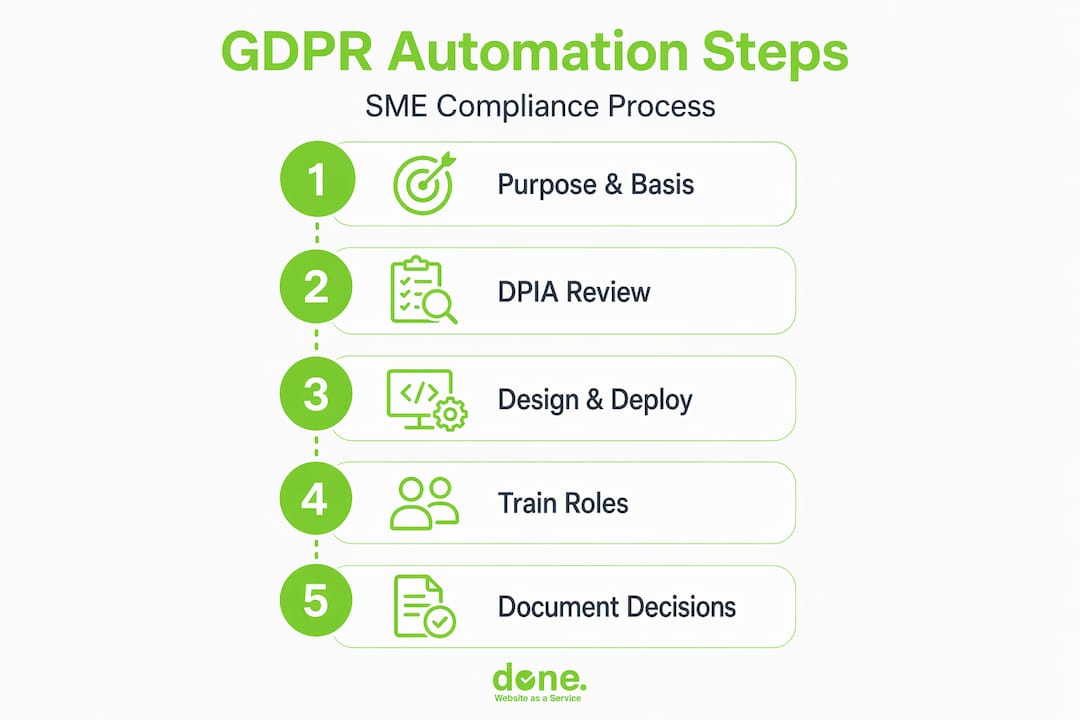
Step 3: Implement technical safeguards
This is where privacy-by-design principles become operational. Specific safeguards to build in include:
- Data minimisation: Collect and process only the personal data actually needed for the stated purpose. If your automation can function without a date of birth, do not include it.
- Access controls: Limit who can view, modify, or export data processed by the automation. Role-based access is the standard approach.
- Encryption: Ensure personal data is encrypted both in transit and at rest within your automation platform.
- Retention limits: Configure automatic deletion or anonymisation of personal data once it is no longer needed for the stated purpose.
- Audit logging: Record every significant action the automation takes involving personal data, including who triggered it and what outcome was produced.
Privacy risk management frameworks such as NIST Privacy Framework 1.1 support privacy-by-design and compliance, providing a structured vocabulary for identifying, assessing, and managing privacy risks across your automation portfolio. Even if you do not adopt the full framework, its core categories (identify, govern, control, communicate, protect) offer a useful checklist for SMEs.
Step 4: Enable contestability and human override
For any automation that produces decisions affecting individuals, you must build in a mechanism for those individuals to contest the outcome and request human review. This is not optional for ADM with legal or significant effects. In practice, this means:
- A clearly communicated right to object or request review in your privacy notice
- A defined internal process for receiving and acting on such requests
- A named individual or team responsible for conducting the review
- A documented timeline for responding (typically within one month under GDPR)
Step 5: Train staff and assign roles
Technology alone does not deliver compliance. Your Data Protection Officer (DPO), if you have one, must be involved in reviewing high-risk automations before deployment. Automation officers or process owners need to understand what the system does, how to interpret its outputs, and how to override it when necessary. Front-line staff who interact with automated outputs need training on recognising when a decision warrants escalation.

Pro Tip: Document every automated decision or profile that impacts an individual’s rights. This documentation is your primary evidence in the event of a regulatory inquiry or individual complaint. A well-maintained log transforms a potential crisis into a manageable review.
Step 6: Test before you go live
Run the automation in a controlled environment with synthetic or anonymised data before exposing it to real personal data. Test not just whether it produces the right outputs, but whether the logging, access controls, and override mechanisms function as designed. Exploring AI tools for SMEs that include built-in compliance features can significantly reduce the burden of this testing phase.
Key metric: Research consistently shows that the cost of remediating a non-compliant automated process after deployment is between five and ten times higher than building compliance in from the start. Investing time in steps one through five pays for itself many times over.
Verification and continuous improvement: Maintaining ongoing compliance
Getting automation live and compliant is a significant achievement. Keeping it compliant over time is an equally important and often underestimated challenge. Regulations evolve, business processes change, data volumes grow, and new risks emerge. A static compliance posture becomes a liability.
How to verify ongoing compliance
Regular verification should be structured, not ad hoc. Build these activities into your operational calendar:
- Quarterly log reviews: Examine your audit logs for anomalies, unexpected data access, or decisions that were overridden frequently. Patterns in overrides often signal that the automation logic needs adjustment.
- Annual DPIA reviews: Revisit your DPIAs at least once a year, or immediately when the automation changes materially, when you introduce new data sources, or when the regulatory environment shifts.
- Staff training refreshers: Privacy knowledge degrades over time. Schedule annual refresher training for all staff involved in operating or reviewing automated processes.
- Vendor reassessments: If you rely on third-party automation platforms, review their data processing agreements and security certifications annually. A vendor’s compliance status can change, and you remain responsible for what happens to personal data processed on your behalf.
- Incident response drills: Test your ability to respond to a data breach or individual rights request involving automated data. Knowing the process in theory and executing it under pressure are very different things.
Common pitfalls SMEs make in compliance automation
Understanding where others go wrong helps you avoid the same mistakes:
- Assuming vendor compliance equals your compliance: A tool being “GDPR-ready” means it can be configured compliantly, not that it is compliant by default. Your configuration choices determine your compliance position.
- Treating the DPIA as a one-time task: A DPIA completed at launch and never revisited quickly becomes irrelevant as the process evolves.
- Overlooking data subject rights in automated workflows: If an individual requests erasure of their data, can your automation handle that request without manual intervention? Many cannot, creating a hidden compliance gap.
- Failing to update privacy notices: When you add new automated processing or change how profiling works, your privacy notice must reflect this. Outdated notices are a frequent finding in regulatory audits.
- Relying on implicit human oversight: Naming a person as the “reviewer” of automated decisions without giving them the time, tools, or authority to actually review is a compliance fiction that regulators will not accept.
Pro Tip: Use your logs and completed DPIA templates as core evidence in audits. Regulators respond positively to organisations that can demonstrate a structured, documented approach to compliance, even when that approach is not perfect. Evidence of good-faith effort and continuous improvement carries significant weight.
“Checkbox compliance is the most dangerous form of compliance. It creates the appearance of safety while leaving the underlying risks entirely unaddressed. The organisations that face the most serious regulatory consequences are often those who believed their documentation was sufficient.”
Oversight should not be tokenistic; documentation, review and improvement are essential for ongoing compliance. This principle should guide every review cycle you conduct. The goal is not to accumulate paperwork but to build genuine understanding of what your automation does and genuine capacity to control it.
Reviewing your approach to staying compliant with AI as part of your broader digital strategy ensures that compliance is not siloed within a single team but is embedded across your operations.
Why GDPR automation is about governance, not just technology
Here is something we observe consistently when working with SMEs across Europe: the businesses that struggle most with GDPR-compliant automation are not the ones with the weakest technology. They are the ones with the weakest governance culture.
It is understandable. Automation vendors market their products as compliance solutions. “GDPR-ready,” “privacy-first,” and “compliant by design” are phrases that appear on sales pages and in product brochures. SME leaders, often stretched thin across multiple priorities, take these claims at face value. They implement the tool, tick the box, and move on. Then, six months later, they discover that the tool’s default configuration logs more data than necessary, that no one has been assigned to review automated decisions, and that the privacy notice has not been updated since the tool went live.
The uncomfortable truth is that technology can support compliance, but it cannot create it. Compliance is a governance outcome. It requires leadership commitment, clear accountability, staff empowerment, and a culture where raising a privacy concern is encouraged rather than seen as an obstacle to progress.
We have seen SMEs with relatively modest automation stacks maintain genuinely strong compliance positions because their leadership took ownership of privacy as a business value, not just a legal obligation. Conversely, we have seen businesses with sophisticated, expensive platforms fail basic compliance checks because no one in the organisation truly understood what the automation was doing with personal data.
The practical implication is this: before you invest in more automation capability, invest in governance capacity. Assign clear ownership. Give your DPO or privacy lead real authority and real access to the systems they are responsible for overseeing. Create an internal process for reviewing new automation before it goes live. Make privacy impact a standing agenda item in your operational reviews.
Automation should serve your governance framework, not bypass it. When you approach it this way, the audit trails and documentation that GDPR requires stop feeling like burdens and start functioning as genuine management tools. You gain visibility into your own processes that you would not otherwise have.
SMEs that succeed in this space are those where privacy is part of the digital culture, not a compliance department’s problem. If you are thinking about how to position AI for practical SME growth, embedding governance thinking from the outset is what separates sustainable growth from growth that creates hidden liabilities.
Take the next step with GDPR-compliant automation support
Implementing automation that is both effective and compliant is a significant undertaking, but you do not have to navigate it alone. At Done.lu, we work with SMEs across Luxembourg and Europe to design, deploy, and maintain automation solutions that place GDPR compliance at the centre, not as an afterthought.

Our team brings together digital strategy, AI consulting, and compliance expertise to help you move from assessment to implementation with confidence. Whether you are starting from scratch or reviewing an existing automation stack, we can help you identify risks, build the right safeguards, and create the documentation you need to demonstrate compliance. Explore our business automation guidance to understand how we approach this work, or review our intelligent automation support resources to see the frameworks we apply. The next step is a conversation.
Frequently asked questions
What is solely automated decision-making under GDPR?
Solely automated decision-making means a decision made by computers with no human input, and GDPR restricts this when it has legal or similarly significant effects on an individual, such as denying a loan or rejecting a job application.
Do SMEs need a Data Protection Impact Assessment for every automation project?
Not every automation requires a DPIA, but they are essential where there is high risk or systematic profiling of individuals, and the EDPB is developing practical templates to make this process more accessible for smaller organisations.
What should human oversight in GDPR-compliant automation look like?
Effective human oversight must be meaningful, meaning active review, genuine capacity to intervene, and real accountability, rather than a nominal sign-off that adds no substantive check on the automated output.
Can SMEs use off-the-shelf templates to help with GDPR automation?
Yes. The EDPB is developing ready-to-use templates for smaller organisations as a practical starting point, which will reduce the resource burden of conducting compliance assessments without specialist legal support.
Is using AI for profiling personal data always high risk under GDPR?
Not always, but profiling and lawful-basis assessment are required whenever AI is applied to personal data, and the combination of AI with profiling frequently triggers enhanced compliance checks that SMEs must be prepared to address.