

Master the role of project management in web development
March 7, 2026
Examples of web design trends that boost your business in 2026
March 10, 2026
Attracting quality leads online remains a persistent challenge for many Luxembourg SMEs operating in a competitive, multilingual digital landscape. Without a structured, localised approach combining automation, content strategy, and targeted outreach, businesses often struggle to convert website traffic into meaningful customer relationships. This guide delivers actionable strategies tailored specifically to Luxembourg’s market dynamics, helping you build a measurable lead generation system that drives sustainable growth.
Table of Contents
- Prerequisites For Effective Lead Generation
- Build A Growth-Driven Website For Lead Capture
- Use Inbound Content Marketing To Attract Leads
- Implement Marketing Automation For Lead Nurturing
- Leverage Social Media For Targeted Lead Generation
- Common Mistakes To Avoid In Lead Generation
- Alternative Approaches And Tradeoffs
- Expected Results And Outcomes
- How Done Can Help Your Lead Generation Efforts
- Frequently Asked Questions
Key takeaways
| Point | Details |
|---|---|
| Foundation first | Effective lead generation starts with localised SEO, a growth-driven website, and GDPR compliance to build trust and reach. |
| Nurture systematically | Marketing automation combined with inbound content marketing nurtures quality leads and reduces manual workload significantly. |
| Amplify strategically | Social media ads expand reach when carefully targeted to Luxembourg’s multicultural demographics and paired with retargeting. |
| Avoid pitfalls | Ignoring mobile optimisation and GDPR risks alienating half your audience and triggering costly fines. |
| Timeline realistic | Expect measurable lead increases after 3 to 6 months with consistent effort across channels. |
Prerequisites for effective lead generation
Before launching campaigns, establish a solid foundation aligned with Luxembourg’s unique market characteristics. Start by mastering local SEO concepts and tools that reflect regional search trends across French, German, and English-speaking audiences. Your website must adopt growth-driven design principles, prioritising lead capture forms, clear navigation, and seamless user experience optimised for continuous improvement.
Plan your inbound content marketing strategy around regional customer pain points and language diversity. Identify topics that resonate with Luxembourg’s business sectors, from finance to logistics, and map content to each stage of the buyer journey. Select a marketing automation platform suited to SMB workflows, ensuring it integrates smoothly with your CRM and email systems without overwhelming your team.
GDPR compliance is non-negotiable. Fines up to €20 million or 4% of global turnover await businesses that mishandle personal data, making legal adherence essential from day one. Implement transparent consent mechanisms, secure data storage, and clear privacy policies to build customer trust whilst avoiding campaign shutdowns.
Key preparation steps include:
- Auditing your current website for lead capture capability and mobile responsiveness
- Researching keyword opportunities specific to Luxembourg’s multilingual search behaviour
- Mapping your ideal customer profile and defining lead qualification criteria
- Setting up analytics tracking to measure conversion rates and traffic sources
- Establishing baseline performance metrics before launching new initiatives
Understanding digital marketing advantages specific to Luxembourg SMEs accelerates your preparation phase. When finding the right internet agency, prioritise partners with proven experience in local market dynamics. Review the digital marketing status in Luxembourg to contextualise your competitive positioning.
Build a growth-driven website for lead capture
Your website serves as the central hub where all lead generation efforts converge. Growth-driven design prioritises continuous optimisation over one-time launches, allowing you to refine landing pages based on real user behaviour data. This iterative approach delivers higher conversion rates by systematically identifying and eliminating friction points in your conversion funnels.

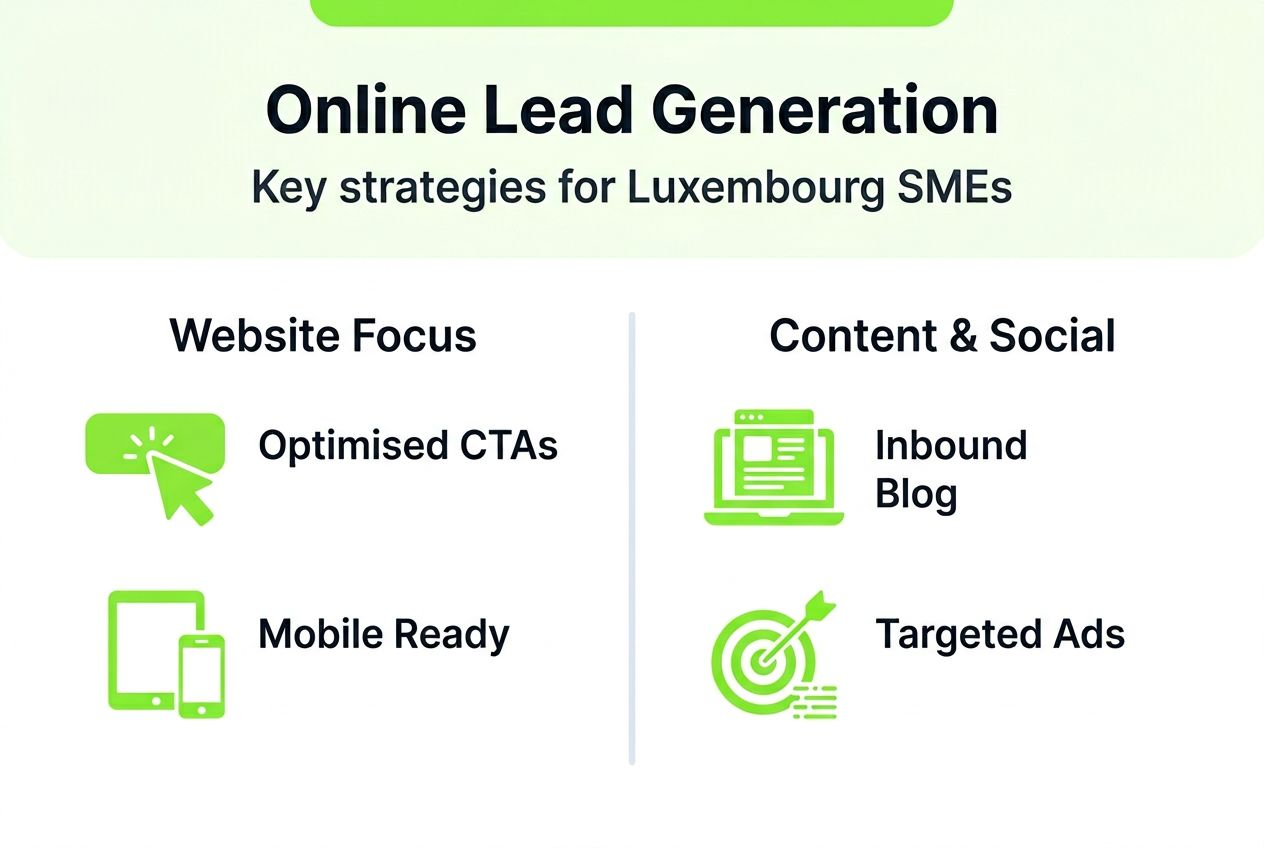
Optimise landing pages with compelling calls-to-action positioned strategically throughout the user journey. Each CTA should communicate clear value, whether offering a free consultation, downloadable resource, or product demo tailored to Luxembourg business needs. Test different button colours, copy variations, and placement to determine what drives the highest click-through rates.
Mobile-friendliness is non-negotiable, with over 60% of Luxembourg web traffic originating from smartphones and tablets. Ensure fast loading times, touch-friendly navigation, and responsive layouts that adapt seamlessly across devices. Poor mobile experience immediately drives potential leads to competitors who prioritise mobile optimisation.
Localise website content and navigation for French, German, and English speakers. Simple translation is insufficient; adapt messaging, imagery, and cultural references to resonate authentically with each language community. Consider regional business etiquette and communication preferences when crafting form fields and contact mechanisms.
Pro Tip: Set up heatmaps and session recordings to observe exactly where visitors drop off or hesitate during conversion flows, then prioritise fixes for the highest-impact friction points.
Essential website optimisation tactics:
- Reducing form fields to the absolute minimum required for lead qualification
- Adding trust signals like client logos, certifications, and testimonials prominently
- Creating dedicated landing pages for each campaign rather than directing traffic to generic homepages
- Implementing live chat or chatbot functionality to capture leads during browsing sessions
- A/B testing headline variations to identify messaging that resonates strongest
Explore custom web design for leads to understand how tailored approaches outperform templates. Follow a comprehensive website design checklist to ensure no critical elements are overlooked. Recognise the importance of responsive design across all business sectors.
Use inbound content marketing to attract leads
Create valuable content addressing specific challenges faced by Luxembourg businesses, from navigating cross-border regulations to optimising logistics in a compact market. This positions your brand as a trusted authority whilst organically attracting qualified prospects searching for solutions. Focus on educational content that genuinely helps readers rather than thinly veiled sales pitches.
Optimise every piece with keywords reflecting Luxembourg’s multilingual search habits. Research shows searchers often mix languages within queries, combining French business terms with English technical vocabulary. Build content clusters around core topics, linking related articles to boost SEO authority and guide visitors deeper into your site.
Offer lead magnets such as eBooks, industry reports, or templates specifically addressing Luxembourg market challenges. A guide on navigating Luxembourg’s tax incentives for startups carries far more conversion power than generic business advice. Gate these premium resources behind simple forms capturing essential contact details and consent.
Maintain a blog and resource centre publishing consistently, aiming for at least two substantive articles monthly. Search engines reward fresh, relevant content with higher rankings, whilst regular publishing keeps your brand top-of-mind for prospects researching solutions. Document case studies featuring local clients to demonstrate tangible results in familiar contexts.
Incorporate social proof throughout your content. Testimonials from recognisable Luxembourg companies build immediate credibility, whilst specific metrics (“increased leads by 156% in four months”) provide concrete evidence of your expertise. Video testimonials carry particular weight, allowing prospects to hear authentic experiences directly from satisfied clients.
Content creation priorities:
- Developing pillar pages covering broad topics comprehensively, then supporting them with detailed subtopic articles
- Repurposing long-form content into multiple formats: blog posts become infographics, videos, and social media snippets
- Addressing objections and concerns proactively within content to prequalify leads
- Updating evergreen content annually to maintain accuracy and search rankings
- Creating comparison guides helping prospects evaluate solutions objectively
Discover the benefits of digital marketing to contextualise how content fits within broader strategies.
Implement marketing automation for lead nurturing
Marketing automation transforms sporadic manual outreach into systematic, scalable nurturing that maintains engagement without overwhelming your team. Popular platforms suited for SMBs include HubSpot, Mailchimp, and ActiveCampaign, each offering different balance points between functionality and complexity. Choose based on your current team capacity and technical comfort level.
Follow these steps to establish effective automation:
- Define lead scoring criteria assigning points for behaviours indicating purchase intent, such as downloading pricing guides, visiting product pages multiple times, or engaging with emails.
- Segment your database by industry, company size, engagement level, and position in the buyer journey to deliver personalised messaging that resonates.
- Design email drip campaigns nurturing each segment with relevant content, spacing messages appropriately to maintain presence without overwhelming recipients.
- Create trigger-based workflows responding automatically to specific actions, like sending case studies after someone downloads an introductory guide.
- Establish lead handoff protocols defining when marketing-qualified leads transfer to sales for direct outreach.
- Monitor campaign performance weekly, tracking open rates, click-through rates, and conversion metrics to identify improvement opportunities.
Automation reduces manual lead qualification workload by approximately 70%, allowing your team to focus energy on high-value conversations with ready-to-buy prospects. It also ensures no lead falls through cracks due to human oversight or capacity constraints during busy periods.
Email sequences should feel conversational and helpful rather than robotic. Vary sending times and days to identify when your audience engages most actively. Personalise beyond just inserting first names; reference specific content they’ve consumed or challenges relevant to their industry.
Pro Tip: Review automation workflows quarterly to remove underperforming emails, update outdated references, and incorporate fresh content that reflects current market conditions and customer feedback.
Explore a proven lead generation automation workflow for implementation guidance. Learn how to transform your website into an automated lead generation engine.
Leverage social media for targeted lead generation
Social media advertising delivers rapid reach amplification when executed with precise targeting and localised creative. LinkedIn excels for B2B lead generation in Luxembourg’s professional services sectors, whilst Facebook and Instagram serve retail, hospitality, and consumer services effectively. Match platform selection to where your ideal customers actively spend attention.
Localise ad creatives and messaging to resonate with Luxembourg’s multicultural demographics. An ad targeting French-speaking finance professionals requires different imagery, tone, and value propositions than one aimed at German-speaking logistics managers. Test variations systematically to identify what drives highest engagement and conversion rates.
Utilise retargeting ads to recover potential leads who previously engaged with your website or content but didn’t convert. These warm audiences convert at 2-3 times the rate of cold traffic, making retargeting among your highest-ROI ad investments. Show them testimonials, case studies, or limited-time offers addressing common objections.
Monitor performance metrics obsessively, particularly cost per lead and conversion rates from lead to customer. A €10 cost per lead means nothing if those leads never purchase; focus on quality indicators like engagement depth and sales-qualified lead percentages. Adjust targeting, creative, and landing pages based on data rather than assumptions.
| Approach | Speed to Results | Cost Level | Lead Quality | Best For |
|---|---|---|---|---|
| Paid social ads | 1-2 weeks | Medium-High | Variable | Quick volume boost |
| Organic content | 3-6 months | Low | High | Sustainable pipeline |
| SEO optimisation | 4-8 months | Low-Medium | Very High | Long-term authority |
| Referral marketing | Ongoing | Very Low | Excellent | Network leverage |
Key social advertising tactics:
- Creating lookalike audiences based on your best existing customers to find similar prospects
- Running A/B tests on ad creative, headlines, and calls-to-action to optimise performance continuously
- Setting up conversion tracking properly to attribute leads and sales accurately to specific campaigns
- Implementing lead ads with pre-filled forms reducing friction for mobile users
- Scheduling ads to run during hours when your target audience is most active online
Review comprehensive digital marketing strategies for Luxembourg to integrate social advertising within broader campaigns.
Common mistakes to avoid in lead generation
Ignoring localisation results in generic messaging that fails to resonate with Luxembourg’s distinct market characteristics. Content must reflect regional business practices, language preferences, and cultural nuances to build genuine connection. Translation alone is insufficient; adapt examples, case studies, and references to local contexts.
Neglecting mobile optimisation alienates over half of web visitors who will immediately abandon slow-loading or difficult-to-navigate mobile sites. Google prioritises mobile-friendly sites in search rankings, meaning poor mobile experience damages both user conversion and organic visibility simultaneously.
Failing GDPR compliance exposes your business to severe consequences. Fines reaching €20 million or 4% of global turnover can halt campaigns entirely, whilst reputational damage from data breaches destroys customer trust permanently. Implement proper consent mechanisms and data handling from the start.
“Non-compliance with data protection regulations represents the fastest way to destroy both your marketing budget and customer relationships simultaneously. Prevention costs far less than remediation.”
Skipping lead nurturing causes high drop-off rates, with 80% of leads never converting without systematic follow-up. Expecting immediate purchases from first-time visitors wastes advertising spend on audiences not yet ready to buy. Implement nurturing sequences keeping your brand present throughout the consideration phase.
Over-relying on paid ads neglects sustainable inbound and automation benefits. Whilst ads deliver quick results, stopping spend immediately halts lead flow. Balance paid acceleration with organic strategies building lasting visibility and authority that compound over time without ongoing ad investment.
Critical mistakes to avoid:
- Sending leads directly to sales before proper qualification and nurturing
- Using the same content and messaging across all languages without cultural adaptation
- Failing to track attribution properly, making ROI assessment impossible
- Ignoring negative feedback and low engagement signals that indicate messaging misalignment
- Setting unrealistic short-term expectations that lead to premature strategy abandonment
Understand digital marketing insights for SMBs to contextualise these common pitfalls within successful strategies.
Alternative approaches and tradeoffs
Paid advertising delivers immediate visibility and lead volume, making it ideal for product launches or filling pipeline gaps quickly. However, costs accumulate continuously, and lead quality varies significantly based on targeting precision. Budget €1,500-€3,000 monthly for meaningful paid campaign impact in Luxembourg’s competitive market.
Inbound content marketing requires patience, typically showing measurable results after 3 to 6 months of consistent publishing. Initial costs remain low, primarily time investment for content creation, but compound benefits grow exponentially as your content library and search authority expand. Cost per lead often drops below €5 once momentum builds.
Organic SEO offers the lowest long-term cost per lead but demands ongoing optimisation and content updates to maintain rankings. Algorithm changes can impact visibility unpredictably, requiring adaptability and technical expertise. However, top search positions deliver consistent, high-quality leads without ongoing ad spend.
Referral marketing supplements other channels effectively, leveraging existing customer satisfaction to generate warm introductions. Quality tends to be exceptional, as referred prospects arrive with built-in trust, but volume remains limited by network size and customer willingness to advocate. Incentivise referrals strategically without compromising relationship authenticity.
| Dimension | Paid Ads | Inbound Content | Organic SEO | Referrals |
|---|---|---|---|---|
| Cost | High ongoing | Low initial | Medium ongoing | Very low |
| Timeline | 1-2 weeks | 3-6 months | 4-8 months | Ongoing |
| Lead Quality | Variable | High | Very high | Excellent |
| Scalability | High | Medium | High | Low |
| Sustainability | Low | High | Very high | Medium |
Most successful Luxembourg SMEs combine approaches strategically. Use paid ads for immediate pipeline filling whilst simultaneously building inbound content and SEO assets that reduce reliance on paid channels over time. Layer in referral incentives to leverage existing customer satisfaction.
Approach selection considerations:
- Starting with limited budgets favour organic and inbound approaches despite slower initial results
- Businesses with immediate revenue needs should allocate 60-70% of budget to paid channels initially
- Companies with strong existing traffic should prioritise conversion optimisation before expanding reach
- Seasonal businesses benefit from paid advertising flexibility to scale spend during peak periods
- B2B services with long sales cycles require sustained nurturing favouring automation and content
Examine digital marketing benefits across different strategic approaches.
Expected results and outcomes
Most Luxembourg SMEs observe measurable lead volume growth after 3 to 6 months of consistent, integrated activity across channels. Initial months focus on foundation building, testing messaging, and refining targeting, whilst compounding benefits accelerate once systems mature. Patience during this ramp-up period separates successful campaigns from premature abandonments.
Aim for landing page conversion rates exceeding 10%, though rates vary significantly by industry and offer type. Free consultation offers typically convert at 8-12%, whilst gated content downloads can reach 15-25% with proper targeting and compelling value propositions. Track conversion rates by traffic source to identify your highest-quality channels.
Marketing automation should reduce lead qualification effort by approximately 70%, freeing your team to focus on high-value conversations with sales-ready prospects. Time savings compound as your automation library grows, with workflows handling routine nurturing tasks that previously consumed hours daily.
Localised SEO implementation can increase lead quality by 30 to 40% by attracting searchers with specific, relevant intent aligned to your offerings. Higher quality means shorter sales cycles and improved close rates, dramatically impacting revenue even without lead volume increases.
Cost per lead expectations vary substantially by channel and industry. Paid social advertising averages €15-€40 per lead, whilst mature inbound strategies deliver leads at €5-€15. Balance immediate volume needs against long-term cost efficiency when allocating budget across channels.
Track progress with clear KPIs:
- Monthly lead volume and month-over-month growth rates
- Conversion rates at each funnel stage from visitor to customer
- Cost per lead and customer acquisition cost by channel
- Lead-to-customer conversion rate and average sales cycle length
- Return on marketing investment calculated as revenue attributed to marketing divided by total marketing spend
- Engagement metrics like email open rates, content downloads, and site session duration
Review digital marketing results expectations to benchmark your performance against industry standards.
How Done can help your lead generation efforts
Navigating Luxembourg’s complex digital landscape requires both technical expertise and deep market understanding. Done delivers tailored web development aligned with growth-driven design principles, creating lead capture systems optimised for continuous improvement rather than static launches. Their proven digital marketing workflow expertise ensures seamless integration of automation, content strategy, and paid amplification.
Partnering with an agency versed in Luxembourg’s multilingual market nuances accelerates your ROI and lead quality from day one. Done’s experience across 150+ projects means they’ve encountered and solved the specific challenges you’re facing. Understanding what web development truly encompasses helps you evaluate whether your current site supports or hinders lead generation goals. Explore how Done can transform your digital presence into a systematic lead generation engine.
Frequently asked questions
What tools do I need to start lead generation online?
Effective lead generation requires SEO and analytics tools like Google Analytics and Search Console, a growth-driven website optimised for conversions, marketing automation software such as HubSpot or Mailchimp, and content planning resources. Ensure all tools support GDPR compliance to protect customer data and avoid substantial fines. Choose platforms matching your business size and technical capacity rather than over-investing in enterprise solutions you won’t fully utilise.
How long before I see results from lead generation efforts?
Most Luxembourg SMEs begin observing measurable lead volume growth after 3 to 6 months of continuous, integrated effort across channels. Paid advertising may yield quicker initial leads within 1 to 2 weeks, but sustaining quality and volume requires consistent nurturing, content creation, and SEO optimisation. Patience combined with data-driven adjustments separates successful long-term strategies from campaigns abandoned prematurely before momentum builds.
What common mistakes should I avoid in digital lead generation?
Avoid neglecting localisation and multilingual content adaptation essential for resonating with Luxembourg’s diverse audience. Ensure strict GDPR compliance in all data collection, storage, and usage to prevent massive fines and reputational damage. Never ignore mobile user experience, which affects over 60% of visitors, or skip lead nurturing workflows that convert initial interest into sales-ready prospects. Balance paid advertising with organic and automation strategies to optimise long-term costs whilst building sustainable lead flow independent of ongoing ad spend.
How much should I budget for lead generation campaigns?
Budget requirements vary significantly based on chosen channels and business goals. Paid advertising campaigns require €1,500-€3,000 monthly for meaningful impact in Luxembourg’s competitive market, whilst inbound content marketing demands primarily time investment with minimal direct costs. Most successful SMEs allocate 7-12% of revenue to marketing overall, splitting this across paid amplification, content creation, automation tools, and agency support. Start with a test budget allowing 3 to 6 months of consistent activity before expecting definitive ROI assessment.