

Top 7 Agence-Web.lu Alternatives 2026
March 3, 2026
What is digital marketing: 25% more leads for Luxembourg SMEs
March 5, 2026
Many Luxembourg SME web projects spiral into delays and budget overruns because of unclear workflows and scope creep. You need a structured, repeatable planning process to avoid these pitfalls. This guide provides a step-by-step workflow tailored specifically for SMEs, helping you set realistic timelines, control costs, and measure success aligned with your business goals. Follow this approach to launch faster and grow smarter.
Table of Contents
- Prerequisites: What You Need Before Starting
- Define Project Scope And Objectives
- Initiate Stakeholder Alignment
- Adopt Growth-Driven Design Methodology
- Implement Project Management Tools
- Common Mistakes And Troubleshooting
- Expected Timelines And Outcomes
- Alternative Approaches And Tradeoffs
- How Done Web Agency Supports Your Project Planning In Luxembourg
- Frequently Asked Questions
Key takeaways
| Point | Details |
|---|---|
| Clear project scope | A clearly defined scope reduces overruns by up to 30% in SME website projects. |
| Scope creep impact | Scope creep affects up to 50% of SME projects, causing timeline and cost overruns. |
| Typical timelines | Most SME website projects complete between 8 and 16 weeks depending on complexity. |
| Growth-driven design advantage | Enables 25% faster launches and 15% higher client satisfaction versus traditional methods. |
| Project management tools | Improve transparency, reduce overhead, and keep teams aligned throughout execution. |
Prerequisites: what you need before starting
Before diving into your website project, you must have the right foundation in place. Missing these prerequisites causes delays and frustration later.
Identify all key stakeholders early. Define their roles, responsibilities, and decision-making authority. When everyone knows who owns what, you eliminate confusion and speed up approvals.
Complete a content inventory and audit of your current digital assets. List all existing pages, images, documents, and marketing materials. This audit reveals what you can reuse and what needs creation, preventing last-minute scrambles.
Secure budget and timeline approvals internally before engaging any agency. Have realistic estimates reviewed and signed off by finance and leadership. This commitment prevents scope creep driven by budget surprises.
Set up project management and collaboration tools. Choose platforms your team will actually use. Train everyone on these tools before the project kicks off so workflows run smoothly from day one.
Early preparation prevents bottlenecks during execution. When you start with clarity on stakeholders, assets, budget, and tools, your project moves faster and stays on track. Consider finding the right web agency in Luxembourg to partner with once your prerequisites are ready.
Define project scope and objectives
Clear scope definition is your first line of defence against overruns. Without it, projects drift and budgets explode.
Set clear, measurable goals aligned with your business objectives. Define what success looks like in numbers: lead generation targets, engagement metrics, or revenue impact. Vague goals lead to vague results.
Document both functional and non-functional requirements. Functional requirements specify features like contact forms or e-commerce checkout. Non-functional requirements cover performance, security, and scalability standards. Both matter equally.
Define boundaries for what is and is not included in this project. List excluded features explicitly. When a stakeholder requests something new, you can point to the agreed scope and discuss whether it warrants a change request.
Establish an approval process to finalize scope before work begins. Require sign-off from all key stakeholders. This formal commitment reduces resistance and protects against scope creep later.
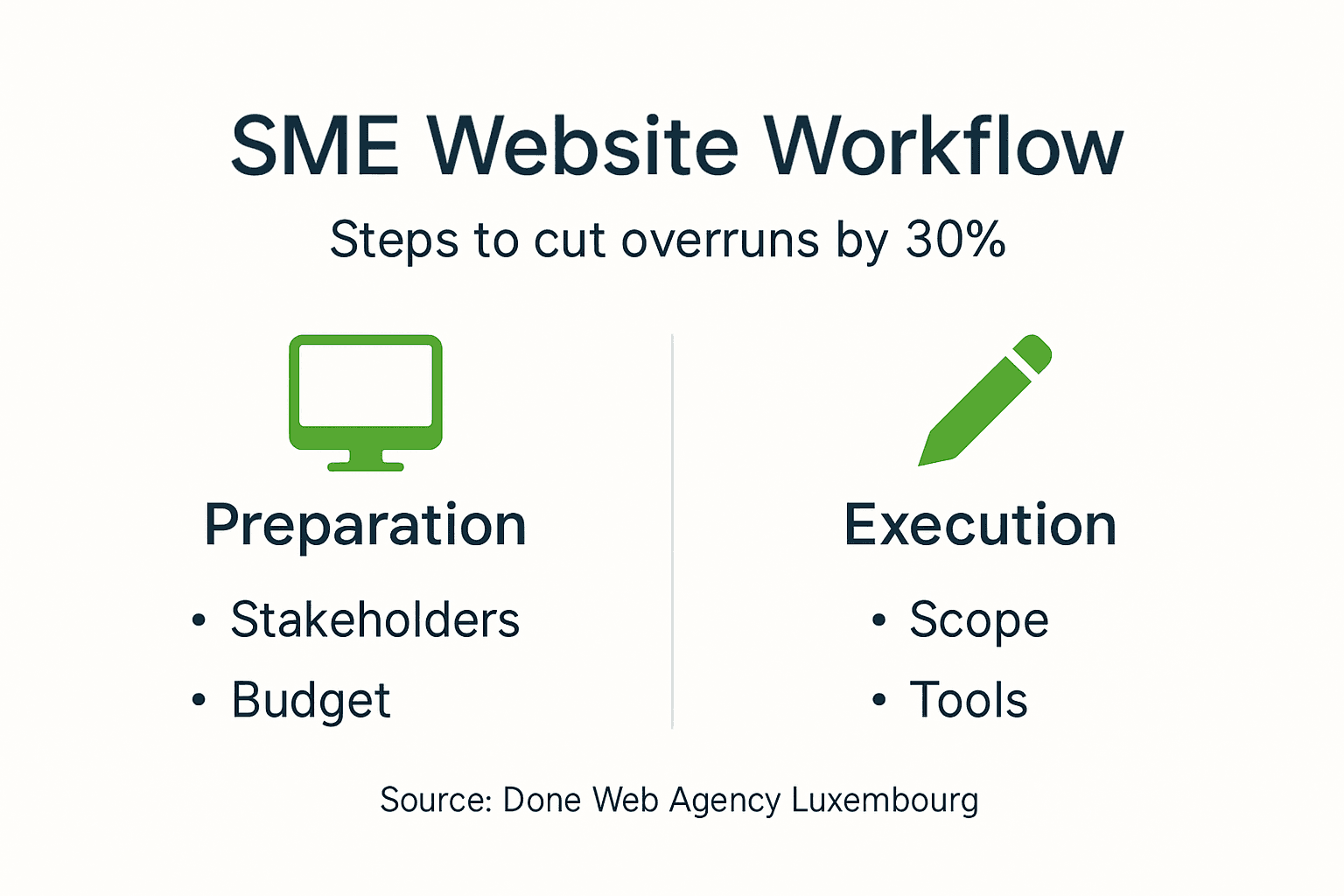
Align scope with your marketing and growth strategies for maximum impact. Your website should support your broader business goals, not exist in isolation. A clearly defined project scope reduces overruns by up to 30% in SME website projects.
Pro Tip: Create a one-page scope document that lists goals, included features, excluded features, and success metrics. Share it widely and refer to it in every meeting.
“The single biggest predictor of project success is whether stakeholders agree on scope before development starts. Ambiguity at this stage costs you later.”
Initiate stakeholder alignment
Securing buy-in from all parties early prevents costly resistance and delays. Stakeholder alignment turns potential blockers into champions.
Conduct kickoff workshops to align vision and expectations. Bring together decision-makers, project managers, designers, and technical leads. Use these sessions to clarify the why behind the project and ensure everyone shares the same vision.
Clarify communication protocols and responsibilities. Decide who approves designs, who handles content, and who manages technical decisions. Establish regular check-in meetings and update schedules so no one feels left out.
Address potential resistance proactively through open discussion. Some stakeholders may fear change or worry about workload. Listen to their concerns and find compromises that keep the project moving.
Document agreements to reference throughout the project. Write down decisions, roles, and commitments. When disputes arise, you can return to this shared record to resolve them quickly.
Early buy-in prevents costly delays and misunderstandings. When everyone feels heard and invested, your project gains momentum instead of fighting internal friction.
Pro Tip: Use a RACI matrix (Responsible, Accountable, Consulted, Informed) to map stakeholder roles. It eliminates confusion and empowers team members to act confidently.
Adopt growth-driven design methodology
Growth-driven design shifts from big-bang launches to iterative improvement. This modern approach delivers faster results and better ROI for SMEs.

Growth-driven design emphasizes iterative builds and data-informed decisions. You launch a functional site quickly, then continuously improve based on real user behaviour and analytics.
Benefits include 25% faster launch times and up to 15% higher client satisfaction over traditional waterfall methods. You get your site live sooner and adapt it as you learn what works.
Launch a functional site early, then continuously improve with analytics. Start with core features and high-priority pages. Monitor user engagement, conversion rates, and feedback. Use this data to prioritize the next round of enhancements.
Contrast growth-driven design with traditional waterfall, which requires complete planning and development upfront. Waterfall offers more predictability but less flexibility. Growth-driven design accepts uncertainty and uses it as an advantage.
Choose your methodology based on your project’s flexibility needs and budget. If your requirements are fixed and well understood, waterfall may work. If you need to adapt quickly to market feedback, growth-driven design wins. Custom web design benefits become clearer when paired with iterative methodologies.
| Aspect | Traditional Waterfall | Growth-Driven Design |
|---|---|---|
| Launch speed | 12-16 weeks | 6-10 weeks |
| Flexibility | Low, changes costly | High, built for iteration |
| Client satisfaction | Moderate | 15% higher on average |
| Best for | Fixed scope, large budgets | Evolving needs, SME budgets |
Implement project management tools
Digital tools transform chaotic workflows into transparent, efficient processes. The right tools keep everyone aligned and accountable.
Criteria for selecting tools include ease of use, integration with existing systems, and support for remote collaboration. Your team should be able to learn the tool in under an hour. It should connect with your email, calendar, and file storage.
Use task boards, timelines, and status updates to monitor progress. Visual boards like Kanban or Gantt charts show who is working on what and when deliverables are due. Regular status updates keep everyone informed without endless meetings.
Regularly track issues and change requests within your tools. When bugs or change requests arise, log them immediately. Assign owners and deadlines. This transparency prevents issues from slipping through cracks.
Train your team for consistent tool adoption. Hold a short training session and provide quick-reference guides. Consistent use is more valuable than having the fanciest tool.
Project management tools improve transparency and reduce management overhead. When information is centralized and accessible, you spend less time chasing updates and more time solving problems.
Common mistakes and troubleshooting
Even well-planned projects hit obstacles. Knowing the common pitfalls helps you avoid or fix them fast.
Scope creep is the top killer of SME projects. Scope creep affects up to 50% of SME website projects, increasing overruns. Fix it by implementing strict change request procedures and scope freeze milestones. Require formal approval for any additions and assess their impact on budget and timeline.
Lack of early stakeholder buy-in leads to resistance and rework. If you skip the alignment phase, expect pushback when you present designs or features. Go back, run workshops, and secure commitment before proceeding.
Unclear or unvalidated requirements cause delays and rework. If your team builds features based on assumptions, you will need costly revisions. Validate requirements through user research, stakeholder interviews, and prototyping.
Document and track changes comprehensively for transparency. Every change request should have a written record with rationale, cost, and timeline impact. This documentation protects both you and your agency partner.
Pro Tip: Establish a change control board that meets weekly to review and approve change requests. This process adds structure without creating bottlenecks.
“Most project failures trace back to poor scope management. The discipline to say no to scope creep is what separates successful projects from failed ones.”
Expected timelines and outcomes
Setting realistic expectations prevents disappointment and helps you plan resources effectively.
Most SME web projects complete between 8 and 16 weeks depending on complexity and resource availability. Simple brochure sites land at the shorter end. E-commerce or custom platforms take longer.
Phased milestones help track progress and manage expectations. Break your project into discovery, design, development, testing, and launch phases. Assign target dates and deliverables to each phase.
Measure success with metrics like lead generation increase, engagement, and ROI. Track conversion rates, time on site, bounce rates, and goal completions. Compare pre-launch and post-launch performance.
Expect 20-50% lead growth and 30-50% marketing ROI improvement after launch. These ranges depend on your starting point and how well you optimize post-launch. Sites using growth-driven design and ongoing optimization see the higher end.
Set KPIs early aligned to business goals for continuous monitoring. Define your key performance indicators during the planning phase. Review them monthly and adjust your strategy based on results.
| Project Type | Typical Duration | Key Milestones | Expected Outcomes |
|---|---|---|---|
| Brochure site | 8-10 weeks | Discovery, Design, Development, Launch | 20-30% lead increase |
| E-commerce | 12-16 weeks | Discovery, Design, Development, Testing, Launch | 30-50% revenue growth |
| Custom platform | 14-20 weeks | Discovery, Design, Development, Integration, Testing, Launch | 40-60% efficiency gains |
Alternative approaches and tradeoffs
No single workflow fits every project. Understanding your options helps you choose wisely.
The waterfall method follows a linear, upfront planning approach. You complete each phase fully before moving to the next. This suits projects with fixed budgets, well-defined requirements, and low tolerance for changes.
Growth-driven design uses an iterative, faster launch approach. You start with a minimum viable site and improve continuously. This method offers better flexibility and higher SME satisfaction but requires ongoing commitment to iteration.
Tradeoffs include speed versus upfront control and resource allocation. Waterfall gives you more predictability but longer time to market. Growth-driven design gets you live faster but requires dedicated resources for ongoing optimization.
Choose based on your project complexity, budget, and evolving requirements. If your market moves fast and you need to adapt quickly, growth-driven design wins. If you have a large budget and rigid compliance requirements, waterfall may be safer.
Understanding these tradeoffs helps you make informed workflow decisions. Neither approach is universally better. Match the methodology to your business context and risk tolerance.
| Factor | Waterfall | Growth-Driven Design |
|---|---|---|
| Planning depth | Extensive upfront | Minimal viable planning |
| Launch timeline | 12-16 weeks | 6-10 weeks |
| Flexibility | Low, changes expensive | High, iteration expected |
| Resource commitment | Front-loaded | Continuous |
| Best suited for | Large, fixed-scope projects | SMEs needing market adaptability |
How Done Web Agency supports your project planning in Luxembourg
You now understand the workflow, but executing it requires expertise and experience. Done Web Agency Luxembourg specializes in growth-driven website planning tailored for Luxembourg SMEs like yours. Our expert team ensures clear scope, stakeholder alignment, and use of agile workflows from day one.
We provide project management support and measurable outcome tracking throughout your project. You benefit from our 150+ completed projects and proven methodologies. Learn more about how investing in web development drives your business growth and why understanding what web development entails matters for your success. Partner with us to avoid common pitfalls and launch effectively. Contact us today to start your project with confidence.
Frequently asked questions
What is a website project planning workflow?
A website project planning workflow is a structured sequence of steps to manage a web project efficiently. It ensures goals alignment, controls scope, and delivers on time. Following a clear workflow reduces overruns and improves digital presence outcomes for SMEs.
How can SMEs prevent scope creep in website projects?
Implement strict change control processes and document all change requests with cost and timeline impacts. Engage stakeholders early for agreement on project scope and boundaries. Require formal approval for any additions and review requests weekly through a change control board.
What are realistic timelines for SME website projects in Luxembourg?
Typical SME website projects last 8 to 16 weeks depending on complexity and resource availability. Brochure sites complete faster, while e-commerce or custom platforms take longer. Phased milestone planning helps track progress and manage expectations effectively throughout the project.
Why is growth-driven design beneficial compared to traditional methods?
It enables faster launches with iterative improvements based on real user data and analytics. Growth-driven design offers up to 15% higher client satisfaction for SMEs versus traditional waterfall approaches. You get live sooner and adapt continuously to market feedback, maximizing ROI.