

Company Data: Fine Tune Only After RAG, GDPR Aware, Cut Costs
August 31, 2026
Fix Stalled B2B Deals Fast: 4 Starter Templates for Buying Jobs
September 2, 2026
Yes, you can get a website without an installation fee, and for most small businesses a monthly managed plan, often called website as a service (WaaS), is the best practical route. The reason is simple: costs stay predictable, hosting and maintenance are included, and you launch faster than with a traditional project quote. The one thing to check before signing anything is who owns the files, how long the contract locks you in, and whether you get proper invoices for your books.
TL;DR:
- Most monthly website plans include hosting, security, backups, and a limited number of content edits, with costs remaining predictable and lower over a year for simple sites.
- When choosing a plan, ask providers about file ownership, contract length, data hosting location, backup frequency, and support hours to avoid hidden charges or ownership issues.
- For Lithuanian businesses, retaining formal invoices and confirming VAT numbers are essential for proper expense claims and compliance, especially for cross-border services within the EU.
- Launching a site within two weeks requires preparing logo files, draft content, and domain credentials beforehand, and confirming ownership and backup details in writing at project start.
- WaaS models are ideal for cash-constrained businesses needing quick deployment, but complex projects requiring custom features should opt for a traditional build to ensure flexibility and functionality.
Table of Contents
- Svetainė be įdiegimo mokesčio: which models actually offer it?
- How do you choose between a monthly plan and a traditional build?
- How do you record monthly website fees correctly in Lithuania?
- What do you need ready to launch in under two weeks?
- When we recommend a monthly plan, and when we don’t
- A managed website plan without the surprises
- Sources
Svetainė be įdiegimo mokesčio: which models actually offer it?
“No setup fee” isn’t a single product. It’s a pricing structure that several different delivery models can offer, and each one spreads the cost differently.
WaaS (website as a service) replaces the big upfront design invoice with a flat monthly fee. Providers can afford to waive the installation cost because they recover it gradually, and because the initial build is usually based on a template framework rather than a fully custom design. This model covers hosting, maintenance, security updates and some content changes as standard.
Agency monthly plans work similarly but sit closer to a traditional agency relationship, often with more design flexibility and a named contact rather than a support ticket system.
AI quick-build tools generate a working site from a short brief in minutes. No setup fee because there’s barely any setup labour involved. Fine for a landing page, weak for anything needing real structure or SEO planning.
Hosted self-serve builders (the DIY route) charge no installation fee because you do the installation. You drag, drop and publish yourself.
A typical monthly package for a basic business site includes:
- Hosting and SSL certificate
- Routine backups and security patching
- A limited number of content edits per month (often two to five)
- Basic uptime monitoring
- Minor bug fixes
What’s usually excluded: a full redesign, a large product catalogue for e-commerce, custom integrations with accounting or CRM software, and anything requiring bespoke development hours.
Expect monthly prices for a straightforward business site to sit in a modest band, rising sharply once e-commerce, multilingual content, or custom functionality enter the brief. WaaS commonly reduces the total cost of running a site over a year once you factor in hosting, security patching and the odd emergency fix that a traditional one-off build leaves you to arrange yourself.
How do you choose between a monthly plan and a traditional build?
Start with a short checklist rather than a gut decision. Ask yourself who needs to access and edit the site, how long you’re comfortable being tied into a contract, and whether GDPR-compliant data storage matters for your sector.
Then ask the provider directly. Here are five questions worth asking word for word:
- “If I cancel, do I receive my website files, or only a screenshot of what existed?”
- “What is the minimum contract length, and is there an exit fee?”
- “How many support hours or content changes are included each month, and what happens beyond that?”
- “Where is my data hosted, and is the setup GDPR compliant?”
- “Do you provide backups, and how often are they taken?”
A short contract checklist covering ownership, transfer fees, minimum term, scope and backups is the single most effective tool for avoiding the traps hidden inside a “no setup fee” headline. Watch for vague change-request policies, an unclear stance on file ownership, or a “buyout fee” mentioned only in the small print if you ever want to leave.
Pro Tip: Before signing, ask for a CMS export option or admin-level access in writing. A provider that hesitates on this question is telling you something about how easy leaving will actually be.
How do you record monthly website fees correctly in Lithuania?
Monthly website subscriptions are a legitimate business expense, but only if you treat the invoice with the same care as any other recurring cost. For sole traders operating under individuali veikla, retaining formal invoices for monthly website services is essential to claim the expense correctly at year-end.
If your provider is based outside Lithuania, including elsewhere in the EU, SVS and PVM rules affect how the purchase is reported. Cross-border service purchases can trigger separate VAT declarations depending on your registration status, so it’s worth confirming your obligations before you commit to a foreign supplier rather than after your first invoice lands.
A workable monthly checklist:
- Save every invoice the moment it arrives, don’t wait for a batch at year-end
- Confirm the invoice shows the provider’s VAT number, the service period, and the net and gross amounts
- Classify the expense under the correct category with your accountant or bookkeeping software
- Reconcile the invoice against your bank statement monthly, not annually
Businesses buying services from other EU countries need to be alert to cross-border VAT reporting duties, since the rules differ from a purely domestic Lithuanian purchase. A dedicated folder for monthly invoices, reconciled against bank statements each month, prevents the scramble accountants dread every January.
What do you need ready to launch in under two weeks?
A monthly plan only moves fast if you’ve done your homework before the kickoff call. Providers can’t build around assets that don’t exist yet.
Before signing, gather:
- Your logo in a high-resolution format (SVG or PNG, not a scanned business card)
- Product or service photos, ideally already resized for web
- Draft copy for your core pages, even rough notes work
- Bank and payment provider details if you’re taking online payments
- Domain login credentials, if you already own one
On day one with the provider, confirm four things in writing: who owns the finished files, how often backups run, what the support response time is, and how you’ll access the CMS. A rough 14-day plan looks like this: days 1 to 3 for briefing and content collection, days 4 to 9 for build and first review, days 10 to 12 for revisions, days 13 to 14 for testing and go-live. Providers who quote much faster than that are usually reusing a rigid template with almost no customisation.
When we recommend a monthly plan, and when we don’t
In our experience, WaaS earns its place when cashflow is the real constraint. We’ve worked with a client who needed to launch before a seasonal peak and simply couldn’t front a large design invoice. A monthly plan solved that in under three weeks.
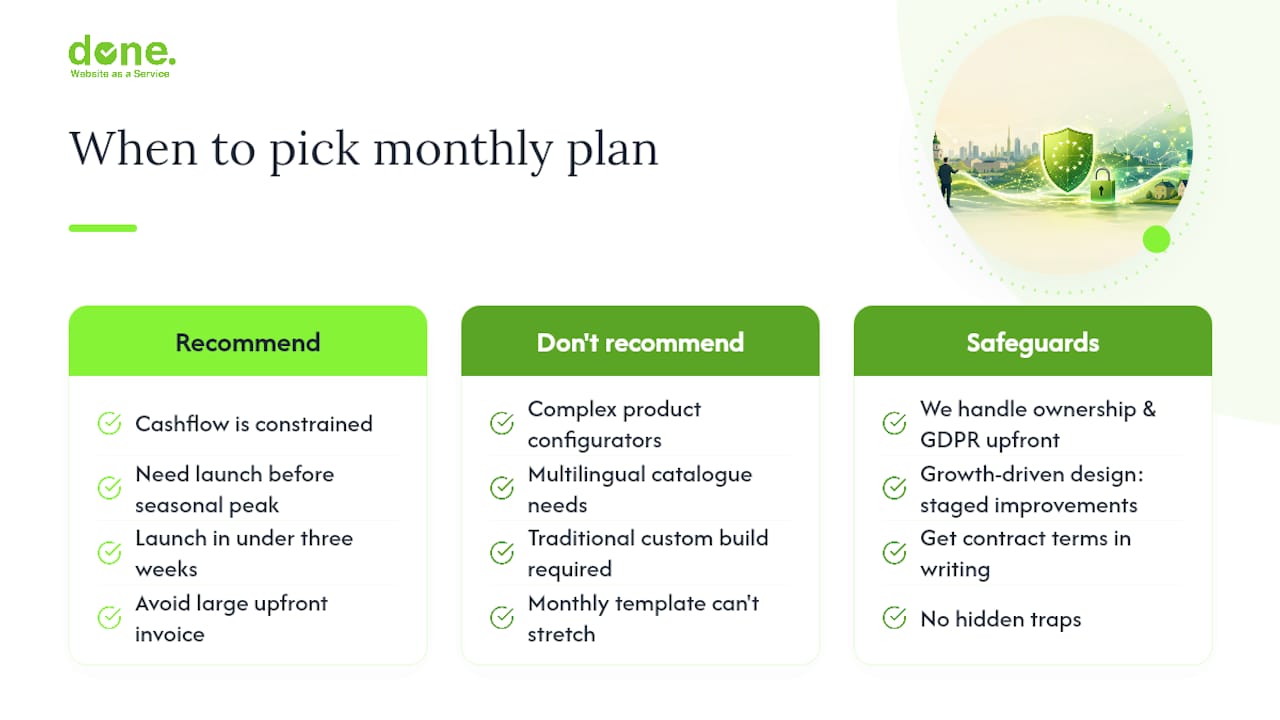
We’ve also had the opposite case: a client with complex product configurators and multilingual catalogue needs where a traditional, fully custom build was the only sensible option. No monthly template could stretch that far.
We handle ownership and GDPR terms upfront, and build in growth-driven design so the site improves in stages rather than needing a full rebuild later. If you want no upfront fee without the hidden traps, get the contract terms in writing before you get excited about the price.
— Thomas
A managed website plan without the surprises
Done runs a website-as-a-service model built for exactly the concerns raised above: no installation fee, a fixed monthly cost, and full clarity on what happens if you ever want to leave.
The monthly fee covers hosting, security updates, backups and a defined number of content changes, all specified in writing before you sign, not discovered afterwards. File transfer terms are agreed upfront, so there’s no ambiguity about ownership if your business needs change. This comes from 350+ real client projects since 2014, with GDPR-conscious hosting built in as standard rather than an add-on, and staged improvements rather than one rigid launch and years of neglect.
If a predictable monthly cost with no installation fee sounds like the right fit for your business, take a look at Done’s website as a service plan and get a straight answer on what your monthly fee would actually include.
Sources
- WaaS – Build, Manage, and Grow Your Online Presence
- Individuali veikla ir internetinė prekyba: Kas svarbu žinoti?