

Launch in 14 Days: GDPR Safe Site, No Install Fee for Lithuanian SMBs
September 1, 2026
AI storage privacy for SMBs: 6 practitioner led steps to cut GDPR risk
September 3, 2026
The B2B pirkėjo kelias today is non-linear and driven by tasks buyers must complete, not stages they pass through. Buyers loop between six recurring “buying jobs” identified by Gartner, and Forrester recommends mapping content to each decision gate. The fastest fix isn’t a bigger funnel. Find the job stalling your buyer and remove that one bottleneck.
TL;DR:
- Buyers often revisit multiple buying jobs simultaneously, making the traditional funnel model outdated and less effective for tracking progress.
- Content should be tailored to specific buying jobs, such as using SEO for problem identification or comparison sheets for supplier selection, to meet real needs.
- Key KPIs to identify where buyers stall include time spent in each job, specific conversion rates, account engagement scores, and pipeline velocity.
- Effective handovers between marketing and sales require clear ownership of buying jobs, with specific assets prepared for each stage and red flags like unresolved legal concerns.
- Building a single, targeted asset for the biggest bottleneck can significantly improve deal progression within four to eight weeks.
Table of Contents
- What is the B2B pirkėjo kelias, and why doesn’t the funnel work anymore?
- How do you map buying jobs to content and channels?
- Which KPIs actually show you where buyers stall?
- How should sales and marketing split ownership of the buying journey?
- What templates should you build for each buying job first?
- How we’ve applied buying jobs mapping with real accounts
- Three priorities if you want a result in a month, not a year
- How Done can help you fix your own buyer journey bottlenecks
- Sources
What is the B2B pirkėjo kelias, and why doesn’t the funnel work anymore?
Forget the tidy top-of-funnel, middle-of-funnel, bottom-of-funnel diagram most marketing decks still use. It assumes buyers move in one direction, at one pace, through one path. They don’t.
Gartner’s research on B2B buying behaviour describes six “buying jobs” that a purchasing group works through, often out of order and often more than once: problem identification, solution exploration, requirements building, supplier selection, validation, and consensus creation. A procurement lead might jump straight to supplier selection while the finance director is still stuck on problem identification. Both are “in the journey” at the same time, doing completely different jobs.
This looping behaviour is why deals stall in ways a funnel chart can’t explain. A prospect that seemed “decision-stage” three weeks ago can reappear doing requirements building again, because a new stakeholder joined the buying group. Gartner’s data shows that combining self-service digital tools with sales interaction, rather than relying on either alone, raises deal quality.
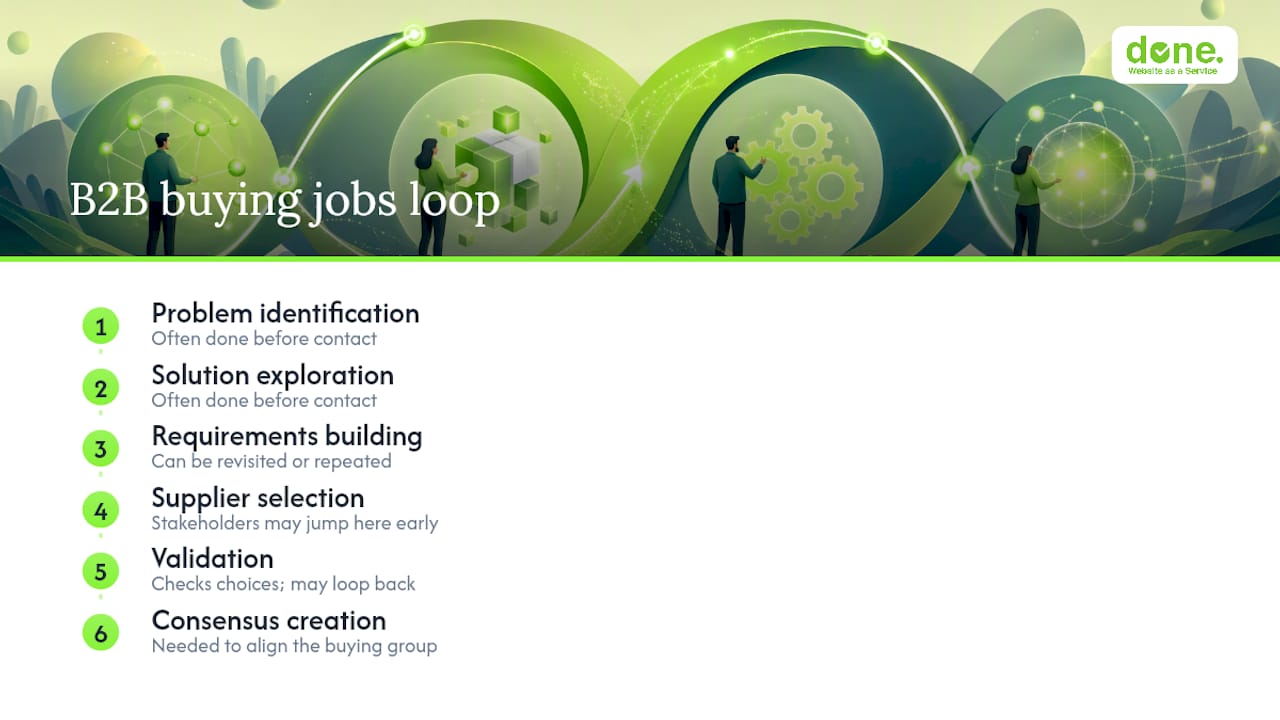
Qualtrics adds a second layer to this: most of the research happens before a buyer ever speaks to your sales team. By the time someone fills out a contact form, they’ve usually already done the problem identification and solution exploration jobs quietly, using search engines, peer reviews, and content they found on their own. If your content only shows up once they’re “ready to talk,” you’ve missed two-thirds of the actual journey.
How do you map buying jobs to content and channels?
Once you accept that buyers do jobs, not stages, the mapping exercise becomes straightforward: identify the job, identify the information need behind it, then pick the content format and channel that satisfies it fastest.
We’ve seen this go wrong constantly with clients who produce beautiful content nobody asked for at that moment. A 40-page whitepaper doesn’t help a buyer who’s trying to validate a shortlist internally, they need a comparison sheet they can forward to a sceptical colleague. Match the format to the job:
- Problem identification → educational blog content and search visibility, because this is where SEO does the heavy lifting.
- Solution exploration → LinkedIn content, webinars and explainer pages that frame the category.
- Requirements building → interactive calculators, spec sheets and configurators the buyer can use unaided.
- Supplier selection → case studies, comparison pages, and ROI one-pagers procurement can circulate.
- Validation → security or compliance documentation, references, and demo scripts tailored to sceptics.
- Consensus creation → a short stakeholder briefing note that a champion can present internally without you in the room.
Local coverage of B2B communication in Lithuania backs this up directly: SEO, LinkedIn and email remain the core channels for reaching business buyers, largely because so many B2B processes still start with a search query, not an outbound email.
Which KPIs actually show you where buyers stall?
Most CRM dashboards track volume, not friction. That’s backwards. You want to know exactly where a buying group gets stuck, not just how many leads entered the pipeline this month.
- Time in stage. How long does an account sit in each buying job before moving (or dying)? A sudden spike tells you exactly where the bottleneck sits.
- Conversion rate between stages. Not overall funnel conversion, the specific rate from, say, requirements building to supplier selection. This isolates the weak link.
- Account engagement score. Track content consumption, multi-stakeholder logins, and demo attendance as one composite signal, not isolated metrics.
- Pipeline velocity. Total deal value divided by average sales cycle length. It’s the single number that tells you whether your fixes are actually working.
Set up simple CRM triggers, three visits to pricing pages, a spec sheet download, a second stakeholder logging in, and use them to flag which job an account is doing right now. Review this weekly for active deals, monthly at the aggregate level. Forrester’s framework is built around exactly this: designing decision gates you can actually instrument, not stages you can only guess at.
How should sales and marketing split ownership of the buying journey?
Misalignment usually isn’t a personality problem, it’s an ownership gap. Nobody agreed who owns which buying job, so both teams assume the other is watching it.
Give marketing clear ownership of problem identification, solution exploration and requirements building. Sales takes over from supplier selection through consensus creation. The handover point needs a trigger, not a vibe, such as a demo request or a stakeholder map appearing in the account.
At handover, sales needs:
- A written brief on what content the account has already consumed.
- The buyer’s own evaluation criteria, if known.
- A stakeholder map naming the economic buyer, technical evaluator, and any blocker.
Watch for three red flags that predict a stalled deal: no identifiable executive sponsor, unresolved compliance or legal concerns, and a champion who can’t articulate ROI in their own words. Each one needs a specific asset, not a follow-up call.
Pro Tip: If a champion can’t explain your ROI case back to you in their own words, they can’t sell it internally either. Fix that gap before you fix anything else.
What templates should you build for each buying job first?
You don’t need twenty content types. You need four that map directly onto the jobs where deals actually get stuck, distributed where the buyer is already looking.
- ROI one-pager for requirements building, distributed as a gated download and shared directly by sales during supplier selection conversations.
- Evaluation checklist for supplier selection, built so procurement can score you against competitors without a call.
- Demo script tailored to a named stakeholder (technical evaluator versus economic buyer see different priorities) for the validation job.
- Stakeholder briefing note for consensus creation, short enough that a champion can forward it unedited.
One good case study can be repurposed across three jobs: a LinkedIn snippet for solution exploration, a detailed PDF for validation, and a one-line reference quote for consensus creation. Build once, distribute three ways, no need to reinvent the format for each job. Tools like Baby Love Growth’s content strategy platform can help prioritise which of these to build first, based on where intent signals actually cluster.
How we’ve applied buying jobs mapping with real accounts
We’ve run this exact diagnosis with clients stuck at supplier selection, the job where B2B deals die most often because nobody built a comparison asset procurement could use unaided. In one case, a single evaluation checklist replaced four separate email threads and cut the stall out entirely.
Done has delivered more than 150 projects across web development, content and workflow automation, and GDPR-aware AI deployment. That’s the practical experience behind this framework, not theory borrowed from a slide deck.
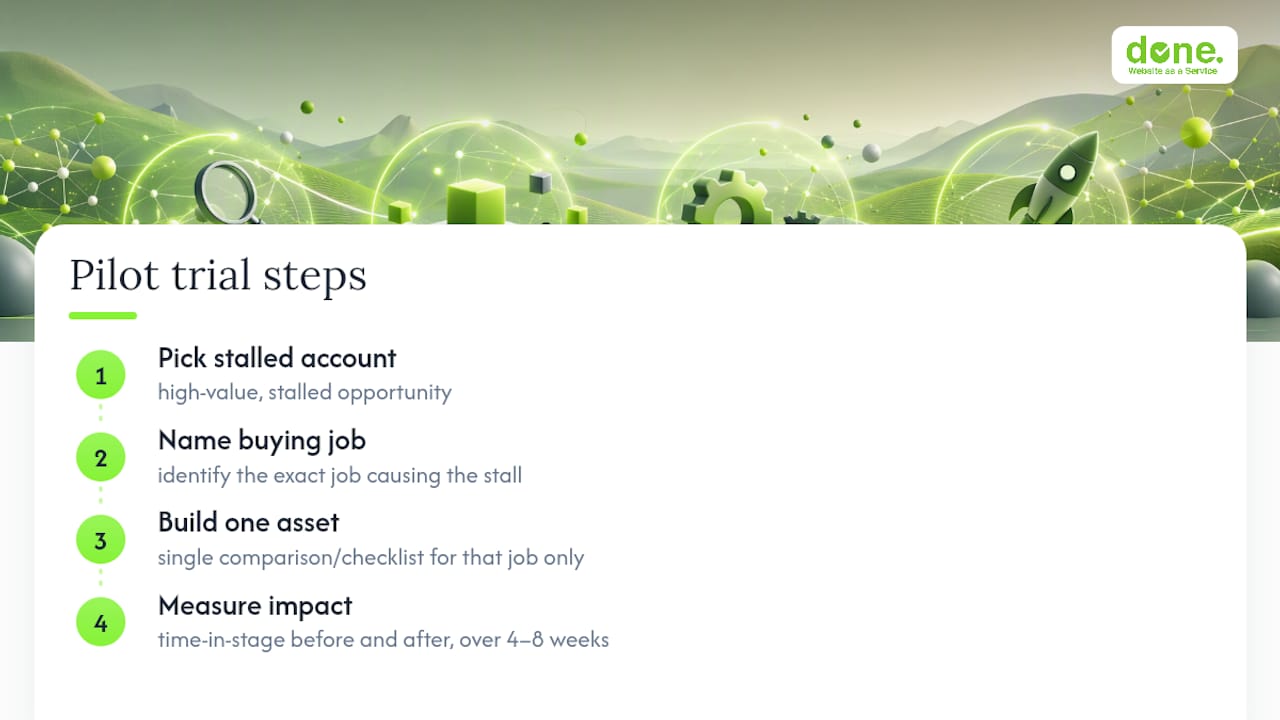
Try this on one account over four to eight weeks: (1) pick a high-value stalled account, (2) name the exact buying job it’s stuck on, (3) build one asset for that job only, (4) measure time-in-stage before and after. Small, deliberate, and cheap enough to run this quarter.
Three priorities if you want a result in a month, not a year
Map jobs for one account first, not your whole pipeline. Fix the single biggest bottleneck, resist building five assets when one will do. Then measure the delta, not just activity.
Pick a stalled account with real budget and a defined timeframe of four to eight weeks. Within the next 72 hours, name the exact job it’s stuck on and draft the one asset that unsticks it.
— Thomas
How Done can help you fix your own buyer journey bottlenecks
Most SMBs we work with don’t need a full journey overhaul, they need one bottleneck diagnosed and fixed. That’s the audit we run: map the buying jobs your target accounts are actually stuck on, then build the specific asset, page, or automation that removes the friction.

Done handles this end to end: a buyer-journey audit, the content and automation to act on it, and where relevant, GDPR-compliant AI tools to score and route accounts without touching data you shouldn’t. Our marketing automation workflows exist specifically to catch the handover triggers this article describes, so leads don’t sit unactioned between teams. If your website itself is the bottleneck, because buyers can’t self-serve validation without calling you, our web development work is built to fix exactly that. Book a short audit call and we’ll tell you, honestly, which single job is costing you the most deals right now.
Sources
- Create a B2B buying journey that drives more profitable purchase decisions
- The Forrester B2B buying decision process framework
- The B2B buying journey: stages and how to optimise them
- B2B e. verslo komunikacija – kaip pasiekti tikslinį pirkėją?