

What is mobile-first design? A practical guide for 2026
June 20, 2026
Inbound marketing ideas that generate real leads in 2026
June 22, 2026
TL;DR:
- Effective social media marketing for SMBs focuses on authentic content, platform selection, and measuring meaningful business metrics. Consistency, community engagement, and strategic use of AI tools support growth without requiring large budgets. Building trust through genuine interactions yields better results than chasing viral content or superficial metrics.
Social media marketing is the strategic use of authentic, audience-focused content and engagement to grow your brand and drive measurable business results. For small and medium-sized businesses, it is one of the most direct ways to reach customers, build trust, and generate leads without the budget of a large corporation. This social media marketing guide covers the core principles that actually work in 2026: choosing the right platforms, creating content people want to engage with, using AI tools without losing your voice, and measuring what genuinely matters. Tools like Buffer, Hootsuite, and Grammarly are referenced throughout because they are practical, widely used, and genuinely useful for SMB teams.
What are the essential elements of a social media marketing strategy?
A successful social media strategy starts with one question: what do you want it to do for your business? Without a clear answer, you end up posting for the sake of posting. Your goals should connect directly to business outcomes, whether that is generating enquiries, driving traffic to your website, or building brand recognition in a specific market.

Once your goals are set, the next step is understanding your audience. Where do they spend time online? What problems are they trying to solve? A B2B services firm in Luxembourg will find its clients on LinkedIn far more readily than on TikTok. A local restaurant will see stronger results on Instagram and Facebook. Platform-specific strategies consistently outperform a one-size-fits-all approach. That finding alone should change how you allocate your time.
Choosing your content pillars
Content pillars are the three to five recurring themes your brand talks about consistently. For a Luxembourg accounting firm, those might be tax deadlines, regulatory updates, client success stories, and team culture. Pillars give your content a shape and make planning far easier. They also help your audience know what to expect from you, which builds the kind of familiarity that leads to trust.
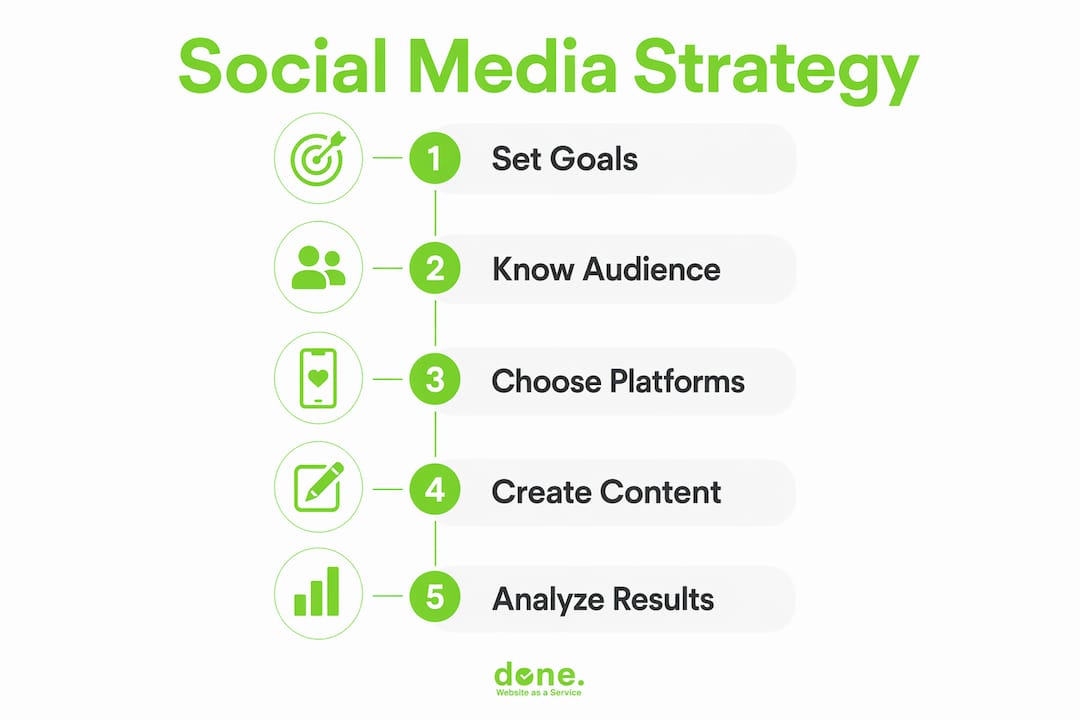
Content formats matter too. Text posts, short videos, carousels, and images each serve different purposes. You do not need all of them. Pick the formats your audience responds to and do those well.
Consistency and paid social media ads
Consistent posting beats chasing viral moments for steady, compounding growth. A business that posts three times a week, every week, will outperform one that posts twenty times in a burst and then disappears for a month. Algorithms reward regularity. So do audiences.
Paid social media ads are worth integrating once your organic presence has a foundation. Ads help SMBs reach specific audiences faster, which is particularly useful for product launches and lead generation campaigns. Think of paid ads as a way to amplify content that already works organically, not as a substitute for it.
- Set goals tied to real business outcomes (leads, traffic, enquiries)
- Choose platforms based on where your audience actually is
- Define three to five content pillars to guide your posting
- Mix formats but focus on what your audience engages with most
- Post consistently rather than sporadically
- Use paid ads to amplify proven content, not replace organic effort
Pro Tip: Focus your resources on two platforms at most. Doing two platforms well produces far better results than spreading thin across five.
How can SMBs create authentic content that builds community?
Authentic, honest content outperforms overpolished, scripted posts. Social media users scroll past content that feels produced for a brochure. They stop for content that feels real. This is not a minor preference. It is the defining shift in what works on social platforms right now.
The practical implication for SMBs is significant. You do not need a professional film crew or a graphic design agency to produce effective content. A well-lit photo of your team at work, a short video explaining a common client question, or an honest post about a challenge you faced and solved will outperform a glossy promotional video in most cases.
Practical content ideas for SMBs
- Behind-the-scenes posts. Show how your product is made, how your team works, or what a typical day looks like. People are curious about the humans behind a business.
- Client stories. Share a brief, specific account of how you helped a client solve a problem. Keep it concrete and avoid vague praise.
- Answer a common question. Pick one question your clients ask regularly and answer it in a short video or text post. This positions you as knowledgeable and builds trust.
- Team introductions. Introduce a team member with a short post about their role and something personal. This humanises your brand.
- Timely commentary. React to a relevant industry development or local news item. This shows you are engaged and current.
Short-form video remains the dominant format, but the intention behind the content now matters more than the format itself. A thirty-second video that answers a real question will outperform a polished two-minute brand film with no clear purpose.
Building a community, not just a following
A smaller, highly engaged community is more valuable than a large passive audience. Algorithms on LinkedIn, Instagram, and Facebook all favour interaction over raw reach. A post that generates ten genuine comments will reach more people than one that gets two hundred likes and no replies. This means your job is to start conversations, not just broadcast messages.
Respond to every comment. Ask questions at the end of your posts. Acknowledge people who share your content. These habits take ten minutes a day and compound into a genuinely active community over months. Tools like Buffer and Hootsuite make scheduling and monitoring easier, so you can manage community engagement without it consuming your entire working day.
Pro Tip: User-generated content and collaborations with complementary local businesses are two of the fastest ways to grow an engaged audience without increasing your content production workload.
What role does AI play in social media marketing for SMBs?
AI tools are now genuinely useful for social media marketing, but the way you use them determines whether they help or hurt your brand. Successful brands use AI to automate routine tasks and support research, while relying on their internal teams to maintain voice, tone, and authentic storytelling. That distinction is critical.
The risk of over-relying on AI is real. Content generated entirely by AI tools tends to sound generic. It lacks the specific details, local references, and human perspective that make your brand recognisable. Audiences notice. Trust erodes quickly when content feels templated.
Here is where AI genuinely adds value for an SMB social media team:
- Content drafting. AI tools can produce a first draft of a caption or post in seconds. Your job is to rewrite it in your own voice, add a specific detail, and make it sound like you.
- Grammar and tone refinement. Grammarly catches errors and flags tone issues before you publish. This is particularly useful for multilingual teams where English is a second language.
- Scheduling and analytics. Buffer and Hootsuite both integrate AI features that suggest optimal posting times and surface which content is performing best.
- Research and ideation. AI tools can scan trends, suggest content angles, and identify questions your audience is asking. This saves hours of manual research.
- Caption variations. AI can generate multiple versions of a caption quickly, which is useful for A/B testing without significant extra effort.
The 2026 digital marketing trends confirm that AI works best as a support layer, not a replacement for human creativity. Use it to work faster. Do not use it to replace the thinking that makes your content worth reading.
How can SMBs measure and improve their social media performance?
Measuring engagement rates, reach, and conversions gives you the data to understand what is working and what is not. Without measurement, you are guessing. With it, you can make small adjustments that compound into meaningful improvements over time.
The most common mistake SMBs make is focusing on vanity metrics. Follower count and total likes feel good but tell you very little about business impact. The metrics that matter are engagement rate (comments, shares, saves divided by reach), click-through rate to your website, and conversions from social traffic.
Key metrics to track
| Metric | What it tells you |
|---|---|
| Engagement rate | How actively your audience interacts with your content |
| Reach | How many unique accounts saw your post |
| Click-through rate | How many people visited your website from social |
| Conversions | How many social visitors completed a desired action |
| Comments and shares | Qualitative signal of content resonance |
Qualitative feedback matters alongside the numbers. A post that generates ten thoughtful comments is performing better than one with five hundred likes and no replies. Read the comments. They tell you what your audience actually thinks.
Buffer and Hootsuite both provide built-in analytics dashboards that track these metrics across platforms in one place. Scheduling and analytics tools like these remove the need to log into each platform separately, which saves time and makes it easier to spot patterns.
Simple A/B testing is accessible to any SMB. Post the same core message with two different headlines or images on different days and compare the results. Do this consistently and you will build a clear picture of what your specific audience responds to. The social media benefits for SMBs compound when measurement informs every content decision.
Pro Tip: Set a fixed monthly review date. Spend thirty minutes looking at your top three and bottom three posts. The pattern that emerges will tell you more than any social media course.
Key takeaways
Effective social media marketing for SMBs requires authentic content, focused platform choices, consistent posting, and measurement of metrics that connect to real business outcomes.
| Point | Details |
|---|---|
| Choose platforms deliberately | Focus on two platforms where your audience is active rather than spreading across all channels. |
| Authentic content wins | Real, specific, human content consistently outperforms polished promotional posts. |
| Community beats follower count | A small, engaged audience drives better results than a large passive one. |
| Use AI as a support tool | AI handles drafting and scheduling; your team provides the voice and specific detail. |
| Measure what matters | Track engagement rate, click-through rate, and conversions rather than likes and follower numbers. |
What I have learned from SMB social media work in Luxembourg
Working with SMB clients in Luxembourg over the past several years has taught me one thing above all else: the businesses that see real results from social media are not the ones with the biggest budgets or the most polished content. They are the ones that show up consistently, speak plainly, and treat their audience like people rather than prospects.
The Luxembourg market has its own character. It is multilingual, relationship-driven, and relatively small. That means your reputation travels fast in both directions. A genuine, well-timed post about a local issue or a client win will reach the right people quickly. A generic, overproduced campaign will be ignored just as quickly.
I have seen clients waste months trying to go viral before they had even established a basic posting rhythm. Viral content is a by-product of consistent, quality effort, not a shortcut to it. Start with two platforms, post three times a week, and respond to every comment for ninety days. The results will be modest at first and then noticeably better. That is how it actually works.
Paid social media ads are worth adding once you have organic content that performs. We have seen clients in Luxembourg use targeted LinkedIn campaigns to reach decision-makers in specific sectors with strong results. But ads amplify what already works. They do not fix content that does not connect.
The digital marketing strategy approaches that work for Luxembourg SMBs share one trait: they are built around the specific audience, not copied from a generic playbook. Adapt everything you read, including this article, to your actual customers and your actual market.
— Thomas
How Done can support your social media marketing efforts
Done is a Luxembourg-based digital and AI agency that has worked with over 350 SMBs across web development, digital marketing, and AI consulting since 2014. If you are building or refining your social media approach, Done can help you move from scattered posting to a structured, measurable programme that connects to your business goals.
Done’s digital marketing workflow services cover social media strategy, content planning, scheduling, and performance reporting. For businesses ready to integrate AI tools into their marketing, Done also provides hands-on AI consulting that keeps your brand voice intact. Whether you need a full social media strategy or support with a specific part of the process, Done works with you at the pace that suits your team. Explore Done’s services at done.lu.
FAQ
What is social media marketing?
Social media marketing is the use of platforms like LinkedIn, Instagram, and Facebook to share content, engage with audiences, and drive business outcomes such as leads, traffic, and brand awareness. It combines organic content with paid advertising and community management.
Which social media platforms should an SMB use?
Choose platforms based on where your specific audience spends time. B2B businesses in Luxembourg typically see the strongest results on LinkedIn, while consumer-facing brands perform better on Instagram and Facebook.
How often should an SMB post on social media?
Consistency matters more than frequency. Three to four posts per week on your chosen platforms, maintained over several months, will produce better results than irregular bursts of high-volume posting.
How do AI tools help with social media marketing?
AI tools like Grammarly, Buffer, and Hootsuite assist with drafting, scheduling, grammar refinement, and analytics. They work best as support tools that speed up routine tasks while your team maintains the brand voice and specific content detail.
What metrics should SMBs track on social media?
Track engagement rate, click-through rate to your website, and conversions from social traffic. These metrics connect directly to business outcomes. Follower count and total likes are less useful indicators of real performance.