

SEO paslaugų kaina: kiek biudžeto reikia verslui
August 21, 2026
Google Ads kainos: what Lithuanian SMEs should budget for
August 23, 2026
Budget for prekės ženklo kūrimo kaina in Lithuania varies widely depending on the scope, and expect additional costs for legal registration of the mark. A simple logo refresh sits at the bottom of that range. A full identity with a brandbook and a brochure site sits near the top. The single biggest driver isn’t the designer’s hourly rate. It’s how many deliverables you bundle into the brief.
Here’s the honest breakdown:
- Logo only, minimal scope: €100–€500
- Mid-range identity package (logo, basic brandbook, simple website): €1,000–€4,000
- Full-service branding (naming, brandbook, multi-page site, rollout): €4,000+
- Trademark registration, done properly through the Valstybinis patentų biuras (VPB): €180 state fee plus €40 per extra class, roughly €220–€500 all in with professional help. An EU-wide mark through EUIPO costs considerably more.
Scope, not seniority, is what pushes a quote from €300 to €3,000. The next section breaks down exactly what you get at each price point, so you can spot a fair quote versus a padded one.
Key Takeaways
Branding costs in Lithuania scale with scope and legal protection, not designer seniority, and a mid-range identity with basic trademark registration typically totals €1,200–€4,500.
| Point | Details |
|---|---|
| Logo-only projects | Budget €100–€500 for a refresh or a simple new logo with limited revisions. |
| Full identity packages | Naming, brandbook, and a basic website typically run €1,000–€4,000. |
| Trademark filing (Lithuania) | VPB state fee is €180 for one class, roughly €480 total with professional help. |
| EU-wide protection costs more | EUIPO filing starts at — for one class, around €1,250 total with an agent. |
| Plan classes for five years | Under-registering forces a costly re-filing later; scope classes ahead of growth. |
| Compare scope, not just price | Done scopes brand and website work as one transparent package with no setup fees. |
Table of Contents
- What does a prekės ženklo kūrimo kaina actually cover in Lithuania?
- Trademark registration costs and timelines: VPB versus EUIPO
- How do you budget and choose a branding provider?
- Done’s approach to brand pricing: a practitioner example
- Editorial take: what most branding guides get wrong about price
- Get a branding quote you can actually compare
- Frequently asked questions
- Sources
What does a prekės ženklo kūrimo kaina actually cover in Lithuania?
Prices listed on agency websites depend heavily on the scope of work involved.
Naming. A basic name-generation session with a handful of options runs €100–€300. Proper naming work, including trademark clash checks and domain availability, climbs to €500–€1,000.
Logo design. A logo refresh (tweaking an existing mark) starts around €100. A brand-new logo with a couple of concepts and revisions lands in the €300–€800 range. Agency price surveys show bespoke logo-plus-identity packages commonly reach €1,000–€4,000 once colour systems, typography, and usage rules are included.
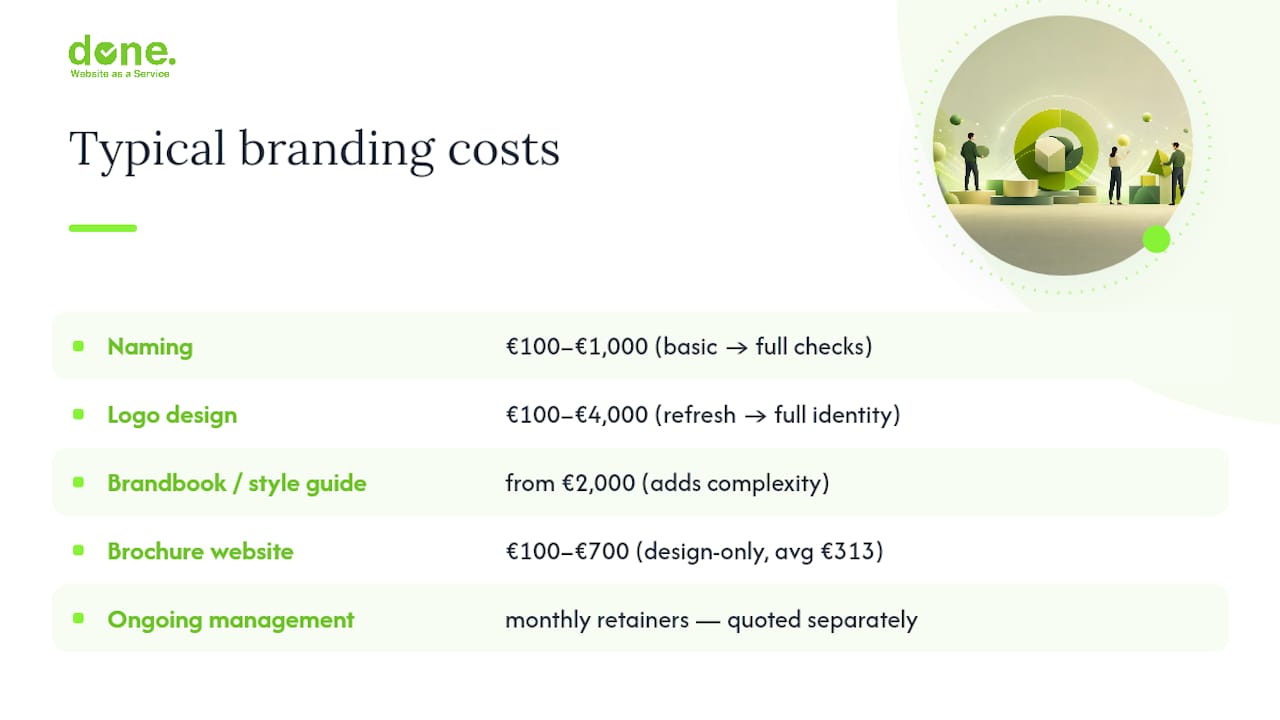
Brandbook or style guide. This is where costs jump. Full identity projects with a proper brandbook commonly start from around €2,000 in Lithuanian agency listings, and complexity (multiple sub-brands, extensive templates) pushes it higher. A brandbook is the point where a logo stops being decoration and becomes a usable system, which is why the price step is so noticeable.
Basic brochure website. Expect this to add a meaningful chunk to any branding budget. Paslaugos lists small branding and brand-management packages from roughly €100 to €700, with an average around €313, though that figure covers design only, not a full site build.
Ongoing brand management. Monthly retainers for social asset creation or brand consistency checks typically sit outside the initial project fee and get quoted separately.
What most quotes exclude: VAT, source files (the editable originals), in-depth market research, competitor testing, copywriting, and photography. Ask for these explicitly.
Two quick contrasts: a €300 logo project usually means two concepts, one revision round, and a PNG/SVG handover with no brandbook. A €3,000 brand identity usually means a discovery session, three to five logo directions, a working brandbook, and colour/typography guidelines ready for a designer to apply to packaging or a website.
Pro Tip: Ask every agency to list what’s explicitly excluded, not just what’s included. The gap between a €300 quote and a €1,200 quote is almost always hiding in the exclusions, not the deliverables.
Trademark registration costs and timelines: VPB versus EUIPO
Registering your mark is a separate legal step from designing it, and it carries its own fee schedule. In Lithuania, the VPB charges €180 for one Nice class when you file electronically, with €40 for each additional class. Paper filing costs more, so electronic filing is worth doing regardless of who handles it.
Most businesses don’t file alone. METIDA’s example pricing shows a professionally handled filing, state fee plus agent fee, totalling around €480 for one class in Lithuania.
For protection across the whole EU, the EUIPO state fees and agent costs are markedly higher than national filing. International filings outside the EU generally take longer and involve additional fees.
The most expensive mistake here isn’t overspending. It’s under-registering. If you file for one Nice class today and expand into new product categories in three years, you’ll likely need a fresh filing, which means paying the state fee and agent cost again from scratch. METIDA’s guidance on this is blunt: plan your class selection around a five-year business outlook, not just what you sell on day one.
How do you budget and choose a branding provider?
Comparing quotes gets easier once you have a fixed checklist to run every proposal through.
- Confirm the deliverables list is written down, not verbal, including file formats (AI, SVG, PNG, PDF) and whether source files are included.
- Check who owns the rights once payment clears. Full transfer should be explicit in the contract.
- Count the concepts and revisions. Two logo directions with one revision round is a very different job from five directions with unlimited tweaks.
- Ask whether research and naming strategy are included, or billed as an add-on.
- Get a timetable and payment schedule in writing before any work starts.
Four questions worth asking every agency directly: What does this quote include and exclude? Who does the naming and research work? Do you handle trademark advice, or coordinate with an IP attorney? What happens if we need extra Nice classes or more revision rounds later?
Watch for red flags: no written scope document, no source-file handover, “unlimited revisions” with no defined timeline, or a quote sitting well below the market range covered above. A price that looks too good rarely includes strategy work, only execution.

If you’re bolting a website build onto the identity work, factor that uplift in before you compare quotes, not after.
Pro Tip: If two quotes differ by more than 30%, don’t assume the cheaper one is worse. Ask both agencies to itemise revisions and research hours side by side. Often the gap is entirely in scope, not skill.
Done’s approach to brand pricing: a practitioner example
Done has run over 150 web and digital projects, and branding work follows the same principle we apply everywhere else: transparent pricing, no setup fees, and a scope you can actually read before you sign anything.
A typical compact package we’d scope for a Lithuanian SMB looks like this: a refreshed or new logo, a working style guide covering colour, typography and usage rules, and a brochure website built with growth driven design principles rather than a one-off static build. That combination lands broadly within the mid-range identity bracket described earlier in this article. It’s illustrative, not a formal quote. Every project scope depends on your specific brief.
Before you contact any agency, prepare three things: a one-page brief describing what you sell and to whom, a short list of your closest competitors, and the Nice classes you’ll likely need if you plan to register the mark. That alone cuts most discovery calls in half.
If website work is part of the plan, it’s worth understanding why the investment pays off before you fix a budget ceiling.
Editorial take: what most branding guides get wrong about price
Most pricing guides treat the logo as the expensive part. It rarely is. The brandbook and the legal filing are where budgets actually break, and both get treated as afterthoughts in typical planning conversations.
We’d argue the conventional advice, “get three quotes and pick the middle one”, is weak guidance. A €300 quote and a €3,000 quote aren’t the same product at different prices. They’re different products. Compare scope line by line before you compare numbers.
If you’re prioritising anything first, prioritise the trademark class selection, not the logo concept count. A weak logo can be refreshed later for a few hundred euros. An under-scoped trademark filing means starting the legal process over, at full cost, once you expand.
The Lithuanian market’s wide price variance (from around €100 to well over €4,000 for what’s nominally the same service) isn’t dishonesty. It reflects genuinely different scopes of work being sold under the same label. Read the deliverables list before you read the price.
Get a branding quote you can actually compare
Done is the alternative to piecing together a logo designer, a copywriter, and a web developer separately for a Lithuanian branding project, one scoped engagement, one price you can see in full before work starts, with no setup fees hidden in the small print.
We build brand identity and website work as one connected package, using website as a service so your site keeps evolving after launch instead of sitting static for three years. If you’re already comparing quotes using the checklist above, send us your one-page brief and we’ll scope exactly what’s included, deliverables, file formats, revision rounds, and timeline, before you commit to anything. Get in touch with Done to start that conversation.
Frequently asked questions
What is a realistic prekės ženklo kūrimo kaina for a small business in Lithuania?
Most small businesses spend €1,000–€4,000 for a logo, basic brandbook, and simple website. A logo alone can cost as little as €100–€500 if that’s all you need.
Does the branding price include trademark registration?
Rarely. Design work and legal registration are separate budget lines. Registering through the VPB adds roughly €220–€500 on top of your design spend for one Nice class.
Is it cheaper to register a trademark only in Lithuania or across the whole EU?
A national VPB filing is significantly cheaper, around €480 with professional help, versus roughly €1,250 for an EU-wide EUIPO filing with agent support. Choose EU coverage only if you’re actively selling beyond Lithuania.
How long does a full branding project take?
A mid-range identity project typically takes four to eight weeks. Trademark registration runs separately and takes four to seven months through the VPB, longer through EUIPO.
What should I prepare before requesting a branding quote?
A one-page brief covering what you sell, your target customers, your closest competitors, and the product categories (Nice classes) you’ll likely need if you register a trademark.
Sources
- Kaip įregistruoti prekių ženklą? – Valstybinis patentų biuras
- Prekių ženklo registravimas procesas – METIDA
- Paslaugos