

Duomenų suverenitetas AI diegimo metu: ką turi žinoti Lietuvos SVV
August 26, 2026
UTM tags for campaigns: how to build and track them properly
August 28, 2026
Yes, you can build usable business scenarios in about 90 minutes using a 2×2 matrix, one-page narratives, and a trigger list. You don’t need a strategy consultant or a six-week planning cycle. You need a focal question, two genuine uncertainties, and the discipline to write down what you’ll do when reality starts leaning one way or the other.
Here’s the micro-template we hand to clients before their first workshop:
- 0 to 15 minutes: Write one focal question (“Should we open a second location by 2027?”).
- 15 to 45 minutes: List external drivers, then pick the two you’re least certain about.
- 45 to 75 minutes: Draw the 2×2 grid and write a short narrative in each quadrant.
- 75 to 90 minutes: Set one measurable trigger per scenario.
The output is one A4 page: 3 to 4 scenarios, one trigger each, and a named owner for the next step.
Pro Tip: Print the grid on paper first. Teams that start in a spreadsheet tend to overthink formatting instead of arguing about the actual uncertainties, which is where the real value sits.
TL;DR:
- Building effective scenarios requires focusing on a clear decision, a short timeframe, and two critical uncertainties selected through impact and unpredictability ratings.
- Using a simple 2×2 matrix with short narratives and measurable triggers helps SMEs maintain relevance and responsiveness over time.
- Regular review of signposts and assigning owners to each trigger ensure scenarios remain actionable and prevent them from becoming outdated or overlooked.
- Conducting staged workshops with diverse participants and a neutral moderator leads to more practical and well-reasoned scenario outputs.
- Maintaining a straightforward runbook with defined actions and success metrics for each trigger significantly improves the likelihood of timely responses.
Table of Contents
- How to make scenarios for your business step by step
- Ready-to-adapt scenario templates with financial notes
- What to monitor, and how often to check it
- Turning a trigger into an action: the runbook
- Running the workshop: who to invite and when
- Why this approach holds up in practice
- Beyond the 2×2: other scenario types worth knowing
- Making scenarios part of how you actually decide things
- Where scenario planning goes wrong
- Examples of scenario planning paying off
- What actually matters once the workshop ends
- Key Takeaways
- Sources
How to make scenarios for your business step by step
A credible business scenario doesn’t start with prediction. It starts with a decision you’re genuinely unsure about and a timeframe short enough to matter. For most SMEs, that’s 6 to 18 months, long enough to see a trend shift, short enough that the exercise stays relevant.
Follow this sequence:
- Write the focal question. Frame it as a decision, not a topic. “Should we hire two more staff before Q3?” beats “the future of our industry.”
- Scan drivers with a PESTEL pass. Political, economic, social, technological, environmental, legal. You’re not writing an essay on each; you’re generating a shortlist of 6 to 10 candidate drivers worth watching.
- Choose two critical uncertainties. Score each driver on impact and unpredictability. The two that score highest on both axes become your matrix.
- Build the 2×2 and name the quadrants. Give each quadrant a short, memorable title rather than a technical label, something a non-planner would understand at a glance.
- Draft 2 to 4 short narratives. Two or three sentences each. State one consequence per scenario, not five.
A quick PESTEL checklist that works for most SMEs:
- Political: regulation, procurement rules, trade policy shifts.
- Economic: interest rates, energy costs, customer purchasing power.
- Social: hiring pools, remote work expectations, demographic shifts.
- Technological: automation adoption, digital marketing trends reshaping customer channels.
- Environmental: supply chain resilience, sustainability requirements from partners.
- Legal: data protection changes, employment law, sector licensing.
The FSB’s guidance on SME scenario work backs this exact structure: identify uncertainties, build a 2×2 matrix, and focus on responses you can actually execute rather than elaborate forecasting models.
Ready-to-adapt scenario templates with financial notes
Borrow these three and swap in your own numbers. Each has a one-line title, a two-sentence narrative, one immediate action, and one metric worth stress-testing.
Optimistic: “Demand outpaces capacity.” Orders grow faster than you can fulfil them, and a key competitor exits the market. Immediate action: pre-negotiate a flexible staffing or subcontracting arrangement now, before you need it.
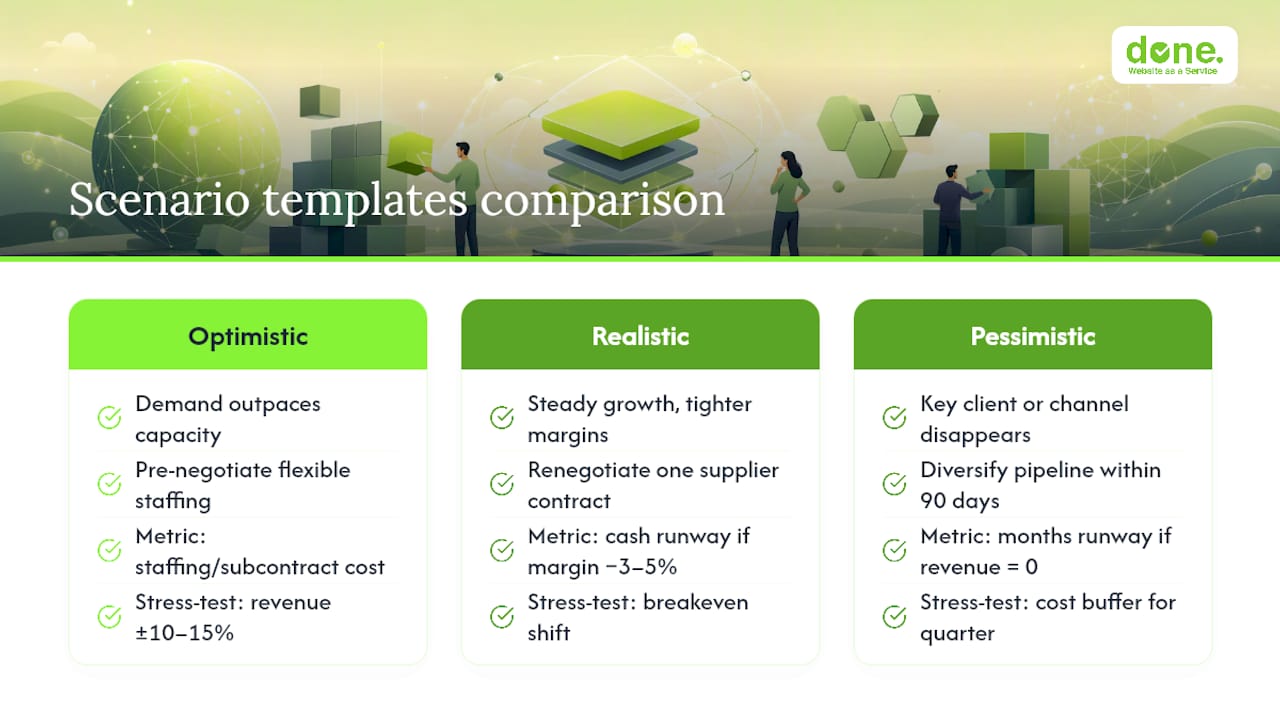
Realistic: “Steady growth, tighter margins.” Revenue grows modestly but input costs and wages rise in step. Immediate action: renegotiate at least one supplier contract this quarter. Metric to test: cash runway if margin compresses by 3 to 5 percentage points.
Pessimistic: “A key client or channel disappears.” Your largest customer leaves, or a sales channel gets disrupted by a platform or regulatory change. Immediate action: diversify pipeline sources within 90 days. Metric to test: how many months of runway remain if that revenue segment drops to zero.
Small business financial planning guidance recommends exactly this structure: build optimistic, realistic, and pessimistic projections and pair each with a short 30 to 90-day action plan so you validate assumptions early instead of waiting for a full financial year to prove you wrong.
For each scenario, run three financial prompts: how sensitive is revenue to a 10 to 15% swing, what cost buffer would absorb a bad quarter, and how far does your breakeven point move under each case.
What to monitor, and how often to check it
A scenario without a signpost is just an opinion. Convert each driver into something measurable, then assign a review cadence.
Take the PESTEL categories you scanned earlier and ask: what number would tell me this is happening?
| Signpost type | Example trigger | Review frequency |
|---|---|---|
| Financial | Revenue variance of 15% against forecast | Monthly |
| Market | New entrant or major customer behaviour shift | Quarterly |
| Operational | Supplier lead-time increases by 30% | Bi-monthly |
| Workforce | Staff turnover crosses an agreed threshold | Quarterly |
Log these somewhere everyone can see, not buried in one manager’s inbox. A shared Google Sheet or Excel file with one row per trigger, a status column, and a last-checked date is sufficient for most teams; SME practice notes consistently favour lightweight tracking tools over dedicated planning software, since complexity is what kills adoption.
- Assign one owner per signpost, not one owner for the whole document.
- Set a calendar reminder tied to the review frequency, not an ad hoc “check when we remember.”
- Archive triggers that fire or expire so the sheet doesn’t accumulate noise.
Turning a trigger into an action: the runbook
A scenario tells you what might happen. A runbook tells your team what to actually do the moment a signpost fires. Keep it to five fields: trigger, immediate action, owner, resources needed, and success metric.
- Trigger: state the exact number or event that activates this runbook.
- Immediate action: the first concrete step, not a strategy statement.
- Owner: one name, not a department.
- Resources: budget line, contact list, or tool needed to execute.
- Success metric: how you’ll know the response worked within 30 days.
Separate no-regret moves, actions worth taking regardless of which scenario unfolds, from scenario-specific responses that only make sense if a particular trigger fires. Renegotiating a supplier contract is usually a no-regret move. Hiring five extra staff is not.
Pro Tip: Before you close the workshop, confirm three things exist: an up-to-date contact list, a named budget line for at least one response, and a one-paragraph communications template for staff or customers. Runbooks fail more often from missing logistics than missing ideas.
Running the workshop: who to invite and when
Invite the owner, someone from finance, a customer-facing lead, someone from operations, and one external moderator. The moderator matters more than most teams expect: without an outsider in the room, groupthink tends to steer every scenario back toward “more of the same.”
Send a short pre-work pack a few days ahead: recent financials, customer feedback themes, and any competitor news worth flagging.
Split the work into two half-days rather than cramming it into one. The first session collects and clusters drivers. The second interprets them and drafts narratives. Case research on SME foresight work found that staged sessions consistently outperform single rushed meetings, largely because participants need time between sessions to actually reconsider assumptions rather than defend their first idea.
Four preconditions make the difference between a workshop that produces action and one that produces a forgotten PDF: diverse participants across roles and seniority, a deliberate challenge to the “business as usual” story, sessions staged over time rather than compressed, and visible leadership commitment to follow up afterwards.
Why this approach holds up in practice
Done has run structured workshops with SMEs across sectors since 2014, and the pattern repeats: teams that skip straight to “what should we do” without first naming their uncertainties end up with generic plans nobody revisits. The method above works because it forces a decision before it asks for a forecast.
A short scenario workshop with Done typically produces:
- One A4 page per business unit with 3 to 4 named scenarios.
- A trigger sheet with owners and review dates already assigned.
- A one-page runbook template your team can reuse for the next planning cycle.
Done’s AI and digital consulting work follows the same audit-first logic, GDPR-aware from the outset, whether the project is a website rebuild or an AI-driven workflow. We’ve seen this with clients repeatedly: the businesses that revisit their scenarios quarterly are the ones that adapt fastest when a trigger actually fires.
Beyond the 2×2: other scenario types worth knowing
The 2×2 matrix is the workhorse for SMEs because it’s fast and visual, but it isn’t the only method, and knowing the alternatives helps you pick the right tool for the decision in front of you.
Exploratory scenarios start from the present and ask “what could plausibly happen next?” This is what the 2×2 matrix produces: a set of divergent but credible futures built from today’s uncertainties. Most SME planning falls into this category because the goal is preparedness, not prescription.
Normative scenarios work backwards from a desired future. Instead of asking what might happen, you ask: “we want to double revenue by 2028, what sequence of events gets us there, and what has to be true along the way?” This suits businesses with a specific target already set, such as an acquisition goal or a market entry deadline.
Single-variable scenarios flex one driver at a time, useful when you have one dominant uncertainty (a single major client, a single regulatory change) rather than two independent ones. They’re simpler than a 2×2 but less useful when several forces are moving at once.
Trend-based scenarios extrapolate current data forward under different assumed rates of change, more useful for capacity planning than strategic pivots.
For most small businesses, starting with exploratory 2×2 work and layering in a normative pass once you have a clear target is the practical order. Trying all four methods in one sitting is how planning exercises collapse under their own ambition.
Making scenarios part of how you actually decide things
Scenarios that live in a folder and never touch a real decision were a waste of a half-day. The integration point is simple: every major decision, a hire, a lease renewal, a pricing change, should get checked against your existing scenario set before it gets approved.

Ask three questions before committing to anything significant: Which scenario does this decision assume we’re in? What happens to this decision if we’re wrong? Is there a version of this choice that works across more than one scenario?
That third question matters most. A decision that only works in your optimistic case is a bet, not a strategy. A decision that holds up reasonably well across two or three scenarios is far more defensible, even if it’s not the maximum-upside choice.
Practically, this means scenario review belongs on the same calendar as budget review, not as a separate, forgettable annual ritual. When a trigger fires, treat it as a formal input to the next planning meeting, not a footnote. Teams that treat scenario checks as informal chat rarely act on them in time.
If your business is weighing a channel shift, say moving budget from print to digital, or restructuring how customers reach you, running that decision through your existing scenarios first can reveal blind spots a straight ROI calculation misses. A clear digital strategy makes this integration easier because you already have a documented direction to test each scenario against.
Where scenario planning goes wrong
The most common failure is building scenarios once and never opening the document again. A scenario set with no review cadence is a historical artefact within two quarters, markets move, and stale scenarios give false confidence.
The second failure is writing scenarios that are all mild variations of the same story. Push the extremes further than feels comfortable; the value is in the range, not the midpoint.
Third, teams often skip the trigger step entirely. A narrative without a measurable signpost is just a story. Without a number attached, nobody knows when to act, and the scenario quietly becomes irrelevant.
Fourth, workshops without leadership follow-through produce plans that die on a shared drive. If the owner or senior leader doesn’t commit publicly to reviewing triggers on schedule, the team learns quickly that the exercise doesn’t matter, and engagement drops the next time round.
Finally, overcomplicating the matrix kills adoption. Five or six scenarios, dense financial models, and jargon-heavy quadrant names are harder to act on than three plain-language narratives with one trigger each. Keep the output usable by someone under time pressure, because that’s exactly who will need it.
Examples of scenario planning paying off
Retailers that ran supply-chain scenario exercises before major disruption events were able to pre-negotiate alternative suppliers rather than scrambling when lead times suddenly extended. The businesses that fared better weren’t the ones with the most detailed forecasts; they were the ones with a pre-agreed runbook naming who to call first.
In the hospitality sector, businesses that had already mapped a “reduced footfall” scenario were able to pivot to takeaway or delivery models faster than competitors treating the shift as a total surprise. The scenario itself didn’t predict the specific event, but it had already forced a conversation about which fixed costs could flex.
Smaller service businesses that build even a simple client-concentration scenario, “what if our top client leaves,” tend to diversify their pipeline earlier than those who don’t, simply because the exercise makes the risk visible on paper instead of living as a vague worry. That visibility is often the entire value of the exercise: not predicting the future accurately, but removing the excuse to ignore an obvious risk.
What actually matters once the workshop ends
Most scenario planning advice focuses on the framework, the matrix, the axes, the narrative structure, and barely mentions what happens after everyone leaves the room. That’s backwards. The framework takes an afternoon to learn. The habit of reviewing triggers monthly and actually changing a decision because of one takes discipline most SMEs don’t build without a nudge.
The overrated part of scenario planning is precision. Owners often think they need better forecasting models before they can start. They don’t. A rough 2×2 with honest uncertainty beats a detailed model built on false confidence, because the model gives you a number and the matrix gives you a range of thinking.
What’s underrated is the runbook. Everyone remembers to write scenarios; almost nobody writes down who does what when a trigger fires. That gap is where most “we saw it coming but didn’t act” stories originate.
If you take one thing from this: skip the perfect matrix and write the trigger sheet first. It forces the questions that actually matter, and it’s the piece most teams never get round to.
— Thomas
Key Takeaways
Practical scenario planning for SMEs works when a 2×2 matrix, one-page narratives, and named triggers replace complex forecasting.
| Point | Details |
|---|---|
| Start with the focal question | Frame a real decision with a 6 to 18-month timeframe before mapping any drivers. |
| Limit to two uncertainties | Score PESTEL drivers on impact and unpredictability to build the matrix axes. |
| Write a trigger for every scenario | A narrative without a measurable signpost gives no signal to act on. |
| Split the workshop across two sessions | Staged sessions with a diverse group and an external moderator outperform one rushed meeting. |
| Build the runbook before the model | Assign owner, resources, and a success metric per trigger so the team knows what to do when it fires. |
Sources
- Strategic foresight and barriers: The application of scenario planning in SMEs (Journal of Futures Studies)
- FSB | Scenario planning for small businesses: A practical guide to navigating uncertainty
- Scenario Analysis Methods for SMEs – Growth Shuttle
- Praktiniai verslo planavimo patarimai pradedantiesiems verslininkams