

Step by step branding guide for SMBs in 2026
August 3, 2026
Conversion optimisation tips for ecommerce: 12 high-impact fixes
August 5, 2026
TL;DR:
- A Luxembourg SME should prioritize a Brand Ikigai workshop before engaging a full-service agency, focusing on purpose first.
- Asking key questions about ownership, GDPR, timelines, and strategy-to-web integration ensures a successful partnership.
For a Luxembourg SME, the most effective approach is to hire a local, full-service digital agency that leads with a Brand Ikigai discovery workshop before touching a logo or a website. Done does exactly this: brand purpose first, visual identity second, GDPR-compliant web implementation third. That sequence matters because skipping the purpose step is the single most common reason SME rebrands fail to generate measurable results.
Before you shortlist any agency, run the Brand Ikigai exercise recommended by the House of Entrepreneurship. It clarifies what makes your business genuinely different, which then narrows your brief and reduces scope creep from day one.
Why this approach works for Central European SMEs:
- Brand Ikigai reconnects you with your core purpose and builds customer loyalty, not just a visual refresh.
- A local agency understands Luxembourg’s multilingual market, GDPR obligations, and funding programmes such as Fit4Start.
- Full-service delivery (strategy → identity → web) means one contract, one point of accountability, and no handover gaps between a branding studio and a separate web developer.
Table of Contents
- What questions should you ask a branding agency before hiring?
- How should you work with a branding agency after signing?
- Can your agency scale with your brand as you grow?
- How do agency pricing models differ, and what costs are often hidden?
- What should you watch for in an agency contract?
- Key takeaways
- Why brand purpose comes before the logo
- What a first engagement with Done looks like
- References and further reading
What questions should you ask a branding agency before hiring?
Ask these four questions in your first meeting. The answers will tell you more than any portfolio.
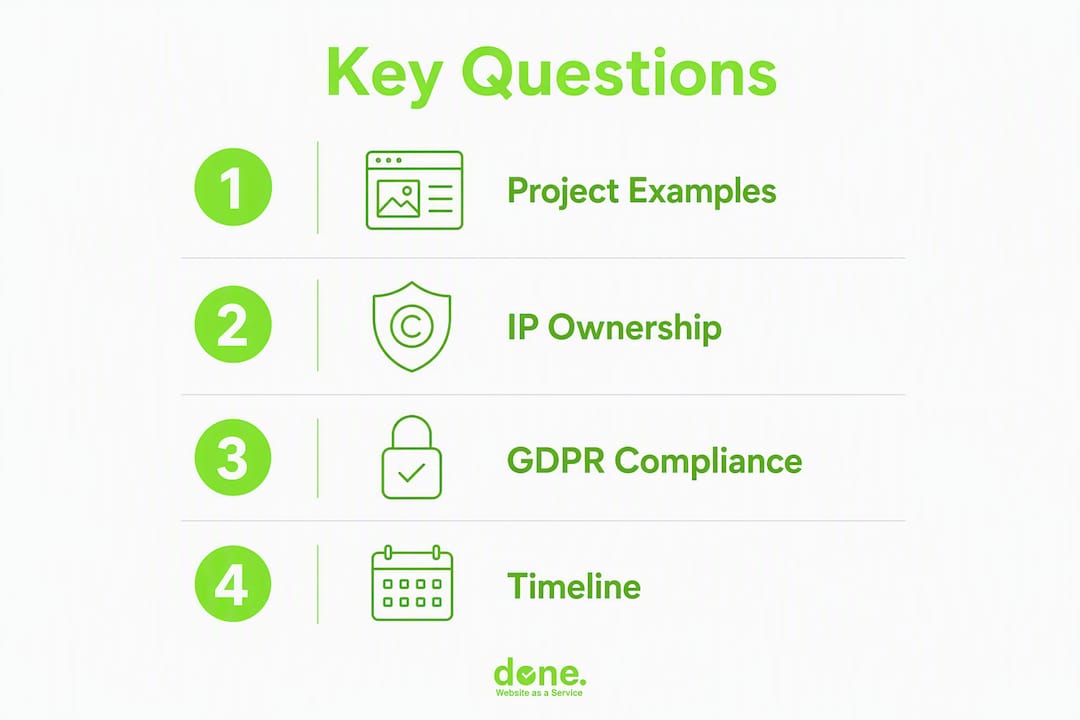
“Can you show me a project where the brand strategy directly shaped the website structure?” Agencies that treat brand and web as separate workstreams rarely produce coherent results. You want to see a case where the brand strategy fed the site architecture, the copy tone, and the calls to action.
“Who owns the assets at the end of the project?” IP assignment must be explicit in the contract. Logos, typefaces, brand guidelines, and website source files should transfer to you on final payment.
“How do you handle GDPR compliance during the build?” A credible agency will name specific practices: data-processing agreements, EU-hosted infrastructure, and consent management on the site.
“What does your timeline look like for a full brand and web project?” For an SME, a realistic timeline runs 10–16 weeks from discovery to launch. Anything under eight weeks for a full rebrand is a red flag.
How should you work with a branding agency after signing?
The post-hire phase is where most projects lose momentum. Set a weekly check-in cadence from week one, not when problems arise. Agree on a shared project tool (Notion, Basecamp, or a simple shared folder) before kick-off so feedback never lives in email threads.

Assign one internal decision-maker. Agencies slow down when feedback arrives from three different people with conflicting opinions. One voice, one approval.
Plan for two formal review gates: one after the brand strategy presentation and one after the visual identity draft. Everything else can be handled asynchronously.
Can your agency scale with your brand as you grow?
A branding agency that cannot support you post-launch is a one-off supplier, not a partner. Before signing, ask whether they offer a Website as a Service (WaaS) model or a retainer for ongoing brand governance. Done’s WaaS model, for instance, treats the website as a strategic tool in permanent development rather than a finished product handed over and forgotten.
Check their current client load. An agency with 40 active projects and a team of three will struggle to respond when you need a campaign asset in 48 hours.
How do agency pricing models differ, and what costs are often hidden?
Three models dominate the market:
- Fixed-price project: predictable budget, but scope changes cost extra. Suitable for a defined rebrand with clear deliverables.
- Monthly retainer: ongoing access to the team. Works well post-launch for brand governance and digital marketing.
- Time and materials: flexible, but requires tight scope discipline from your side.
Hidden costs to watch for: stock photography licences, font licences, hosting fees, CMS training, and third-party tool subscriptions. Ask for a full cost breakdown, not just the headline fee.
What should you watch for in an agency contract?
Three clauses deserve close attention before you sign anything.
IP assignment must state that all deliverables transfer to you on final payment, not on a rolling licence. If the agency retains ownership of the logo, you cannot use it freely if you switch suppliers.
Revision rounds should be capped and defined. “Unlimited revisions” sounds generous but creates scope disputes. Two structured rounds per deliverable is standard practice.
Termination terms matter. A 30-day notice period with asset handover on exit is reasonable. A 90-day lock-in with no asset release is not.
Key takeaways
A Brand Ikigai–first, agency-delivered approach gives Luxembourg SMEs a measurable brand foundation and a GDPR-compliant web presence from a single accountable partner.
| Point | Details |
|---|---|
| Start with Brand Ikigai | Run the House of Entrepreneurship’s Brand Ikigai exercise before briefing any agency. |
| Ask the four key questions | IP ownership, GDPR practices, timeline, and strategy-to-web continuity are non-negotiable. |
| Budget for the full scope | A brand and web project for an SME in Central Europe typically runs 10–16 weeks. |
| Watch the contract clauses | IP assignment, capped revision rounds, and a 30-day exit clause protect you. |
| Done as your partner | Done delivers Brand Ikigai workshops, visual identity, and GDPR-compliant WaaS implementation under one contract. |
Why brand purpose comes before the logo
Most SMEs I speak with arrive with a brief that starts at the logo. That is understandable, but it is the wrong starting point. A logo is the output of a brand strategy, not the strategy itself. When you skip the purpose work, you end up with a visual identity that looks professional but says nothing specific about why your business exists and who it genuinely serves.
The Brand Ikigai methodology from the House of Entrepreneurship is one of the most practical tools I have seen for this. It forces a business to sit at the intersection of what it does well, what the market needs, and what makes it distinct. That intersection becomes the brief. Everything else, the name, the colours, the website structure, follows from it.
We have seen this with clients in Luxembourg’s financial services and professional services sectors. The ones who invest a half-day in purpose discovery before the visual work begins end up with brands that their teams can actually explain to a prospect. That coherence shows up in digital branding outcomes too: clearer positioning leads to better conversion rates on the website.
On GDPR: Done assigns all brand assets and website source files to the client on final payment, processes all project data on EU-hosted infrastructure, and includes a data-processing agreement as standard. These are not optional extras.
What a first engagement with Done looks like
Done’s first step is a Brand Ikigai discovery workshop, typically a half-day session that produces a written brand purpose statement, a positioning map, and a prioritised deliverables list. From there, the project moves through visual identity, brand guidelines, and web implementation under a single contract with transparent, fixed pricing and no setup fees.
Bring a one-page brief to your first conversation: your objective, your primary audience, any GDPR or data-sovereignty constraints, and two or three reference sites you admire. Done will scope the project from that starting point and give you a clear timeline and cost range before any commitment is made.
Contact Done to book a discovery session.
References and further reading
The resources below are worth consulting before you brief an agency or sign a contract.
House of Entrepreneurship (Luxembourg)
The Brand Ikigai guide is the primary source for the discovery methodology referenced throughout this article. The same publication includes practical templates for business creation, procurement checklists, and notes on service vouchers available to Luxembourg SMEs for marketing and client management services.
Done resources
- Branding strategy guide for SMBs: deeper methodology for the brand purpose phase.
- 90-day branding action plan: pairs with the checklist above for post-launch execution.
- Why invest in digital branding: ROI framing for stakeholder conversations.
Verifying case studies and testimonials before you hire:
- Ask for two client references you can contact directly, not just written testimonials.
- Request a before-and-after metric: traffic, leads, or conversion rate, with a timeframe.
- Check that the agency’s portfolio includes projects in your sector or of comparable complexity.
- Confirm the named projects were delivered by the current team, not a previous one.