

Why measure website performance: a practical SMB guide
June 8, 2026
SEO best practices for SMBs: 2026 guide
June 10, 2026
TL;DR:
- Inbound marketing attracts customers by providing valuable content tailored to their needs, creating long-term engagement. It involves four stages: attract, convert, close, and delight, with each step generating measurable results and growth. Combining inbound efforts with targeted outbound activities allows SMBs to build authority, reduce costs, and achieve sustainable lead generation over time.
Inbound marketing is defined as the practice of attracting customers by creating and sharing helpful, relevant content that aligns with their interests and buying journey, earning their engagement rather than forcing it. Unlike paid advertising or cold outreach, inbound marketing pulls prospects toward your business because the content genuinely answers their questions. Platforms like HubSpot and Salesforce have built entire ecosystems around this methodology, and for good reason: content-driven attraction consistently produces higher-quality leads than interruptive tactics. For small and medium-sized businesses in particular, inbound marketing offers a way to compete with larger budgets by building authority and trust over time. This guide explains how it works, what separates it from outbound methods, and how to implement it without wasting effort.
What is inbound marketing and why does it matter?
Inbound marketing is a methodology that attracts potential customers by being present and useful when they are actively searching for solutions, rather than pushing messages at people who have not asked for them. The US Chamber of Commerce describes this as earning attention through value, not buying it through interruption. This distinction matters enormously for businesses with limited marketing budgets, because every piece of content you create continues working long after you publish it.
The methodology sits within the broader discipline of digital marketing, but it has a specific orientation: it is pull-based, not push-based. A well-written blog post, a useful video tutorial, or a detailed guide can attract qualified visitors to your website for months or even years. Paid ads stop the moment your budget runs out. Inbound content does not.
For business owners and marketing professionals, the practical implication is straightforward. When a prospect searches for “how to manage payroll in Luxembourg” and finds your article, they arrive already interested in the topic you solve. That is a fundamentally different conversation than interrupting someone on social media with a banner they did not request.
What are the key stages of inbound marketing?
Inbound marketing consists of four stages: Attract, Convert, Close, and Delight. Each stage has a distinct goal, a set of tactics, and measurable success indicators. Understanding how they connect is what separates businesses that generate consistent leads from those that publish content without results.

| Stage | Goal | Key tactics | Success metric |
|---|---|---|---|
| Attract | Draw in qualified visitors | SEO blogging, social media, video | Organic traffic, impressions |
| Convert | Turn visitors into leads | Landing pages, CTAs, lead magnets | Conversion rate, form submissions |
| Close | Turn leads into customers | Email nurturing, lead scoring, CRM | Sales qualified leads, close rate |
| Delight | Turn customers into advocates | Onboarding content, surveys, support | Retention rate, referrals |
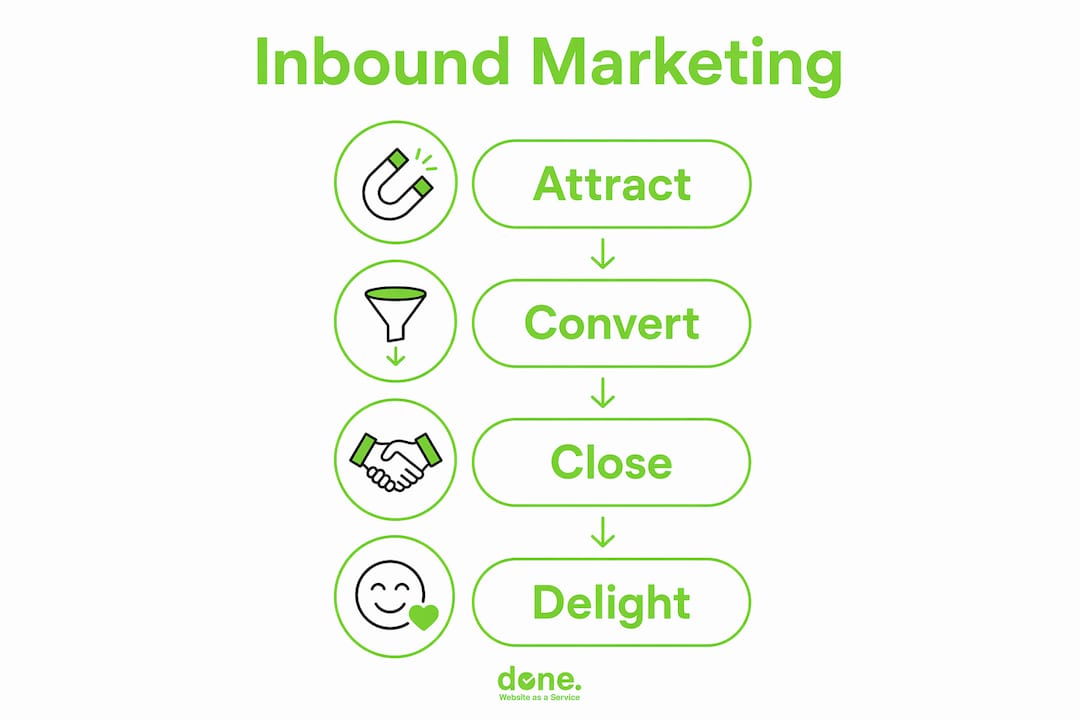
The Attract stage is where most businesses start. You publish content that answers the questions your ideal customers are already typing into Google. SEO-optimised blog posts, YouTube tutorials, and LinkedIn articles all serve this purpose. The goal is not volume of traffic but relevance. A hundred visitors who are genuinely interested in your service are worth more than ten thousand who are not.
The Convert stage is where many businesses lose momentum. Attracting visitors is only useful if you give them a clear next step. This means landing pages with a single focused offer, calls to action that match the visitor’s intent, and lead magnets such as e-books, checklists, or webinars that provide enough value to justify sharing an email address.
The Close stage is where marketing hands off to sales, or where automation takes over. Lead nurturing sequences, CRM tools like HubSpot or Pipedrive, and lead scoring help your team focus on prospects who are genuinely ready to buy. The Delight stage is often overlooked, but coordinating across content, sales, and support teams to serve existing customers is what drives referrals and repeat business.
Pro Tip: Map each piece of content to a specific stage before you create it. If you cannot answer “which stage does this serve and what action should the reader take next?”, the content will not convert.
Inbound vs outbound marketing: what is the real difference?
Inbound earns attention with valuable content, while outbound buys attention through paid ads, cold calls, and direct mail. This is not a philosophical distinction. It has direct consequences for your cost per lead, lead quality, and long-term return on investment.
Outbound marketing interrupts. A television advertisement, a cold email, or a display banner reaches people regardless of whether they are interested in your offer. Some percentage will respond, but the majority will ignore or resent the intrusion. Inbound marketing, by contrast, focuses on attracting prospects who choose to respond because of genuine interest. The conversion rates are typically higher and the sales cycle shorter, because the prospect has already done research before they contact you.
The table below summarises the core differences:
| Factor | Inbound marketing | Outbound marketing |
|---|---|---|
| Attention model | Earned through content | Purchased through ads |
| Lead quality | Higher intent, self-qualified | Mixed intent, broad audience |
| Cost over time | Decreasing (content compounds) | Fixed or increasing |
| Speed to results | Slower (3 to 12 months) | Faster (immediate reach) |
| Trust building | High (educational approach) | Lower (interruptive approach) |
The compounding returns effect is one of the most underappreciated advantages of inbound. Quality content continues attracting leads long after publication, unlike paid efforts that stop the moment your budget ends. A blog post published today can still generate enquiries two years from now. A Google Ads campaign generates nothing the day you pause it.
That said, outbound is not the enemy. For businesses that need revenue quickly, combining inbound and outbound reduces the risk that inbound alone is too slow for short-term goals. Use outbound to fill the pipeline now while inbound builds long-term authority.
Pro Tip: If you are just starting out, allocate 70% of your marketing effort to inbound content and 30% to targeted outbound. As your content library grows and organic traffic increases, you can shift the balance further toward inbound.
What are effective inbound marketing strategies for lead generation?
Effective inbound marketing strategies share one characteristic: they match content to the specific questions and concerns a prospect has at each stage of their buying journey. This is called content-to-intent mapping, and aligning content and CTAs with buyer journey stages is what separates content that converts from content that simply gets read.
The following tactics form the core of a practical inbound programme:
- SEO blogging. Publish articles that answer the specific questions your prospects search for. Use tools like Google Search Console or Semrush to identify high-intent keywords. Prioritise long-tail queries such as “inbound marketing for small business Luxembourg” over broad terms.
- Video content. Short explainer videos on LinkedIn or YouTube build trust faster than text alone. A two-minute video answering a common client question can outperform a 1,500-word article for certain audiences.
- Lead magnets. E-books, templates, checklists, and webinars give prospects a reason to share their contact details. The offer must be specific and immediately useful. “10 questions to ask before hiring a web agency” converts better than “Download our free guide.”
- Email nurturing sequences. Once a prospect converts, a series of automated emails keeps your business relevant while they evaluate options. Each email should deliver value, not just promote your services.
- Social media engagement. LinkedIn is particularly effective for B2B inbound. Publishing thought leadership posts, commenting on industry discussions, and sharing client results all build the authority that makes prospects choose you.
- Marketing automation. Platforms like HubSpot, ActiveCampaign, and Mailchimp allow you to trigger personalised content based on a prospect’s behaviour. A visitor who downloads your pricing guide should receive different follow-up content than someone who read a beginner’s blog post.
You can explore proven inbound examples for SMBs to see how these tactics work in practice across different sectors.
The most common mistake businesses make is creating content without a conversion path. Every piece of content needs a next step. A blog post should link to a related guide or a contact form. A video should direct viewers to a landing page. Without this structure, you attract visitors but convert none of them.
Here is a practical sequence for building your first inbound programme:
- Define two or three buyer personas based on your best existing clients.
- Map the questions they ask at each stage of the buying journey.
- Create one piece of content per stage per persona.
- Build a landing page with a lead magnet for the Convert stage.
- Set up a three-email nurture sequence triggered by the lead magnet download.
- Measure traffic, conversion rate, and email open rates after 90 days.
- Refine based on what is working and expand from there.
Pro Tip: Do not try to cover every channel at once. Pick one content format you can produce consistently, whether that is written articles, short videos, or a monthly newsletter, and do it well for six months before adding another channel.
How do you measure inbound marketing success?
Measuring inbound marketing requires tracking metrics at each stage of the funnel, not just total website traffic. Traffic is a vanity metric unless it converts. The KPIs that actually matter are conversion rate, lead quality, cost per lead, and customer retention.
The key metrics to monitor are:
- Organic traffic growth. Month-on-month increase in visitors arriving from search engines. This confirms your SEO content is working.
- Conversion rate. The percentage of visitors who complete a desired action, such as filling in a contact form or downloading a lead magnet. A rate below 1% on a landing page usually indicates a mismatch between the content and the offer.
- Lead quality score. Not all leads are equal. Track how many marketing-qualified leads (MQLs) become sales-qualified leads (SQLs). A high volume of low-quality leads suggests your content is attracting the wrong audience.
- Email engagement. Open rates and click-through rates on nurture sequences reveal whether your follow-up content is relevant. An open rate below 20% typically signals a subject line or timing problem.
- Customer acquisition cost (CAC). Divide total marketing spend by the number of new customers acquired. Inbound should reduce this figure over time as content assets accumulate.
Without ongoing content maintenance, inbound’s compounding effects stall. Search algorithms change, buyer questions evolve, and competitors publish newer content. A quarterly content audit, where you update statistics, refresh examples, and improve internal linking, is not optional. It is what keeps your content ranking and converting.
Realistic timeframes matter here. Most businesses see meaningful organic traffic growth between three and six months after starting a consistent inbound programme. Lead generation from content typically becomes reliable at the nine to twelve month mark. This is not a reason to delay. It is a reason to start now.
Pro Tip: Set up a simple monthly dashboard in Google Looker Studio or Notion that tracks your five core KPIs. Reviewing it monthly takes 20 minutes and prevents you from making decisions based on gut feeling rather than data.
What are the common challenges with inbound marketing?
Inbound marketing works, but it is not effortless. The businesses that abandon it usually do so because of predictable, avoidable problems. Understanding these challenges before you start saves significant time and budget.
The most frequent obstacles and their solutions are:
- Slow early results. Inbound takes time. Businesses expecting leads within four weeks will be disappointed. Set a 90-day review point for initial data and a 12-month horizon for full assessment.
- Content creation bottlenecks. Producing consistent, high-quality content is the hardest operational challenge. Solve this by batching content creation, repurposing existing material across formats, or working with a specialist agency.
- Misalignment between marketing and sales. Inbound requires coordination across content, social media, and sales teams. If sales does not follow up on inbound leads promptly or does not understand the content the prospect has already consumed, conversion rates suffer. A shared CRM and a defined handoff process fix this.
- Lack of a clear conversion path. Publishing content without landing pages, CTAs, or lead magnets means you attract visitors but capture no leads. Every content asset needs a next step.
- Treating inbound as a one-off project. Inbound is a continuous system, not a campaign. Businesses that publish 20 articles and then stop see results plateau. Consistency compounds.
Inbound and outbound complement each other when the challenges of slow lead flow become acute. If your pipeline needs filling quickly, a targeted LinkedIn outreach campaign or a Google Ads push can generate near-term revenue while your inbound content matures. The two approaches are not mutually exclusive. They serve different time horizons.
For businesses generating leads online for the first time, the practical advice is to start small, measure everything, and build from what works rather than trying to replicate a large brand’s content operation from day one.
Key takeaways
Inbound marketing generates higher-quality leads than outbound because it attracts prospects who are already searching for what you offer, producing compounding returns that grow over time.
| Point | Details |
|---|---|
| Core definition | Inbound marketing earns attention through relevant content rather than paid interruption. |
| Four-stage framework | Attract, Convert, Close, and Delight form a connected system where each stage feeds the next. |
| Compounding returns | Quality content continues attracting leads long after publication, unlike paid ads that stop immediately. |
| Measurement discipline | Track conversion rate, lead quality, and CAC rather than traffic alone to assess real performance. |
| Balanced approach | Combining inbound with targeted outbound reduces revenue risk, especially in the first 12 months. |
Why inbound marketing is the right long-term bet for most SMBs
I have worked with SMB clients across Luxembourg and broader Europe for over a decade, and the pattern is consistent. Businesses that invest in inbound marketing for 12 months and stick with it almost always outperform those that rely solely on paid advertising. The ones that struggle are not failing because inbound does not work. They are failing because they expected it to work like a paid campaign, with immediate, predictable returns.
The honest reality is that inbound marketing is a slow build with an asymmetric payoff. The first three months feel like shouting into a void. By month six, you start seeing traffic. By month twelve, you have content assets that generate enquiries while you sleep. That is a fundamentally different business position than one where every lead requires a fresh advertising spend.
What I tell clients is this: your content library is a business asset, in the same way your website or your client relationships are assets. A well-written article that ranks on page one of Google for a relevant query is worth real money. It does not appear on your balance sheet, but it should.
The other thing I have observed is that inbound marketing forces a discipline that benefits the whole business. When you have to explain clearly what problem you solve and for whom, your sales conversations improve. Your website gets sharper. Your proposals get better. The process of creating useful content makes you a clearer thinker about your own offer.
One caution: do not confuse activity with progress. Publishing three articles a week that nobody reads is not inbound marketing. It is content production without strategy. Start with a digital marketing strategy that defines your audience, their questions, and your conversion path. Then create content within that framework.
— Thomas
How Done can help you build an inbound marketing system
At Done, we have helped over 150 SMBs across Luxembourg and Europe build inbound marketing systems that generate qualified leads without constant ad spend. Our approach combines content strategy, website optimisation, and marketing automation workflows into a single, measurable programme tailored to your business.
Whether you are starting from scratch or looking to improve an existing content programme, we can audit your current setup, identify the gaps, and build a system that compounds over time. We work with businesses in professional services, e-commerce, technology, and regulated sectors where GDPR-compliant lead generation is non-negotiable. If you want to understand how inbound marketing can work specifically for your business, get in touch with the Done team for a practical, no-obligation conversation.
FAQ
What is inbound marketing in simple terms?
Inbound marketing is the practice of attracting customers by creating content that answers their questions and solves their problems, rather than interrupting them with advertisements. Prospects find you because your content is useful, not because you paid to appear in front of them.
How long does inbound marketing take to show results?
Most businesses see meaningful organic traffic growth between three and six months, with reliable lead generation typically developing between nine and twelve months. The timeline depends on content consistency, SEO quality, and how competitive your sector is.
What is the difference between inbound and outbound marketing?
Inbound earns attention through valuable content that prospects seek out, while outbound purchases attention through paid ads, cold calls, and direct mail. Inbound produces higher-intent leads over time; outbound delivers faster but more expensive reach.
What are the most effective inbound marketing techniques?
SEO blogging, lead magnets such as e-books and webinars, email nurturing sequences, and marketing automation are the core techniques. Content-to-intent mapping, matching each piece of content to a specific buyer journey stage, is what makes these techniques convert rather than simply attract.
Is inbound marketing suitable for small businesses?
Inbound marketing is particularly well-suited to small businesses because quality content compounds over time, reducing reliance on paid advertising budgets. The key is consistency and a clear conversion path, not the volume of content produced.