

Intelligent automation: A practical guide for European SMEs
May 4, 2026
Document processing AI: unlock efficiency for European SMEs
May 6, 2026
TL;DR:
- Fewer than one in three medium-sized EU businesses have adopted AI technologies, highlighting significant adoption gaps and competitive risks. Implementing a structured, evidence-based approach—starting with readiness assessments, pilot programs, and gradual rollout—can help SMEs improve efficiency while safeguarding data sovereignty. Access to EU and Luxembourg support mechanisms, along with careful tool selection and change management, is essential for sustainable AI integration.
Fewer than one in three medium-sized EU businesses have adopted AI technologies, despite the tools being more accessible and affordable than at any previous point in history. Only 17% of small enterprises across the EU were using AI in 2025, a figure that should give every business owner pause. The gap between what is possible and what is actually being implemented represents both a competitive risk and a missed opportunity. This article cuts through the noise to give you a clear, structured path to AI adoption that genuinely improves efficiency while keeping your data firmly under your control.
Table of Contents
- Understanding the current state of AI adoption in SMEs
- Practical frameworks for SME AI adoption: Evidence-based approaches
- Key support mechanisms: Luxembourg and EU initiatives for SMEs
- Balancing efficiency with data sovereignty: Choosing the right AI tools
- From pilot to full implementation: Lessons and measurable outcomes
- Why most SME AI adoption fails — and what actually works
- Unlock support for SME AI adoption in Luxembourg and Europe
- Frequently asked questions
Key Takeaways
| Point | Details |
|---|---|
| SME adoption lag | AI adoption rates among SMEs remain far behind large enterprises, presenting an untapped opportunity for efficiency gains. |
| Structured interventions | Evidence-based frameworks like readiness workshops are proven to turn AI interest into practical implementation for SMEs. |
| Government support | Luxembourg and EU initiatives offer sandboxes, packages, and consultant-led modules to help SMEs adopt AI securely and effectively. |
| Data sovereignty focus | Ecosystem approaches and careful governance enable SMEs to maintain strong data privacy when integrating AI solutions. |
| Measure and iterate | Ongoing measurement and pilot-based rollouts are key for achieving lasting transformation and reliable ROI. |
Understanding the current state of AI adoption in SMEs
The numbers tell a stark story. According to Eurostat, only 17% of small enterprises were using AI technologies in 2025, compared with 30.36% of medium enterprises and a significantly higher 55.03% for large enterprises. That means large businesses are adopting AI at more than three times the rate of their smaller counterparts. This is not simply a matter of resources. It reflects a structural gap in guidance, confidence, and practical frameworks.
| Enterprise size | AI adoption rate (2025) |
|---|---|
| Small enterprises | 17% |
| Medium enterprises | 30.36% |
| Large enterprises | 55.03% |
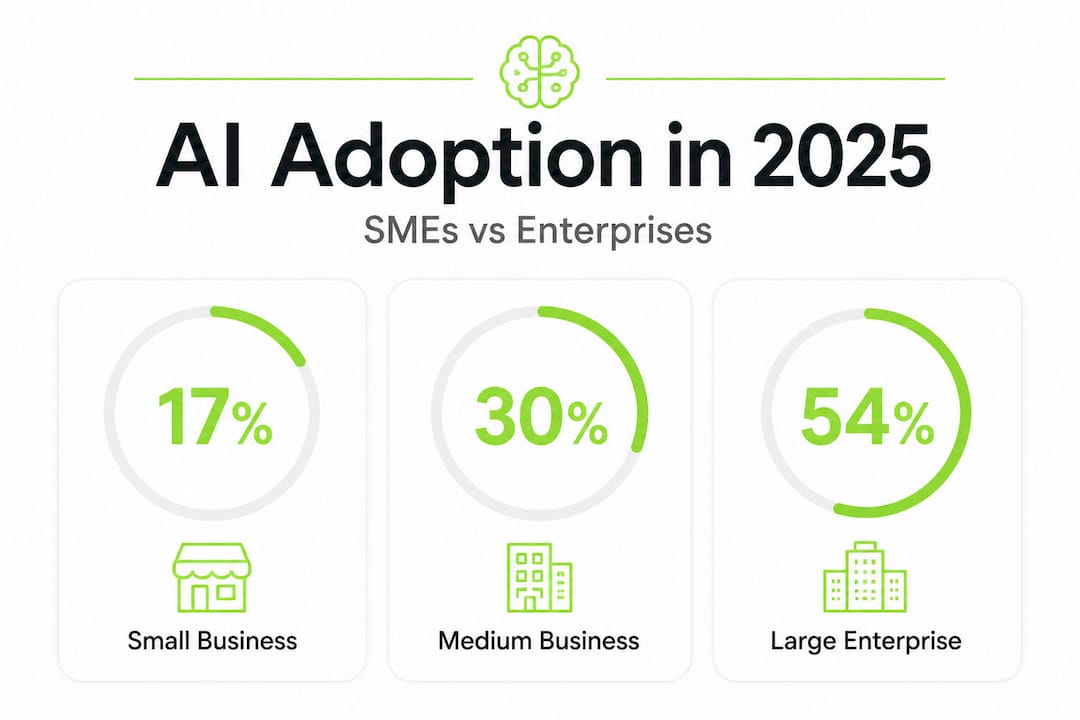
This competitive gap matters enormously. Large businesses are using AI to automate repetitive tasks, generate marketing content, analyse customer data, and streamline operations. Every quarter that your business waits to adopt similar tools is a quarter in which your larger competitors widen their efficiency advantage.
The most commonly used AI technologies among European SMEs include:
- Natural language processing (NLP) for customer communication and document handling
- Machine learning tools for data analysis and forecasting
- Generative AI for content creation, summarisation, and drafting
- Robotic process automation (RPA) for repetitive administrative workflows
- AI-assisted marketing tools for audience targeting and campaign optimisation
What makes this moment particularly significant is that the cost barrier has dropped dramatically. Many of the best AI tools for SMEs are now available as affordable subscription services, with no requirement for an in-house data science team. The challenge is no longer access. It is knowing where to start and how to ensure that your adoption is structured, secure, and sustainable.
“The competitive risk of non-adoption is no longer theoretical. Businesses that delay structured AI integration are actively allowing the efficiency gap to widen in favour of those who act now.”
Having established the scale of the challenge, we move to how SMEs can practically start their adoption journey.
Practical frameworks for SME AI adoption: Evidence-based approaches
The single most effective thing an SME can do is follow a structured, evidence-based framework rather than adopting tools reactively in response to hype. Research from the Stanford Digital Economy Lab is currently testing a practical, low-cost intervention model that begins with a half-day workshop to assess digital readiness and co-develop a tailored AI action plan. The results of this approach are instructive for any SME owner considering where to begin.
Why does the workshop model work? Because most SMEs do not fail at AI adoption due to a lack of enthusiasm. They fail due to a lack of structured planning. A business that rushes to implement a generative AI writing tool without first auditing its existing workflows will inevitably find that the tool does not integrate cleanly, the team does not trust the outputs, and the initial investment yields little measurable return.
Here is a numbered framework that reflects the best evidence-based practice:
- Conduct a digital readiness assessment. Before any tool is selected, evaluate your current processes, data infrastructure, and team capabilities. Identify which tasks consume the most time and which are most repetitive.
- Co-develop an AI action plan. Define specific objectives, prioritise two or three high-impact use cases, and set measurable targets for each. Vague goals produce vague results.
- Pilot access to generative AI tools. Choose one tool and run a structured pilot with a small team for four to eight weeks. Collect feedback and usage data throughout.
- Measure and iterate. After the pilot, assess outputs against your original targets. Refine the approach, resolve friction points, and then consider scaling.
- Roll out gradually with training and support. Introduce tools to wider teams with clear training, documentation, and a named internal champion to sustain momentum.
This scaffolding approach is particularly valuable for SMEs because it does not require a dedicated AI team or a large technology budget. It uses what you already have, structured systematically.
| Approach | What it involves | Best suited for |
|---|---|---|
| Ad hoc tool adoption | Trying tools as they appear | Businesses with high tech literacy and dedicated IT support |
| Structured pilot programme | Readiness check, action plan, measured pilot | Most SMEs, especially those new to AI |
| Full AI strategy rollout | Comprehensive AI audit, multi-department implementation | Medium enterprises with dedicated digital leads |
Pro Tip: When selecting your first AI use case, choose something with a clearly measurable output, such as time spent drafting emails or the number of customer enquiries handled per hour. Measurable baselines make it far easier to demonstrate value to sceptical stakeholders within your team.
Understanding using AI tools in marketing is one excellent starting point, since marketing workflows are often highly repetitive and well-suited to early automation. You can also explore European AI strategies for SMEs to see how peer businesses across the continent are structuring their adoption journeys.
Building on practical evidence, let us examine policy and ecosystem-level support.
Key support mechanisms: Luxembourg and EU initiatives for SMEs
If you are running a business in Luxembourg or operating within the broader EU market, you have access to a concrete set of institutional support mechanisms designed specifically to reduce the risk of AI adoption. These are not abstract policy commitments. They are practical tools available to you now.
The European Commission’s Apply AI Strategy outlines EU-wide programmes intended to speed AI uptake, with specific emphasis on SMEs and access to high-quality, structured data. At the national level, Luxembourg’s AI strategy references several mechanisms directly targeted at smaller businesses, including:
- AI sandboxes: Controlled environments where SMEs can test AI applications with real data without regulatory exposure. These act as innovation safe spaces, letting you experiment before you commit.
- SME Package for AI: A structured entry-level package that gives businesses a clear, supported first step into AI integration without requiring significant upfront investment.
- Fit 4 Digital – AI: A consultant-supported programme that helps SMEs define their specific challenges, set objectives, prioritise actions, assess feasibility, and build a roadmap that includes cost estimates and projected ROI.
- Digital Experience Centres: Physical and virtual hubs where businesses can see AI tools in action, ask questions, and test solutions in a supported environment.
- EU Data Union Strategy: An initiative focused on giving businesses structured access to high-quality datasets, which is foundational to training and customising AI tools effectively.
What makes the consultant-led roadmap model particularly powerful is the ROI dimension. Many SME owners are hesitant about AI investment because they cannot quantify the return. The Fit 4 Digital approach directly addresses this by building projected cost savings and efficiency gains into the planning stage, giving decision-makers a business case before any significant expenditure occurs.
Pro Tip: If you are based in Luxembourg, contact the Luxinnovation agency to access the Fit 4 Digital programme. The consultant support is subsidised, meaning your out-of-pocket cost for the initial feasibility and roadmap work is significantly lower than commissioning this independently.
For expert guidance on navigating these programmes, digital consulting for Luxembourg SMBs can help you map the right support mechanism to your specific situation. You can also read about the digital advantages for Luxembourg SMEs to understand the broader ecosystem in which these AI programmes sit.
Support is just one part. Selecting the right tools is another foundational step.
Balancing efficiency with data sovereignty: Choosing the right AI tools
Data sovereignty is the question that keeps many Luxembourg and European SME owners from moving forward with AI. The concern is legitimate. When you feed customer data, financial records, or proprietary business information into a cloud-based AI platform, you need to know precisely where that data is processed, how long it is retained, and who has access to it. Getting this wrong is not just a compliance issue. It is a reputational and legal risk.
The good news is that the EU ecosystem described above, particularly the Luxembourg AI sandbox model, provides a concrete pathway to de-risk adoption and tighten governance around data flows. But you can also take independent steps to ensure you choose tools that respect your obligations.
Here is what to look for when vetting any AI tool for EU deployment:
- GDPR compliance documentation: The provider must clearly state how personal data is handled, stored, and deleted. If this information is buried in general terms of service, treat that as a warning sign.
- Data residency options: Look for providers that offer EU-based data storage or, better still, on-premise deployment options. Data processed outside the EU can trigger cross-border transfer obligations under GDPR.
- Processing agreements: Any AI provider processing personal data on your behalf must sign a Data Processing Agreement (DPA). Do not use any tool that refuses to provide one.
- Access controls and audit logs: Enterprise-grade AI tools should allow you to control who within your team can access specific features, and should produce audit logs for compliance reviews.
- Vendor transparency: Choose providers who publish their AI model policies, subprocessor lists, and security certifications such as ISO 27001 or SOC 2.
Our AI GDPR guide for SMEs covers this topic in significant depth and is worth reading before you finalise any tool selection.
Pro Tip: For businesses in data-sensitive sectors such as legal services, healthcare, accounting, or financial advice, consider private on-premise AI deployment rather than cloud-based tools. This keeps all data processing within your own infrastructure, eliminating third-party data exposure entirely. The upfront investment is higher, but the governance advantage is substantial.
One common pitfall is selecting tools based on popularity rather than fit. A tool that works well for a large e-commerce company in the United States may not be suitable for a Luxembourg legal firm operating under strict professional secrecy obligations. The evaluation criteria above should always take priority over brand recognition or marketing claims.
Having covered the step-by-step process, let us distil lessons from real-world pilots and expert insight.
From pilot to full implementation: Lessons and measurable outcomes
Moving from a successful pilot to full implementation is where many SMEs stumble. The enthusiasm that drives a small pilot can quickly dissipate when the wider rollout encounters resistance from team members who were not involved in the initial phase, or when the process of integrating a new tool with existing systems proves more complex than anticipated.

The Stanford Digital Economy Lab’s model is informative here: outcomes are assessed using survey and administrative data over time following adoption pilots. This matters because it underscores that measurement is not a one-time activity. It is an ongoing process that informs every subsequent iteration.
Here is a practical sequence for moving from pilot to full implementation:
- Define your KPIs before the pilot ends. Identify two to four specific, measurable indicators that you will track throughout implementation. Examples include: time saved per task, error rate reduction, customer response time, or volume of content produced per week.
- Gather evidence during the pilot. Use surveys, time-tracking tools, and output logs to collect data systematically. Anecdotal feedback is useful, but quantitative data is what justifies continued investment.
- Identify integration requirements. Before rolling out to the full team, map how the AI tool needs to connect with your existing software, including your CRM, email platform, or document management system.
- Address change management early. Communicate clearly with your team about what the tool does, what it does not do, and how it affects their roles. People adopt tools they understand and trust.
- Scale incrementally with review checkpoints. Rather than switching everyone over simultaneously, introduce the tool department by department, with a formal review at each stage.
- Build in ongoing optimisation. AI tools improve when they are used consistently and when their outputs are reviewed and refined. Assign a team member to monitor performance and feed improvements back into the process.
“The businesses that sustain AI adoption are those that treat implementation as a continuous process, not a one-time project. The pilot is the beginning, not the proof of concept.”
For SMEs looking to integrate AI into content production and lead generation workflows, AI content generation for SMEs offers practical guidance on measuring content-related ROI and iterating effectively.
The most common barriers at this stage are resource shortage, technical integration complexity, and internal resistance to change. None of these are insurmountable, but all of them require deliberate management. Businesses that anticipate these challenges in the planning phase recover far more quickly when they arise.
Why most SME AI adoption fails — and what actually works
After working with businesses across Luxembourg and Europe on digital and AI transformation, we have observed a consistent pattern. The businesses that struggle with AI adoption are almost never the ones that lack access to tools. They are the ones that adopted tools without a plan.
The most prevalent failure mode is what we call “AI for AI’s sake.” A decision-maker reads about a promising new tool, purchases a subscription, and asks a team member to start using it. There is no readiness assessment, no defined objective, and no measurement framework. Six months later, the subscription is still active but no one is using the tool consistently, and no tangible benefit has been recorded. The business concludes that AI is “not ready” for them, when in reality the planning was simply not ready for AI.
The second most common failure is under-investing in change management. AI tools change how people work. That is the point. But human beings are not naturally enthusiastic about changes to their routines, especially when those changes feel imposed rather than explained. The SMEs that succeed in AI adoption treat the human element as seriously as the technical one. They involve team members in the pilot, gather genuine feedback, and address concerns openly rather than dismissing them.
Data governance is another area where SMEs consistently underestimate the importance of early investment. Businesses that establish clear policies around data use, tool access, and output review before they scale are in a far stronger position than those that try to retrofit governance after the fact. Governance is not a constraint on AI adoption. It is what makes adoption sustainable.
The editorial reality is this: structured frameworks, bespoke planning, and measured pilots are not bureaucratic obstacles. They are the reason some SMEs succeed where others fail. Reading about how AI boosts digital marketing for European SMEs gives you a useful view of the concrete efficiency gains that are achievable when adoption is approached systematically.
The businesses that get this right do not necessarily have larger budgets or more technically sophisticated teams. They have better processes and a commitment to measuring what they do.
Unlock support for SME AI adoption in Luxembourg and Europe
You now have a clear picture of what structured AI adoption looks like, what support is available, and how to protect your data throughout the process. The next step is making it real for your specific business.
Done.lu provides AI consulting for SME transformation that mirrors the evidence-based frameworks outlined in this article. We work with businesses in Luxembourg and across Europe to conduct readiness assessments, develop tailored AI strategy roadmaps for SMEs, and implement tools that improve efficiency without compromising data sovereignty. Whether you are evaluating your first AI tool or ready to scale an existing pilot, our team provides the structure, technical guidance, and ongoing support to make adoption sustainable. Explore the top AI tools for SMEs we recommend, and get in touch to start with a no-obligation consultation.
Frequently asked questions
What is the first step for SMEs in Luxembourg considering AI adoption?
The first step is a digital readiness assessment, typically conducted in a structured half-day workshop, to identify your current capabilities and co-develop a tailored AI action plan before any tool is selected.
How do SMEs ensure AI tools comply with EU data sovereignty and privacy requirements?
SMEs should use government-supported sandboxes and consultant-led feasibility analyses to vet AI solutions for GDPR compliance and data residency requirements before committing to full-scale deployment.
Are there specific support programmes for SME AI adoption in Luxembourg?
Yes: Luxembourg offers AI sandboxes, Fit 4 Digital consultant support, and dedicated SME Packages that provide structured, subsidised entry points into practical AI adoption.
How can SMEs measure the ROI of their AI adoption efforts?
ROI is measured by tracking pre-defined KPIs through ongoing surveys and administrative data collected both before and after pilot implementation, enabling accurate comparison of efficiency gains against investment costs.
What is the biggest barrier to successful AI adoption for SMEs?
The biggest barrier is the absence of structured planning and follow-through. Readiness-based workshops and expert support provide the scaffolding that SMEs typically lack when they attempt to adopt AI tools independently without a defined framework.