

Business automation in Luxembourg: Boost efficiency with AI
May 1, 2026
Unlock lead growth and efficiency with AI content generation
May 2, 2026
TL;DR:
- Effective AI onboarding builds trust, adoption, and measurable business improvements.
- Preparation focuses on people, data, technology, and KPIs before initial implementation.
- Ongoing, iterative onboarding is essential for long-term AI success and continuous business growth.
Adopting artificial intelligence is no longer a question of whether your business should act, but how quickly and how wisely you move. Faster AI adoption could boost total factor productivity in the EU by up to 0.3 percentage points per year, yet many SMEs invest in AI tools only to see them gather dust within months. The reasons are familiar: no clear plan, confused teams, and technology that feels like a black box nobody dares to question. This guide gives you a structured, practical approach to AI onboarding that European SMEs can follow step by step, from initial preparation through to measurable, lasting results.
Table of Contents
- Understanding AI onboarding: Why it matters for your business
- Preparing for onboarding: What you need to get started
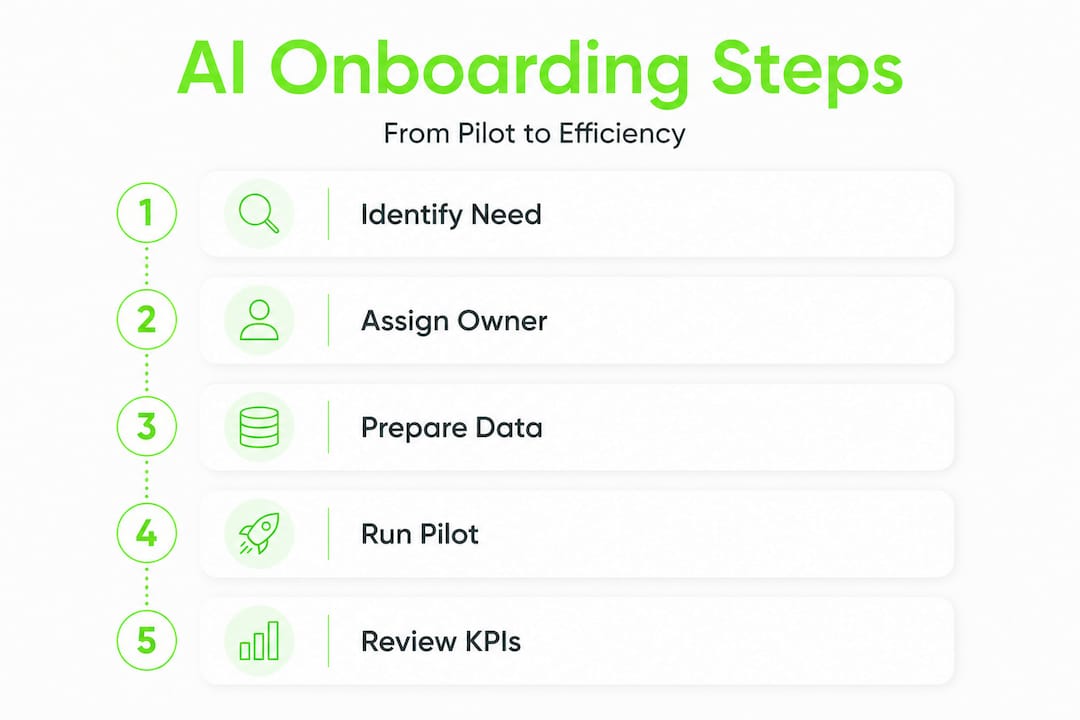
- Step-by-step onboarding: From pilot to rollout
- Common pitfalls and how to overcome them
- Measuring success: KPIs and continuous improvement
- The overlooked truth about AI onboarding for SMEs
- Unlock effortless AI onboarding with expert support
- Frequently asked questions
Key Takeaways
| Point | Details |
|---|---|
| Start small and focused | Pilot AI on a single workflow, assign an owner, and iterate before wider rollout. |
| Prioritise transparency | Explain AI’s limitations and set clear expectations to build trust across your team. |
| Track and adapt KPIs | Measure AI’s impact with baseline and ongoing KPIs to drive continuous improvement. |
| Human oversight is vital | Keep humans in-the-loop for decision-making and regular review of AI processes. |
| Onboarding is never finished | Continuous updates and learning are essential for sustaining business value from AI. |
Understanding AI onboarding: Why it matters for your business
AI onboarding is far more than installing software or subscribing to a platform. It is the process of integrating artificial intelligence into your business operations in a way that is understood, trusted, and actively used by your team. Done well, it delivers tangible improvements in efficiency and output. Done poorly, it leaves staff sceptical, leadership disappointed, and budgets wasted.
One of the most significant barriers SMEs face is the so-called “black box” problem. Many AI tools produce results without clearly explaining how they arrived at those results. When your accounts team cannot understand why the AI flagged a particular transaction, or your marketing manager cannot explain why the AI recommended a specific audience segment, trust collapses rapidly. This is not a technology failure. It is an onboarding failure. AI transformation for European SMEs frequently stalls at precisely this point, not because the tools are inadequate, but because the people using them were never brought along for the journey.
Transparency with your team and your stakeholders is therefore central to effective onboarding. Employees need to know what the AI is doing, where its limitations lie, and how their own judgement remains essential. This is especially important in sectors such as legal services, finance, or healthcare, where errors carry serious consequences.
As noted by experts in this space, onboarding builds trust in AI tools and prevents the black box barrier from undermining adoption before it even begins. Consider also the broader potential: well-integrated AI can dramatically improve how businesses understand their customers, with improving customer insights becoming a practical reality rather than a marketing promise.
Effective AI onboarding achieves four core goals:
- Adoption: Staff actively use the AI tools in their daily workflows rather than reverting to old habits.
- Trust: Teams understand what the AI does, what it cannot do, and why its outputs are reliable (or when they are not).
- Business outcomes: The AI delivers measurable improvements in productivity, accuracy, speed, or revenue.
- Risk reduction: Your business avoids regulatory, data, and reputational risks by embedding appropriate oversight from the start.
“Onboarding is not a one-time event. It is the ongoing process through which people and organisations come to genuinely trust and rely on AI. Without deliberate effort to explain how a system works, what its limitations are, and how it handles errors, adoption will always remain shallow.” — Forbes Technology Council
Preparing for onboarding: What you need to get started
A successful AI rollout does not begin with technology. It begins with preparation. Before you introduce any AI tool to your team, you need clarity on four pillars: people, data, technology, and key performance indicators (KPIs).
People are your starting point. Assign one person, ideally a business owner or a senior manager, to take formal responsibility for the onboarding process. This person becomes your AI champion. They coordinate between departments, gather feedback, and escalate problems. Without this ownership, onboarding becomes everyone’s vague responsibility and nobody’s actual job.
Data is the fuel that drives AI. You need to understand what data your business holds, where it is stored, how it is structured, and whether it is clean enough to use. Many SMEs discover that their CRM data is incomplete, their documents are stored inconsistently, or their customer records exist in multiple incompatible formats. Identifying these gaps before onboarding begins saves considerable time and frustration later.

Technology prerequisites depend on the AI solution you are implementing. The table below gives a simplified overview of what different types of AI deployments typically require:
| AI solution type | Core technology requirement | Data requirement | Typical integration |
|---|---|---|---|
| Marketing automation | CRM platform, email tool | Customer contact data | API or native connector |
| Document processing | Cloud storage or local server | Structured document archive | File access permissions |
| Customer chat assistant | Website CMS access | FAQ and product data | Chat widget or plugin |
| Private on-premise AI | Local server or secure VM | Sensitive business data | IT configuration required |
| Knowledge base assistant | Internal wiki or drive | Documented processes | Search indexing setup |
KPIs are your success benchmarks. Before you switch anything on, record your baseline numbers. How long does it take to process an invoice today? How many support queries does your team handle per hour? What is your current lead response time? These figures give you something concrete to measure against after onboarding. AI tools for small business generate real returns only when you can compare before and after with confidence.
Organisational prerequisites to confirm before you begin include:
- Leadership buy-in from the top, not just curiosity but active commitment to the process
- Staff awareness so that employees understand why AI is being introduced and what it means for their roles
- Data access permissions reviewed and approved, particularly for GDPR compliance
- Training schedule drafted for the pilot group before the AI goes live
- Feedback channel established so that users can report problems or confusion quickly
As successful onboarding experts confirm, starting with small pilots, clear ownership, baseline KPIs, and structured iteration dramatically increases the chances of a positive outcome.
Pro Tip: Resist the temptation to onboard multiple AI tools simultaneously. Choose one workflow, one team, and one clear problem to solve first. A focused pilot builds confidence and gives you clean data to evaluate before you expand.
Step-by-step onboarding: From pilot to rollout
Once your preparation is complete, you are ready to begin the structured onboarding process. The following sequence is designed specifically for SMEs that want to move from a standing start to a confident, organisation-wide rollout.
-
Define the scope. Choose one specific workflow or business problem for your pilot. For example, automating the first response to incoming customer enquiries, or using AI to draft and categorise meeting notes. Narrow scope produces clear results.
-
Select your pilot group. Identify four to eight people who will participate in the pilot. Choose team members who are open to change and willing to share honest feedback. Avoid including the most resistant sceptics in the first wave.
-
Configure and test the AI tool. Work with your provider or consultant to set up the AI with your actual business data. Run internal tests before exposing it to live workflows. Identify obvious errors or gaps in outputs at this stage.
-
Set your pilot timeline. A 4 to 8 week pilot gives enough time to gather meaningful data without extending the process unnecessarily. Week one focuses on familiarisation, weeks two to six on active use and data collection, and the final week on review and decision-making.
-
Run the pilot with human-in-the-loop oversight. This is perhaps the most important step. Human-in-the-loop means that a person reviews, approves, or corrects AI outputs before they are acted upon. It prevents costly errors, builds staff confidence, and generates the feedback data you need to improve the system. Examining how AI supports competitive intelligence in similar businesses shows that human oversight consistently produces better long-term outcomes than full automation from day one.
-
Collect feedback weekly. Ask pilot participants specific questions: What did the AI get right? What did it get wrong? What tasks still feel faster or safer to do manually? Use a simple shared document or form to capture responses consistently.
-
Review and iterate. At the end of the pilot, compare your KPIs against the baseline figures recorded before you started. Use feedback to refine the AI configuration, update training materials, and address concerns. Then decide whether to expand or adjust.
-
Plan the wider rollout. Once the pilot delivers positive results, create a phased rollout plan for the broader team. Use your pilot participants as internal advocates who can share their experience with colleagues.
The following comparison illustrates why human oversight during onboarding is not optional:
| Approach | Error rate | Staff confidence | Time to trust | Recommended for SMEs |
|---|---|---|---|---|
| Human-only workflow | Low | High | Immediate | For complex or sensitive tasks |
| Human-in-the-loop AI | Low to medium | High | 4 to 8 weeks | Yes, strongly recommended |
| Fully automated AI | Medium to high | Low | Rarely achieved without training | No, not at onboarding stage |
Refer to your AI strategy roadmap throughout this process to ensure that your pilot aligns with your broader business goals. If lead generation is a priority, consider how AI onboarding for lead generation can be integrated early in your pilot scope.
Pro Tip: Assign one team member to be the dedicated “AI reviewer” during the pilot. This person checks outputs, logs anomalies, and becomes your internal expert. The role builds internal capability that remains with your business long after the pilot ends.
Common pitfalls and how to overcome them
Even well-prepared teams encounter challenges. The following mistakes account for the majority of failed AI onboarding projects in SMEs, and each one has a clear solution.
-
Ignoring the black box problem. When staff do not understand how the AI produces its outputs, they either distrust it entirely or accept its results uncritically. Both outcomes are problematic. The solution is to explain AI limitations clearly during onboarding, including the possibility of hallucinations (where the AI generates plausible but incorrect information) and the circumstances in which human review is mandatory.
-
Underestimating change management. Many businesses focus entirely on the technology and forget that people need support. Employees worry about job security, unfamiliar tools, and changed responsibilities. Communicate clearly, involve staff early, and frame AI as a support tool rather than a replacement. Using AI tools for marketing effectively, for example, requires marketers to feel confident in the outputs, not threatened by the process.
-
Skipping feedback cycles. Onboarding without a regular feedback loop produces stagnant, unreliable AI outputs. Business data changes, customer behaviours shift, and the AI needs to be updated accordingly. Schedule monthly feedback reviews as a standing agenda item.
-
Setting expectations too high, too fast. AI tools produce genuine improvements, but not overnight. Staff who expect perfection in the first week become disillusioned quickly. Manage expectations honestly from the start.
-
Failing to document the process. If your AI champion leaves the business or the pilot team moves on, institutional knowledge walks out with them. Document every configuration decision, training update, and feedback finding from day one.
A well-informed perspective on decisions with AI reinforces that the highest-performing teams treat AI as a partner in decision-making, not an oracle that replaces human judgement entirely.
Pro Tip: Schedule a “lessons learned” session at the end of every pilot phase, even if results are positive. What worked, what surprised you, and what you would do differently next time are equally valuable questions regardless of the outcome.
“The organisations that succeed with AI are those that treat onboarding not as a project with a start and end date, but as an ongoing practice of learning, adapting, and improving alongside their tools.” — Forbes Technology Council
Measuring success: KPIs and continuous improvement
After implementing your onboarding process, it is vital to measure impact and refine your approach over time. AI investment is only justifiable when it produces results you can observe and quantify.
Selecting the right KPIs starts with your baseline data. Review the numbers you recorded before the pilot and compare them systematically. The most useful KPIs for SME AI onboarding typically fall into four categories: productivity, accuracy, speed, and revenue impact.
Statistic to note: According to current investment trends, AI budgets in 2026 represent approximately 9% of total IT spending for businesses actively adopting AI solutions. If your competitors are allocating that proportion and you are not measuring your returns, you are falling behind on two fronts simultaneously.
The table below gives you practical benchmarks to work from:
| KPI | Baseline example | Expected improvement | Review frequency |
|---|---|---|---|
| Invoice processing time | 45 minutes per invoice | 15 to 20 minutes (55% reduction) | Monthly |
| Customer query response time | 4 hours average | Under 30 minutes | Weekly |
| Marketing email production time | 3 hours per campaign | 45 minutes | Per campaign |
| Document classification accuracy | 78% correct | 92 to 95% correct | Monthly |
| Lead qualification rate | 12% of inbound leads | 20 to 25% | Monthly |
Track your marketing automation KPIs alongside operational metrics to build a complete picture of AI’s impact across the business.
For continuous improvement, follow these steps on a recurring basis:
- Review KPIs monthly during the first three months, then quarterly once results stabilise.
- Update training data whenever your products, services, pricing, or processes change significantly.
- Re-run feedback sessions with active AI users every quarter to capture emerging concerns or opportunities.
- Benchmark against industry peers to understand whether your gains are in line with broader market expectations.
- Expand scope gradually by adding one new workflow or team at a time, using your initial pilot framework as the template.
Continuous improvement is not an optional extra. It is the mechanism through which AI delivers compounding value over time rather than a one-off efficiency bump.
The overlooked truth about AI onboarding for SMEs
Here is something most guides on AI adoption will not tell you directly: the businesses that see the greatest long-term returns from AI are not necessarily the ones that started earliest or spent the most. They are the ones that understood early that onboarding never truly finishes.
There is a persistent myth that AI implementation works like installing a boiler. You bring in a specialist, they configure the system, and then it runs reliably in the background with minimal intervention. This view is not only wrong, it is actively harmful. It sets businesses up for disappointment and leads decision-makers to write off AI as overhyped when the real problem was the approach.
The reality is that perpetual onboarding is not a technical nicety but a business necessity. AI systems need ongoing updates, human context, and regular retraining as your business evolves. A customer service AI trained on your 2024 product catalogue will start producing outdated answers by mid-2025 without deliberate intervention. A document processing tool that worked well for your team of five may behave unpredictably when your team doubles and new document formats appear.
We have observed this pattern consistently across our work with SMEs across Luxembourg and Europe. The businesses that harness AI for sustainable growth approach onboarding as a living business process, not a completed project. They assign ongoing ownership, budget for quarterly reviews, and treat staff feedback as a critical data source rather than a nice-to-have.
The practical implication for you is straightforward: build the cost and time of ongoing onboarding into your AI business case from the beginning. Not because AI is high-maintenance in a burdensome sense, but because the businesses that treat it as a dynamic, evolving capability will consistently outperform those that treat it as a static deployment.
“The real competitive advantage in AI is not in being first to implement. It is in being the organisation that continuously learns from its implementation and keeps the system aligned with how the business actually operates today.” — Forbes Technology Council
Unlock effortless AI onboarding with expert support
Navigating AI onboarding alone is possible, but it is significantly slower and riskier than working with a partner who has done it before. Whether you are at the preparation stage or ready to expand a successful pilot, expert guidance can compress your timeline and sharpen your results.
At Done.lu, we specialise in guiding SMEs through exactly this process. From initial audit to tool selection, pilot design, team training, and ongoing support, our AI consulting for business service is built around the specific needs of businesses operating in Luxembourg and across Europe. If you are ready to build a structured, GDPR-compliant AI roadmap, our AI strategy consulting team can help you prioritise the right workflows and tools from day one. Explore our curated selection of best AI tools 2026 to identify the most practical starting point for your business and take the next step with confidence.
Frequently asked questions
What is AI onboarding in business?
AI onboarding is the process of systematically integrating artificial intelligence into your business workflows, covering both technology and change management so your team can use AI effectively. As confirmed by industry research, onboarding builds trust in AI tools and prevents the black box barrier from blocking genuine adoption.
How long does it take to onboard AI in an SME?
A typical AI onboarding pilot lasts 4 to 8 weeks, but continuous updates and perpetual onboarding are needed as the business grows. Experts recommend a 4 to 8 week pilot with human-in-the-loop oversight before expanding to the wider team.
Which KPIs should I track during AI onboarding?
Key KPIs include productivity gains, error reduction, process speed, and measurable revenue impact. Establishing baseline KPIs before the pilot begins is essential for tracking genuine improvement accurately.
What are the biggest risks in AI onboarding for SMEs?
The main risks are poor change management, ignoring explainability issues, and failing to adapt processes as AI evolves. It is important to explain AI limitations including hallucinations and black box concerns during onboarding to build lasting trust across your team.