

Avoid a Month of Missing Reports: Local Matomo Install Rules for SMBs
August 29, 2026
Company Data: Fine Tune Only After RAG, GDPR Aware, Cut Costs
August 31, 2026
Yes, you can build a defensible AI investicijų ROI case, but only once you count the full cost of ownership, haircut your early assumptions and pick a way to attribute results. Run one measurable pilot, tag its costs and outcomes from day one, and check the numbers against benchmarks from MIT and AWS, before you present a figure to your board.
TL;DR:
- Calculating AI ROI requires including all hidden costs such as integration, governance, training, and ongoing data maintenance, not just license fees.
- Tracking cost per outcome from the start, with attribution to specific teams and use cases, helps ensure measurable and defendable ROI assessments.
- Low adoption rates and overlooked scaling costs are the main reasons most AI ROI cases fail, so setting clear kill thresholds and monitoring feature usage is crucial.
- A structured, narrow use case approach with regular review, sensitivity modeling, and separate budgeting for governance increases the chances of building a credible ROI case.
Table of Contents
- What AI ROI actually means (and why productivity gains aren’t ROI)
- The TCO and benefit checklist finance teams keep missing
- The ROI formula and a worked example you can copy into a spreadsheet
- Building a measurement cadence that survives scrutiny
- Why most AI ROI cases collapse (and how to stop yours doing the same)
- Done’s practitioner checklist for a defensible AI ROI case
- Six questions worth asking before you sign off on any AI investment
- Get your AI investment audited before you commit budget
- Sources
What AI ROI actually means (and why productivity gains aren’t ROI)
AI ROI is net benefit divided by total cost of ownership, expressed as a percentage or a payback period. That’s a different question from “did the tool save time?” A chatbot that cuts response time by 40% has delivered a productivity gain. It has only delivered ROI once you’ve weighed that saved time against licence fees, inference costs, integration hours and the months your team spent getting comfortable with it.
Three things separate AI ROI from a simple efficiency metric:
- Indirect and strategic value counts too: reduced compliance risk, faster quoting that wins more tenders, or the capacity to take on clients you’d otherwise have to turn away.
- The J-curve is real. MIT’s 2025 research found organisations commonly underestimate total AI programme costs by two to four times, and early adoption often brings a temporary productivity dip before any gain shows up.
- Optimistic first estimates need a haircut. Whatever number your pilot produces in month one, treat it as a ceiling, not a forecast.
The TCO and benefit checklist finance teams keep missing
Most AI ROI cases fall apart because the cost side is half-built. Licence fees are the visible cost. The rest hides.
- Tool licences and API/inference costs — often the smallest line, not the biggest, once usage scales.
- Integration and engineering time — connecting the tool to your CRM, ERP or document store.
- RAG or knowledge-base upkeep — someone has to keep the data feeding the model current.
- Governance and compliance — GDPR reviews, access controls, audit trails.
- Change management and training — the hours your team spends learning to actually use it well.
On the benefit side, Shopify’s guidance recommends converting time saved into a fully loaded labour cost, not a base salary, because base salary understates what an hour of someone’s time truly costs the business once you add employer contributions and overheads.
Pro Tip: If a customer service assistant saves five staff four hours a week each at a fully loaded rate of €35 an hour, that’s €3,640 a month in recovered capacity, before you’ve counted a single euro of extra revenue from faster response times.
The ROI formula and a worked example you can copy into a spreadsheet
The core formula stays simple: ROI (%) = (Net Benefit ÷ TCO) × 100, where net benefit is monetised gains minus TCO. Payback period is TCO divided by average monthly net benefit. Cost per outcome, the metric AWS recommends tracking, is total AI spend divided by the number of completed outcomes (tickets resolved, quotes generated, leads qualified).
Here’s a realistic first-year picture for a 25-person SME running an AI-assisted invoicing and customer support pilot:
It’s also almost certainly wrong.
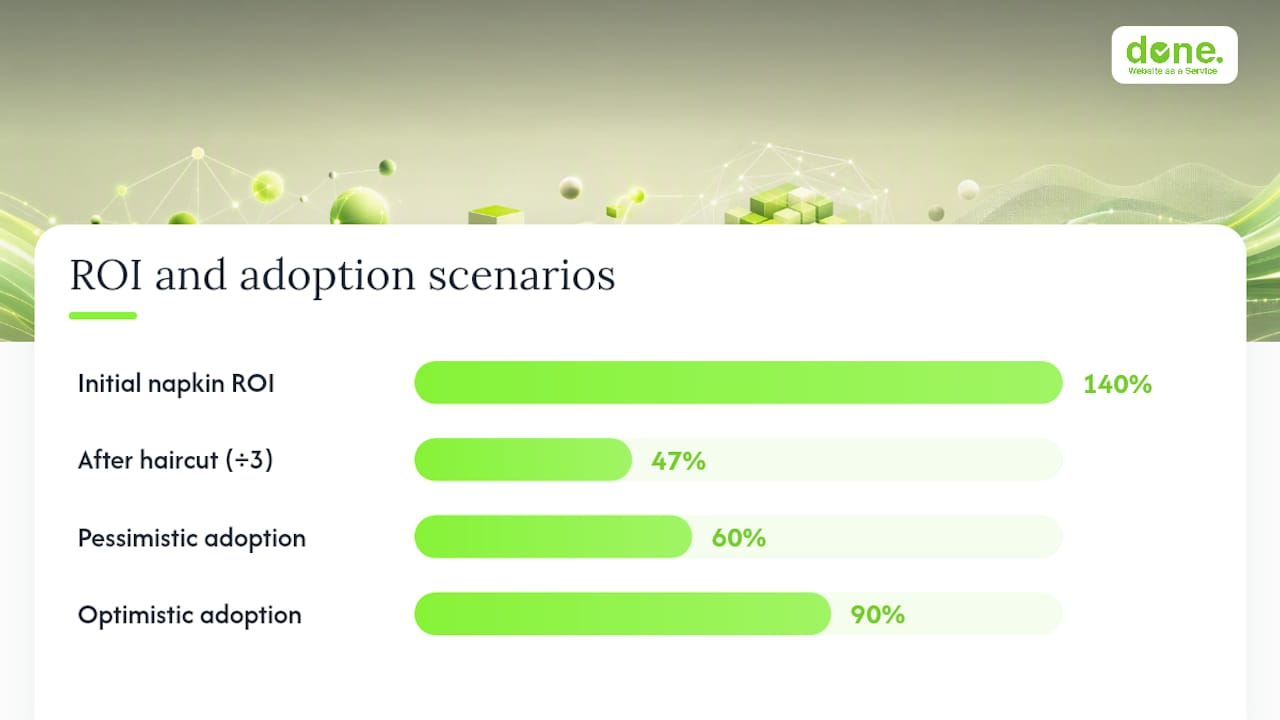
- Apply the haircut rule: divide the napkin figure by three to account for adoption lag, hidden integration costs and the J-curve dip. That takes 140% down to a far more defensible 47%.
- Recheck with a sensitivity range: model a pessimistic case (adoption at 60%) and an optimistic one (adoption at 90%) before you commit a number to the board.
- Translate the three rows, cost, benefit, haircut, into a single slide. CFOs trust a number more when they can see how you got conservative.
Building a measurement cadence that survives scrutiny
Cost per outcome only works if you tag spend from the start. AWS’s approach involves attributing every euro of AI spend to a specific team, tool and outcome, so you can see exactly which use case is earning its keep.
Three attribution methods cover most SME cases:
- A/B testing works when you can run the AI process alongside the manual one for the same volume of work.
- Time-boxed pilots suit teams too small to split into two groups. Run four to eight weeks, measure before and after.
- Matched-market comparisons fit multi-location businesses. Run the pilot in one branch, compare against a similar branch without it.
Review pilots monthly and scaled deployments quarterly. Set a kill threshold before you start, not after. If cost per outcome hasn’t improved within two review cycles, or adoption sits below your minimum usage target, stop and reassess rather than sinking more budget in on hope.
Pro Tip: Track feature usage (weekly active users of the AI tool, not just licence seats) as your earliest warning sign. Low usage predicts poor ROI months before the financial numbers confirm it.

Why most AI ROI cases collapse (and how to stop yours doing the same)
The CAIO playbook and MIT’s research point to the same recurring failure: teams price the licence, forget the integration, and never budget for the productivity dip that comes with the J-curve.
- Inference costs scale with usage in ways a pilot rarely reveals, budget for growth, not the pilot volume.
- Governance and change management get bundled into “implementation” and then quietly dropped from the ongoing cost model.
- Low adoption is the single biggest silent killer. A tool nobody uses returns nothing, no matter how good the underlying model is.
- Run a basic sensitivity template: three columns (pessimistic, base, optimistic), one row per cost and benefit line, and always present the pessimistic column first.
Done’s practitioner checklist for a defensible AI ROI case
We’ve built AI ROI cases for SMEs across 350-plus client projects, and the pattern holds regardless of sector: the businesses that get a clean, defensible number are the ones that scope narrowly and measure honestly.
A seven-step version we use with clients:
- Pick one measurable use case, not a company-wide rollout.
- Set a baseline before touching any tool (current time, cost, error rate).
- Run a time-boxed pilot with tagged costs.
- Track cost per outcome weekly.
- Apply the haircut rule to your first results.
- Set a kill/scale threshold in advance.
- Budget separately for training and governance, especially where GDPR-compliant private AI is required for regulated data.
Pro Tip: For customer-facing use cases, read Done’s AI strategy consulting roadmap before scoping your pilot. It’s the step most teams skip, then regret.
Six questions worth asking before you sign off on any AI investment
Before you approve a business case, ask your CFO or vendor: What’s the baseline metric? What’s the full TCO, including governance? What adoption rate justifies this? What’s the kill criterion? Who owns data governance? What payback period is realistic, given Deloitte’s research points to two to four years being typical, not the six months a vendor demo implies. Ask those six now, before the invoice arrives.
— Thomas
Get your AI investment audited before you commit budget
Done is the practical alternative to guessing your way through an AI business case. Instead of a generic vendor pitch, we run a short, structured audit: baseline your current process, size the real TCO, and scope a pilot with a measurable outcome before you spend a euro on licences.

We’ve done this for SMEs across regulated sectors, legal, finance, accounting, where GDPR-compliant private AI deployment matters as much as the ROI figure itself. Our pricing is transparent, with no setup fees, and our AI strategy consulting approach walks through audit, pilot, integration and adoption coaching as one continuous process, not a one-off engagement. For a broader look at where AI tends to pay off fastest for SMEs, our guide to artificial intelligence for SMBs is a useful starting point. If your team is weighing up whether the productivity gains a tool promises will actually survive the J-curve, agencies have seen similar patterns play out, with AI-driven productivity gains reaching 3.2x ROI in some cases once adoption matures. Request a short audit or pilot scoping call with Done and get a TCO model built around your actual numbers, not a vendor’s demo slide.
Sources
- Productivity paradox: AI adoption in manufacturing firms (MIT Sloan / 2025)
- Calculating the ROI of AI | AWS Cloud Financial Management
- How to measure the business value of generative AI | Google Cloud Blog
- AI ROI: How to Calculate Returns in 2026 – Shopify