
Up to 35.26% lift: Checkout fixes that cut cart abandonment for SMEs
September 18, 2026
A/B testing compares two versions of a page (a control and a variant) to see which one produces more of a chosen result, whether that’s sign-ups, purchases, or clicks. It’s worth running when you have enough traffic to reach roughly 350 to 1,000 conversions per variant, or when a wrong decision would be expensive to reverse. If neither applies, start with a five-user interview or a heatmap instead.
TL;DR:
- A/B testing requires at least 350 to 1,000 conversions per variant for reliable results; lower traffic typically favors qualitative methods.
- Focus testing on elements directly affecting revenue or user intent, such as headline copy, call-to-action wording, and form length, rather than cosmetic details.
- Confirm you have enough traffic before running a test and ensure the change is hard or costly to undo and would significantly impact revenue if wrong.
- Use visual editing tools and track primary metrics carefully, logging hypotheses, sample sizes, and test duration to maintain accuracy and compliance.
- Always verify accessibility compliance and segment results by device and source to avoid misleading conclusions and ensure a fair evaluation.
Table of Contents
- What is A/B testavimas svetainėje and what does it answer?
- When should you run an A/B test?
- Which page elements are worth testing first?
- How many visitors do you actually need?
- What tools do you need to set one up?
- How do you interpret A/B test results properly?
- How do you keep experiments accessible and compliant?
- A hands-on testing checklist you can use today
- When testing isn’t worth it
- How Done.lu runs experiments without the guesswork
- Sources
- FAQ
What is A/B testavimas svetainėje and what does it answer?
A/B testing, sometimes written as split testing, means showing half your visitors the original page and half a changed version, then measuring which one performs better against a single metric. Say you’re testing a checkout page: version A keeps your current “Buy Now” button, version B changes it to “Add to Basket.” Whichever version produces more completed purchases wins.
It differs from heatmaps and user interviews in one key way: those tools tell you what people do or why they hesitate, while A/B testing tells you which specific version actually converts better. Heatmaps generate hypotheses. A/B tests confirm or kill them.
A/B testing typically resolves questions like:
- Does shorter form copy increase sign ups?
- Does a visible price on the homepage reduce or increase enquiries?
- Does removing a navigation step improve checkout completion?
When should you run an A/B test?
Not every idea deserves a live experiment. Before building one, ask three questions: do you have enough traffic, is the change reversible, and what happens if you guess wrong?
Use this checklist to decide:
- Do you get at least a few hundred conversions a month on the page in question?
- Is the change hard or costly to undo if it flops (a full redesign, a pricing model, a new checkout flow)?
- Would a wrong call damage revenue meaningfully, not just cosmetically?
- Can you commit to running the test for a full business cycle without touching it?
If you answered yes to most of these, test it. If traffic is thin and the change is low risk (moving a testimonial block, tweaking a headline), just ship it and watch what happens, or run a small qualitative check first.
Pro Tip: Reversible, low stakes changes rarely justify the setup time of a formal test. Save A/B testing for decisions you’d genuinely regret getting wrong.
Which page elements are worth testing first?
Start with elements that touch money or intent directly, not cosmetic details. In our experience with client sites, message level changes (what you’re saying, not how it looks) move the needle far more than colour or font tweaks.
Priority order for most SMB sites:
- Hero copy and value proposition: does the first sentence visitors read actually explain what you do and why it matters to them?
- Call to action wording and placement: “Get a Quote” versus “Book a Call” can shift click-through rates noticeably on service pages.
- Form length: cutting fields from eight to four often lifts completion, particularly on mobile.
- Pricing presentation: showing a “from” price versus hiding it entirely changes enquiry volume in opposite directions depending on your market.
- Checkout and email flows: for ecommerce, testing shipping cost visibility or a guest checkout option tends to outperform micro tests on button colour.
If you’re short on ideas, our guide on boosting website conversions walks through a wider set of tactics worth trying first.
How many visitors do you actually need?
This is where most small business tests fail before they even start. A common CRO rule of thumb suggests you need roughly 1,000 conversions per variant for a confident result, and around 350 for directional guidance that’s useful but not statistically bulletproof.
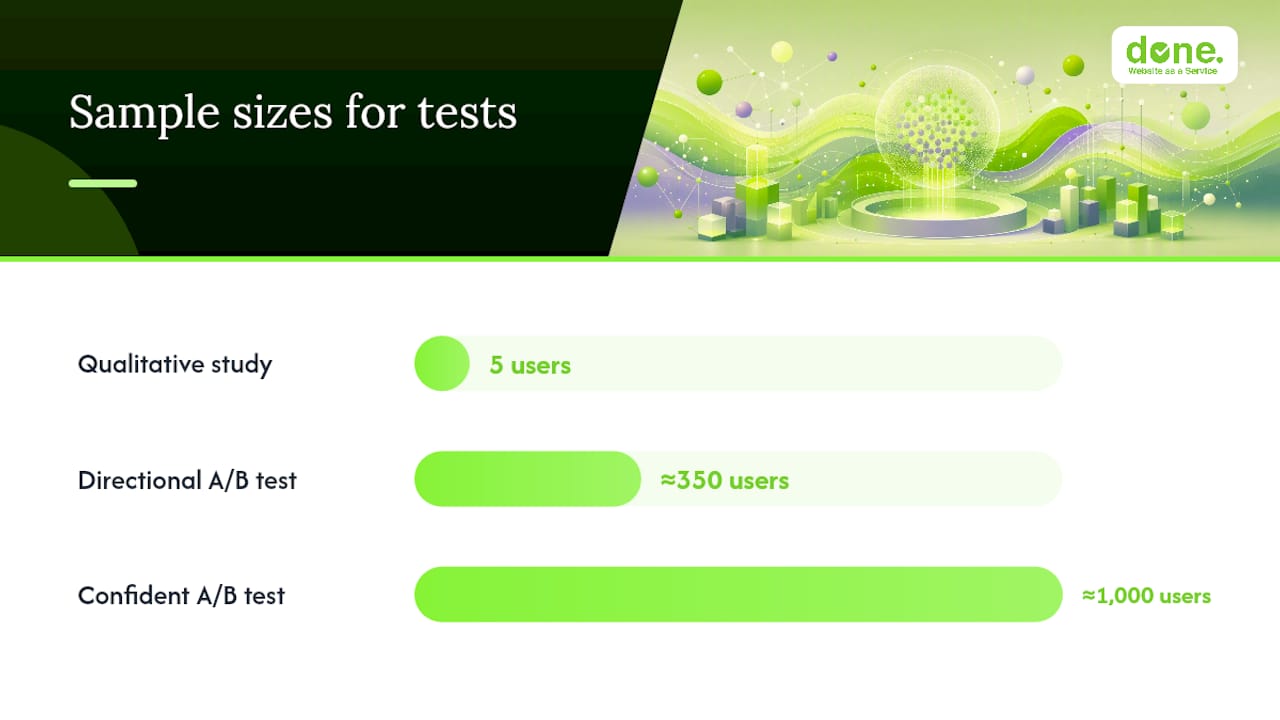
The maths behind this involves your baseline conversion rate, the minimum detectable effect (MDE) you care about, and standard statistical power and significance settings. Smaller expected improvements need larger samples to detect reliably; a test looking for a 2% lift needs far more traffic than one looking for a 20% lift.
Practical guidance for run time and traffic:
- Run tests for at least one full business cycle, a minimum of two weeks and ideally four weeks, to account for weekday and weekend variation.
- Never stop early because results look promising after three days. Early data is noise, not signal.
- If your traffic won’t reach 350 conversions per variant within a reasonable window, don’t force a test. Run a qualitative study instead.
Statistic: Jakob Nielsen’s usability research found that testing with just five users typically uncovers around 85% of usability problems, which makes small qualitative studies a genuinely efficient alternative when your traffic can’t support a proper split test.
What tools do you need to set one up?
Two tool categories matter here: visual editors for building variants, and feature flagging platforms for more technical control. For most SMBs, visual editors remain the easier entry point because they don’t require developer time for every change.
A practical, budget-friendly combination pairs Microsoft Clarity for qualitative session data with a lightweight experiment platform like Convert, PostHog, or GrowthBook for the actual split testing. Worth noting: Google Optimize was discontinued in 2023, so any guide still recommending it is out of date.
Before launching anything, get the basics right:
- Wire your primary metric first (the one decision maker), then add secondary metrics.
- Check your analytics isn’t double counting conversions across the control and variant.
- Log every test in a simple registry: hypothesis, primary metric, sample size target, planned duration, and rollout decision, before you launch it.
How do you interpret A/B test results properly?
A “winning” variant on your primary metric isn’t automatically a green light to ship it. Check secondary and revenue related metrics first, because a variant can lift sign ups while quietly damaging average order value or increasing support tickets.
Segmentation matters here too. A variant can win overall but lose for mobile users or a specific traffic source, so break results down by device and channel before declaring victory.
Once your test concludes, follow a consistent process:
- Confirm the primary metric hit your planned sample size, not just your planned duration.
- Cross check secondary metrics and any guardrail metrics for damage.
- Segment by device, traffic source, and new versus returning visitors.
- If inconclusive, don’t rerun the identical test. Adjust the hypothesis or the sample size target.
- Log the outcome and decision in your test registry for future reference.
How do you keep experiments accessible and compliant?
Running variants without checking accessibility is a common blind spot. A new CTA button, a redesigned form, or a restructured navigation can all quietly break keyboard access or contrast ratios for users relying on assistive technology.
Watch for these basics during any live test:
- Keyboard navigation still works through the full variant, not just the control.
- Contrast ratios meet WCAG thresholds on new colour combinations.
- Alt text carries over to any new images or icons introduced in the variant.
Automated scanners like WAVE, ARC Toolkit, and similar tools catch a meaningful share of issues but not all of them, so pair automated checks with manual keyboard testing. Institutional guidance in Lithuania also points to the W3C Web Accessibility Evaluation Tools List as a solid starting reference. Our own accessibility guide covers manual checks in more depth.
A hands-on testing checklist you can use today
Every test we help set up starts with a one line hypothesis: “Changing X will increase Y because Z.” That single sentence forces clarity before anything gets built.
Seven items to check before launch:
- Hypothesis written in the format above.
- Primary metric named and tracked correctly.
- Sample size target calculated, not guessed.
- Test duration set (minimum two weeks) and locked in advance.
- Segmentation plan agreed (device, source) before launch.
- Accessibility checked on the new variant.
- Rollout decision criteria written down before you see any data.
Three tests most SMBs can run immediately: shortening a contact form from eight fields to four, testing a visible “from” price on a services page, and testing guest checkout against forced account creation on an ecommerce checkout flow. We track downstream impact on revenue and repeat purchase rate, not just the immediate conversion, and log every test in a written registry so nothing gets repeated by accident six months later.
Pro Tip: If you can’t articulate the hypothesis in one sentence before building anything, the test isn’t ready yet.
When testing isn’t worth it
Small sites chase statistical significance they’ll never reach. If your site gets 200 visitors a month, running a formal split test on button colour is a waste of a quarter. Spend that time on five user interviews instead.
Done.lu leans toward speed for low traffic clients and rigour for high traffic ones. That balance, not blind faith in testing, is the real skill. One takeaway: calculate your monthly conversions before writing a single hypothesis.
— Thomas
How Done.lu runs experiments without the guesswork
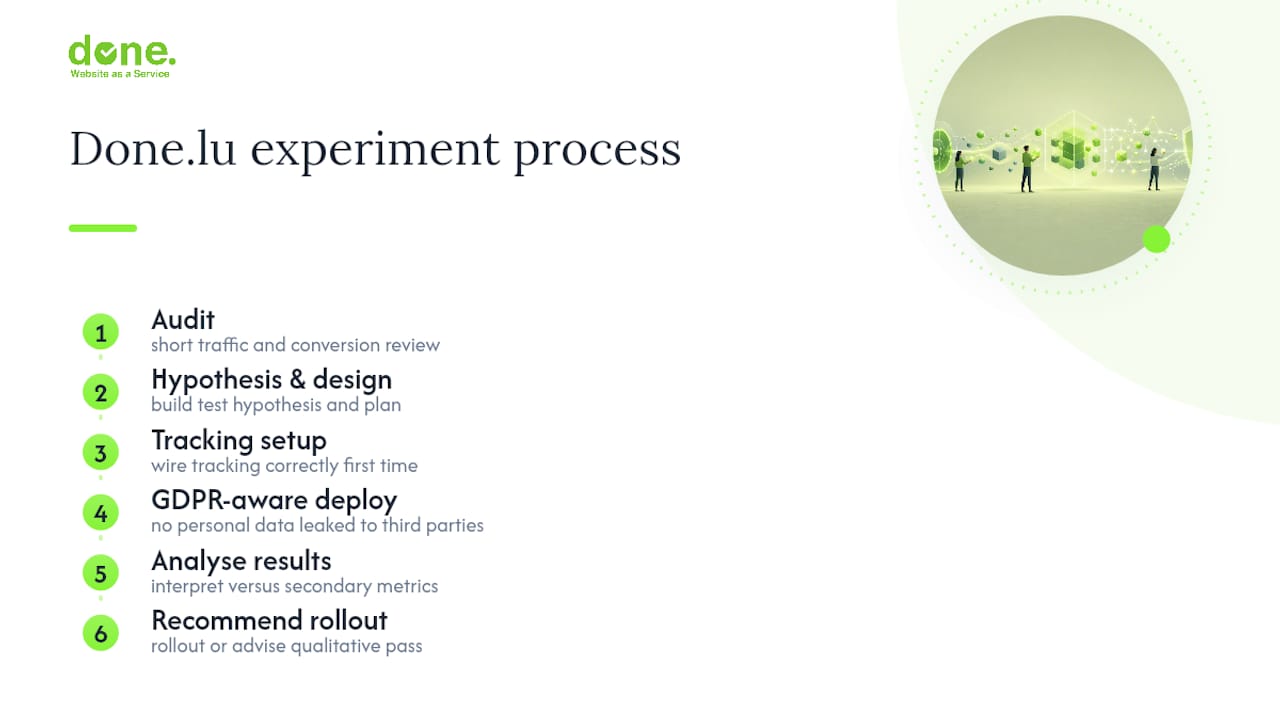
Done.lu is the practical route for SMBs in Luxembourg who want experiments run properly without hiring a dedicated CRO analyst. We’ve built this into how we handle digital marketing work generally: audit first, then test design, then tracking setup, then GDPR-aware deployment that doesn’t leak personal data into third-party dashboards you haven’t vetted.
A typical engagement starts with a short audit of your traffic and current conversion rates to work out whether a formal test is even viable, or whether user interviews would serve you better first. From there we build the hypothesis, wire the tracking correctly the first time (a mistake here invalidates weeks of data), and interpret results against secondary metrics before recommending a rollout.
If your site sits on our Website as a Service plans, starting at €195 a month for the One Pager tier, testing infrastructure and tracking can be built into ongoing maintenance rather than billed as a separate project each time. Get in touch through our consulting page to talk through whether your traffic supports testing yet, or whether a quicker qualitative pass makes more sense first.
Sources
For sample size logic, FastStrat’s guide is a solid start. For tooling and duration rules, see Kolonell’s method breakdown. Partner reading: Baby Love Growth’s CRO guide and Save Your App for qualitative research methods.
- A/B Testing for Small Business: When It Is Worth It
- SME website A/B testing 2026: tools + complete method | Kolonell
- WCAG 2026 changes and accessibility testing guidance (Tobalt)
- Prieinamumo stebėsenos veikla ir testavimo priemonės (VSSA)
FAQ
What sample size do I need for A/B testavimas svetainėje?
A common rule of thumb is around 1,000 conversions per variant for confident decisions and roughly 350 for directional guidance. Below that, treat results as a hint, not a verdict, and consider qualitative testing instead.
How long should an A/B test run?
Run tests for at least one full business cycle, a minimum of two weeks and ideally four, so weekday and weekend traffic patterns both get represented. Stopping early because early numbers look good is one of the most common mistakes in split testing.
What should I test if my site gets little traffic?
Skip formal A/B testing and run five user interviews or a short usability session instead, since testing with just five users typically surfaces around 85% of usability problems. This gives you actionable direction without needing statistical significance you can’t reach.
Can Done.lu set up and run A/B tests for my website?
Yes, Done.lu designs hypotheses, sets up tracking, and deploys experiments as part of its digital marketing and website services. Pricing for managed website plans starts at €195 a month; get in touch through the consulting page for a project-specific quote.
Do I need to check accessibility during an A/B test?
Yes. Automated scanners like WAVE and Lighthouse catch only part of accessibility issues, so pair them with manual keyboard navigation checks on every new variant before it goes live to the full audience.