

Prepare for EHDS 2031: Two AI Deployment Paths for EU Patient Data
September 17, 2026
350–1,000 Conversions: When SMB A/B Tests Pay Off and Stay GDPR Aware
September 19, 2026
Show your full price early, default to guest checkout, and add one express wallet button. Those three changes tackle the leading causes of cart abandonment, and checkout redesigns benchmarked by Baymard show conversion gains of up to 35.26% when stores fix checkout friction properly. Recovery emails and retargeting matter too, but they only reclaim carts you failed to save the first time. A quick audit, whether internal or run by an external consultant, is where this should start.
TL;DR:
- Showing the full price, including shipping and taxes, on early pages reduces surprise costs that cause abandonment for about 42% of shoppers who browse rather than buy.
- Implementing a guest checkout default, minimizing form fields, and adding an express wallet near the top of checkout pages can increase conversion rates by up to 35 percent.
- Conducting a quick audit by analyzing funnel data, session replays, and device-specific abandonment helps identify precise issues, enabling targeted fixes rather than broad redesigns.
- Sending three timed recovery emails—within 1 to 3 hours, at 24 hours, and optionally at 72 hours—outperforms longer sequences, but fixing checkout friction should take precedence.
- Clear return policies visible before checkout, especially highlighting the return window and shipping costs, significantly lower hesitation and cart abandonment.
Table of Contents
- Krepšelio palikimo mažinimas: high-impact fixes to prevent abandonment first
- What data actually shows where your store is losing customers?
- How should you time abandoned cart recovery messages?
- Technical and payment fixes your developers should prioritise
- A 7-step checklist you can run this week
- Return policy clarity and its role in reducing cart abandonment
- In experience working with SMB e-commerce clients, the quickest wins are often the checkout ones: guest checkout, a visible shipping estimate, one express wallet. Small fixes can consistently outperform bigger recovery projects in the first few weeks.
- How Done helps you fix checkout and recover lost carts
- Sources
- FAQ
Krepšelio palikimo mažinimas: high-impact fixes to prevent abandonment first
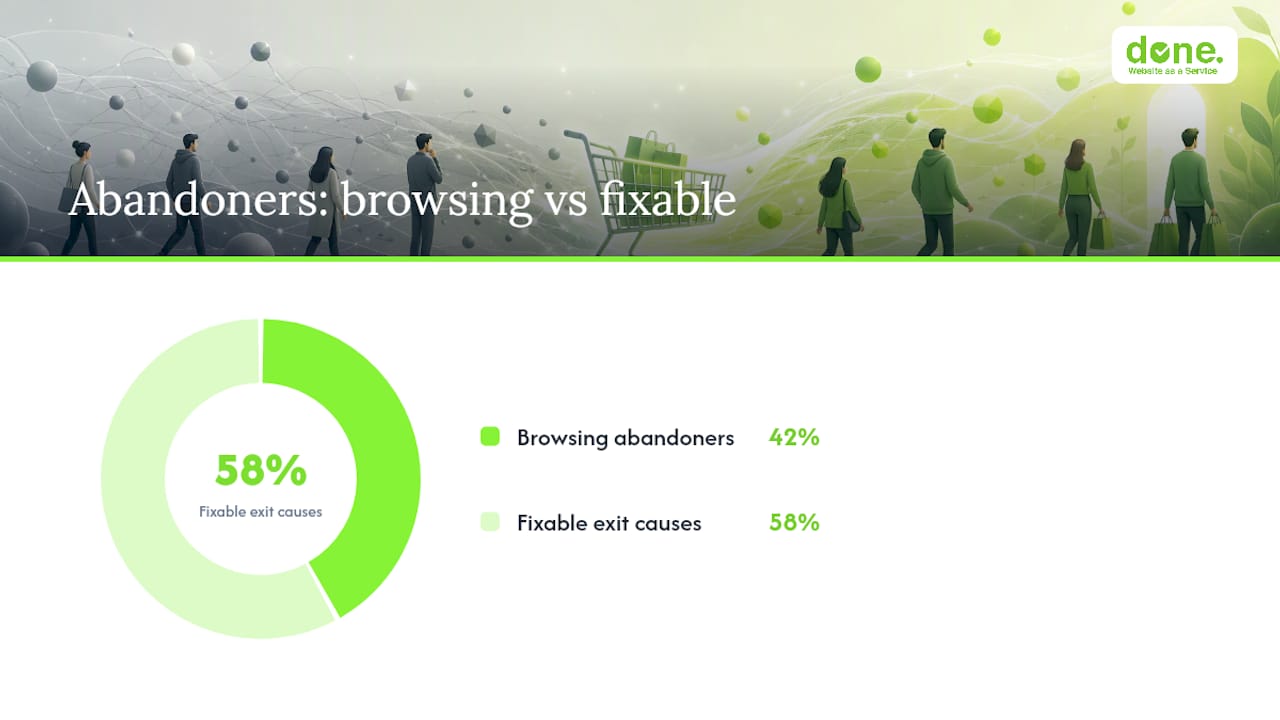
Cart abandonment reduction, or krepšelio palikimo mažinimas, works best as prevention rather than rescue. Global abandonment sits around 70.22% according to both Statista and Baymard’s benchmarking data, and a meaningful share of that is fixable, not just “window shoppers” who were never going to buy. Baymard’s own research suggests roughly 42% of abandoners were browsing rather than buying. That leaves a majority whose exit was caused by something you can actually change.
Start with the things that shock a buyer late in the process. Nothing kills a sale faster than a shipping cost that appears for the first time on the payment screen.
- Show shipping, tax, and total cost on the product page or cart, not just at the final step.
- Make guest checkout the default, and put an express wallet (Apple Pay, Google Pay, or similar) near the top of the cart and checkout screen.
- Cut checkout down to essential fields only. Baymard’s usability testing found typical checkouts carry around 23.48 form elements when the practical ideal is closer to 12 to 14.
- Add a simple progress indicator so shoppers know how many steps remain.
- Show recognisable payment logos and a clear returns policy near the payment button, not buried in a footer link.
- Treat mobile as the priority channel: Statista’s data shows abandonment runs higher on mobile than desktop, and a slow phone checkout is often the single biggest leak.
Pro Tip: Before redesigning anything, screenshot your own checkout on a mid-range Android phone with a throttled connection. Most owners have never actually done this, and it’s usually where the real problems surface.
None of this requires a full rebuild. It requires deciding which three or four fields on your checkout form are genuinely necessary, and removing the rest.
What data actually shows where your store is losing customers?
Guessing where shoppers drop off wastes time. The fix is a short, structured look at your own funnel before you touch a single design element.
- Segment abandonment by device, channel, and product. A store getting most of its traffic from mobile paid social will have a different abandonment profile than one built on desktop email traffic, and the fix differs accordingly.
- Validate your checkout events. Broken or duplicated GA4 purchase events are common enough that Done’s own GA4 validation guidance exists specifically because merchants routinely trust numbers that are quietly wrong.
- Watch session replays at the worst-performing step. FullStory recommends reviewing real sessions rather than relying on aggregate stats alone, since replay shows the exact click, form error, or stall that a funnel report cannot.
- Run a tight diagnostic sprint. Ten session replays from your worst checkout step, plus five basic usability checks (form field count, error message clarity, mobile button size, load time, payment options shown), gives you a real punch list within a day.
This is the same approach behind Done’s conversion optimisation checklist: diagnose narrowly before you redesign broadly.
How should you time abandoned cart recovery messages?
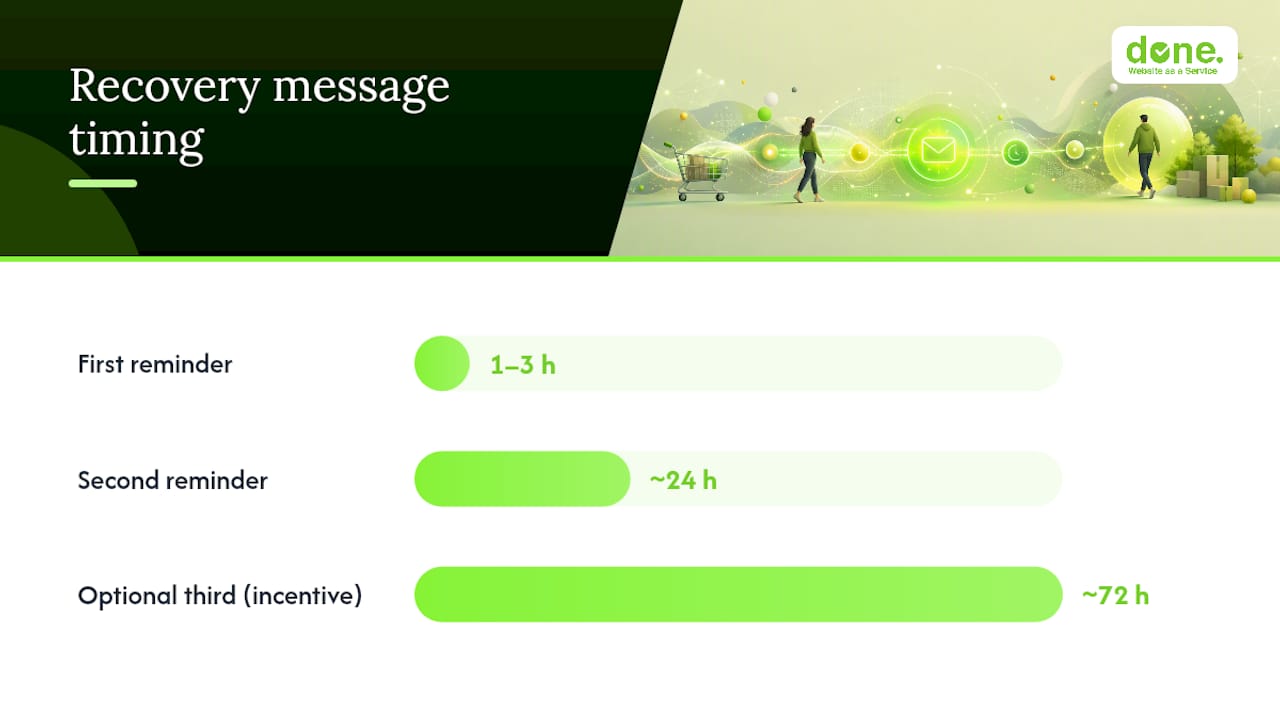
Recovery works, but only within limits, and timing matters more than most owners assume. Drip’s guidance recommends a first reminder within 1 to 3 hours of abandonment, a second at around 24 hours, and an optional third message near 72 hours if you want to use an incentive.
Abandoned-cart emails typically convert in the single digits, according to Baymard’s benchmarking, which is genuinely useful, but nowhere near a substitute for fixing the checkout that caused the abandonment in the first place.
What the messages should contain:
- The exact cart contents, with a product image, not a generic “you left something behind” line.
- One clear call-to-action button, ideally returning the shopper straight to a pre-filled cart.
- A light trust signal: stock level, a short delivery estimate, or a simple review count.
- SMS reserved for genuine purchase intent, with proper consent and a tight message limit. It converts well when used sparingly and becomes irritating fast when overused.
- Dynamic retargeting ads built from first-party cart data, run on a short time window rather than following someone for three weeks after they bought the item elsewhere.
Three messages, sent at the right intervals, will outperform a long automated sequence every time. Longer sequences tend to fatigue the list without adding meaningful recovery.
Technical and payment fixes your developers should prioritise
Some of the biggest abandonment causes are invisible to owners because they only show up as a declined card or a slow page, not as an obvious design flaw.
- Make sure your payment gateway handles declines gracefully, with a specific, human-readable error rather than a generic failure message that leaves the shopper guessing.
- Offer at least one express wallet alongside the local payment method your customers actually expect. FullStory’s research notes that missing an expected payment option is a recurring, avoidable cause of drop-off.
- Improve load times on the cart and checkout pages specifically, not just the homepage. Deferring non-critical scripts and compressing images matters more here than almost anywhere else on the site, since Baymard’s benchmarking links faster load times directly to conversion.
- Test your promo code field under real conditions. A code that fails silently, or an “apply” button that hangs, will send a price-sensitive shopper straight to a competitor tab.
These are engineering tasks, not marketing ones, which is exactly why they get skipped. A marketing team can spot a missing trust badge; it takes a developer to notice that the discount field throws a silent error on Safari.
A 7-step checklist you can run this week
Prevention beats recovery, so work through fixes roughly in this order:
- Pull your funnel data and rank abandonment by device and channel.
- Add a shipping cost estimate to the cart page.
- Switch checkout to guest-first, with account creation offered after purchase.
- Add one express wallet button near the top of checkout.
- Remove every non-essential form field and add a progress indicator.
- Test checkout load speed on a real phone, not just a lab tool.
- Launch a three-message recovery flow (1 to 3 hours, 24 hours, optional 72 hours) and A/B test one variable at a time, such as incentive size.
Pro Tip: Change one thing at a time. Stores that redesign checkout, switch payment providers, and launch a new email flow in the same week rarely know which change actually moved the number.
Return policy clarity and its role in reducing cart abandonment
An unclear or hidden returns policy causes hesitation at the exact moment a shopper is deciding whether to trust you with their card details. If the return window, cost of return shipping, and process aren’t visible before checkout, plenty of shoppers simply close the tab rather than gamble on getting stuck with an item they can’t send back easily.
The fix costs nothing beyond editing a page. State the return window in plain terms (30 days, 60 days, whatever it actually is), say clearly whether return shipping is free or charged, and link that policy directly from the product page and the cart, not only from a footer link three clicks away. A short line near the payment button, such as “Free returns within 30 days,” does more for conversion than most owners expect, because it removes a risk calculation the shopper would otherwise have to make alone.
Clarity matters more than generosity here. A strict but clearly stated 14-day policy will usually outperform a vague, unexplained “flexible returns” promise, because uncertainty is what stalls the decision, not the specific number of days.
In experience working with SMB e-commerce clients, the quickest wins are often the checkout ones: guest checkout, a visible shipping estimate, one express wallet. Small fixes can consistently outperform bigger recovery projects in the first few weeks.
Traffic mix matters more than owners think. A store leaning hard on paid social will show higher baseline abandonment than one built on email and organic search, and that’s not a checkout failure, it’s audience behaviour.
Fix the leak before you build the pump. Recovery flows on a broken checkout just recycle the same lost sales.
— Thomas
How Done helps you fix checkout and recover lost carts
Done is the practical alternative to hiring a full agency team for this kind of work: one accountable partner handling the audit, the fixes, and the ongoing marketing automation, rather than three separate vendors who don’t talk to each other.

A typical starting engagement looks like this: a short audit of your current checkout and funnel data, a prioritised roadmap based on what’s actually losing you sales, and two quick wins implemented within the first sprint, usually guest checkout and a visible shipping estimate. From there, Done’s e-commerce development service covers the deeper technical and payment work, while the digital marketing team builds the abandoned-cart email and retargeting flows that actually convert. If your site itself needs rebuilding around better checkout UX, Done’s Website as a Service plans start from €195 a month with no setup fees, so you’re not committing to a large upfront project just to fix a checkout page. Get in touch for an audit and a clear list of what to fix first.
Sources
- Cart abandonment rate (Baymard)
- Global digital shopping cart abandonment rate 2026 | Statista
- Reduce cart abandonment (FullStory)
- Abandoned cart email timing (Drip)
FAQ
What is the single biggest cause of cart abandonment?
Unexpected costs revealed late in checkout, usually shipping or taxes, are one of the most common causes, which is why showing full price early on the cart page matters so much.
How much can fixing checkout UX actually improve conversion?
Baymard’s benchmarking suggests checkout redesigns can lift conversion by up to 35.26% on typical large sites, though results depend on how broken the existing checkout was.
When should I send my first abandoned cart email?
Send the first reminder within 1 to 3 hours of abandonment, a second around 24 hours later, and an optional third near 72 hours if you’re using an incentive.
Does mobile checkout speed really matter that much?
Yes. Mobile abandonment runs higher than desktop according to Statista’s data, and slow mobile checkout is frequently the single largest preventable leak in a store’s funnel.
How much does Done charge to help fix cart abandonment?
Done’s Website as a Service plans start at €195 a month for a One Pager, rising to €315 for Starter and €625 for Business, with e-commerce and marketing automation work quoted after an audit.