

Validate GA4 Purchase Events to Stop Wrong Revenue for Online Stores
September 6, 2026
Launch Growth Driven Design for SMBs in 90 Days
September 8, 2026
Automate lead capture, the welcome sequence, and lead routing before anything else. Those three workflows respond fastest, so expect quicker replies, better-qualified leads, and hours back for your sales team within weeks. None of it works without two prerequisites in place first: clean CRM integration and a deliverability check on your sending domain.
TL;DR:
- Prioritize automating lead capture, immediate confirmation, and welcome sequences at the top of the funnel to generate measurable results within two weeks.
- Build and test a minimum set of workflows—welcome, lead routing, and abandoned cart recovery—before scaling volume to ensure reliability.
- Monitor key KPIs such as speed-to-lead, stage-to-stage leakage, and conversion rates regularly, focusing on reducing manual follow-up and increasing lead qualification.
- Ensure proper deliverability infrastructure, including SPF, DKIM, and DMARC, to prevent automation from ending up in spam and to maximize inbox placement.
- Use CRM-first platforms and keep automation owners accountable to maintain data quality, governance, and reliable scaling of marketing automation systems.
Table of Contents
- Pardavimų piltuvėlio automatizavimas: what to prioritise by stage
- How do you build a sales funnel automation rollout plan?
- Which KPIs actually tell you the funnel is working?
- What tools actually fit a small sales team?
- Why deliverability decides whether automation works at all
- Keeping automation reliable as it scales
- What Done.lu has learned from funnel automation projects
- How Done can build and run this for you
- Sources
Pardavimų piltuvėlio automatizavimas: what to prioritise by stage
Pardavimų piltuvėlio automatizavimas, or sales funnel automation, only pays off when you sequence it correctly. Automate the wrong stage first and you’ll spend weeks fixing a broken workflow instead of generating leads. The funnel has three practical stages, and each one calls for a different type of automation.
TOFU (top of funnel) is about capture and confirmation. Get this wrong and every stage below it inherits the problem.
- Auto-tag new leads by source the moment they submit a form
- Send an immediate confirmation email, not a “we’ll be in touch” delay
- Trigger a short welcome sequence that sets expectations on response time
MOFU (middle of funnel) is where behaviour data starts doing the work.
- Set behaviour triggers: page revisits, pricing page views, email opens
- Gate deeper content behind a second capture point to qualify intent
- Build lead scoring rules so sales only sees leads worth calling
BOFU (bottom of funnel) is where automation protects revenue you’d otherwise lose to friction.
- Automate booking or demo confirmations with calendar sync
- Recover abandoned quotes or carts with a two-touch follow-up
- Trigger onboarding sequences the moment a deal closes
Run the welcome sequence and abandoned-cart recovery as your first experiments. Both produce measurable signals inside a fortnight, long before you’d see movement from anything further up the funnel.
How do you build a sales funnel automation rollout plan?
A rollout without a plan turns into six disconnected tools and nobody owning any of them. We’ve seen this with clients. The fix is a sequence, not a launch date.
- Audit first. List every lead source, current conversion rate between stages, and who owns each handoff. If nobody can tell you the current speed-to-lead, start there.
- Map the stages. Define what counts as MOFU versus BOFU for your business specifically, then write the trigger and action rule for each transition.
- Build the minimum viable set. Three sequences: welcome, lead routing, abandoned-action recovery. Include a fallback rule for every automated branch, so a lead never falls into silence when a condition isn’t met.
- Test before volume. Sample-send to a small list, run a deliverability check, and confirm every conditional branch fires correctly. A QA checklist should include: does the fallback trigger, does tagging apply, does the CRM field update.
- Train the team. Brief sales and support on what’s automated, what escalates to a human, and who monitors exceptions daily for the first month.
- Scale with a measurement loop. Add volume only after the MVP holds steady for two to three weeks, then iterate on the weakest stage.
Pro Tip: Don’t build all three MVP workflows in the same week. Launch the welcome sequence, watch it for five working days, then add the next one. Sequential rollout catches broken logic before it compounds.
Marketing automation, when properly tied to your CRM, increases sales productivity and improves lead nurturing, but only once the mapping and fallback rules from steps two and three are solid. Skip that groundwork and the automation just moves the mess faster.

Which KPIs actually tell you the funnel is working?
Track five numbers: conversion rate per stage, speed-to-lead, customer acquisition cost (CAC), lifetime value (LTV), and revenue directly influenced by automated touches. Everything else is noise until these five are stable.
Stage-to-stage leakage is the number most SMBs never calculate, and it’s usually where the real revenue is hiding. Take your MOFU-to-BOFU conversion rate, multiply the drop-off by average deal value, and you’ll usually find a five-figure number nobody had noticed.
Benchmark to work towards: marketing automation paired with CRM integration has been linked to ROI as high as $5.44 for every $1 invested across multiple studies, with SMBs running a handful of high-impact workflows seeing the strongest early returns.
For a realistic first month, don’t expect dramatic swings in CAC or LTV. Expect faster speed-to-lead and a measurable drop in manual follow-up time. That’s the signal the workflow is doing its job.
- Review speed-to-lead and routing accuracy weekly for the first month
- Move to a monthly cadence once the MVP workflows are stable
- Report stage conversion and leakage every quarter alongside CAC/LTV trends
What tools actually fit a small sales team?
Don’t buy a platform because a competitor uses it. Buy the category that matches your workflow volume.
- CRM-first platforms suit teams where the CRM is already the single source of truth and automation just extends it.
- Outbound sequence tools fit teams doing active multi-touch outreach across email and calls.
- Deliverability-first solutions matter once you’re sending meaningful volume and inbox placement becomes the bottleneck.
- Orchestration layers make sense only once you’re running more than two or three tools and need one place to see the whole picture.
A solo operator or two-person sales team rarely needs orchestration. A five-rep team juggling four tools usually does. Whatever you choose, insist on two-way sync, event-level tracking, and webhook support. Without those, “integration” is just two tools that happen to share a login page.
Expect $50 to $150 a month for a solo setup, and $300 to $800 for a small team running two to four connected platforms. Anything below that range usually means missing features; well above it, you’re often paying for capacity you won’t use for a year.
Why deliverability decides whether automation works at all
Inbox placement is the multiplier that everything else depends on. You can write the best sequence in the world and it will fail quietly if it lands in spam.
Deliverability infrastructure isn’t a nice-to-have bolted onto automation. It’s the layer that determines whether automation reaches anyone at all. Skip it and you’re optimising a sequence nobody will ever read.
Before scaling volume, check SPF, DKIM, and DMARC on your sending domain, and confirm your sender reputation is clean. Firstsales research shows that proper warm-up and authentication can lift inbox placement from an industry average of 60 to 70% up to 75 to 87%, which directly moves reply and conversion rates.
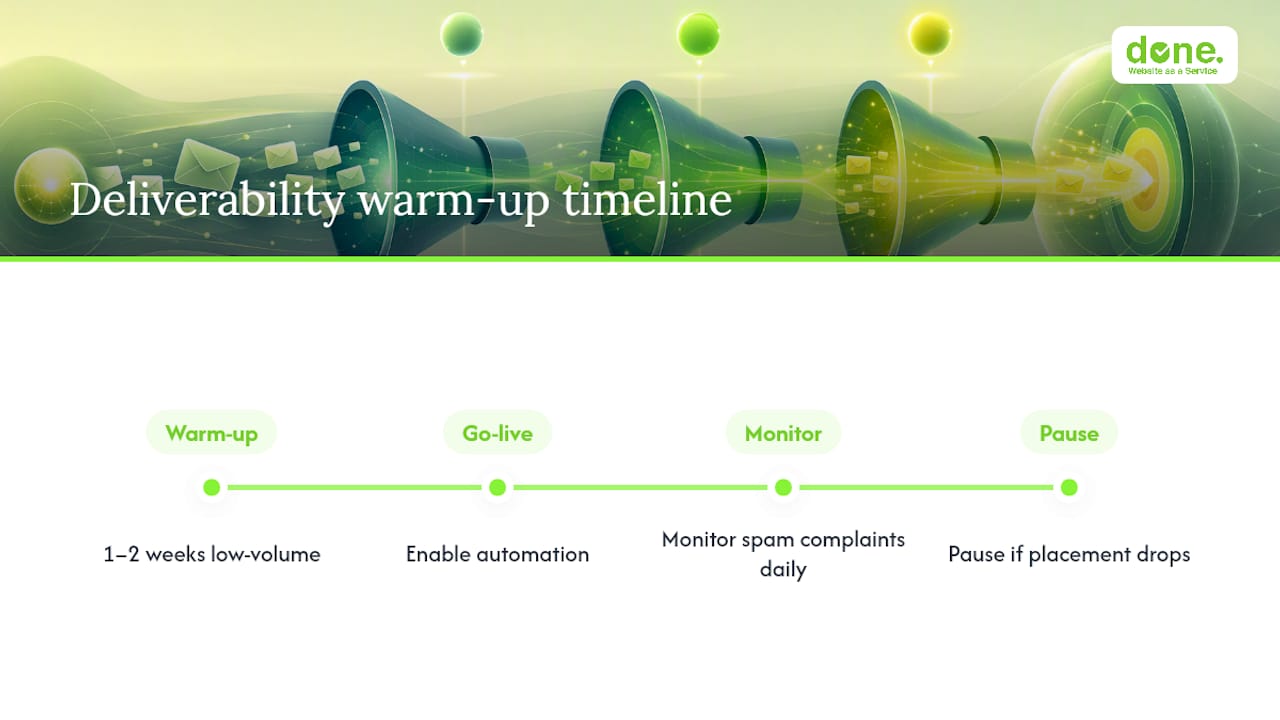
Pro Tip: Warm up a new domain with low-volume manual sends for one to two weeks before switching on any automated sequence. Monitor spam complaints daily and pause volume increases the moment placement drops.
Keeping automation reliable as it scales
Automation amplifies whatever’s already true about your data. Clean CRM records make automation faster; messy ones make the mistakes happen at scale instead of one at a time.
- Keep one single source of truth for lead records, with mandatory fields and consistent naming
- Put change control on every automation flow, including a rollback plan before you edit anything live
- Resist adding a new tool for every new problem; one orchestration layer beats five overlapping subscriptions
- Build consent management and retention rules into every sequence from the start, not retrofitted after a complaint
Ownership matters more than tooling here. Someone specific needs to own the automation stack, or governance quietly disappears within a quarter.
What Done.lu has learned from funnel automation projects
Small teams rarely need ten workflows. In our experience, the three that consistently produce results are the welcome sequence, abandoned-cart recovery, and lead routing. Payback usually shows up within four to eight weeks, visible first in speed-to-lead, not revenue. If you want the full build framework, our digital marketing workflow guide covers it in more depth.
— Thomas
How Done can build and run this for you
Running a funnel audit, GDPR-compliant automation build, and deliverability setup takes real hours most SMB teams don’t have spare. That’s the gap Done fills: we’ve done this across 350+ client projects since 2014, and we know exactly where Lithuanian and European SMBs lose time trying to DIY it.
If your team is under five people and you just need the three core workflows working reliably, a fixed-scope pilot usually makes more sense than a DIY month of trial and error. A short discovery audit can cover current conversion rates, CRM data quality, and deliverability status, then build the minimum viable automation set with team training. GDPR-aware consent handling should be built in from the first workflow, not added afterwards.
If you’re weighing DIY against an agency build, the honest answer depends on your team size and how much CRM cleanup you’re starting from. Our digital marketing automation guide for SMEs is a useful next read either way. When you’re ready to move, book a discovery call with Done and get a fixed-scope proposal for your first three workflows.
Sources
Figures on automation ROI and lead productivity come from Salesforce’s research on marketing automation and Martin Ebongue’s 2026 marketing automation statistics. Deliverability benchmarks are drawn from Firstsales’ sales automation statistics, and funnel-stage framing from Skaitykle’s guide to effective funnel creation. For build steps, see Done’s guide to transforming your website into a lead generator.
- Marketing automation benefits | Salesforce
- Sales automation statistics 2026 – Firstsales
- Marketing automation statistics 2026: 20 numbers that matter