

Google Ads kainos: what Lithuanian SMEs should budget for
August 23, 2026
Website migration without downtime: the complete playbook
August 25, 2026
If you want 50 leads at a target cost per acquisition, budget roughly two to three thousand euros a month before you touch a keyword.
That number only holds if you commit to watching it for at least 90 days. Google’s own budgeting guidance treats campaign planning as a continuous cycle, not a one-off decision, and that is the mindset SEM biudžeto planavimas actually demands.
Your next move today:
- Pick one campaign, not five.
- Set its daily budget at roughly monthly budget ÷ 30.4.
- Let it run untouched for two weeks before judging results.
Key Takeaways
Effective SEM biudžeto planavimas means calculating spend from target conversions and CPA, then adjusting weekly based on real performance data rather than fixed assumptions.
| Point | Details |
|---|---|
| Use the core formula | Target conversions × target CPA, plus a 30 to 50% testing buffer, sets your starting monthly budget. |
| Match bidding to objective | Use CPM for awareness, CPC for traffic, and CPA or Target ROAS once you have roughly 30 conversions in 30 days. |
| Allocate by funnel stage | A common lead-generation split is 60% search, 20% remarketing, and 20% display or experiments. |
| Review on a routine | Check pacing and search terms weekly; save major budget reallocations for a monthly review. |
| Get expert support | Done combines SEM management with conversion-rate optimisation and GDPR-aware analytics for SMEs that need faster, compliant results. |
Table of Contents
- How do you define measurable SEM goals before setting a budget?
- How do you calculate a defensible SEM budget?
- How should you allocate SEM budget across campaign types?
- Which bidding strategy and budget controls should you use?
- What should you measure, and how often should you review it?
- Why trust this approach to SEM budget planning?
- What do SMEs consistently get wrong with SEM budgets?
- Need help running SEM without the guesswork?
- Frequently asked questions
- Sources
How do you define measurable SEM goals before setting a budget?
Vague ambitions produce vague budgets. Start by converting a business target, say €30,000 in monthly revenue, into a campaign-level number: how many sales or leads does that actually require, given your average order value or deal size?
- Translate revenue into volume. €30,000 revenue at a €500 average deal means you need 60 conversions a month, not “more traffic.”
- Match the objective to the right bidding model. Awareness campaigns run on CPM, traffic campaigns on CPC, and conversion campaigns on CPA or Smart Bidding, according to Google Ads’ guidance on budgets and bid strategies.
- Fix your scope before you fix your spend. Geographic targeting, the number of product lines you’re advertising, and campaign duration all move the total budget up or down.
Get this step wrong and every number after it is built on sand.
How do you calculate a defensible SEM budget?
Two formulas cover almost every SME scenario. Use target conversions × target CPA when you know roughly what a lead or sale is worth to acquire. Use target revenue ÷ target ROAS when you’re running ecommerce and thinking in return on ad spend rather than cost per lead.
Without historical data, don’t guess wildly. Conservative starting benchmarks (adjust once you have three to four weeks of real numbers):
- Conversion rate: 2 to 4% for search campaigns on a decent landing page.
- CPA: varies heavily by sector, but treat your first estimate as a hypothesis, not a fact.
- Testing buffer: 30 to 50% on top of your core number.
Worked example: You want 50 leads a month. Set a reasonable target CPA for your sector. Add a testing buffer and plan a budget accordingly, with daily spend about a thirtieth of your monthly budget.
That buffer isn’t padding, it’s tuition. Local SME guidance on Google Ads budgeting recommends starting modest and increasing spend only once a campaign proves itself, and Google itself notes that automated bidding needs a multi-week learning window before it stabilises. Budget for the learning, not just the outcome.
How should you allocate SEM budget across campaign types?
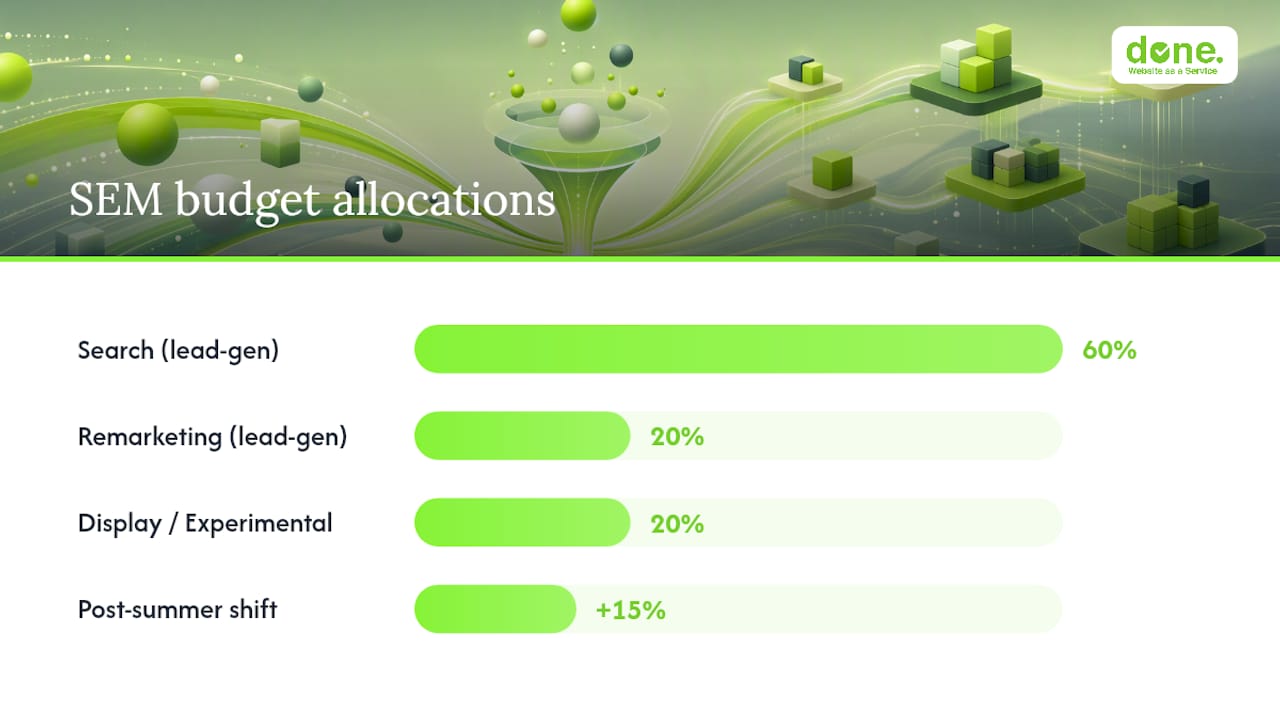
A single lump sum spread evenly across search, remarketing, and display is one of the fastest ways to waste money. Allocation should follow funnel stage and business objective, not an even split for the sake of tidiness.
For a typical lead generation business:
- 60% search campaigns targeting high-intent keywords.
- 20% remarketing to people who visited but didn’t convert.
- 20% display or experimental campaigns to test new audiences.
For ecommerce, shift more weight toward remarketing, since cart abandonment recovery often has the lowest CPA in the whole account. For brand awareness plays, CPM-based display and video can take a larger share early, then shrink once you have enough search volume data to justify shifting budget toward conversion campaigns.
This is common in allocation guidance for advertising budgets, and it keeps testing from ever threatening what already works.*
Seasonality changes this picture fast. A B2B services firm might see enquiries drop in August and spike in September, meaning that shifting 15% of the monthly budget forward into the post-summer push often outperforms spreading it evenly across the year. Product lifecycle matters too: a newly launched product line justifies a heavier experimentation share until you know which keywords and audiences actually convert.
Which bidding strategy and budget controls should you use?
Bidding strategy decides how efficiently your budget gets spent, not just how much you spend. Getting this wrong burns cash even with a perfectly calculated budget.
- Start with manual CPC when you have no conversion history. It gives you direct control while you gather the data Smart Bidding needs.
- Move to Target CPA or Target ROAS once you have roughly 30 conversions in 30 days. That’s the rough threshold where automated bidding starts to have enough signal.
- Use daily and shared budgets deliberately. A shared budget across several ad groups can prevent one greedy campaign from starving the rest.
- Layer on device and location bid adjustments once you see where conversions actually cluster.
- Build a negative keyword list from day one and set conservative bid caps during the first testing phase, a practice consistently flagged in SME campaign planning guidance.
Set spend alerts too. A single misconfigured broad-match keyword can burn through a week’s budget in a day if nobody’s watching.
What should you measure, and how often should you review it?
Four numbers matter more than the rest: CPC, CPA, ROAS, and conversion rate. Each one should trigger a specific budget decision, not just get logged in a spreadsheet.
- CPA rising steadily? Either your bids are too aggressive or your landing page is leaking conversions, fix the page before you touch the bid.
- ROAS falling below target? Reallocate spend away from underperforming campaigns toward the ones already beating target.
- Conversion rate flat despite more traffic? The problem is downstream of the ad, not the keyword.
Pro Tip: Check pacing and search-term reports weekly. Save strategic reallocation decisions, shifting budget between campaigns, for a monthly review, so you’re not reacting to one noisy day.
The loop that actually works is simple: monitor, diagnose, test, reallocate, and repeat, using conversion rate optimization tips to improve campaign performance. Improving your landing page conversion rate is frequently the fastest lever available, because it lowers your effective CPA without spending another euro on ads, a point Done’s own guide to campaign ROI makes directly. It’s also why SEM and CRO should never be planned as separate projects.
Why trust this approach to SEM budget planning?
This guide reflects how Done approaches paid search for its own clients, not theory borrowed from a textbook.
- Written for Done, a Luxembourg digital agency with over 150 completed projects across web, marketing, and AI.
- Done’s teams build GDPR-aware analytics setups, relevant for any business tracking conversions under EU privacy rules.
- Further reading: our guide on SEM campaign structure and practical conversion optimisation fixes.
- Specific project examples are available on request through our team.
What do SMEs consistently get wrong with SEM budgets?
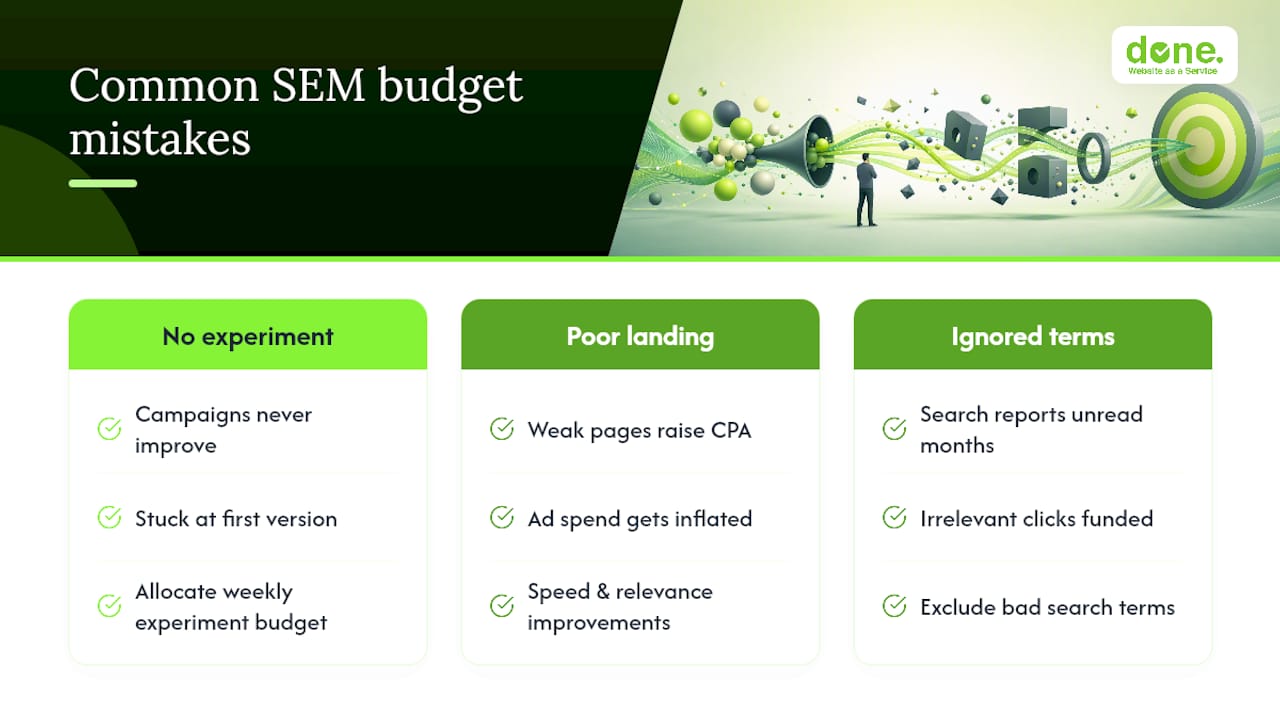
Three mistakes show up again and again. No experimentation budget, so campaigns never improve past their first version. Weak landing pages, so ad spend inflates CPA instead of lowering it. And search-term reports left unread for months, quietly funding irrelevant clicks.
In our experience, the fix is rarely more budget. It’s usually a tighter ad group, a faster landing page, or an afternoon spent excluding bad search terms. Treat your budget as something you adjust weekly, not something you set once and defend.
Need help running SEM without the guesswork?
Some SMEs plan and manage their own SEM budgets fine once they have the formula. Others simply don’t have the hours to check pacing weekly, read search-term reports, and rebuild landing pages when conversion rates slip. Done runs SEM setup, ongoing campaign management, and conversion-rate optimisation together, because a budget spent on ads without a page built to convert is money left on the table.

That combination matters more for businesses handling regulated or sensitive customer data, where analytics and consent tracking need to be GDPR-aware from the start, not bolted on afterwards. If you’re short on time, need faster ROI than trial and error allows, or manage data under stricter compliance rules, it’s worth having a specialist set the structure once rather than rebuilding it three times yourself. See how Done approaches lead-generation campaign delivery and get in touch to discuss your own SEM budget and setup.
Frequently asked questions
How much should a small business spend on SEM per month?
There’s no universal figure, but working backwards from target conversions × target CPA, plus a testing buffer, usually lands SMEs somewhere between a few hundred and a few thousand euro a month depending on sector and competition.
How long before I know if my SEM budget is working?
Give it at least 90 days. Automated bidding strategies need several weeks of data to stabilise, and judging performance before that window closes usually leads to premature, wrong conclusions.
Should I use manual or automated bidding when I’m just starting out?
Start manual if you have no conversion history, then move to Target CPA or Target ROAS once you’re generating roughly 30 conversions a month, giving Smart Bidding enough signal to work with.
What’s the fastest way to lower my SEM costs without cutting budget?
Improve your landing page conversion rate. It reduces your effective cost per acquisition without spending another euro on clicks, which is usually a bigger lever than tweaking bids.