

Prekės ženklo kūrimo kaina: what Lithuanian SMBs pay in 2026
August 22, 2026
SEM biudžeto planavimas: the formula and process that works
August 24, 2026
Google Ads has no fixed price. Costs are set through real-time auctions, shaped by your bids, your ad and landing-page quality, and how many competitors want the same customer. For most Lithuanian SMEs, a workable starter budget for basic search campaigns is generally considered modest but sufficient to gather initial data.
At that level, expect a modest but measurable flow of clicks and a handful of conversions, enough to start learning what works before you commit more.
- Auction-based pricing, not a price list or fixed tariff
- €200–€800/month typically covers a single, tightly focused search campaign
- The biggest lever isn’t your bid, it’s your Quality Score and landing-page relevance
Pro Tip: Before increasing your budget, fix your landing page. A better Quality Score often cuts your cost per click faster than any bid adjustment.
Key Takeaways
Google Ads pricing is auction-driven, not fixed, and the strongest cost control comes from improving Quality Score and landing-page relevance rather than simply raising bids.
| Point | Details |
|---|---|
| Auction-based, not flat-rate | Google Ads kainos depend on bids, Quality Score, and competition, never a fixed price list. |
| Start small and test | €200–€800/month is a realistic Lithuanian SME starter range for search campaigns over 2–4 weeks. |
| Quality Score cuts costs | Better ad relevance and landing pages lower effective CPC more reliably than bigger bids. |
| Automation needs data | Smart Bidding works best once your campaign achieves a sufficient monthly conversion volume; below that, expect more variability. |
| Budget for the whole picture | Management fees, tracking tools, and policy compliance sit alongside ad spend, not inside it. |
| Managed support available | Done runs audits, GDPR-aware tracking setup, and monthly optimisation for Lithuanian SMEs testing or scaling Google Ads. |
Table of Contents
- What drives Google Ads kainos: auction mechanics and Quality Score
- How much should Lithuanian SMEs budget monthly?
- How do Smart Bidding and Performance Planner affect your costs?
- Setting your first Google Ads budget: a practical checklist
- Which KPIs tell you if your budget is working?
- What hidden costs sit alongside your ad spend?
- How can Lithuanian SMEs allocate budget more efficiently?
- Done.lu practitioner view: testing before scaling
- Managed Google Ads support built for Lithuanian SMEs
- Sources
What drives Google Ads kainos: auction mechanics and Quality Score
Every time someone searches, Google runs an auction between advertisers bidding on that keyword. Your position, and what you actually pay, depends on ad rank: a combination of your bid, your Quality Score, and the expected impact of ad formats. You’re not just paying for a slot. You’re paying for a slot relative to how relevant your ad is compared to competitors.
Quality Score is built from three things: expected click-through rate, ad relevance, and landing-page experience. Google is explicit that a stronger ad rank and Quality Score can lower your effective cost per click, sometimes substantially.
Auction value also shifts in real time based on:
- Device (mobile bids often behave differently to desktop)
- Time of day and day of week
- Geographic location, including city versus regional targeting
- Audience signals, such as past site visitors or similar-interest groups
Competitive sectors push prices up regardless of how well you optimise. Legal services, insurance, and construction tend to carry higher CPCs in Lithuania than niche retail or local services, simply because more advertisers are bidding on the same terms.
How much should Lithuanian SMEs budget monthly?
Budget ranges depend heavily on campaign goal and industry, but three broad tiers cover most Lithuanian small and medium businesses.
Starter budgets for small campaigns typically fund one or two tightly scoped search campaigns. Expect limited daily impressions, a small but real trickle of clicks, and enough data over a few weeks to identify which keywords convert. This tier suits businesses testing whether Google Ads works for them at all.
Growth budgets (€800–€3,000/month) open the door to automated bidding strategies and broader keyword coverage. Practical Lithuanian guidance suggests starting with a clear goal and a modest test budget before scaling, which matches what we see in practice, jumping straight to a large budget without validated data usually just burns money faster.
Campaign type changes the maths considerably:
- Search campaigns generally carry the highest CPC but the strongest buyer intent
- Display campaigns cost far less per click but convert at a lower rate
- YouTube (video) campaigns price differently again, often per view rather than per click
Lead-generation goals (a form fill, a phone call) usually produce a lower cost per acquisition than ecommerce sales goals, where the buyer has to complete a full purchase rather than just express interest.
How do Smart Bidding and Performance Planner affect your costs?
Smart Bidding doesn’t set a fixed price per conversion; learn about the benefits of AI-managed paid advertising for improving efficiency. It uses machine learning to bid per auction, chasing the next cheapest available conversion rather than holding your cost per acquisition steady. That distinction matters for how you read your results week to week.
- Smart Bidding adjusts each bid using signals like device, location, and time, meaning your marginal cost moves constantly, not just your average.
- Target CPA and target ROAS strategies need enough conversion history to work reliably. Too little data and the algorithm is essentially guessing.
- Performance Planner lets you model what happens to conversions and average cost if you raise or lower your budget, useful before committing to a bigger spend.
- As a rough threshold, campaigns with fewer than 15 to 30 conversions a month often see more volatility under automated bidding. Manual or conservative strategies tend to be steadier until that volume builds.
Pro Tip: Run Performance Planner scenarios monthly, not just at launch. Lithuanian seasonal demand shifts (think pre-Christmas retail or back-to-school) change what a given budget will actually buy you.
Setting your first Google Ads budget: a practical checklist
Getting your first budget right matters more than getting your first ad copy right. Follow this sequence rather than guessing.
- Pick one goal and one metric. Decide whether you’re measuring leads, phone calls, or completed sales, and set up tracking for that exact action before you launch anything.
- Choose a test budget you can afford to lose. a moderate monthly budget for four weeks is enough to gather real signal without risking your quarter’s marketing spend.
- Run it for 2 to 4 weeks before major changes. Auctions need time to stabilise; adjusting bids daily just confuses the data.
- Model your next step with Performance Planner before increasing spend, and build in a seasonal buffer for known peaks in your sector.
Use these decision rules once data arrives:
- If cost per acquisition is stable and below your target, increase budget gradually
- If conversion volume is too low to judge performance, extend the test rather than change strategy
- If cost per acquisition is rising with no improvement in quality, pause and revisit targeting before spending more
Which KPIs tell you if your budget is working?
Four numbers matter more than the rest: click-through rate, conversion rate, cost per conversion, and total conversion volume. Watch them weekly, not daily, small daily swings rarely mean anything.
The fastest wins for reducing waste:
- Add negative keywords to stop paying for irrelevant searches
- Rebuild slow or mismatched landing pages, this alone often lowers cost per conversion more than any bid change (more on this here)
- A/B test ad copy every few weeks rather than leaving one version running for months
- Adjust device bids once you see a clear performance gap between mobile and desktop
Pause keywords that spend without converting after a reasonable data window, and shift that budget to whatever is already outperforming. Set an automated alert for sudden cost spikes so you catch a problem before it drains a week’s budget.
What hidden costs sit alongside your ad spend?
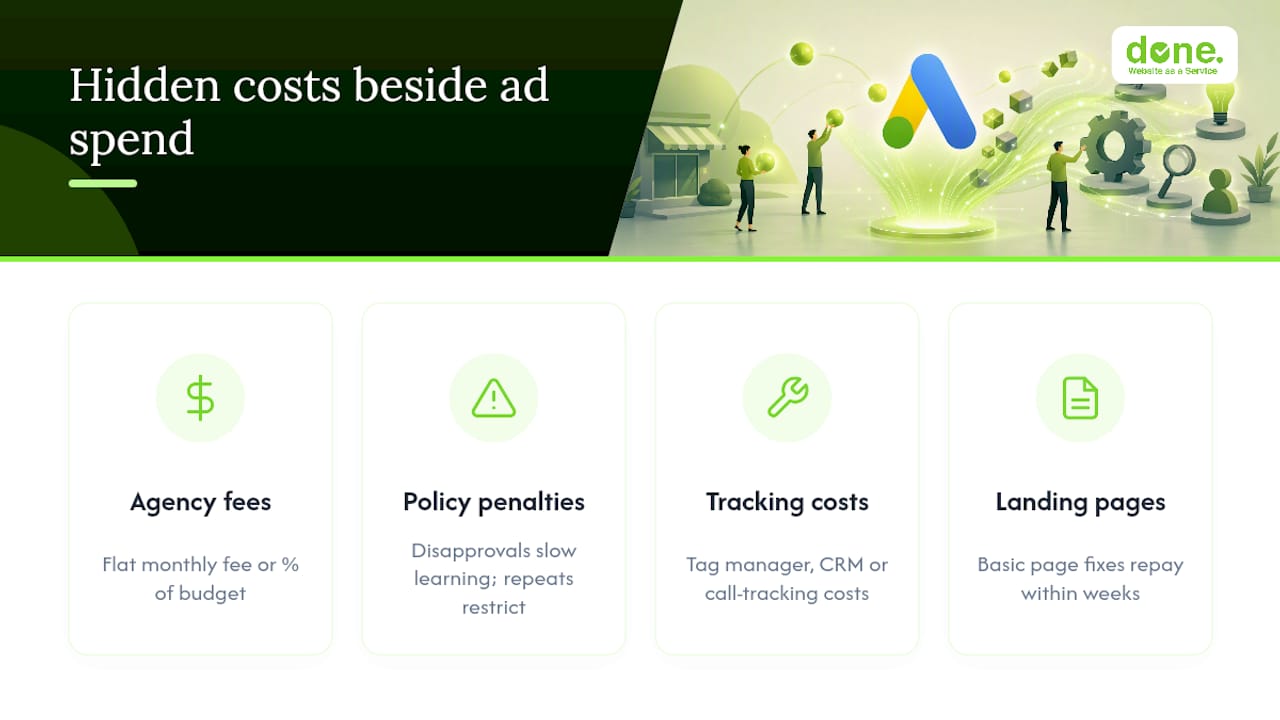
Your media budget, what you pay Google directly, is only part of the real cost of running Google Ads. Three other cost categories catch businesses off guard.
Management fees. If you hire an agency or freelancer, expect a separate fee on top of ad spend, either a flat monthly rate or a percentage of budget. This is normal and often worthwhile, but it needs its own line in your budget, not an assumption that it’s bundled into your ad spend.
Policy penalties and disapprovals. Google enforces strict advertising policies. An ad disapproved for a policy breach doesn’t just fail to run, it can also slow your account’s learning phase and delay Smart Bidding stability. Repeated violations can trigger account-level restrictions, which is a far more expensive problem than a single rejected ad.
Tracking and tooling costs. Reliable conversion tracking sometimes requires a tag management setup, a CRM integration, or a call-tracking tool, each with its own cost. Skipping this step is tempting, but it directly undermines Smart Bidding, which depends on accurate conversion data to optimise properly.
Landing-page and creative costs. Ads without a decent landing page waste money regardless of bid strategy. Budgeting for basic page improvements alongside your ad spend, rather than treating them as an afterthought, tends to pay for itself within weeks.
How can Lithuanian SMEs allocate budget more efficiently?
Lithuania’s market has its own rhythm. Seasonal demand spikes (holiday retail, back-to-school, summer tourism in coastal towns) push CPCs up temporarily, and competitor activity in a given sector can shift auction dynamics almost overnight. Guides focused on Lithuanian small businesses stress flexible, seasonally aware budgeting rather than a fixed monthly figure carried unchanged all year.
Practical ways to stretch a limited budget further:
- Geo-target tightly. If you serve Vilnius or Kaunas specifically, don’t pay for clicks from regions you can’t service.
- Shift budget toward your best-performing days and hours once you have a few weeks of data showing when conversions actually happen.
- Use exact and phrase match more than broad match early on, broad match tends to burn budget on loosely related searches until your negative keyword list matures.
- Pair paid search with a stronger organic and SEM strategy so you’re not paying for every single click that could come from search visibility instead. A practical guide to SEM’s role in the funnel is worth reading before you finalise allocation.
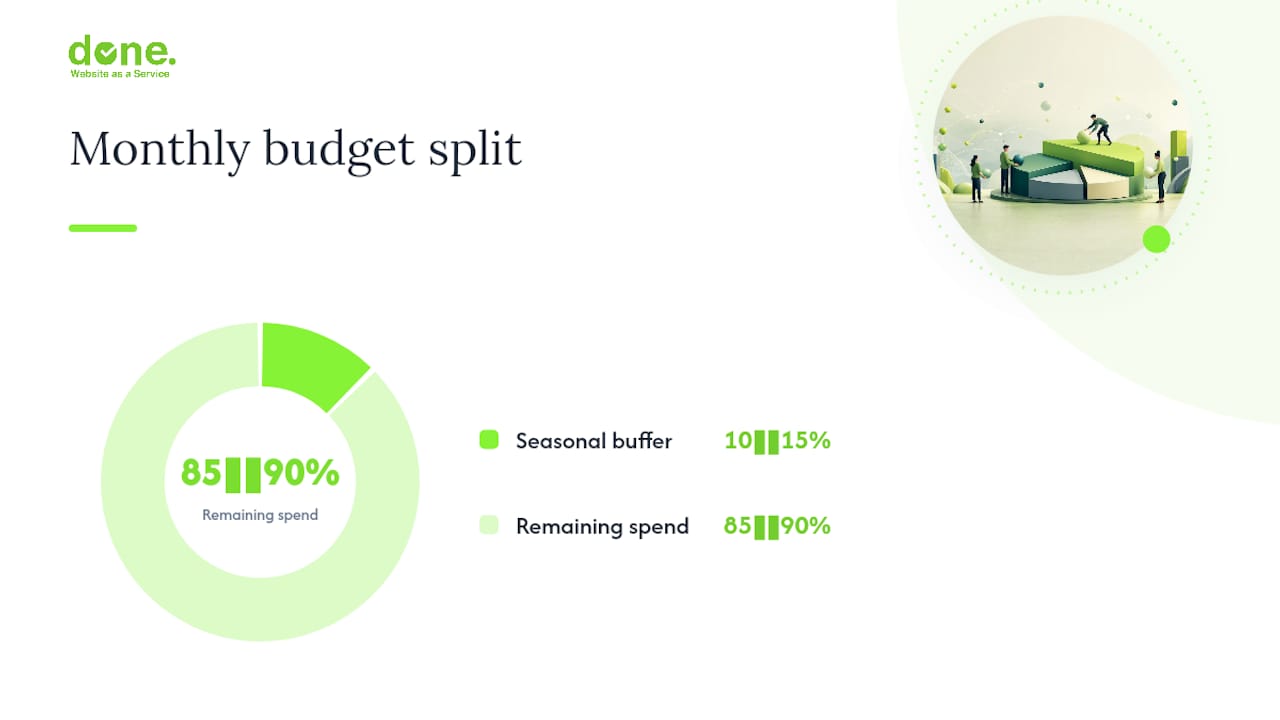
- Reserve 10 to 15% of budget as a seasonal buffer rather than spending the full amount evenly every month.
None of this replaces good measurement. Budget allocation decisions are only as good as the conversion data feeding them.
Done.lu practitioner view: testing before scaling
In our experience, the biggest budgeting mistake Lithuanian SMEs make is scaling before the data is stable. We start every new account with a short test budget, usually four weeks, to validate real unit economics before touching Smart Bidding targets.
Stable automated bidding performance usually takes six to twelve weeks once conversion tracking is solid. For Lithuanian businesses, that also means setting up tracking in a GDPR-aware way from day one, not retrofitting consent management after the fact.
Managed Google Ads support built for Lithuanian SMEs
Running a Google Ads account well takes ongoing attention: watching auctions shift, rebuilding landing pages, and re-checking Smart Bidding targets every few weeks. Done handles that full cycle for Lithuanian SMEs, from initial audit through campaign build, GDPR-compliant conversion tracking, and monthly reporting, so you’re not juggling it alongside running your business.

Our approach starts with an honest audit of what a realistic budget can achieve for your sector, then a test phase before any bigger commitment. Tracking setup follows Lithuanian and EU data-handling requirements from the start, which matters if you’re in a regulated sector or simply want to avoid consent problems later. This sits alongside the wider digital marketing strategy work we do for SMEs who want paid search working alongside their website and organic presence, not in isolation.
If you want a clear, quoted starting budget based on your actual goals rather than a generic benchmark, get in touch with Done for a scoped proposal.