

Conversion optimisation tips for ecommerce: 12 high-impact fixes
August 5, 2026
HubSpot vs Pipedrive: the SMB buyer’s guide for 2026
August 8, 2026
Optimizely is the stronger choice for engineering-led enterprise programmes that need server-side feature flags, multi-method statistical inference, and governance at scale. VWO is the better fit for mid-market marketing teams who want built-in behavioural analytics, a no-code visual editor, and a faster path to their first live test.
Here is the short shortlist to act on immediately:
- Mid-market or SMB marketing team: Start your evaluation with VWO. Published MTU pricing, native heatmaps, session recordings, and a no-code editor mean you can run your first test within days, not weeks.
- Engineering-led enterprise programme: Evaluate Optimizely. Server-side SDKs, advanced feature-flag governance, and a multi-method Stats Engine justify the higher total cost of ownership when you are running experiments across multiple products or properties.
- No in-house development resource, GDPR complexity, or cross-market rollout: Consider a managed approach with an agency. The tooling decision becomes secondary when the implementation overhead exceeds your team’s capacity.
Table of Contents
- How do Optimizely and VWO compare side by side?
- What makes Optimizely the right choice for enterprise programmes?
- What makes VWO the practical choice for mid-market CRO teams?
- Pricing, ROI, and total cost of ownership
- How do you decide which platform to evaluate first?
- GDPR, data residency, and what Central European teams need to verify
- Key takeaways
- A practitioner’s view from client projects
- Done’s managed experimentation service for Luxembourg SMEs
- Useful sources for deeper reading
How do Optimizely and VWO compare side by side?
The table below covers the eight dimensions that matter most when choosing between these two platforms. Pricing signals are indicative; always request a vendor quote matched to your actual monthly unique visitor (MTU) volume.

| Dimension | Optimizely | VWO |
|---|---|---|
| Best for / ideal buyer | Engineering-led enterprise teams, data science, multi-product programmes | Mid-market marketing teams, SMBs, CRO-focused roles |
| Core features | Feature flags, server-side SDK, multi-method Stats Engine, visual editor | Visual editor, A/B and multivariate testing, native heatmaps, session recordings, surveys, form analytics |
| Ease of setup / engineering required | High: SDK integration, governance configuration, often professional services | Low to medium: tag-based setup, no-code editor, self-serve onboarding |
| Performance / page-speed impact | Lower client-side risk when server-side SDK is used; CDN/Edge delivery available | Client-side snippet adds some page-weight; server-side option available for advanced plans |
| Integrations | Warehouse-native analytics, CDP connectors, DXP ecosystem | Google Analytics 4, Segment, HubSpot, Salesforce, plus native behavioural analytics reducing third-party needs |
| Pricing model | Quote-only enterprise pricing; sales-led procurement | Published MTU-scaled tiers; entry plans accessible to mid-market budgets |
| Support & onboarding | Dedicated customer success, professional services; longer onboarding timeline | Self-serve documentation, live chat, onboarding calls; faster time to first test |
| GDPR / data residency | Data processing addendum available; EU data centre options; subprocessor list on request | Data processing addendum available; EU hosting options; consent-mode integrations supported |
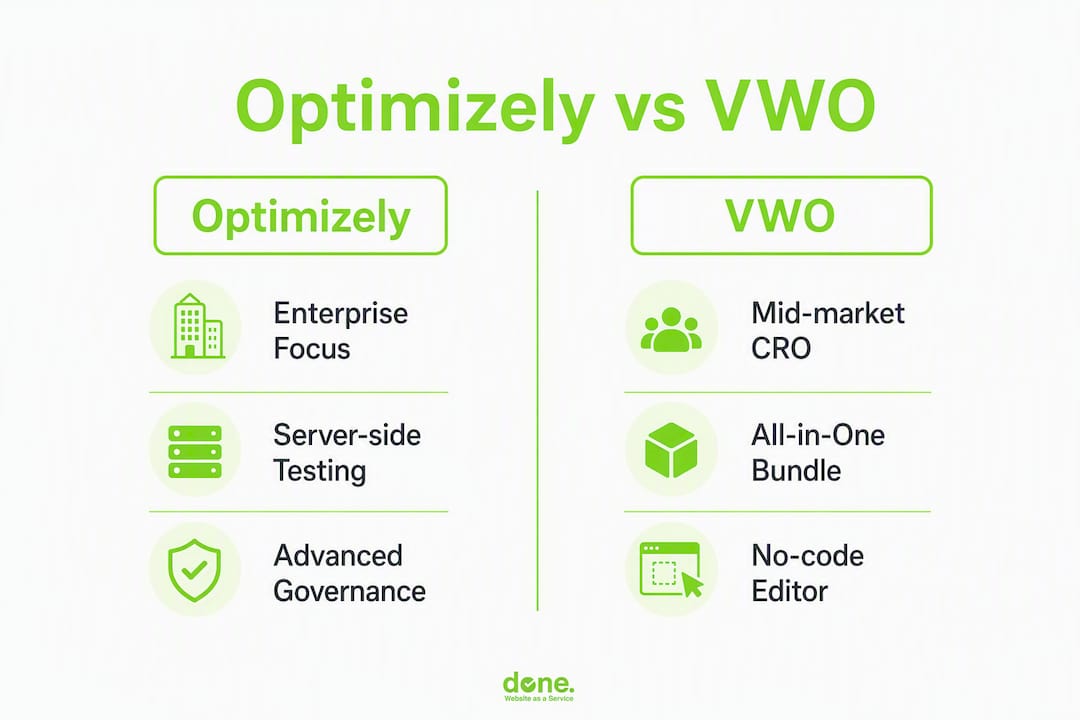
Both platforms support A/B, multivariate, and server-side testing, but they differ sharply on bundled analytics and procurement model. Independent comparisons consistently place Optimizely as the enterprise standard and VWO as the mid-market all-rounder.
What makes Optimizely the right choice for enterprise programmes?
Optimizely’s clearest strengths sit on the server side. Its SDK coverage spans multiple languages including JavaScript, Python, Java, Ruby, Go, and Swift, which means engineering teams can run experiments inside application logic rather than relying on a client-side snippet. That matters when you are testing pricing algorithms, recommendation engines, or checkout flows where a flicker effect would be unacceptable.
Governance is a genuine differentiator. Role-based access controls, approval workflows, and multi-project coordination are built into the platform rather than bolted on. For organisations where a failed experiment on a production system carries real commercial risk, those controls are worth paying for.
The Stats Engine deserves specific attention. Optimizely offers sequential testing, Bayesian inference, and frequentist methods within the same platform, designed for always-valid inference so teams can peek at results without inflating false-positive rates. That is a meaningful advantage for data science teams running high-velocity programmes.
Limits to be honest about:
- Optimizely commonly requires a longer sales cycle and higher first-year total cost of ownership because of implementation, training, and professional services costs.
- Licensing Web Experimentation alone often brings an enterprise onboarding model that increases TCO beyond the subscription fee itself.
- Without dedicated engineering resource, the SDK integration and governance configuration can take weeks rather than days.
- Optimizely often forms part of a broader Digital Experience Platform (DXP) purchase, which changes the procurement conversation entirely.
Technical artefacts to request in a demo:
- SDK support matrix with the languages your engineering team actually uses
- Sample governance workflow showing how an experiment moves from draft to live
- Data export schema and warehouse connector documentation
- Edge/CDN delivery options and their performance benchmarks
Pro Tip: Ask the Optimizely sales team for a reference customer in your vertical who runs server-side experiments. The implementation story — how long from contract to first live test — is more revealing than any feature checklist.
Optimizely’s multi-method Stats Engine is designed for always-valid inference at scale, meaning teams can monitor results continuously without the false-positive inflation that plagues standard frequentist tests stopped early. For a data science team running dozens of concurrent experiments, that statistical rigour is the core justification for the higher price point.
What makes VWO the practical choice for mid-market CRO teams?
VWO’s strongest selling point is the bundle. Heatmaps, session recordings, form analytics, and on-site surveys sit inside the same subscription, so a marketing team does not need to pay separately for a behavioural analytics tool. In practice, this removes the data-silo overhead that comes from stitching together separate platforms and often delivers a lower effective total cost of ownership for teams spending under £25,000 per year on experimentation tooling.

The no-code visual editor is genuinely usable by non-developers. A marketer can set up a headline test on a landing page without writing a line of code, which is why VWO wins on ease of setup in most head-to-head comparisons. Many mid-market teams reach their first live test quickly after signing up.
VWO uses a Bayesian SmartStats approach that presents results as probability statements rather than p-values, which tends to be more intuitive for marketing teams who are not statisticians. The statistical trade-off is that Optimizely’s multi-method engine offers more flexibility for advanced inference scenarios, but for standard A/B and multivariate tests on marketing pages, VWO’s approach is entirely adequate.
Where VWO is less suitable:
- Feature-flag maturity for complex progressive rollouts is less deep than dedicated enterprise flag platforms.
- Very high-traffic programmes with millions of monthly unique visitors may encounter scaling considerations worth discussing with the vendor.
- Warehouse-native analytics integrations are less mature than Optimizely’s, so data-science-heavy teams may still need third-party connectors.
What to expect in the first 30–60 days: Tag installation and goal configuration in week one; first A/B test live by week two; heatmap and session-recording data informing the second test hypothesis by week four. Prioritise the visual editor, heatmaps, and SmartStats modules before exploring surveys or form analytics.
Pro Tip: During a VWO trial, measure three things: time from account creation to first live test (target under five working days), implementation hours logged by your team, and whether the native heatmap data is sufficient to replace your current session-replay subscription. Those three numbers will tell you more than any vendor demo.
For many mid-market marketing teams, the faster time to first test and bundled analytics deliver higher short-term ROI than an enterprise experimentation engine. The question is not which platform has more features — it is which platform your team will actually use consistently.
Pricing, ROI, and total cost of ownership
The pricing gap between the two platforms is significant and worth modelling carefully before you start a procurement process.
VWO publishes MTU-scaled pricing with entry tiers accessible to mid-market teams, while Optimizely uses quote-only enterprise pricing that requires a sales conversation. That difference alone affects your procurement timeline by weeks.
Common additional cost buckets to include in your TCO model:
- Implementation: SDK integration, QA, and governance setup for Optimizely; tag installation and goal configuration for VWO.
- Training: Optimizely typically requires structured onboarding; VWO’s self-serve documentation reduces this cost.
- Third-party analytics: VWO’s bundled heatmaps and session recordings reduce the need for separate tools, lowering effective TCO for mid-market teams. Optimizely users often retain a separate behavioural analytics subscription.
- Ongoing maintenance: Governance workflows, SDK version updates, and multi-project coordination add engineering overhead for Optimizely programmes.
The table below shows indicative first-year cost ranges for different programme sizes. These estimates are based on published comparisons and typical implementation patterns; always request vendor quotes matched to your actual traffic and team structure.
| Programme size | VWO (estimated first-year range) | Optimizely (estimated first-year range) |
|---|---|---|
| Small (entry-level) | Accessible to smaller teams | Generally for larger scale |
| Mid-market | Suitable for mid-market budgets | Targeted at mid-market and above |
| Enterprise | Suitable for enterprise-grade programmes | Enterprise pricing applies |
Optimizely’s enterprise feature set pays off when you are running server-side algorithm experiments across multiple properties, coordinating feature rollouts with engineering, or operating in a regulated environment where governance and audit trails are mandatory. For a single-site marketing programme, the cost differential is hard to justify.
Procurement teams should demand example MTU calculations and sample first-year TCO scenarios from vendors rather than relying on list prices or verbal estimates.
How do you decide which platform to evaluate first?
Work through these discriminators in order. The first question that gives you a clear answer is usually the right stopping point.
Decision path:
- Do you need server-side feature flags tied to progressive rollouts or algorithm experiments? If yes, evaluate Optimizely first.
- Is your primary team marketing-led with limited engineering resource? If yes, start with VWO.
- Is your monthly unique visitor count under 500,000 and your annual experimentation budget under £30,000? VWO is almost certainly the right starting point.
- Do you have a data processing agreement requirement with EU data centre specification and a named subprocessor list? Both platforms can meet this, but verify it in writing before signing.
- Is your procurement timeline under eight weeks? Optimizely’s sales cycle often exceeds this; VWO’s self-serve entry is faster.
Questions to ask during vendor demos:
- What SDK languages do you support, and what is the typical integration time for our stack?
- Walk me through your approval workflow for a new experiment going live on a production system.
- How does your platform handle consent-mode changes mid-experiment?
- What is the page-speed delta for your client-side snippet at our traffic volume?
- Can you show us a data export schema and confirm EU data centre availability?
- What does a typical first-year TCO look like for a team our size?
Proof of concept metrics to track:
- Time from account activation to first live test
- Implementation hours logged by your team
- Page-speed delta before and after snippet installation
- Tracking accuracy verified against your existing analytics
- Integration effort with your current CRM or analytics stack
When to hire an agency instead:
Consider a managed approach if you have no in-house development resource for SDK work, if GDPR complexity requires server-side tracking and consent-flow architecture, or if you are running experiments across multiple markets with different legal requirements. The tooling decision becomes secondary when implementation overhead exceeds your team’s capacity. Done’s digital marketing workflow guide covers structuring these decisions within a broader optimisation programme.
GDPR, data residency, and what Central European teams need to verify
GDPR compliance in experimentation is not just about cookie banners. The data your testing platform collects — session recordings, heatmap clicks, form interactions, user identifiers — all falls within the scope of personal data processing under the GDPR. For teams in Luxembourg and Central Europe, this means the vendor relationship requires a signed data processing addendum (DPA) before you go live.
GDPR verification checklist for vendor evaluation:
- Signed DPA with the vendor, covering all data collected by the experimentation platform
- Named subprocessor list, updated regularly and accessible without a support ticket
- EU data centre confirmation (not just “EU option available” — get the specific location in writing)
- IP anonymisation enabled by default or configurable at account level
- Data export controls: can you delete a user’s experiment data on a subject access request?
- Consent-mode integration: does the platform respect your CMP’s consent signals and suppress tracking for non-consenting users?
Server-side tracking is the most reliable way to handle consent correctly in an experimentation context. When tracking logic runs on your server rather than in the browser, you control exactly what data is collected and when, independent of ad-blocker interference or consent-banner timing issues. Both Optimizely and VWO support server-side implementations, but the configuration complexity differs significantly.
When GDPR or data sovereignty is a priority, implement server-side tracking for experiments and insist on a data processing addendum that lists EU subprocessors by name. A vendor who cannot produce that list promptly is a compliance risk, regardless of how good their feature set is.
In our experience working with Luxembourg SMEs, the most common gap is not the DPA itself but the subprocessor list. Vendors sometimes route data through US-based analytics or logging services that are not disclosed upfront. We routinely request the full subprocessor list before any platform goes live, and we configure server-side tracking and consent flows as standard for clients in regulated sectors. Done’s GDPR-compliant automation guide covers the broader principles that apply equally to experimentation setups.
Pro Tip: In your demo contract or proof-of-concept agreement, include a clause requiring the vendor to notify you within 72 hours of any subprocessor change. This mirrors the GDPR’s own breach notification window and gives you a contractual basis to act if a new subprocessor raises a compliance concern.
Key takeaways
VWO is the right starting point for most mid-market marketing teams in Central Europe; Optimizely earns its higher cost only when server-side feature flags, multi-method statistical inference, and enterprise governance are genuine requirements.
| Point | Details |
|---|---|
| Platform fit by team type | VWO suits marketing-led SMB and mid-market teams; Optimizely suits engineering-led enterprise programmes with server-side needs. |
| TCO gap is significant | Optimizely’s first-year costs typically run well above VWO’s for comparable traffic, once implementation and professional services are included. |
| Bundled analytics reduce VWO’s effective cost | Native heatmaps, session recordings, and surveys in VWO remove the need for a separate behavioural analytics subscription. |
| GDPR requires active verification | Always obtain a signed DPA, a named subprocessor list, and EU data centre confirmation before any platform goes live. |
| Done for managed experimentation | Done handles platform setup, consent flows, and GDPR-compliant tracking for Luxembourg SMEs who prefer a managed approach. |
A practitioner’s view from client projects
Most of the teams we work with at Done are not choosing between Optimizely and a comparable enterprise platform. They are choosing between starting an experimentation programme properly and not starting one at all. That framing matters, because the right tool is the one your team will actually use.
We have seen clients spend months in Optimizely procurement conversations while their conversion rate sat untouched. In several cases, a VWO trial running a single landing page test delivered measurable improvement before the enterprise contract was even signed. Speed to first insight is underrated in these decisions.
The GDPR piece is where we add the most value for Luxembourg clients specifically. Configuring a consent flow that correctly suppresses experiment tracking for non-consenting users, setting up server-side event logging, and verifying the subprocessor list are not glamorous tasks, but they are the ones that prevent a compliance incident six months after launch. We treat them as non-negotiable steps in every experimentation rollout, not optional extras.
One corrective action we perform regularly: clients who have installed a testing platform’s client-side snippet without checking its interaction with their consent management platform. The result is often that experiment data is collected for users who declined analytics cookies, which is a GDPR violation regardless of which platform you chose. Fixing it requires either a server-side migration or a careful reconfiguration of the consent-mode integration. Neither is complicated, but both require someone who knows what to look for.
Done’s managed experimentation service for Luxembourg SMEs
Running a proper A/B testing programme without in-house development resource is genuinely difficult. The tooling is only part of the problem; the consent architecture, the statistical interpretation, and the ongoing test prioritisation are where most teams stall.

Done offers a managed experimentation service that covers the full setup: platform selection matched to your traffic and team size, GDPR-compliant consent flow configuration, server-side tracking where required, and a dashboard you can actually read. For most Luxembourg SMEs, this costs less than a self-managed enterprise licence once you account for the implementation and compliance work you avoid. We run proof-of-concept projects that deliver a first live test within two weeks of kick-off, with clear metrics agreed upfront.
If you are weighing the investment in web development needed to support server-side experiments, or you simply want a team that has done this before to handle the setup, talk to Done about a scoped experimentation project. No long-term contract required for the initial proof of concept.
Useful sources for deeper reading
A short list of vendor documentation and independent analyses worth consulting during your procurement process.
- G2 comparison: Optimizely Web Experimentation vs VWO Testing — user reviews and feature ratings from verified buyers; useful for checking real-world implementation experiences.
- Kirro: VWO vs Optimizely 2026 — covers published pricing tiers and MTU examples; request the vendor to match these to your actual traffic figures.
- Piperocket: VWO vs Optimizely — detailed feature comparison including statistical engine differences; useful for technical evaluation teams.
- Crazy Egg: Optimizely vs VWO true strengths — practical breakdown of governance features and analytics trade-offs.
- Personizely: VWO vs Optimizely best fit guide — clear buyer segmentation by budget and use case.
- Lucky Orange: VWO vs Optimizely use cases compared — covers TCO and procurement process considerations in detail.
Always ask vendors for MTU calculation examples that match your actual monthly traffic, not round-number illustrations. A vendor who cannot produce a realistic first-year cost scenario for your specific volume is not ready to be your experimentation partner.
For teams who prefer a managed route, Done’s e-commerce optimisation guide and campaign ROI optimisation guide cover the measurement frameworks that sit underneath any experimentation programme.