
Top 3 AI reporting tools 2026
May 12, 2026
Top 3 AI email automation alternatives 2026
May 14, 2026
TL;DR:
- Luxembourg’s business community is advancing rapidly in AI adoption, with most companies reaching an advanced level of maturity. However, sustainable and compliant AI implementation remains a challenge, requiring structured guidance and risk management. National initiatives like the AI Factory and Fit 4 Digital – AI provide practical support to SMEs, emphasizing governance, data readiness, and continuous strategy development.
Luxembourg’s business community is moving faster on AI than most European markets. In fact, 63% of surveyed Luxembourg companies are already at an advanced stage of AI maturity, a figure that surprises even many business owners operating in the market. Yet behind that headline number lies a more complicated reality: adopting AI tools is one thing, and running them sustainably, compliantly, and effectively is quite another. This guide gives Luxembourg SME owners a clear, practical pathway from initial interest through to confident, structured AI adoption that genuinely delivers business growth.
Table of Contents
- Luxembourg’s national AI Factory and digital transformation support
- Understanding Luxembourg’s AI regulation and compliance framework
- Practical steps for adopting AI in your SME
- Overcoming common challenges: Governance and implementation gaps
- Why sustainable AI adoption demands more than digital enthusiasm
- How Done supports Luxembourg SMEs driving the future of work
- Frequently asked questions
Key Takeaways
| Point | Details |
|---|---|
| AI adoption is accelerating | Most Luxembourg SMEs now have advanced AI maturity, driving digital transformation. |
| Regulation is EU-centric | AI operations are governed by the EU AI Act and national supplements, requiring structured risk management. |
| Feasibility first, then pilot | SMEs should assess internal data and workflow before committing to full-scale AI projects. |
| Governance fills the gap | Formal oversight and implementation frameworks are essential to avoid enthusiasm outpacing reality. |
| Expert support fast-tracks progress | Consulting partners like Done help convert readiness into reliable and lasting business impact. |
Luxembourg’s national AI Factory and digital transformation support
With this context set, it is vital to understand how national initiatives translate into practical actions for Luxembourg’s SME owners. The good news is that Luxembourg has invested significantly in structured support, meaning you do not have to navigate AI adoption alone.
The centrepiece of this national effort is the AI Factory initiative, a coordinated programme designed to guide both private companies and public sector bodies through safe, efficient, and compliant AI adoption. It provides a structured service catalogue covering everything from initial AI readiness assessments through to deployment support and staff training. Think of it as a blueprint that removes the guesswork from where to begin.
Alongside the AI Factory, Luxembourg has developed a programme specifically tailored to SMEs: Fit 4 Digital – AI. This track offers focused feasibility analysis that uses real business data to determine which AI use cases are viable, appropriate, and cost-effective for a given company. The approach is deliberately practical, avoiding generic technology recommendations in favour of assessments grounded in what your business actually needs and what your data can genuinely support.
Key features of Luxembourg’s SME AI support programmes
Here is a summary of what each major initiative offers:
| Programme | Target audience | Core offering | Key benefit |
|---|---|---|---|
| AI Factory | Companies and public bodies | Service catalogue, structured adoption support | Safe, compliant, efficient deployment |
| Fit 4 Digital – AI | SMEs specifically | Feasibility analysis using internal data | Avoids wasted investment |
| Digital Skills programmes | SME teams | Training and upskilling resources | Builds internal capability |
The AI Factory’s service catalogue is particularly useful because it breaks AI adoption into clearly defined stages. You are not expected to go from zero to full deployment overnight. Instead, the catalogue maps out the steps: assess, design, pilot, review, and scale. Each stage has defined inputs and expected outputs, making it far easier to plan resource allocation and set realistic timelines.
For SMEs specifically, the Fit 4 Digital – AI programme is worth prioritising early. It targets the critical question that most business owners struggle to answer: which AI use case should we start with? Rather than exploring every available technology, the programme helps you focus on the intersection of your operational pain points and your available data. This focus prevents the common mistake of adopting AI tools that look impressive in demonstrations but do not address any real problem in your business.
- AI Factory supports structured deployment across private and public sectors
- Fit 4 Digital – AI offers SME-specific feasibility analysis tied to real business data
- Programmes emphasise safe, efficient, and compliant AI adoption from the outset
- Stepwise support models allow SMEs to scale gradually without overcommitting resources
Did you know? Luxembourg’s national programmes are designed to reduce the risk of AI adoption for SMEs, not just promote it. This risk-reduction focus makes them far more useful to business owners than generic technology promotion campaigns.
Connecting these national resources with specialist digital consulting for Luxembourg SMBs means you can translate programme outputs into genuine business strategy, rather than leaving the work half-finished after an initial assessment.
Understanding Luxembourg’s AI regulation and compliance framework
Building on the national programmes, SMEs must also navigate the complex regulatory environment as they integrate AI. This is an area where many business owners feel less confident, and understandably so. Regulation around AI is still evolving, and the landscape can seem technically dense.
The starting point is straightforward: Luxembourg’s AI regulation is governed primarily by the EU AI Act and related legal instruments. Luxembourg does not have a stand-alone national AI law that sits separately from European frameworks. This means if you understand the EU AI Act’s requirements, you have the foundation of what applies to your business in Luxembourg.
Understanding the EU AI Act’s risk classification
The EU AI Act organises AI systems into four risk categories. Understanding where your intended AI use cases fall is the first compliance step you need to take.
| Risk level | Description | SME implication |
|---|---|---|
| Unacceptable risk | Prohibited AI applications | Avoid entirely |
| High risk | Applications in critical areas (HR, finance, healthcare) | Requires conformity assessment and documentation |
| Limited risk | Chatbots, recommendation systems | Transparency obligations apply |
| Minimal risk | Spam filters, AI-assisted scheduling | Few restrictions, low compliance burden |
Most SMEs will be working with limited or minimal risk AI tools for the majority of their use cases. However, if you are in financial services, healthcare, or legal sectors in Luxembourg, you are more likely to be touching high-risk categories, particularly around automated decision-making or client profiling. In those cases, compliance documentation and human oversight mechanisms are mandatory, not optional.
What does compliance actually mean in practice for an SME? It generally involves three areas:
- Risk classification: Identify which category your intended AI application falls under before deployment.
- Documentation: Maintain records of how the AI system works, what data it uses, and how decisions are reviewed. This is your audit trail.
- Oversight mechanisms: Ensure there is a human in the loop for any consequential decision the AI influences, particularly in high-risk categories.
Pro Tip: Treat AI adoption as a governance project from day one, not just an IT project. Assign responsibility for AI oversight to a named person within your organisation, even if that person’s role is part-time. Having a designated owner makes documentation, review cycles, and accountability far more manageable.
Understanding AI and GDPR compliance together is also essential, since AI tools frequently process personal data, triggering obligations under both frameworks simultaneously. Managing them in isolation is inefficient and increases risk.
“Compliance is not a one-time checkbox. It is an ongoing responsibility that evolves as both the technology and regulation develop.” This mindset shift, from viewing compliance as a project to treating it as a process, is one of the most important changes Luxembourg SME owners need to make as they integrate AI into their operations.
One practical step is to map every AI tool you currently use or plan to use against the EU AI Act risk categories before you expand any deployment. This mapping exercise is straightforward and ensures you are never caught off-guard by a compliance obligation you did not realise existed.
Practical steps for adopting AI in your SME
With clear compliance requirements understood, SMEs can now focus on the step-by-step process of adopting AI with confidence and clarity. The structure below reflects the methodology recommended by Luxembourg’s own Fit 4 Digital – AI programme, adapted for practical execution.
Step 1: Identify your internal pain points first
Before you look at any technology, list the top five processes in your business that consume the most time, produce the most errors, or create the most friction for your team. AI adoption works best when it solves a problem that is genuinely painful and clearly defined. Examples might include customer enquiry handling, invoice processing, appointment scheduling, or data entry from physical documents.
Step 2: Assess your data readiness
AI systems depend on data. If the data you have is incomplete, inconsistently formatted, or stored across disconnected systems, any AI tool you deploy will produce unreliable results. A data readiness assessment asks: what data do we have, where is it stored, how clean is it, and is there enough of it to train or run an AI effectively?

This step is specifically required by the Fit 4 Digital – AI feasibility analysis process. Running it before committing to any specific solution prevents costly mistakes and wasted investment. Many SMEs skip this step out of eagerness to begin, only to discover months later that their chosen AI tool cannot perform as expected because the underlying data is not ready.
Step 3: Run a structured feasibility assessment
A feasibility assessment combines your pain point analysis with your data readiness review to produce a shortlist of viable AI use cases. It should also include a rough cost-benefit estimate, so you understand the expected return before committing any budget. This is where external consulting support often pays for itself, because an experienced advisor can challenge assumptions and identify use cases you might have missed.
Statistic to consider: Businesses that run structured feasibility assessments before AI deployment report significantly higher satisfaction with outcomes than those that adopt tools reactively. The assessment phase is an investment in getting the implementation right.
Step 4: Pilot a single use case before scaling
Choose the highest-priority, lowest-risk use case from your feasibility shortlist and run a defined pilot. A good pilot has clear success metrics set in advance, a fixed time period (typically eight to twelve weeks), and a review process built in at the end. Resist the temptation to pilot multiple use cases simultaneously. Focus produces better data and clearer lessons.
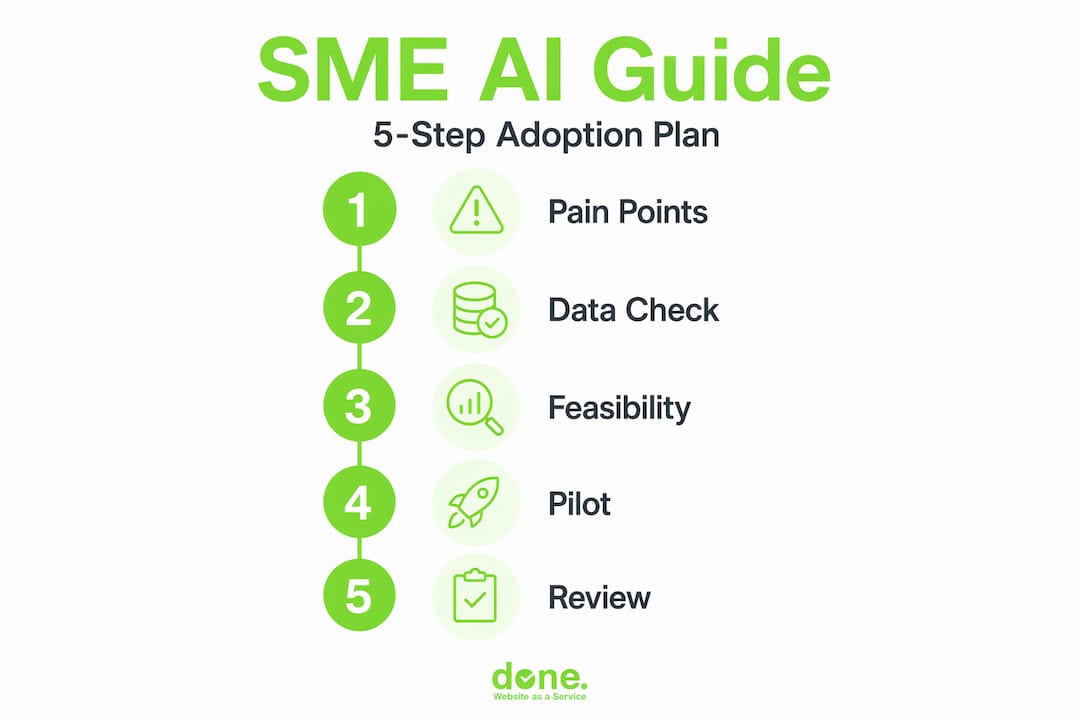
Step 5: Review, adjust, and plan the next phase
After the pilot concludes, review results against your predefined metrics honestly. What worked? What did not? What do your team members say about the experience? Use those answers to adjust the solution, update your compliance documentation, and decide whether to scale, iterate, or pivot to a different use case.
Pro Tip: Build your pilot review into the calendar before the pilot starts. If the review date is not scheduled in advance, it tends to get delayed indefinitely as day-to-day operations take priority.
For a fuller breakdown of how to execute these stages, explore practical AI steps for SMEs and consider how AI change management strategies can help your team adapt smoothly throughout the process.
Overcoming common challenges: Governance and implementation gaps
Having learned the step-by-step process, it is equally important to be aware of the pitfalls and how best to resolve them using proven approaches. The evidence from Luxembourg’s own business community points to a clear pattern.
Despite the high reported AI maturity among Luxembourg companies, governance and sustainable implementation remain the most significant challenges. What this means in practice is that many businesses have explored AI, perhaps adopted some tools, but have not formalised the processes around those tools. There is no ownership, no documentation, no review cycle, and no plan for scaling.
The most common implementation gaps
These are the pitfalls we see most frequently when working with SMEs on AI adoption:
- Lack of defined governance: No one person or team owns the AI strategy, so accountability is diffuse and decision-making stalls.
- Unclear roadmaps: Businesses adopt individual tools reactively without a broader strategy connecting them to business objectives.
- Inadequate oversight: AI systems are deployed and then left running without regular review, creating both compliance risk and performance drift.
- Insufficient staff training: Teams are expected to use new AI tools without being shown how they change existing workflows or what to do when results look unexpected.
- Skipping the pilot phase: Businesses jump from feasibility directly to full deployment, losing the valuable learning opportunity that a structured pilot provides.
- Treating AI as purely an IT concern: When AI adoption is managed only by the IT team without involvement from operations, finance, or leadership, the solutions produced often do not address the actual business need.
“Digital enthusiasm is necessary but not sufficient. Sustainable AI adoption requires formal governance, clear ownership, and an ongoing commitment to evaluation.” This is the pattern that separates businesses achieving real returns from those accumulating a collection of underused tools.
The fixes are practical and within reach of any SME. Formalise governance by assigning a named AI lead. Build a simple roadmap that connects each AI initiative to a specific business goal. Schedule quarterly reviews of all active AI tools. Invest in team training before deployment, not after frustration sets in.
For SMEs looking to move beyond ad hoc adoption into a structured operational framework, business automation with AI in Luxembourg offers a useful lens for thinking about how AI fits into broader operational efficiency goals.
Why sustainable AI adoption demands more than digital enthusiasm
Working with Luxembourg SMEs over an extended period reveals a pattern that the Chamber of Commerce survey data confirms: a high AI maturity score does not automatically translate into durable business impact. In fact, it can mask fragility. A business that has explored many AI tools without governance structures in place is not more advanced. It is more exposed.
The survey evidence from Luxembourg shows precisely this pattern. Advanced AI maturity at the sector level coexists with significant gaps in sustainable execution at the company level. This is not a contradiction. It reflects the fact that awareness and experimentation naturally precede structured implementation. The problem arises when businesses stay in the exploration phase indefinitely, assuming that familiarity with the technology is the same as operational readiness.
Our view is that the single most important shift Luxembourg SME owners can make is to treat AI adoption as a continuous process rather than a series of discrete projects. Each tool deployed, each pilot run, each governance decision made should feed into an evolving strategy that grows smarter with experience. This is precisely what the national AI Factory framework is designed to support, but it requires commitment from business leadership to activate it effectively.
The businesses that achieve sustainable results from AI share a few consistent characteristics. They have a named AI lead with clear responsibilities. They document their use cases and review outcomes formally. They invest in training their teams not just on how to use a tool, but on why it has been chosen and what good results look like. And they maintain an ongoing relationship with expert advisors rather than treating implementation as a one-time event.
This last point matters more than it might appear. AI regulation, best practices, and available tools are all evolving rapidly. A strategy that was appropriate in early 2025 may need significant adjustment by late 2026. Businesses that rely on static implementation plans without ongoing expert input will find their AI investments depreciating in value faster than they expect.
If you are serious about translating digital readiness into durable competitive advantage, a structured approach to AI strategy consulting for SMEs is not an optional luxury. It is the mechanism that converts enthusiasm into measurable, sustainable results.
How Done supports Luxembourg SMEs driving the future of work
Luxembourg SMEs that want to move from AI curiosity to confident, sustainable implementation now have a clear picture of what is required. The national programmes, compliance frameworks, and step-by-step methodologies described in this guide give you the foundation. What bridges the gap between knowing and doing is expert support tailored to your specific business context.
Done.lu works directly with SMEs across Luxembourg to design and implement AI strategies that are practical, GDPR-compliant, and genuinely aligned with business objectives. Whether you need an initial AI audit, a structured feasibility assessment, help selecting and deploying the right tools, or ongoing governance support, our team provides guidance at every stage. Our AI consulting for SME growth services are built around your operational reality, not a generic technology template. If you are ready to move from readiness to results, start with a clear AI strategy roadmap designed for your business and your goals.
Frequently asked questions
Is there a specific Luxembourg AI law SMEs must follow?
No. AI in Luxembourg is governed by the EU AI Act and national legal supplements, not a stand-alone Luxembourg-specific AI law. Understanding the EU framework gives SMEs the compliance foundation they need.
How does Fit 4 Digital – AI help small businesses adopt AI?
The Fit 4 Digital – AI programme offers structured feasibility analysis using internal SME data to assess readiness and identify viable use cases before any piloting or investment begins.
What is the main challenge for Luxembourg SMEs adopting AI?
Many Luxembourg SMEs show high AI maturity in terms of interest and exploration, but governance structures and sustainable implementation remain the most significant practical obstacles.
Should AI adoption be treated differently than other IT projects?
Yes, because AI carries specific compliance, risk classification, and governance obligations under EU regulations that standard IT projects do not, requiring a more structured and documented approach from the outset.
What is the recommended first step for SMEs looking to adopt AI?
Start with a structured internal needs and data readiness assessment before piloting anything. The Fit 4 Digital – AI programme specifically emphasises this feasibility-first approach to avoid wasted investment and failed pilots.