

Unlock lead growth and efficiency with AI content generation
May 2, 2026
Intelligent automation: A practical guide for European SMEs
May 4, 2026
TL;DR:
- Structured AI change management enables SMBs to achieve significant labor savings and high ROI early in adoption. Clear frameworks, focused goals, empathetic communication, and iterative measurement build confidence, reduce resistance, and foster long-term capability. Small, incremental wins along specific workflows lead to sustainable AI integration and measurable business growth.
A small Norwegian firm with 25 employees achieved a 41% first-year ROI from labour savings alone after adopting AI in a structured way. German SMBs deploying quote automation have reported returns of 700% within twelve months. These are not outliers reserved for technology companies or large corporations. They are the direct result of approaching AI adoption with a clear plan, realistic goals, and genuine commitment to managing the change. This guide walks you through the frameworks, real-world evidence, and practical steps that make AI change management work for small and medium-sized businesses across Luxembourg and Europe.
Table of Contents
- Why SMBs need an AI change management strategy
- Core AI change management frameworks: What works for SMBs
- Real-world cases: AI success stories and benchmarks for European SMBs
- Overcoming challenges: People, data, and ethical concerns
- Luxembourg and European SMBs: Programmes, funding, and getting started
- Our perspective: Why small steps trump grand AI strategies
- Connect strategy and results: How we accelerate AI change for SMBs
- Frequently asked questions
Key Takeaways
| Point | Details |
|---|---|
| Structured change wins | A clear, stepwise approach to AI change management delivers better results and less risk for SMBs. |
| Start with one workflow | Focus on a single, high-impact business process to pilot and optimise your AI journey. |
| Leverage local support | SMBs in Luxembourg and Europe can access funding and expert guidance for digital transformation. |
| Measure and adapt | Regularly track and refine your progress with specific ROI and employee feedback. |
| Human factors matter | Empathy, communication, and ethical considerations are essential when integrating AI alongside your team. |
Why SMBs need an AI change management strategy
AI adoption without structure is one of the most common and costly mistakes SMBs make. Many business owners hear about a promising tool, deploy it quickly, and then find that their team resists using it, the ROI is impossible to measure, and enthusiasm fades within a few weeks. That pattern is not a failure of AI. It is a failure of change management.
Change management, in this context, means having a deliberate process for introducing new technology into your organisation. It covers how you prepare your people, how you define success, how you handle resistance, and how you measure the value generated over time. Without it, even excellent AI tools will underperform or be abandoned.
The specific barriers facing SMBs are different from those facing large enterprises. Budget constraints make it harder to absorb failed experiments. Smaller teams mean that one resistant employee can block progress. Skills gaps are often sharper because there is no dedicated IT or data science function. And unclear ROI is especially damaging when every euro counts. These are the exact problems that AI consulting for SMBs is designed to address.
Structured AI change management solves these problems by creating accountability and clarity before the first tool is deployed. Research confirms that the most effective approaches for SMBs include:
- Establishing governance from day one, with clear ownership and decision rights
- Focusing on a single high-impact goal rather than trying to automate everything at once
- Communicating with empathy, acknowledging staff concerns rather than dismissing them
- Identifying AI champions inside your team who will advocate for the change
- Delivering role-based training so each person learns what they actually need to know
- Measuring iteratively so you can demonstrate wins and adjust where needed
“AI change management for SMBs involves structured frameworks starting with governance, single high-impact goals, empathetic communication, AI champions, role-based training, and iterative measurement.”
Each of these steps addresses a specific failure mode. Governance prevents scope creep. A single goal prevents paralysis. Empathetic communication reduces resistance. Champions create internal momentum. Role-based training avoids overwhelming staff. Iterative measurement builds confidence and justifies further investment.
Core AI change management frameworks: What works for SMBs
Having established why a strategy is vital, let’s explore which methodologies offer the best structure for your SMB. There are several proven frameworks, and understanding their differences helps you choose the right starting point for your situation.
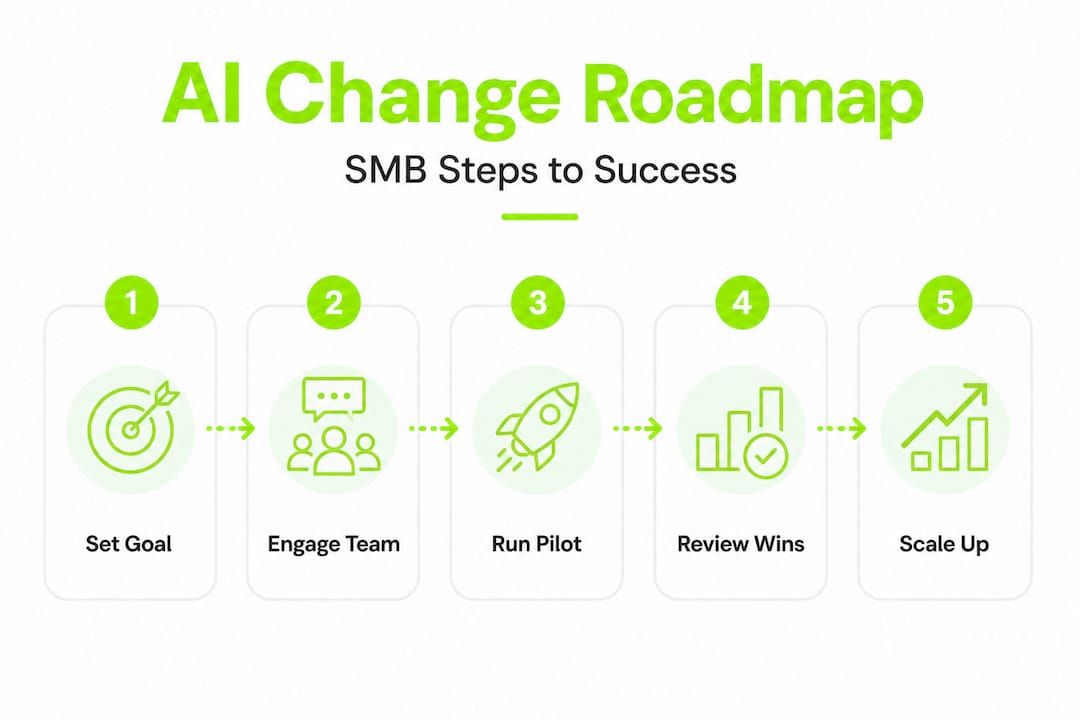
The 5-step framework focuses on the human dimension of change. It asks you to define a precise goal first, then communicate the rationale with empathy, co-create the solution with your team rather than imposing it, train people based on the reality of their day-to-day work, and finally measure both hard and soft wins. This framework works particularly well for businesses where staff buy-in is the primary risk.
The 90-day playbook is more time-bound and operational. It begins with governance in the first week, moves into pilot testing between days 15 and 45, and then evaluates and scales from day 46 to 90. This structured timeline is valuable because it gives everyone, including sceptical team members, a clear sense of when decisions will be made and what the evaluation criteria are.

The 4 stages of AI adoption model describes the maturity journey: the cognitive stage (AI as a basic tool that assists with specific tasks), the intern stage (AI taking on defined, repeatable workflows), the collaborator stage (AI working alongside humans in real time), and the agent stage (AI acting semi-autonomously within set parameters). Understanding which stage you are at helps you set realistic expectations and avoid trying to run before you can walk.
The AI adoption guide for small and midsize enterprises recommends moving through these stages deliberately, with each stage building the data quality, team confidence, and governance structures needed for the next.
Framework comparison
| Framework | Primary goal | Typical timeline | Best for |
|---|---|---|---|
| 5-step human-centred | Staff buy-in and culture change | 60 to 90 days | People-heavy resistance |
| 90-day playbook | Structured pilot and scale | 90 days | Operational implementation |
| 4-stage maturity model | Long-term capability building | 6 to 18 months | Strategic AI roadmaps |
| Single workflow focus | Quick ROI demonstration | 30 to 60 days | First-time AI adopters |
To get started with a single workflow, follow this sequence:
- Map the workflow you want to improve, documenting every step and the time each takes
- Identify the bottleneck or pain point that AI could realistically address
- Select one tool that addresses that specific problem, not a broad platform
- Run a 30-day pilot with two or three team members and collect time and quality data
- Review results together with the pilot team before deciding whether to expand
This approach is the foundation of a credible AI strategy roadmap and avoids the trap of over-investing before you have evidence.
Pro Tip: When selecting your AI champion, choose someone who is respected by peers but also naturally curious about technology. They do not need to be your most senior person. In fact, a mid-level employee who uses the workflow daily will have far more credibility with colleagues than a manager who rarely engages with the operational detail. Pairing them with leadership support is the most effective combination you can deploy.
There is a broad range of best AI tools for SMBs available at accessible price points. Choosing the right tool matters less than choosing the right process for adopting it.
Real-world cases: AI success stories and benchmarks for European SMBs
With the frameworks in mind, let’s see what real-world outcomes look like for small businesses in Europe. The data is encouraging, and it comes from businesses of a scale directly comparable to yours.
European AI adoption benchmarks
| Country or context | SMB metric | Result |
|---|---|---|
| Norway (25-person SME) | First-year ROI from labour savings | NOK 86k, 41% ROI |
| Germany (quote automation) | First-year ROI | 700% |
| Denmark | SMEs satisfied with AI cost savings | 65% exceeding expectations |
| Luxembourg (SME average) | AI adoption rate | 33.61%, above EU 20% |
| Luxembourg (L’Unico office) | Energy, cost and CO2 reduction via AI | 23%, 23%, 27% respectively |
Luxembourg stands out in the European context. With an AI adoption rate of 33.61%, Luxembourg SMEs are performing significantly above the EU average of 20%. This is partly because of proactive national programmes and partly because of the Grand Duchy’s concentration of financial services and technology firms, which create a spillover effect of digital maturity into smaller businesses.
The Fit 4 AI programme, run by Luxinnovation, offers co-financing for consulting services to help Luxembourg SMBs plan and implement AI projects. This dramatically reduces the financial risk of getting started, particularly for businesses with limited discretionary budgets.
The L’Unico case is worth examining in more detail. This Luxembourg office used AI to optimise its energy management, achieving a 23% reduction in energy consumption, a 23% reduction in operating costs, and a 27% reduction in CO2 emissions. These results came not from a complex AI deployment but from applying machine learning to an existing building management system. The key success factors were:
- A focused goal (energy efficiency, not a broad digital transformation)
- Integration with existing infrastructure rather than replacing it
- Measurement from day one so progress was visible and motivating
- External consulting support to navigate the technical setup
You can see how AI boosts digital marketing for European SMEs in a comparable way, applying the same principle of focused, measurable deployment. And the broader opportunities around harnessing AI in business extend well beyond marketing and energy into operations, customer service, and financial administration.
The Danish satisfaction data is also significant. When 65% of SMBs report that AI cost savings exceeded expectations, it challenges the assumption that AI overpromises and underdelivers. Structured adoption is the differentiating factor. Businesses that invested in planning, training, and measurement tended to outperform their initial projections. Those that did not invest in structured change management were more likely to report disappointment.
Overcoming challenges: People, data, and ethical concerns
To unlock such benefits, you’ll need to navigate the practical roadblocks that come with digital transformation. The most common are not technical. They are human.
The barriers SMBs face most frequently include:
- Existential job fears among staff who worry that AI will replace their roles
- Model opacity, meaning employees do not understand how AI decisions are made and therefore do not trust them
- AI literacy gaps, where team members lack the foundational knowledge to use tools effectively
- Ethical concerns about data privacy, bias in automated decisions, and accountability
- Hybrid workflow challenges, where AI tools need to coexist with manual processes and human judgement
Each of these is manageable, but none should be ignored. The compelframework.org research on AI change management is clear that addressing these concerns proactively is essential because AI can support pattern recognition and data processing at scale, but it cannot replace human sensing of political dynamics, emotional nuance, or situational context.
“AI augments human capability but cannot replicate the contextual judgement that experienced employees apply to ambiguous, relationship-driven, or ethically complex situations.”
This perspective is important because it reframes AI as a tool that amplifies your team’s value rather than diminishing it. When staff understand this framing, resistance tends to decrease significantly. People become more open to learning because they see AI as making their work more interesting and less repetitive, not as a threat to their livelihood.
Practical steps for overcoming these barriers include involving employees in the tool selection process, sharing pilot results openly, and creating a safe space to raise concerns without judgement. For SMBs operating in data-sensitive sectors such as finance, legal, and healthcare, the ethical and operational dimensions of business automation require particular care, especially under GDPR.
The digital marketing advantages available to Luxembourg SMBs offer a useful parallel. Businesses that communicated transparently with their teams about new marketing tools saw faster adoption and better results than those that simply deployed without explanation.
Pro Tip: Before launching any AI pilot, hold a dedicated thirty-minute session with the affected team to explain what the tool does, what it does not do, and how their feedback will shape its use. This single step reduces resistance more effectively than any amount of training alone, because it signals respect for your employees’ experience and intelligence.
Luxembourg and European SMBs: Programmes, funding, and getting started
If you’re based in Luxembourg or the wider region, you have unique resources to accelerate your transformation. Access to co-financing, structured consulting programmes, and a well-developed SME support ecosystem means your first AI initiative does not have to be a financial risk.
Here is how to access the Fit 4 AI programme and get started:
- Register your interest through Luxinnovation’s online portal and check eligibility for the co-financing scheme
- Commission a diagnostic from an approved AI consulting partner to identify your highest-value automation opportunity
- Receive a structured recommendation covering tool selection, implementation timeline, and training needs
- Apply for co-financing to offset consulting and implementation costs
- Launch a 30 to 90-day pilot focused on a single workflow, with clear measurement criteria agreed in advance
- Review and iterate at the end of the pilot before deciding on full-scale deployment
The key insight from Luxembourg SME data is that businesses combining training with AI adoption amplify their gains by a factor of 5.9 compared with those that simply deploy tools without investing in skill development. That figure should inform every budget decision you make about your AI programme.
Quick wins that Luxembourg and European SMBs consistently report success with include:
- Invoice processing and accounts payable automation, which reduces manual data entry and error rates
- Customer email triage and response drafting, which saves front-line staff significant time each week
- Meeting transcription and summary tools, which improve knowledge retention and reduce follow-up errors
- Document classification and search, particularly valuable for legal, compliance, and HR functions
- Social media content scheduling and performance monitoring, which frees marketing staff for strategic work
Funding and support sources available across the region include:
- Fit 4 AI (Luxembourg): Co-financing for SME AI consulting and diagnostics
- Digital Europe Programme: EU-wide funding for digital skills and technology adoption in SMBs
- Horizon Europe: Research and innovation funding applicable to AI projects
- National digitalisation funds: Available in Germany, France, Belgium, and the Netherlands
The digital consulting resources for Luxembourg SMBs are extensive, and navigating them becomes far simpler with an experienced local partner who understands both the technical and administrative landscape.
Our perspective: Why small steps trump grand AI strategies
After working directly with SMBs on AI change management across Luxembourg and Europe, we have arrived at a perspective that runs counter to much of what you will read in technology press: the grand transformation strategy is almost always the wrong starting point for a small or medium-sized business.
Large consultancies and technology vendors have a commercial incentive to sell you sweeping visions of AI-powered reinvention. These narratives are exciting. They are also, for most SMBs, a path to wasted budget, demoralised teams, and scepticism about AI that can set a business back by two or three years.
The businesses we have seen achieve the most durable results are those that started with one process, one team, and one clear question: did this make our week easier or not? When the answer is yes, measured with actual data, the cultural momentum shifts in a way that no boardroom presentation ever could. People become advocates. They start suggesting the next use case themselves.
Compounding small wins is not a consolation prize for businesses that cannot afford big change programmes. It is, in our experience, the most reliable route to meaningful AI capability. A single workflow automated well builds the data quality, the team confidence, and the governance habits needed to tackle the next one. After three or four cycles, you are not a business that did one AI project. You are a business with an embedded AI practice.
The conventional wisdom that you need a comprehensive data strategy before you can begin is also, in most cases, wrong for SMBs. You need enough data to test a hypothesis in a specific workflow. That is a much lower bar, and most businesses already meet it without realising.
We strongly recommend following an AI roadmap for SMBs that is explicitly designed to build incrementally, with each stage informed by evidence from the previous one rather than by assumptions made at the start. This is not timid thinking. It is disciplined, efficient, and far more likely to produce lasting value.
Pro Tip: Set a compounding wins target at the start of your AI programme. Aim to demonstrate a measurable improvement in one workflow every quarter. Four small wins in a year add up to a genuinely transformed operation, and they create a track record that justifies continued investment far more convincingly than any projected ROI from a business case built on assumptions.
Connect strategy and results: How we accelerate AI change for SMBs
Ready to translate principles into growth? Done Web Agency helps SMBs operationalise successful AI change management from initial audit through to full implementation and team training.
At Done.lu, we combine AI business growth expertise for SMEs with hands-on experience delivering results across Luxembourg and Europe. Our approach is built on the same iterative, evidence-led methodology described throughout this guide. We begin with a focused diagnostic, identify your highest-value automation opportunity, and support your team through a structured pilot that generates measurable ROI. Whether you need a practical workflow automation guide or a full-scale strategy, we provide the technical and human support to make it work. Our business automation services in Luxembourg are GDPR-compliant by design and tailored to the reality of SMB budgets and team structures. Speak to us about your first AI project today.
Frequently asked questions
What is AI change management, and why is it essential for small businesses?
AI change management is a structured process for adopting artificial intelligence tools, ensuring your team, workflows, and outcomes improve together. Following structured frameworks with governance and iterative measurement is vital to reduce risk and maximise ROI.
How quickly can an SMB see results from AI adoption?
Many European SMBs report measurable ROI within 90 days when using a properly structured implementation. The 90-day playbook methodology builds in governance, piloting, and evaluation stages that make first-year gains predictable and reproducible.
Are there funding or support programmes for AI adoption in Luxembourg?
Yes. The Fit 4 AI programme offers co-financing and structured consulting to support SME digital transformation in Luxembourg, significantly reducing the financial risk of your first AI project.
Will adopting AI lead to job losses in my organisation?
There is no evidence of short-term job losses for SMBs embracing AI. AI typically automates specific tasks and creates capacity for higher-value, more rewarding work rather than eliminating roles.
What are the most common mistakes when managing AI-driven change?
The most frequent mistakes are skipping structured planning, under-communicating with staff about the purpose and limitations of AI tools, and neglecting to measure impact at the task level. Frameworks that emphasise governance and communication consistently outperform those that focus on technology alone.
Recommended
- AI strategy consulting for SMEs: A roadmap to efficiency
- How to use AI tools to boost your SME’s digital marketing
- How AI transforms businesses: a guide for SMEs in Europe
- Harnessing artificial intelligence in business for SME growth
- How AI is Transforming Business Automation in 2025 | Blog
- Creative team management strategies for innovative SMEs | Ready Accounting