

Web Rebranding: Boosting Digital Growth in 2026
February 22, 2026
Step by Step Web Design for Ecommerce Success
February 24, 2026
Managing an e-commerce site in Luxembourg often means watching your products slip past potential customers simply because your website does not surface in the right search results. Understanding SEO fundamentals empowers you to shape online visibility, ensuring your brand stands out among both local and international competitors. This guide clarifies key SEO pillars, exposes common misconceptions, and reveals how a well-rounded approach leads to sustainable online growth.
Table of Contents
- SEO Fundamentals And Common Misconceptions
- On-Page Vs. Off-Page SEO Strategies Explained
- Essential Ranking Factors For E-Commerce Websites
- Measuring SEO Impact On Online Visibility
- Avoiding Common SEO Mistakes In Marketing
Key Takeaways
| Point | Details |
|---|---|
| Understanding SEO’s Pillars | Focus on the four core pillars: Technical, On-page, Content, and Off-page SEO to enhance visibility and drive traffic. |
| SEO is Ongoing | Treat SEO as an ongoing effort, adapting to algorithm updates and changing customer behavior, not a one-time project. |
| Combine Strategies | On-page and Off-page SEO must work together to maximize ranking potential and drive credible traffic. |
| Measure SEO Impact | Regularly track key metrics like organic traffic and conversion rates to assess SEO effectiveness and make informed adjustments. |
SEO Fundamentals and Common Misconceptions
Search engine optimization shapes how your Luxembourg e-commerce business appears online. Without it, your products remain invisible to customers actively searching for solutions you offer. SEO fundamentals break down into four distinct pillars that work together to boost your organic visibility and drive qualified traffic to your site.
The four core pillars of SEO are:
- Technical SEO: Ensures your website’s foundation is sound—fast loading speeds, mobile responsiveness, clean code, and proper site structure help search engines crawl and index your pages efficiently.
- On-page SEO: Optimizes individual pages with relevant keywords, compelling meta descriptions, proper heading structure, and high-quality content that answers customer questions.
- Content SEO: Focuses on creating valuable, original content that addresses real customer needs and establishes your authority in your industry.
- Off-page SEO: Builds your site’s credibility through backlinks from reputable sources, brand mentions, and social signals that signal trustworthiness to search engines.
When selecting which keywords to target, you’ll need strategic keyword research that aligns with your customers’ actual search behavior. This foundation determines which opportunities you pursue first.
Breaking Down Common Misconceptions
Many business owners believe SEO is purely a technical task handled by specialists who work in isolation. This misunderstands how SEO actually works. SEO impacts your entire marketing strategy—from content creation to customer experience to brand visibility.
Another widespread myth claims SEO and paid advertising are competitors. They’re not. SEO increases organic traffic through unpaid search results while paid ads supplement that visibility. Both channels work together in a healthy marketing strategy.
Here’s what actually separates SEO from paid search:
- SEO builds sustainable, long-term visibility that compounds over time—results may take months but last years.
- Paid ads deliver immediate visibility but stop the moment you stop paying.
- SEO impacts brand awareness beyond direct clicks; search visibility builds credibility.
- Paid ads depend on continuous budget allocation; SEO requires upfront work, then ongoing maintenance.
Many small e-commerce owners also believe SEO is a one-time project. Reality differs significantly. Search algorithms update constantly, competitor strategies evolve, and customer behavior shifts. Your site requires ongoing optimization to maintain and improve rankings.
SEO success isn’t about gaming algorithms—it’s about genuinely serving what your customers search for and making your site technically sound so search engines can understand your value.
One final misconception: that SEO only matters for enterprise brands. For small and medium-sized businesses in Luxembourg, SEO offers competitive advantage. While larger competitors may dominate paid advertising budgets, strategic SEO positions you effectively against local and international rivals with lower competition in niche markets.
Pro tip: Start by auditing which pages on your site currently rank in search results and for which keywords, then focus your optimization efforts on pages already gaining traction—improving existing visibility requires less effort than building from zero.
On-Page vs. Off-Page SEO Strategies Explained
Your SEO strategy requires two distinct but equally important branches working together. On-page SEO focuses on optimizing what happens on your actual website, while off-page SEO builds your reputation beyond it. Both approaches drive rankings, but they operate differently and require different tactics.
On-page SEO is what you control directly. You optimize your website’s content, structure, and technical elements to help search engines understand your pages and rank them higher. Off-page SEO involves external factors—primarily backlinks and brand mentions—that signal authority to search engines.
What On-Page SEO Actually Covers
On-page optimization means perfecting individual pages to rank for specific keywords your customers search for. This includes:
- Content quality and relevance: Write comprehensive answers to customer questions with proper keyword placement.
- Meta tags and descriptions: Craft compelling title tags and meta descriptions that encourage clicks from search results.
- Heading structure: Use H1, H2, and H3 tags logically to organize content and signal importance.
- URL structure: Keep URLs clean, descriptive, and keyword-relevant rather than filled with numbers or parameters.
- Internal linking: Connect related pages on your site to distribute authority and guide both users and search engines.
For small e-commerce sites, optimizing internal linking structure dramatically improves how search engines crawl and understand your product pages, making this tactic especially valuable.
Here’s a comparison of on-page and off-page SEO strategies for e-commerce businesses:
| Aspect | On-Page SEO Focus | Off-Page SEO Focus |
|---|---|---|
| Primary Control | Direct (website content) | Indirect (external partners) |
| Main Objective | Improve page relevance | Build domain authority |
| Key Activities | Content, meta tags, links | Backlinks, mentions, outreach |
| Impact on Rankings | Enhances keyword signals | Increases trust/credibility |
The Off-Page SEO Difference
Off-page SEO happens outside your website. The primary factor is backlinks—when other reputable websites link to yours. Building backlink authority demonstrates to search engines that your content deserves trust and visibility.
Other off-page tactics include:
- Earning brand mentions across industry websites and publications.
- Social media engagement and sharing that amplifies your content’s reach.
- Local business listings and citations for location-based visibility.
- Influencer partnerships that bring credibility and traffic.
How They Work Together
Think of on-page SEO as preparing your product for sale—polishing it, describing it accurately, and organizing your store logically. Off-page SEO is equivalent to getting other trusted retailers to recommend your product to their customers.
You can have perfectly optimized pages, but without backlinks and authority signals, search engines won’t rank them as highly. Conversely, strong backlinks to poorly optimized pages waste that authority potential.
Both on-page and off-page SEO must work together; excelling at only one leaves ranking potential unrealized and leaves your competitors an opening.
For Luxembourg e-commerce businesses, this means combining best-in-class content and page optimization with strategic outreach to earn links from industry blogs, local business directories, and relevant publications in your sector.
Pro tip: Start by auditing your top-performing pages—those already earning some organic traffic—and apply on-page optimization improvements like better internal links and meta tags, then use those improved pages as anchors for your off-page link-building efforts.
Essential Ranking Factors for E-Commerce Websites
E-commerce ranking success depends on a specific set of factors tailored to how customers actually shop online. Unlike generic websites, your e-commerce site must balance SEO optimization with conversion performance. These factors work together to improve both visibility and sales.
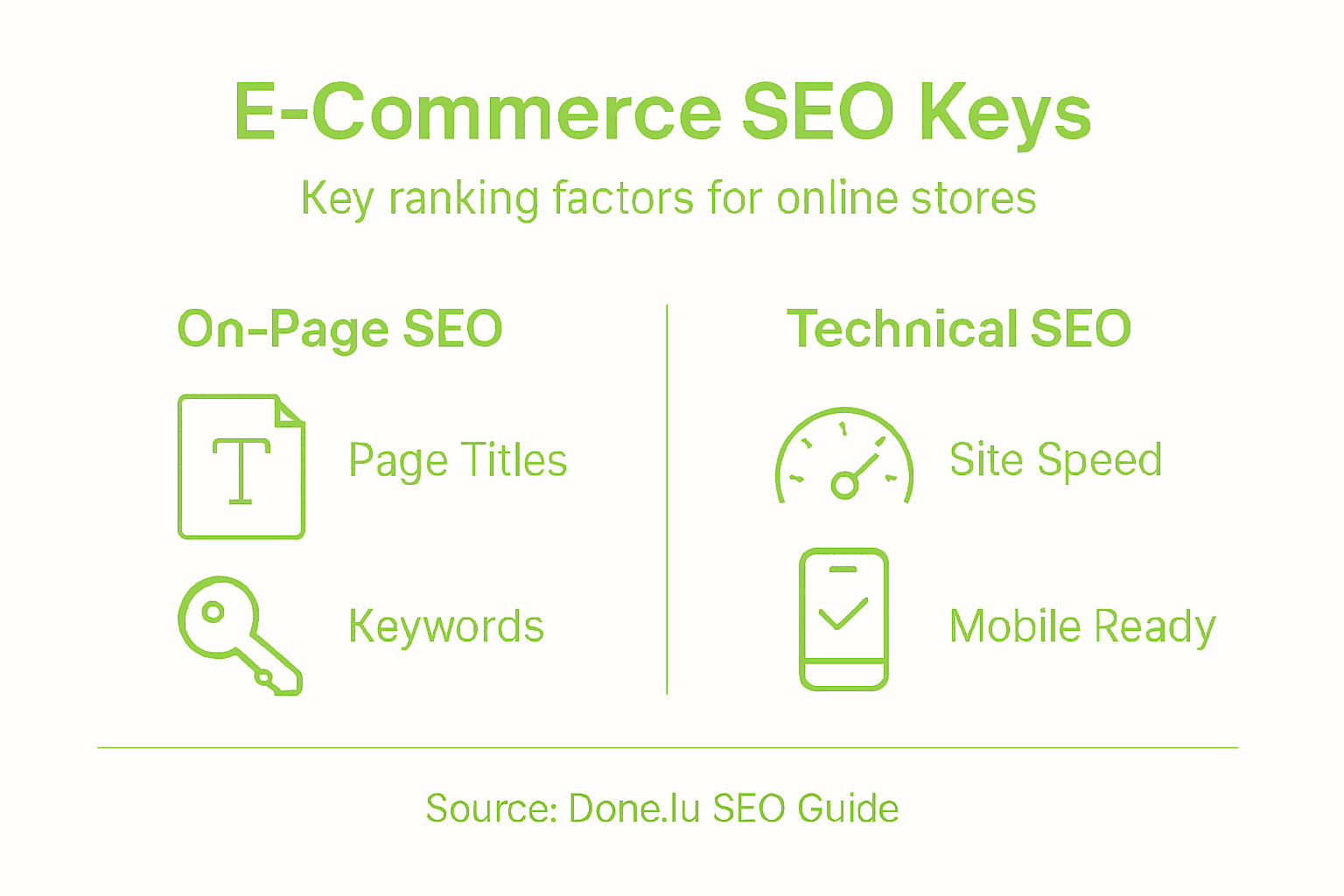
Search engines prioritize different ranking signals for e-commerce sites than they do for blogs or informational content. Your product pages, site structure, and user experience directly influence where you rank and how many qualified buyers find you.
Core Technical Ranking Factors
Your website’s foundation matters before anything else. Page speed ranks among the most critical factors—customers abandon slow sites, and search engines penalize them in rankings. Mobile optimization is non-negotiable; most e-commerce traffic comes from smartphones, and search engines prioritize mobile-first indexing.

Other essential technical factors include:
Below is a quick reference table of the most important e-commerce SEO technical ranking factors and their business impact:
| Technical Factor | Why It Matters | Business Impact |
|---|---|---|
| Page Speed | Reduces visitor drop-off | Higher transactions, conversions |
| Mobile Optimization | Serves mobile shoppers | Wider reach, lower bounce rate |
| HTTPS Security | Protects customer data | Builds trust, boosts rankings |
| Structured Data | Enhances search listings | Increases click-throughs |
- HTTPS security: Encrypt customer data with SSL certificates to build trust and improve rankings.
- Clean site architecture: Organize products logically so search engines crawl efficiently.
- XML sitemaps: Help search engines discover all your product pages.
- Structured data markup: Use product schema to display rich snippets in search results.
Product Page Optimization
Each product page is a ranking opportunity. Optimize them individually rather than treating them as identical templates. Write unique product descriptions that answer customer questions—not manufacturer copy everyone else uses.
Keyword research focused on buyer intent shapes product page strategy. Customers searching for “waterproof hiking boots Luxembourg” need different content than those searching “best winter boots.” Match your optimization to actual search behavior.
Include:
- Descriptive product titles with relevant keywords.
- High-quality images with optimized alt text.
- Customer reviews that generate fresh, authentic content.
- Clear pricing and availability information.
User Experience and Conversion Factors
Searching ranks your site, but user experience keeps visitors there. Improving site speed, navigation clarity, and mobile responsiveness signals quality to search engines and reduces bounce rates.
Intuitive checkout processes, visible customer support, and trust signals (security badges, return policies) all influence both rankings and conversion rates. Search engines now consider Core Web Vitals—metrics measuring how smoothly your site responds to user interaction.
E-commerce ranking success requires combining SEO fundamentals with genuine attention to customer experience; sites optimized purely for algorithms without considering buyer needs ultimately rank lower and convert worse.
Pro tip: Audit your top 20 best-selling products and ensure each has unique, keyword-optimized descriptions, high-quality images with alt text, and customer reviews; these pages already convert, so improving their SEO compounds your results.
Measuring SEO Impact on Online Visibility
You can’t improve what you don’t measure. SEO success requires tracking specific metrics that reveal whether your optimization efforts actually drive visibility and traffic. Without measurement, you’re essentially guessing whether your SEO strategy works.
Online visibility means appearing in search results when your target customers search for solutions. Measuring it requires looking at both where you rank and how many people actually find you.
Key Metrics That Matter
Start by tracking these essential metrics in Google Search Console and Google Analytics:
- Organic impressions: How many times your site appears in search results (visibility).
- Click-through rate (CTR): What percentage of searchers click your listing versus competitors’ listings.
- Ranking positions: Which keywords rank where and how they trend month-to-month.
- Organic traffic: Actual visitors arriving from search results.
- Pages indexed: How many of your pages Google has found and indexed.
These metrics tell different stories. High impressions with low CTR means you’re visible but your page title or description doesn’t appeal to searchers. High rankings with low traffic suggests you’re targeting the wrong keywords.
Conducting Regular SEO Audits
Systematic SEO audits measure your site’s technical health, content quality, and competitive positioning. Run audits quarterly to catch issues before they harm rankings.
Audit checklist:
- Indexation status: Verify Google has discovered all important pages; check for crawl errors.
- Content analysis: Review which pages generate traffic and which underperform.
- Backlink profile: Monitor new links and identify broken link opportunities.
- Site speed: Test mobile and desktop performance; identify bottlenecks.
- Technical issues: Check mobile responsiveness, SSL certificate validity, redirect chains.
Connecting SEO to Business Results
Visibility metrics alone don’t prove ROI. Track conversion-focused metrics that connect organic traffic to actual revenue. How many customers from search results complete purchases? What’s the average order value from organic visitors?
Your e-commerce analytics should show:
- Organic traffic by product category.
- Conversion rate from organic visitors versus paid or direct traffic.
- Revenue attributed to organic search.
- Customer acquisition cost from organic channels.
Visibility without conversions is vanity; measure the metrics connecting organic search to actual business outcomes, not just rankings and traffic.
For small and medium-sized Luxembourg e-commerce businesses, this means tracking which product categories gain organic visibility and whether that visibility converts. If your hiking boots rank well but generate few sales, you need different optimization—different keywords, better product descriptions, or improved user experience.
Pro tip: Set baseline metrics today—current rankings, organic traffic, conversion rates—then measure the same metrics monthly; this reveals which optimizations actually work for your specific business rather than following generic SEO advice.
Avoiding Common SEO Mistakes in Marketing
Many Luxembourg e-commerce managers damage their SEO by accident. These mistakes waste time, harm rankings, and sometimes trigger search engine penalties. Knowing what to avoid prevents costly missteps that take months to recover from.
Common SEO mistakes fall into several categories: content problems, technical issues, and security vulnerabilities. Each damages your visibility differently, but all are preventable with proper knowledge and processes.
Content and Keyword Mistakes
Keyword stuffing destroys rankings. Cramming keywords into content unnaturally reads poorly and signals spam to search engines. Instead, use keywords naturally within sentences that provide genuine value to readers.
Creating authentic, well-structured content with keywords placed strategically in titles, headings, and opening paragraphs works better than repetitive keyword placement.
Other critical content mistakes include:
- Duplicate or vague page titles: Write unique, descriptive titles for every page; generic titles waste ranking opportunity.
- Thin or shallow content: Pages with minimal text don’t rank; comprehensive answers to customer questions do.
- Poor heading structure: Use H1 for main topic, H2 for sections, H3 for subsections; skip heading levels.
- Ignoring mobile optimization: Half your traffic comes from phones; poorly formatted mobile pages lose rankings and customers.
Technical Issues That Kill Rankings
Technical mistakes harm visibility even when your content is excellent. Slow page speed kills rankings and drives visitors away. Unoptimized images, bloated code, and poor server response times are common culprits.
Website security vulnerabilities create unexpected problems. Insecure coding practices and outdated software create openings for malicious actors to inject spam or malware into your site, which damages SEO and customer trust.
Maintain security by:
- Installing SSL certificates for HTTPS encryption on all pages.
- Updating software, plugins, and frameworks regularly.
- Implementing firewalls and monitoring for intrusions.
- Scanning for malware and suspicious code regularly.
- Using strong password policies for admin accounts.
Optimization Mistakes
Over-optimization creates problems as serious as under-optimization. Search engines penalize sites that manipulate rankings through artificial means rather than providing genuine value.
Common over-optimization mistakes include buying links instead of earning them, creating low-quality pages just to target keywords, and using cloaking (showing different content to search engines than visitors).
The safest SEO approach focuses on creating genuinely valuable content that serves customers first, then optimizing that content naturally for search engines—this strategy sustains rankings long-term without penalty risk.
For small e-commerce businesses in Luxembourg, this means focusing optimization effort on product pages and content that actually converts customers, not on targeting every possible keyword variation through artificial means.
Pro tip: Audit your top 50 pages for the most common mistakes: duplicate titles, thin content, poor mobile formatting, and slow loading speeds; fixing these high-traffic pages delivers ranking improvements faster than creating new content.
Unlock the Full Potential of Your Digital Marketing with Strategic SEO
The article highlights the challenge many businesses face in building sustainable search visibility through continuous, customer-focused SEO efforts rather than one-time fixes. If you struggle with maintaining your e-commerce site’s rankings or wonder how to effectively balance on-page and off-page SEO to attract qualified customers in Luxembourg and beyond, Done.lu offers tailored solutions designed to solve these exact pain points. Our expertise in comprehensive web development and growth-driven design ensures your website’s technical foundation is solid while delivering compelling, keyword-optimized content that truly resonates with your audience.
Don’t let your digital marketing efforts stall due to SEO misconceptions or technical hurdles. Partner with Done.lu to create a fully responsive, strategically optimized online presence that drives traffic and converts visitors into loyal customers. Visit Done.lu today to explore how our customized SEO and inbound marketing services can elevate your business growth now.
Discover more about maximizing digital marketing success with SEO fundamentals and start transforming your online visibility today.
Frequently Asked Questions
What are the four core pillars of SEO?
The four core pillars of SEO are Technical SEO, On-page SEO, Content SEO, and Off-page SEO. Together, they enhance your website’s visibility and drive qualified traffic.
How does Technical SEO benefit my website?
Technical SEO ensures that your website is fast, mobile-responsive, and properly structured for search engines to crawl and index your pages efficiently, which improves your overall rankings.
Why is on-page SEO important for e-commerce?
On-page SEO is crucial for e-commerce as it optimizes individual product pages with relevant keywords, compelling meta descriptions, and high-quality content that answers customer queries, thus enhancing visibility and conversions.
How can I measure the impact of my SEO efforts?
You can measure SEO impact by tracking metrics such as organic impressions, click-through rates (CTR), ranking positions, organic traffic, and conversion rates from those visitors to determine the effectiveness of your optimization strategies.