

Avoid Six Month Delays: GDPR First AI for Legal Documents for EU Firms
September 21, 2026
The single biggest fix finance teams need for SEO finansų sektoriui is to stop treating it like standard SEO. Build a compliance-first, E-E-A-T-led operating model instead, where legal review sits inside the content architecture from day one. That means named experts on every high-stakes page, a documented backlink audit, and a technical checklist built for scrutiny, not just speed. This model changes what “ranking well” actually means in finance and legal SEO contexts.
TL;DR:
- Finance content must incorporate legal review early in the process and include named experts with verified credentials to meet regulatory and trust standards.
- Backlinks in the financial sector require regular, documented audits to prevent regulatory scrutiny and algorithmic penalties, especially avoiding undisclosed paid links.
- Technical SEO for finance sites should prioritize HTTPS enforcement, structured data implementation, and fast mobile web performance to build trust and comply with industry expectations.
- Content claims must be qualified, disclosures transparent, and update frequencies clearly visible, with a focus on avoiding absolutes and misleading language.
- Tracking key metrics like lead conversions, update latency, and visibility, combined with stakeholder sign-off on compliance, improves SEO results and regulatory safety.
Table of Contents
- Why SEO is different for financial services (YMYL)
- E-E-A-T and named-expert architecture: who has to be named?
- Compliance-first content workflow: build legal review into the process
- Link risk and backlink audit for finance sites
- Technical SEO checklist specific to financial services
- Content and authoring rules: tone, claims, sourcing
- Measurement, KPIs and reporting for financial SEO
- Practitioner perspective: what actually moves the needle
- How Done can help with compliance-first SEO for finance
- Sources
- FAQ
Why SEO is different for financial services (YMYL)
Google classifies financial content as Your Money or Your Life (YMYL): pages that can affect someone’s financial wellbeing if the information is wrong. Insurance comparisons, loan advice, pension guidance, investment commentary. All of it.
This classification raises the quality bar considerably. Search Quality Rater Guidelines expect named experts, sourcing discipline, and demonstrable freshness on any page that could influence a financial decision. A blog post that would rank fine for a bakery gets buried if it comes from an anonymous “admin” account with no named author.
Generic SEO playbooks fail here in predictable ways:
- They optimise for keyword volume, not for the trust signals Google actually checks on finance pages.
- They treat legal review as a bottleneck to skip, not a ranking input.
- They copy competitor content structures without checking if the claims are compliant in this market.
- They ignore update cadence, so rate pages go stale and lose credibility fast.
In our experience, the teams that struggle most are the ones porting over e-commerce or hospitality SEO habits into a regulated niche. It doesn’t transfer.
E-E-A-T and named-expert architecture: who has to be named?

Experience, Expertise, Authoritativeness, Trust. For finance content, this isn’t a checkbox, it’s the actual mechanism by which Google decides whether to trust a page enough to rank it.
Every substantive finance article needs a real author profile, not a generic “Editorial Team” byline. That profile should include:
- The author’s actual credentials and professional background.
- A named reviewer, distinct from the author, with their own bio.
- Links to external verification: LinkedIn, a regulator register, a professional body listing.
- A visible last reviewed date on the article itself.
Behind the scenes, this needs to be machine-readable too. Structured data using Person and Article schema lets search engines parse who wrote something, who reviewed it, and when. This is one of the most under-implemented but highest-impact trust signals we see on finance sites in Lithuania: the information often exists somewhere on the site, but it’s never structured so Google can actually use it.
Pro Tip: Keep a small internal bench of two or three credentialed reviewers who sign off on finance content regularly. A rotating cast of reviewers with no consistent presence online does less for E-E-A-T than one or two people Google can build a trust profile around over time.
Compliance-first content workflow: build legal review into the process
Retrofitting compliance onto finished content is how teams end up rewriting half their site after a regulator complaint. Regulatory guidance is clear that financial and advertising content must avoid misleading claims, and that review should happen before publication, not after.
A workable operational sequence looks like this:
- Topic triage. Decide if the topic is even legally viable to publish before anyone writes a word.
- Legal feasibility check. Confirm the company holds the licence or authorisation needed to discuss the product using specific regulated terms.
- Content brief. Lock the claims, sources, and disclosures the writer is allowed to use.
- Authoring. Draft against the brief, no improvised claims.
- Named reviewer sign-off. A credentialed reviewer approves the final text and is recorded as doing so.
- Publish with timestamp. The publish date and reviewer name go live with the article.
Pre-approved disclosure templates and standard legal phrasing cut review time dramatically, because the reviewer isn’t drafting new language every time, just checking fit.
Pro Tip: Run two publishing tracks: a fast-moving one for rate-sensitive pages (interest rates, fees, promotional terms) reviewed weekly, and a slower one for evergreen explainer content reviewed quarterly. Mark each page type internally so nobody applies the wrong cadence by mistake.
Link risk and backlink audit for finance sites
Backlinks carry more risk in finance than almost any other sector. A spammy or paid link pointing at a bank or insurer’s domain doesn’t just risk an algorithmic penalty, it can draw regulator attention if it looks like undisclosed promotion.
A practical audit checklist:
- Export the full backlink profile using a standard SEO toolset.
- Classify referring domains by type: editorial, directory, forum, paid placement, unknown.
- Review anchor text distribution for over-optimised or manipulative patterns.
- Flag anything that looks like undisclosed paid promotion.
- Contact webmasters requesting removal before considering disavow.
Pro Tip: Keep a remediation log of every outreach attempt with dates and responses. Regulators and search engines both respond better to a documented process than a sudden bulk disavow with no paper trail. Set a recurring 30/90-day cycle: light monitoring monthly, a full classification pass quarterly.
Technical SEO checklist specific to financial services
Trust isn’t only editorial, it’s technical too. A page can have a named expert and a clean legal review and still underperform if the infrastructure behind it looks unreliable.
Priorities worth fixing first if capacity is limited:
- HTTPS and HSTS enforced sitewide, with particular attention where any payment or account data flows through the page.
- Structured data for
Article,Person,Organization, andBreadcrumbListso authorship and timestamps are machine-readable, not just visible to human readers. - Core Web Vitals thresholds met on mobile first, since most finance research now starts on a phone.
- Canonical tags correctly set on any page with rate variations or regional duplicates.
- Accessible markup, since accessibility failures are themselves a weak trust signal to raters.
If the site runs on WordPress, this is where discipline matters most: it’s a capable platform for content-heavy finance sites, but the default plugin and hosting configuration needs hardening, not left at defaults, given the sensitivity of what’s published.
Content and authoring rules: tone, claims, sourcing
The writing itself carries legal exposure if it’s careless. A few non-negotiable habits:
- Never write “guaranteed returns” or “100% approval” or similar absolutes. Use qualified language and cite the primary source behind any figure.
- Disclose monetisation or partnerships clearly on any page that could influence a purchasing decision, near the claim itself, not buried in a footer.
- Publish a visible update cadence and a simple change log on rate-sensitive pages so readers can see when something last changed.
Pro Tip: Write a short internal “banned phrases” list for finance content: guaranteed, risk-free, best rate, no fees ever. Give writers the qualified alternative alongside each one, so the compliant version is the easy default, not an afterthought caught in review.
Measurement, KPIs and reporting for financial SEO
Standard traffic dashboards miss what actually matters here. Track:
- Organic leads and assisted conversions specifically from named-author pages versus unnamed ones.
- Visibility and ranking movement segmented by author coverage.
- Update latency: how long a rate page sits stale before it’s refreshed.
- Core Web Vitals alongside editorial metrics like citation count and reviewer sign-off turnaround.
Report monthly, with a stakeholder sign-off step that includes compliance, not just marketing. That single addition tends to catch issues before they become regulator conversations.
Practitioner perspective: what actually moves the needle
The biggest time-saver we’ve seen isn’t a tool, it’s pre-approved disclosure language. One client cut legal review time by giving writers a bank of compliant phrasing upfront, so review became a check, not a rewrite.
The most common SME mistake: publishing rate pages with no visible reviewer or update date. It reads as guesswork, even when the numbers are accurate.
This week’s action: pick your three highest-traffic finance pages and add a named reviewer and a last-updated date. Nothing else. See what it does to trust signals before touching anything bigger.
— Thomas
How Done can help with compliance-first SEO for finance
Done is the practical alternative to hiring a generalist agency that treats finance content like any other niche. We’ve built content marketing workflows around named-author architecture and update cadences specifically because generic SEO advice breaks down under regulatory scrutiny.

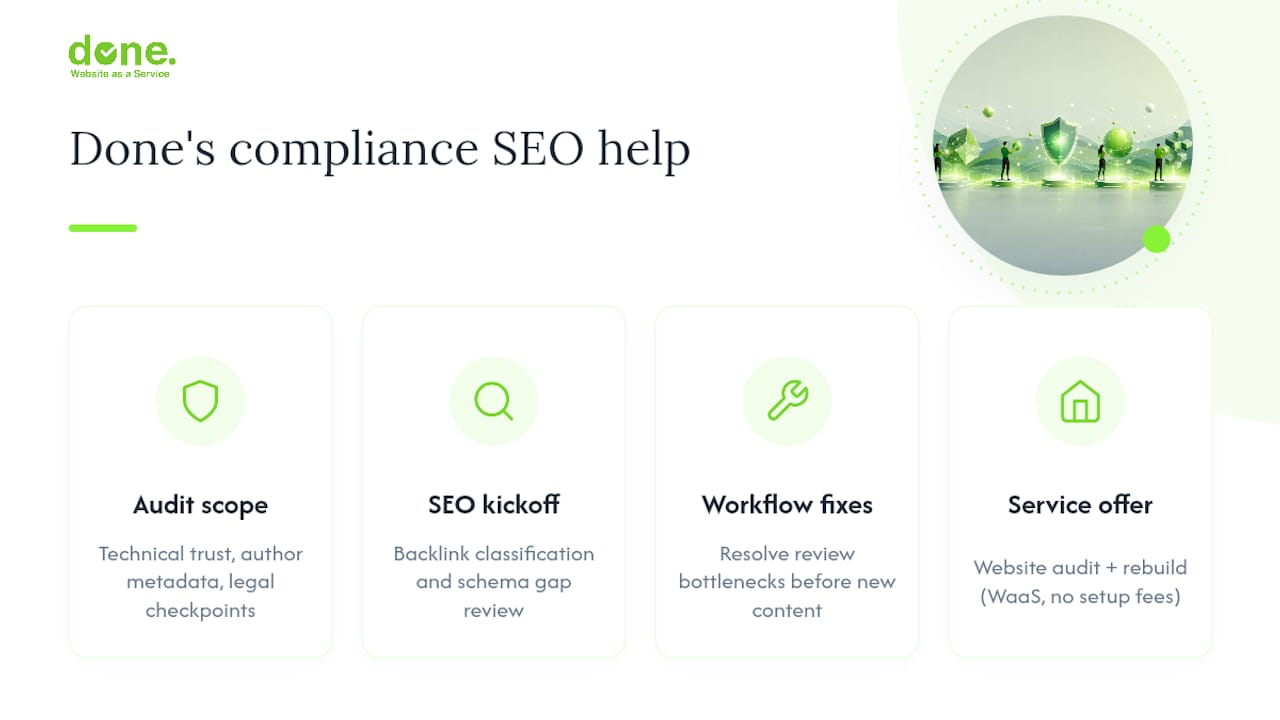
A specialised partner shortens the distance between “compliant” and “ranking” because the same audit covers both at once: technical trust signals, author metadata, and the legal checkpoints regulators expect to see. Our SEO strategy work starts with exactly the kind of audit this article describes, backlink classification, schema gaps, review workflow bottlenecks, before any new content gets written. Headlines and page titles matter here too: getting the terminology accurate in an H1 and meta title is often the first thing raters and readers judge.
If your finance site needs a full audit and a rebuilt content governance process, start with a website audit and rebuild scoped around Website as a Service, no setup fees, ongoing maintenance included. Get in touch and we’ll walk through what a compliance-first version of your current site would actually look like.
This article is general information, not a substitute for advice from a qualified financial advisor. Consult a qualified financial professional about your own circumstances before acting on anything here.
Sources
- New guidelines: avoid misleading advertising — Njord Law
- YMYL & E-E-A-T: Why financial services SEO plays by the rules — Search Engine Land
- Nuorodų rizika finansų sektoriuje: ką daryti pastebėjus grėsmę — Seocheaper
FAQ
Do I need a named author on every finance page?
Named authors matter most on YMYL pages that could influence a financial decision, such as rate comparisons or investment guidance. Lower-stakes pages, like a company history page, carry less risk without one, but adding named review everywhere strengthens overall site trust.
When should we disavow a backlink instead of requesting removal?
Attempt webmaster outreach first and log every attempt before considering disavow. Regular audits with a documented remediation process protect both your rankings and your audit trail if a regulator ever asks.
How often should rate-sensitive pages be updated?
Rate-sensitive pages need a faster review cycle, often weekly, while evergreen explainer content can run on a quarterly cadence. Publish the last-updated date visibly so readers and search engines can both see the page is current.
Can Done audit an existing finance website for compliance and SEO gaps?
Yes, Done’s consulting and website services cover technical audits, backlink review, and content governance for regulated sectors. Pricing for Website as a Service starts at €195 per month for the One Pager plan, with Starter and Business tiers available.
What’s the fastest fix for a finance site with limited SEO resources?
Add named reviewers and visible update dates to your highest-traffic pages first. It’s the single change most likely to move E-E-A-T signals without a full technical rebuild.