

Avoid Buying a DMS: SME Use Cases for Document Version Control
September 20, 2026
Yes, AI can help with legal documents, but only as a supervised drafting and search assistant under strict GDPR and EU AI Act controls. Use enterprise or private deployments with a signed data processing agreement and a no-training clause, run a data protection impact assessment before any pilot, and keep a lawyer checking every output. Skip any of the three, and you are carrying risk you cannot see.
TL;DR:
- Using AI for legal documents requires a signed data processing agreement, a no-training clause, and proper documentation before deployment to avoid unseen risks.
- Private retrieval systems can quickly search and index firm-controlled archives, but AI should not replace lawyer judgment due to hallucination risks.
- GDPR mandates maintaining records of lawful data processing, conducting DPIAs for high-risk tasks, and ensuring cross-border data transfers comply with Standard Contractual Clauses.
- Implementing controls like de-identification, explicit sign-offs, and sub-processor monitoring from the start is essential for auditability and legal compliance.
- A focused, well-scoped pilot with signed agreements and technical safeguards can be run within weeks, avoiding extended delays or regulatory issues.
Table of Contents
- What AI teisiniams dokumentams actually does well
- What do GDPR and the EU AI Act actually require?
- How do you keep AI-assisted document work auditable?
- Can machine translation be trusted for legal documents?
- Which deployment model fits a legal team?
- How do you run a compliant AI pilot without wasting six months?
- Practitioner notes from Done
- Get a GDPR-aware AI audit before you deploy anything
- Sources
- FAQ
What AI teisiniams dokumentams actually does well
Intelligent document processing has moved past simple keyword search. For legal teams, the realistic wins sit in a handful of well-defined tasks, not in replacing a lawyer’s judgement.
Firms running private retrieval systems (RAG, or retrieval-augmented generation) can index their own DOCX and PDF archives and search across contracts, memos and precedent in seconds rather than hours. Some legal AI platforms now build these as firm-controlled indices that avoid training on client data, which keeps privilege intact (Moterra).
Beyond search, the practical use cases are:
- First-pass contract review — flagging unusual clauses, checking consistency against a standard template, and surfacing missing definitions.
- Template population — drafting routine correspondence, NDAs or standard letters for lawyer approval before sending.
- Bulk machine translation — handling volume work with a human post-edit pass for anything client-facing.
- Clause retrieval — pulling precedent language from an indexed archive instead of manual search through old matters.
What AI in legal services does not do reliably is unsupervised legal interpretation. Hallucination remains the primary operational risk in legal drafting, which is why every output needs a citation check and a lawyer’s sign-off before it leaves the building (Chambers and Partners).
What do GDPR and the EU AI Act actually require?
Two frameworks apply at once, and legal teams need to satisfy both.
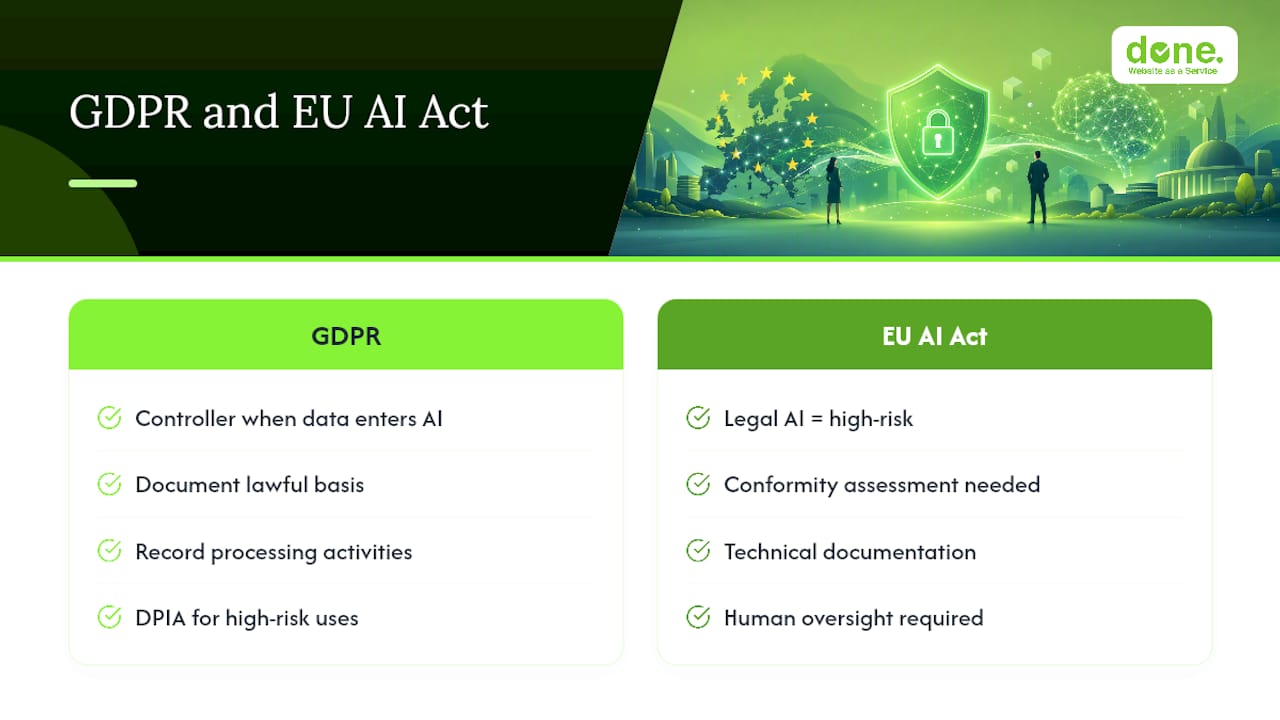
Under GDPR, your firm is the controller the moment client data goes into any AI system. That means you document the lawful basis, keep a record of processing activities, and can show a regulator why the processing is necessary. Legitimate interest paired with clear client transparency tends to be the most defensible basis for many firms, but only when it’s backed by a documented balancing test (GDPR & AI legal documents compliance guide).
A DPIA (data protection impact assessment) is required whenever the processing is likely to be high risk, which most legal AI use cases are, given the sensitivity of client data. Keep the DPIA, plus supporting logs, on file. If data crosses borders, the DPA needs Standard Contractual Clauses or another recognised transfer safeguard, not just a vendor’s word that things are fine.
The EU AI Act adds a second layer on top. Systems used in legal interpretation or administration of justice are classified high-risk, which brings conformity assessments, technical documentation, and mandatory human oversight into scope (Chambers and Partners). Practically, that means combining your DPIA with AI Act conformity steps: documented risk management, logging, and post-market monitoring for anything that touches legal interpretation directly.
Update your engagement letters and privacy notices to disclose AI use where it’s material to the client relationship. It’s a small change with an outsized effect on trust, and it closes a gap regulators are watching closely. A practical GDPR compliance guide for European SMEs covers the DPIA mechanics in more depth if you’re building one from scratch.
How do you keep AI-assisted document work auditable?
Controls only work if they’re built before the pilot starts, not bolted on afterwards.
Automate de-identification before anything leaves your systems for external processing. Replacing names, ID numbers and case references with placeholders, then reinserting real data only after verification, cuts your GDPR exposure substantially. Some document processing tools now automate this step at the application level rather than leaving it to manual redaction.
Define who signs off on AI output before it goes to a client. That gate needs to be explicit, not assumed. Log every interaction, set a retention schedule, and have a clear deletion procedure that matches your firm’s actual policy, not a vendor’s default.
Check your vendor’s sub-processor chain. Ask who touches the data downstream and how fast they’ll notify you of a breach. A short notification window, ideally under 72 hours, should be written into the contract, not implied.
Pro Tip: Map your DPIA mitigations directly onto your technical controls. If the DPIA says “access is restricted to case handlers,” your system’s access policy should enforce exactly that, not a looser version of it.
A robust DPIA for legal AI documents purpose, necessity and proportionality, plus a specific threat model covering hallucination and data exfiltration (AI Vortex). Our own guide on protecting confidential data in AI workflows walks through the encryption and access-control side of this.
Can machine translation be trusted for legal documents?
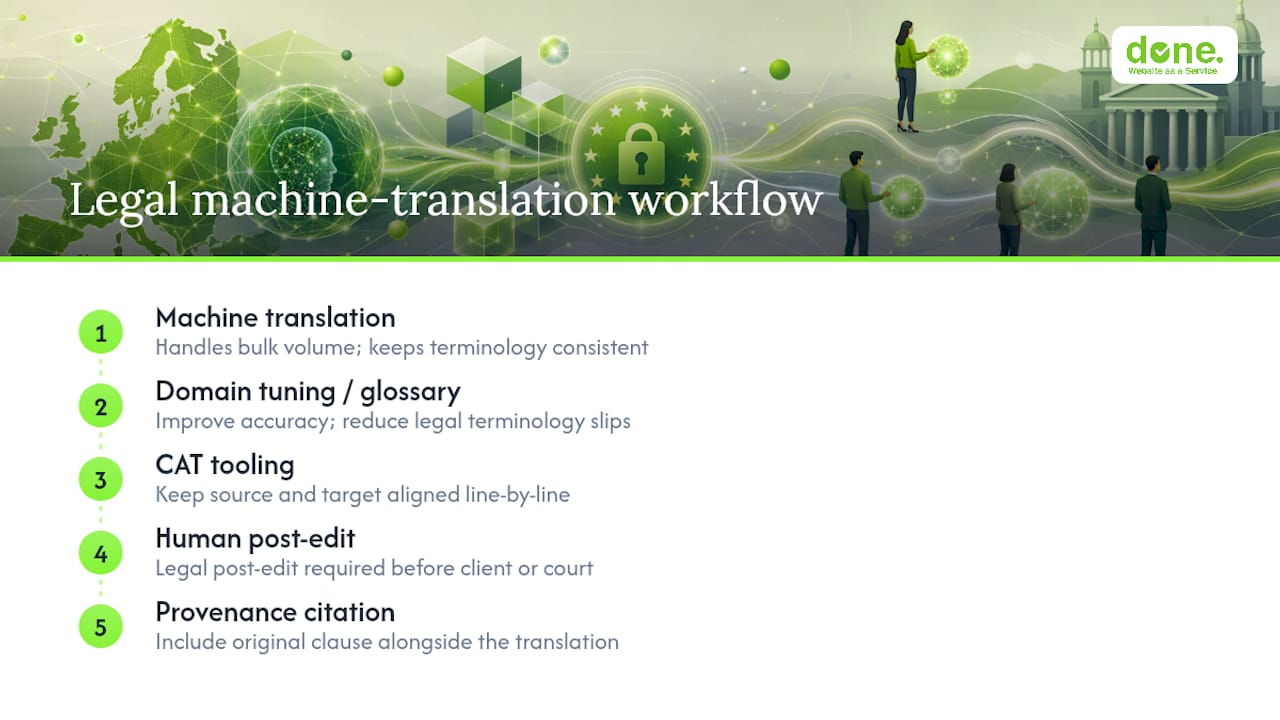
Machine translation handles bulk volume well and keeps terminology consistent across a large document set. It is not flawless, and legal terminology is exactly where generic MT engines tend to slip.
The fix is a workflow, not a single tool. Pair the MT engine with a legal glossary or a domain-tuned model, and route everything through CAT (computer-assisted translation) tooling that keeps source and target aligned line by line. Domain tuning and custom glossaries improve accuracy meaningfully, but a human legal post-edit remains necessary before any translated document goes to a client or a court.
Keep provenance intact. Cite the original-language clause alongside the translation in anything that might later be disputed, so nobody has to reverse-engineer which version governs.
Which deployment model fits a legal team?
You have four realistic options: an enterprise API with EU data residency, a private cloud instance, a fully on-premise system, or an isolated RAG index that never leaves firm infrastructure. Consumer-tier chatbots are not on this list. They typically train on your inputs by default, which is the opposite of what a law firm needs (GDPR & AI legal documents compliance guide).
Before signing with any vendor, check for:
- A signed DPA with Standard Contractual Clauses covering any cross-border transfer.
- An explicit no-training clause on your data, in writing, not in a sales deck.
- An EU data residency option, so your data never leaves the jurisdiction you operate in.
- SOC 2 or ISO 27001 certification (or a documented equivalent).
- Audit logs and clear retention or deletion guarantees.
- A disclosed sub-processor list and a breach notification timetable measured in hours or days, not weeks.
A small pilot with these controls in place typically runs a few weeks from scoping to first results, and budget bands scale with data volume rather than headcount.
How do you run a compliant AI pilot without wasting six months?
- Pick one measurable use case and limit the data scope tightly. Contract review on a single matter type beats “everything, everywhere.”
- Map data flows and run a rapid risk assessment. Know exactly where data goes before you send a single document.
- Select a deployment model and secure a DPA with the clauses above already negotiated, not promised.
- Implement de-identification and access policies, then run the pilot with lawyer sign-off. Measure time saved, error rate and lawyer override frequency before scaling.
Our document processing AI guide for SMEs has a fuller breakdown of pilot scoping if you want a template to start from.
Practitioner notes from Done
In our experience running AI audits, the pilots that work start narrow and stay documented. The ones that fail almost always skipped the DPIA, used a consumer chatbot for convenience, or signed a vendor contract with vague sub-processor language. Start small, write down every control decision, and leave the final sign-off with a lawyer, not the model.
— Thomas
Get a GDPR-aware AI audit before you deploy anything
There are consulting providers who build privacy-first, human-first AI deployments for regulated sectors, with no setup fees and transparent pricing from audit through team training.

We’ve run this kind of assessment for firms handling exactly this problem: private data, real client stakes, and a genuine need to move faster without cutting corners on GDPR or the AI Act. Our AI consulting service covers the audit, the pilot build, and the team training that makes the system actually get used rather than shelved after month one.
If you’re weighing up whether your firm is ready for a supervised AI pilot, request a consulting audit and we’ll map out where the quick wins are and where the real risk sits.
Sources
For the legal detail behind this article, consult the EDPB opinion on AI models, the Chambers AI Act practice guide, and the AI Vortex GDPR governance guide.
This article is general information, not a substitute for advice from a qualified lawyer. Consult a qualified legal professional about your own circumstances before acting on anything here.
- Artificial Intelligence 2026 – Europe-Wide | Chambers and Partners
- GDPR legal AI data processing — AI Vortex
FAQ
Can lawyers legally use AI to draft contracts?
Yes, provided the tool is used under enterprise-grade data protection terms and every output is reviewed by a qualified lawyer before it’s relied upon. Consumer chatbots are unsuitable for client data because they generally train on inputs by default (GDPR & AI legal documents compliance guide).
Is a DPIA always required for legal AI tools?
A DPIA is required whenever the processing is likely to be high risk, which covers most legal AI use involving client data. Firms should keep the DPIA and its supporting logs on file for regulatory review.
What’s the biggest compliance mistake law firms make with AI?
Skipping the DPIA and relying on a vendor’s informal assurance instead of a signed DPA with proper transfer clauses. Missing sub-processor disclosure and weak deletion controls are recurring enforcement triggers (AI Vortex).
Does the EU AI Act apply to legal document AI?
It can, particularly where the system is used in legal interpretation or administration of justice, which the Act classifies as high-risk. That triggers conformity assessments, documentation and mandatory human oversight (Chambers and Partners).
How does Done help firms run a compliant AI pilot?
Done runs GDPR-aware AI audits, scopes a narrow pilot, and trains the team on the controls that keep it compliant, all through its consulting service. Pricing is discussed during the audit rather than published as a flat rate, since scope varies by firm.