

Why choose digital transformation: a practical guide for SMEs
July 31, 2026
Growth-driven design workflow: a step-by-step guide
August 2, 2026
TL;DR:
- AI systems now answer queries by citing authoritative, structured content, challenging traditional search rankings. Central European businesses must implement schema markup and publish native-language pillar pages to capture AI citations and improve visibility. Adopting GDPR-safe AI workflows, native content, and structured data provides a strategic advantage in the evolving SEO landscape of 2026.
The single most important shift in 2026 SEO is this: AI systems such as ChatGPT, Google’s AI Overview, and Perplexity now answer queries directly, and the sites they cite are overwhelmingly those with structured, authoritative, native-language content. For Central European businesses, the immediate priority is clear: deploy complete Schema.org markup and publish at least one authoritative pillar page in your local language this quarter.
YouGov research found that 39% of German online users used an AI assistant in the last 30 days, while search engines remain the primary source at 79%. AI is not replacing search yet, but it is already competing for the same attention. The gap between those two numbers is exactly where your content strategy needs to sit.
This article covers:
- The major SEO trends reshaping visibility in 2026, with one concrete action per trend
- A six-month roadmap sized for small Central European teams
- New KPIs, recommended tools, and GDPR-safe AI adoption steps
Pro Tip: Before reading further, open Google Search Console and filter for queries where your impressions are high but clicks are low. Those are the positions AI Overviews are eating first.
Table of Contents
- What are the biggest SEO trends in 2026 for Central Europe?
- How do you build a six-month SEO roadmap for Central Europe?
- Which KPIs actually matter for AI-influenced search in 2026?
- Which tools support AI-first SEO work in Central Europe?
- What does GDPR compliance look like for AI-powered SEO in Central Europe?
- Why is native-language content a competitive moat in Central European markets?
- Key takeaways
- What we have seen with clients in Luxembourg and Central Europe
- Ready to build your AI-era SEO foundation?
- Authoritative sources and further reading
What are the biggest SEO trends in 2026 for Central Europe?
1. AI search systems are changing how citations work
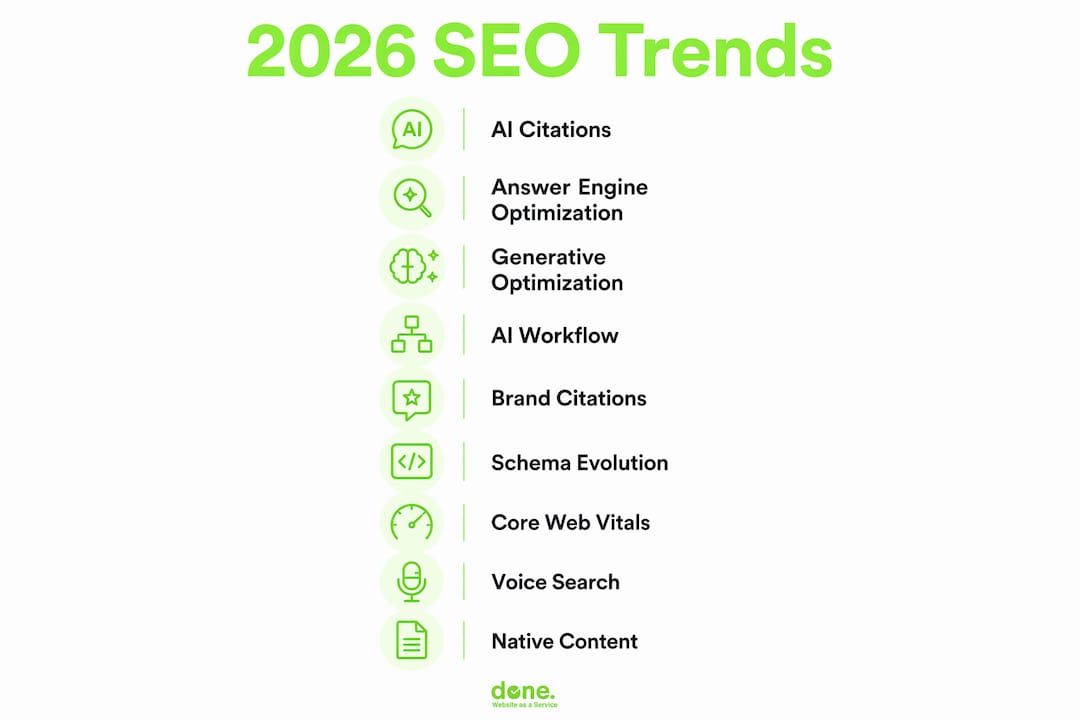
ChatGPT, Bing Copilot, and Perplexity do not rank ten blue links. They synthesise an answer and cite two or three sources. To appear in those citations, your content needs to be structured, factually dense, and clearly attributed to a named author or organisation. AI referral traffic in Germany sits at 0.32% and across the DACH region at 0.38%, which sounds small. The significance is not the volume today; it is that organic search share is falling faster in DACH than globally, and the trajectory is steep.
One action: Add an Author schema with a named person and credentials to every article you publish.
2. Google’s AI Overview and Answer Engine Optimisation (AEO)
Google’s AI Overview now appears above organic results for a growing share of informational queries. Pew Research found that Google users are less likely to click links when an AI summary is present. AEO, the practice of structuring content so that answer engines can extract and cite it, is no longer optional for high-traffic informational pages.

One action: Rewrite your top five landing pages to open with a direct, one-paragraph answer to the primary question, then support it with structured evidence.
3. Generative Engine Optimisation (GEO)
GEO is the discipline of making your content easy for large language models to parse, trust, and cite. The three signals that matter most are: demonstrable authoritativeness (named experts, credentials, citations), structured facts (numbered lists, tables, defined terms), and short, extractable answers at the top of each section.
One action: Audit your three highest-traffic pages. If the first 100 words do not contain a direct answer, rewrite the opening.
4. AI as a workflow layer, not just a content generator
The most productive teams in 2026 are not using AI to write everything. They are using it for summarisation, classification, and monitoring: extracting key points from competitor content, tagging inbound queries by intent, and flagging ranking changes. Regulators are watching these use cases closely, expecting auditability and human governance at every step.

One action: Implement a simple prompt log. Record every AI prompt and output used in published content, who approved it, and when.
Pro Tip: Tools such as Semrush and Ahrefs both now include AI-visibility tracking features. Run a weekly AI-mention report alongside your standard rank tracker to catch citation gains before they show up in traffic.
5. Brand citations matter more than raw backlinks
The weight given to raw link counts is declining relative to brand mentions, expert citations, and on-site proof of expertise. Founder-led, expert content on company domains outperforms generic institutional pages for AI citations in CEE B2B contexts. A named founder publishing opinionated commentary on your own domain is now a stronger signal than a directory link.
One action: Publish one founder or subject-matter expert commentary piece per month, with a named author bio and structured data.
6. Structured data and Schema evolution
96.5% of Central European SMB sites lack the Schema.org markup needed for reliable AI reading, and 66.9% have no structured data at all. The schemas that matter most right now are: Organization, Service, FAQPage, HowTo, Speakable, and LocalBusiness. Implementing these puts you ahead of the vast majority of your peers immediately.
One action: Use Google’s Rich Results Test and Ryte or Seobility to audit your current Schema coverage this week.
7. Core Web Vitals, mobile-first, and video SEO
Google’s mobile-first indexing is fully established, and Core Web Vitals scores remain a ranking factor. Largest Contentful Paint (LCP) under 2.5 seconds and Cumulative Layout Shift (CLS) below 0.1 are the thresholds to meet. Video content is growing as a citation source too: YouTube videos with proper title, description, and VideoObject schema appear in AI-generated answers more frequently than unstructured video pages.
One action: Run PageSpeed Insights on your homepage and your top three landing pages. Fix the single largest LCP issue first.
8. Voice search and conversational queries
Voice queries are longer, more conversational, and often local. Phrases such as “where can I find a web agency near me that handles GDPR” are typical. Capturing these means writing in natural question-and-answer format and including Speakable schema on pages with clear spoken answers.
9. Native-language content in smaller CEE markets
Poland is the largest CEE market at approximately 38 million people, with strong domestic media and relatively low competition for authoritative native Polish content. The same scarcity applies in Czech, Hungarian, Romanian, and Slovak. A single well-structured, expert-authored article in Polish or Czech can capture AI citations that dozens of English-language pages are competing for globally. In Czechia, Seznam remains a material search engine alongside Google, so a two-engine localisation approach produces measurably better results than a Google-only strategy.
How do you build a six-month SEO roadmap for Central Europe?
A small team of two to four people can execute this plan. The table below shows the primary goal per month; the bullets below it show who does what.
| Month | Primary goal | Key deliverables |
|---|---|---|
| 1 | Technical and Schema audit | Full Schema gap report; Core Web Vitals baseline; mobile audit |
| 2 | Quick wins: Schema rollout and page rewrites | Organization, Service, FAQ schemas live; top 5 pages rewritten for AEO |
| 3 | Native-language content hub | 3 pillar pages in local language; author bios with structured data |
| 4 | Outreach and citation building | Local media pitches; founder commentary published; 5 brand citations secured |
| 5 | Measurement and AI monitoring setup | AI citation tracking live; SERP feature share baseline; GA4 AI-referral segment |
| 6 | Review, iterate, and scale | Performance review; second content batch; Schema expansion to HowTo and Speakable |
Roles and weekly time commitments:
- Owner or project manager (2–3 hours/week): approves content, signs off on Schema changes, reviews monthly KPI report
- Content lead (6–8 hours/week): writes pillar pages, manages author bios, runs outreach sequences
- Developer (3–4 hours/week in months 1–2, then 1–2 hours/week): implements Schema, fixes Core Web Vitals, sets up GA4 segments
- Privacy or compliance reviewer (1–2 hours/week): reviews AI-generated content before publication, maintains prompt logs
Checklist of phase deliverables:
- Month 1: Schema audit report, Core Web Vitals scores, mobile usability report
- Month 2: Schema markup live on all key pages, AEO rewrites complete, Rich Results Test passing
- Month 3: Three native-language pillar pages published with author schema
- Month 4: Five local media or industry citations secured, founder commentary live
- Month 5: AI citation monitoring dashboard active, GA4 AI-referral traffic segment configured
- Month 6: Full performance review, second content batch planned, Speakable schema tested
For SMEs with limited budgets, prioritise developer time in months 1–2 and content time in months 3–4. Schema and technical fixes deliver the fastest measurable return because the baseline is so low across the region. Content investment compounds more slowly but builds the durable moat. If budget forces a choice, fix the structure first, then fund the content. A useful starting point for understanding the ROI case is the guide to SEO investment for Luxembourg SMEs.
Which KPIs actually matter for AI-influenced search in 2026?
The standard rank-tracking dashboard is no longer sufficient on its own. Add these metrics alongside your existing organic traffic and position data.
New and retained KPIs:
- AI citation share: how often your domain appears in ChatGPT, Perplexity, or Bing Copilot answers for your target queries
- SERP feature impressions: impressions for Featured Snippets, AI Overviews, and People Also Ask boxes (Google Search Console)
- Zero-click rate: the proportion of impressions that generate no click (rising as AI Overviews expand)
- Branded query share: growth in direct brand-name searches, a proxy for AI-driven awareness
- AI referral traffic: sessions arriving from ChatGPT, Perplexity, or Copilot (tag in GA4 as a custom channel)
- Organic click-through rate by query type: segment informational vs transactional to see where AI Overviews are suppressing clicks
Measurement setup:
- In GA4, create a custom channel group that captures referrals from
chat.openai.com,perplexity.ai,bing.com/chat, andcopilot.microsoft.com. - In Google Search Console, filter by query type and monitor impression-to-click ratios monthly. A rising impressions figure with flat or falling clicks signals AI Overview cannibalisation.
- Use a tool such as the AI search prompt tracker to run regular prompt tests and record which sources AI systems cite for your target queries.
- Set a monthly sampling cadence: run 20–30 representative queries through ChatGPT, Perplexity, and Bing Copilot and log citation appearances in a shared spreadsheet.
Experiment template:
- Hypothesis: Adding
FAQPageschema to our top five service pages will increase SERP feature impressions by a measurable amount within 60 days. - Metric: SERP feature impressions (Google Search Console) and AI citation appearances (manual prompt log).
- Timeframe: 60 days post-implementation.
- Sample: All queries for which those five pages currently rank in positions 1–20.
- Decision rule: If SERP feature impressions increase and at least two AI citation appearances are recorded, roll out to all service pages.
Which tools support AI-first SEO work in Central Europe?
You do not need an expensive stack. The tools below cover the core capabilities, and most have free tiers or affordable SME pricing.
By category:
- Site performance and Core Web Vitals: Google PageSpeed Insights (free), Ryte (European data centres, GDPR-friendly), Seobility (German-based, strong for DACH and CEE)
- Structured data testing: Google Rich Results Test (free), Schema Markup Validator (free)
- Rank and visibility monitoring: Semrush or Ahrefs for keyword tracking and backlink analysis; Sistrix for DACH and CEE SERP visibility scoring
- AI citation monitoring: manual prompt logs plus the AI online reputation management framework for structuring content to improve citation chances
- Content workflow: Notion or Airtable for editorial calendars and prompt logs; your existing CMS for publication
Vendor selection checklist (GDPR and data sovereignty):
- Does the vendor store data in EU data centres? Ask for the data processing agreement (DPA) before signing.
- Does the tool provide audit logs of queries and outputs? Non-negotiable for regulated sectors.
- Can it integrate with your existing CMS without requiring third-party data transfers?
- What is the training requirement for your team? Tools with steep learning curves drain SME time budgets fast.
- Is the pricing transparent and proportionate for a team of under ten people?
Pro Tip: Ryte and Seobility are both based in German-speaking Europe, process data under EU law, and are well-suited to Central European markets. For SMEs that cannot justify Semrush or Ahrefs pricing, Seobility’s mid-tier plan covers rank tracking, on-page audits, and backlink monitoring at a fraction of the cost.
For teams considering workflow automation to connect these tools, the priority is always to automate monitoring and reporting first, then content classification, and only then content generation.
What does GDPR compliance look like for AI-powered SEO in Central Europe?
Using AI tools in your content and SEO workflow is not inherently a compliance problem, but it requires deliberate controls. The following checklist covers the minimum for most SMEs.
GDPR checklist for AI use in marketing:
- Data minimisation: do not feed personal data (customer emails, CRM records) into public AI tools such as ChatGPT or Perplexity. Use anonymised or synthetic data for testing.
- Purpose limitation: document the specific purpose for each AI use case. “Content drafting” and “query classification” are distinct purposes and should be recorded separately.
- Recordkeeping: maintain a log of AI tools in use, their data processing agreements, and the categories of data they touch.
- DPIA triggers: if you use AI to profile users or make automated decisions affecting individuals, a Data Protection Impact Assessment is required under GDPR Article 35.
- Vendor due diligence: obtain and review the DPA for every AI tool before use. Check data residency and sub-processor lists.
Five practical controls (drawn from regulatory guidance on AI marketing compliance):
- Define authority: assign one named person responsible for AI tool approvals and prompt governance.
- Control access: limit which team members can use which AI tools, and log access.
- Keep prompt and output logs: retain records of significant prompts and their outputs, especially for published content.
- Human review for high-risk content: any AI-generated content that makes factual claims, gives advice, or represents the brand publicly must be reviewed and approved by a named person before publication.
- Monitor post-launch: set a monthly review to check that AI-generated content remains accurate and has not drifted from approved messaging.
Red flags when reviewing a vendor contract:
- No EU data centre option or no DPA available on request
- No audit log capability
- Sub-processors listed in jurisdictions without EU adequacy decisions
- Contractual terms that allow the vendor to use your data for model training
For SMEs in regulated sectors such as legal, finance, or healthcare, GDPR-compliant AI adoption requires an additional layer of review. When in doubt, escalate to a qualified data protection adviser before deploying any new AI tool that touches client data.
Why is native-language content a competitive moat in Central European markets?
The scarcity argument is straightforward: fewer high-quality native-language sources means a single authoritative local asset can capture AI citations and SERP visibility that would require dozens of competing pages in English. Poland, with approximately 38 million people, has strong domestic media and relatively low competition for authoritative Polish content. The same pattern holds in Czech, Hungarian, Romanian, and Slovak markets.
AI systems trained predominantly on English content are actively looking for authoritative local sources to cite when answering queries in those languages. A well-structured Polish or Czech article with named authorship, Schema markup, and local media citations can rank and be cited far faster than an equivalent English-language piece competing globally.
Action steps:
- Commission or write one research-led piece per quarter in the primary local language of your target market, authored by a named expert.
- Include founder or subject-matter expert commentary with a named bio and
Authorschema. - Pitch the piece to two or three local media outlets or industry publications for a citation or republication.
- Submit to local directories and industry associations relevant to your sector.
Measurement signals to track:
- AI citation appearances for local-language queries (manual prompt log, monthly)
- Branded search growth in the target market (Google Search Console, country filter)
- Local referral links from press pickups (Ahrefs or Semrush backlink monitor)
- Organic impressions for local-language queries (Search Console, language filter)
Illustrative approach your team can replicate:
Publish a local-language research piece (e.g. “State of digital marketing for SMEs in Poland 2026”) with original data or curated statistics, a named author bio, and Article plus Author schema. Pitch it to three Polish business media outlets. Track AI citation appearances weekly for 90 days. This sequence, done once per quarter, builds a compounding citation profile that generic English content cannot easily displace. For the local SEO dimension, the local SEO statistics guide provides supporting data on why local signals matter disproportionately for SMEs.
Key takeaways
AI-first SEO in 2026 rewards Central European businesses that combine complete Schema markup, named-expert content in native languages, and GDPR-safe AI workflows, because the structural gap across the region means even modest investment produces outsized visibility gains.
| Point | Details |
|---|---|
| Schema is the fastest win | 96.5% of Central European SMB sites lack adequate Schema markup; deploying it now puts you ahead of nearly all peers. |
| AI citation share is the new KPI | Track appearances in ChatGPT, Perplexity, and Bing Copilot monthly alongside organic clicks and SERP feature impressions. |
| Native-language content compounds | A single authoritative pillar page in Polish, Czech, or Hungarian can capture AI citations that English content cannot easily contest. |
| GDPR controls are non-negotiable | Maintain prompt logs, human review for published AI content, and EU-resident data processing for every tool in your stack. |
| Done as your starting point | Done’s Schema audit and native content starter project gives Luxembourg and Central European SMEs a structured, GDPR-safe path to AI-era visibility. |
What we have seen with clients in Luxembourg and Central Europe
Done has been working with SMEs in Luxembourg and the broader Central European region since 2014, across more than 350 projects. The pattern we see most consistently is this: businesses with technically sound websites and no structured data are invisible to AI systems, not because their content is poor, but because AI cannot reliably parse what they do or who they are.
We have seen two recurring signals that predict early AI citation wins. First, clients who implement complete Organization and Service Schema alongside a named-author content piece tend to see their domain appear in Perplexity and Bing Copilot answers within 60–90 days, often before any significant change in Google rankings. Second, founder commentary published on the company domain, even a single well-argued 800-word piece, generates local media citations and branded search growth that institutional “about us” pages never achieve.
For Luxembourg SMEs specifically, the multilingual dimension adds a layer of opportunity. A business that publishes authoritative content in French, German, and Luxembourgish occupies a near-empty citation space for AI queries in those languages. We have not seen another agency in the market systematically exploit this yet.
The practical recommendation for most clients at this stage is to start with a Schema audit and one native-language pillar page, then build the measurement infrastructure before scaling content. Trying to scale content before the tracking is in place means you cannot learn from what works. For teams that want to understand how SEO drives measurable business growth before committing to a full project, that resource covers the ROI case in detail.
Ready to build your AI-era SEO foundation?
Done’s starter project for Central European SMEs covers the four things that move the needle fastest in 2026: a full Schema and technical audit, deployment of Organization, Service, and FAQPage markup, one native-language pillar page with author schema, and a basic AI citation monitoring setup. The typical timeline is eight to twelve weeks, and the deliverables are yours to keep and build on.
All work is carried out under GDPR-compliant processes, with data processed within the EU. For clients in regulated sectors, Done offers private on-premise AI deployment so that no sensitive data leaves your infrastructure.
To get started, visit Done’s digital consulting services or contact the team directly to book an initial audit conversation. If you want to understand how AI consulting fits into a broader growth plan, the AI consulting for SMBs page sets out the approach in full.
Authoritative sources and further reading
The following sources informed the recommendations in this article. Each is worth bookmarking for ongoing reference.
- YouGov: AI assistants as the second most used information source in Germany — primary data on AI vs search engine usage in the DACH region; essential context for understanding the pace of change.
- SE Ranking: AI traffic in the DACH region 2026 — quantified AI referral traffic by platform and region; the most granular DACH-specific measurement available.
- Enhancely: AI readiness Europe 2026 — the source for the 96.5% Schema gap statistic; essential reading for anyone planning a structured data rollout.
- Link Building Journal: Poland and Central Europe 2026 playbook — practical guidance on native-language link building and the competitive dynamics of CEE markets.
- ITKeyMedia: CEE B2B communication trends 2026 — evidence for founder-led content outperforming institutional accounts in CEE AI citation contexts.
- Luthor: AI marketing compliance guide 2026 — the five practical controls framework for GDPR-safe AI use in marketing workflows.
- Pew Research: Google users and AI summaries — primary research on zero-click behaviour when AI Overviews appear; useful for justifying AEO investment to stakeholders.
- Done.lu — Done’s full service portfolio for Luxembourg and Central European SMEs, including Schema audits, native content projects, and GDPR-compliant AI implementation.