

Branding tips for businesses: your 90-day action plan
July 26, 2026
E-commerce SEO checklist: 2026 guide for online stores
July 27, 2026
TL;DR:
- A practical SEO strategy consists of nine repeatable steps that focus on targeted keyword research and technical optimization.
- It emphasizes mapping keywords to single pages, implementing GDPR-compliant measurement, and building relevant backlinks for sustainable growth.
A practical SEO strategy is a nine-step, repeatable sequence you can run in phases. Start with targeted keyword research for your highest-priority service page today, and build from there.
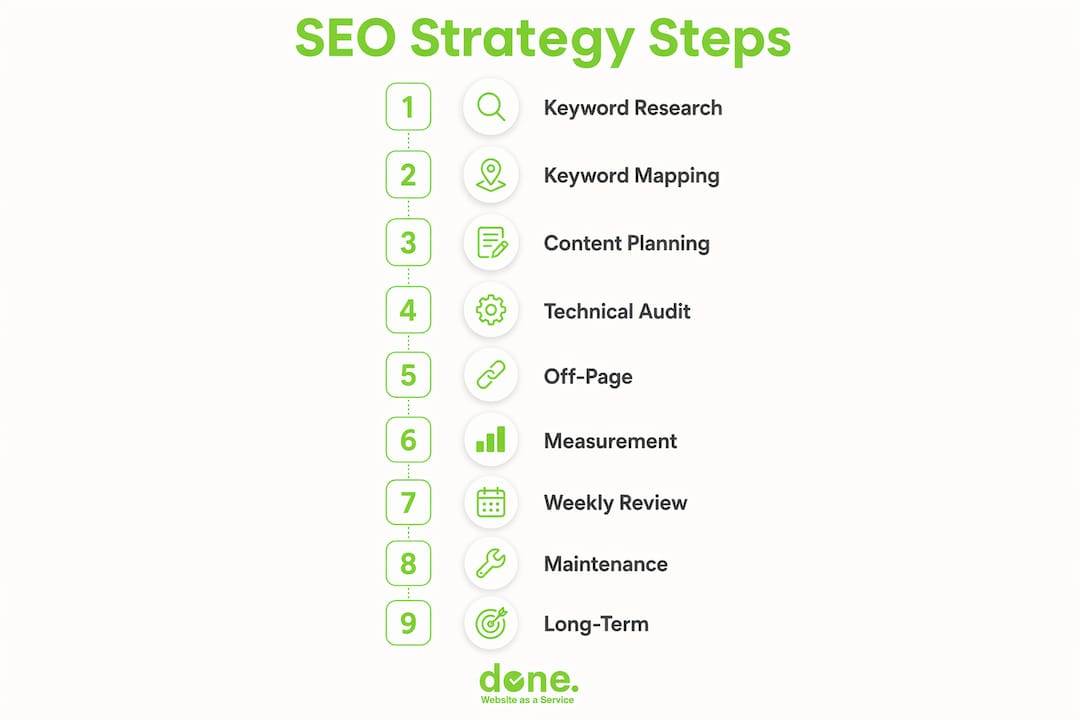
Your nine-step SEO checklist:
- Step 1: Keyword research — find realistic queries your customers actually use
- Step 2: Keyword map — assign one intent to one page, eliminate cannibalisation
- Step 3: Content plan and on-page optimisation — briefs, metadata, EEAT signals
- Step 4: Technical SEO audit — fix what blocks Google from crawling and indexing you
- Step 5: Hreflang and local SEO — handle multilingual and regional signals correctly
- Step 6: Off-page strategy — earn relevant links through partnerships and PR
- Step 7: Measurement — track the right KPIs with GDPR-compliant tools
- Step 8: Workflow and roles — assign ownership and set a weekly cadence
- Step 9: Iterate — review monthly, adjust quarterly
Immediate next action: Open Google Search Console (or a free keyword tool if your site is new), pick your single best-converting service or product page, and list ten phrases a real customer might type to find it. That list is the seed for everything that follows.
TL;DR: Set one measurable goal — for example, significantly increase organic visits to your priority landing page over time. The first metric to watch is average position for your target keyword cluster in Search Console. Everything else flows from that baseline.
Table of Contents
- How to do keyword research that actually finds buyers
- How to build a keyword map that prevents cannibalisation
- How to create a content plan and on-page optimisation that satisfies EEAT
- What does a technical SEO audit actually cover?
- What off-page tactics actually work for SMBs?
- Which KPIs should you track, and how do you do it without breaking GDPR?
- How to run the strategy week to week: roles, AI tools, and GDPR implementation
- What does a realistic SEO timeline and budget look like for an SMB?
- Key takeaways
- Why most SMBs get SEO backwards
- Done’s SEO package for SMBs in Central Europe
- Useful sources and further reading
How to do keyword research that actually finds buyers
Keyword research is where most SMBs waste the most time. They chase high-volume terms that large brands already own, produce content that ranks on page four, and wonder why organic traffic stays flat. The fix is to start with business outcomes, not search volumes.
Begin with your top-converting pages. Which pages currently generate enquiries or sales? Map each one to the search intent behind it: is the visitor comparing options, ready to buy, or just learning? Commercial intent queries (“accountant Luxembourg SME” or “web agency Bratislava quote”) convert at a different rate than informational ones (“what is SEO”), and your keyword plan should reflect that split.
Building your keyword set:
- Seed terms: list every service, product, and location you serve, then expand with synonyms your customers use (not your internal jargon)
- Search Console: filter by pages with impressions but low CTR — those are queries Google already associates with you that you have not yet optimised for
- Site search logs: if your site has internal search, those queries are gold — they show exactly what visitors cannot find
- Customer interviews: ask your last five clients what they typed before they found you; the answers are almost always different from what you assumed
Multilingual considerations for Central Europe matter more here than anywhere else in the process. A business serving clients in Luxembourg, Germany, and Poland is dealing with three languages, three search cultures, and meaningfully different keyword volumes. “Comptable Luxembourg” and “Steuerberater Luxemburg” are not translations of each other in terms of search behaviour — they attract different audiences with different expectations. Run separate keyword sets per language, and do not assume a direct translation will carry the same volume or intent.
Pro Tip: Focus on convertibility, not volume. A keyword with 50 monthly searches and clear commercial intent will outperform a 5,000-search informational term every time for an SMB with limited content resources. Use keyword discovery methods to identify those high-intent gaps before your competitors do.
For a deeper look at how keyword choice connects to lead generation, the Done guide on choosing the right keywords walks through practical examples from Central European markets.
How to build a keyword map that prevents cannibalisation
Once you have a keyword set, the next job is to assign each cluster to exactly one page. Without this step, two of your own pages compete for the same query — Google picks one, usually not the one you want, and both rank lower than they should.
Cluster by intent and funnel stage
Group keywords by what the searcher wants to do, not by topic similarity alone. A cluster like “Luxembourg web agency,” “web agency Luxembourg prices,” and “hire web agency Luxembourg” all belong on your services or pricing page — not spread across three blog posts. An informational cluster like “how long does SEO take” belongs on a dedicated article, not on your homepage.

Assign each cluster a primary keyword, a page URL, and a funnel stage (awareness, consideration, decision). When a cluster is too large for one page, create a topic hub: one pillar page covering the broad intent, supported by several sub-pages targeting narrower variants. This is the architecture that builds topical authority over time.
When to create, consolidate, or split
- Create a new page when no existing page targets the intent and the cluster has clear commercial or informational value
- Consolidate when two or more thin pages target the same intent — merge them into one stronger page and redirect the weaker URLs
- Split when one page is trying to serve two genuinely different intents (for example, a page that mixes “how to do X” with “buy X service” — these need separate pages)
Multilingual mapping and hreflang basics
For multilingual sites, each language version needs its own URL structure. The three common approaches are subdirectories (/fr/, /de/), subdomains (fr.example.com), or separate country-code top-level domains (ccTLDs like .lu, .de, .pl). For most Central European SMBs, subdirectories on a single domain are the most practical choice: they consolidate domain authority and are easier to manage technically. Use hreflang tags to tell Google which language version to serve to which audience.
Simple keyword map template:
| Page URL | Primary keyword | Secondary keywords | Intent | Funnel stage | Locale |
|---|---|---|---|---|---|
| /services/web-agency | web agency Luxembourg | web design Luxembourg, website creation SME | Commercial | Decision | lu, de |
| /blog/seo-timeline | how long does SEO take | SEO results timeline, months to rank | Informational | Awareness | en |
Common mapping mistakes to avoid:
- Targeting the same primary keyword on two different pages
- Creating thin landing pages with fewer than 400 words and no clear CTA
- Forgetting to map 404 pages from old URLs to their nearest live equivalent
- Assigning a high-competition keyword to a new page with no authority
- Skipping locale assignment on multilingual sites, causing hreflang conflicts
How to create a content plan and on-page optimisation that satisfies EEAT
Your keyword map is the brief. Now you need to turn it into a content calendar and a set of on-page tasks that Google and your readers will both reward.
Content brief template
A brief does not need to be long. For each page or article, document:
- Target keyword and two to three secondary keywords
- Search intent (what is the visitor trying to do?)
- Primary message (one sentence: what should the reader take away?)
- Word count guidance (match or slightly exceed the average of the top three ranking pages for that query)
- Internal links to include (two to four relevant pages from your site)
- Metadata draft: title tag (50–60 characters), meta description (140–160 characters)
- Schema type if applicable (Article, LocalBusiness, FAQPage, Product)
On-page checklist
- Title tag includes the primary keyword near the start and stays within 60 characters
- H1 matches or closely echoes the title tag but is written for the reader, not the algorithm
- H2 and H3 headings use secondary keywords naturally and break the page into scannable sections
- Meta description includes a clear benefit and a soft call to action
- Images have descriptive alt text (not “image1.jpg”)
- Canonical tag points to the preferred URL, especially on paginated or filtered pages
- Internal links use descriptive anchor text, not “click here”
- Structured data (schema) is implemented and validated in Google’s Rich Results Test
EEAT for SMBs without whitepapers
Experience, Expertise, Authoritativeness, and Trustworthiness (EEAT) sounds intimidating for a small business. In practice, it comes down to a few concrete signals. Put the author’s name and a short bio on every article. Add your physical address and local phone number to your contact page and footer. Include genuine client references — not invented testimonials, but real named clients who have given permission. For regulated sectors (legal, financial, medical), make sure a qualified professional reviews any content that touches their domain before it goes live.
For multilingual briefs, translation is not enough. A French-speaking audience in Luxembourg has different cultural references and different expectations around formality than a French audience in Paris. Always have a native speaker review translated content, check date formats (DD/MM/YYYY in most of Central Europe), and confirm that any prices or legal references apply to the correct jurisdiction.
AI tools are useful for drafting outlines, generating first-draft paragraphs, and researching competitor content structure. Human review is mandatory for any factual claim, any regulated topic, and any content that carries your brand’s name. The content marketing guide for SMBs covers editorial workflow in more detail.
What does a technical SEO audit actually cover?
Technical SEO is the part most SMBs delay because it feels like a developer’s job. Some of it is. But a clear prioritisation framework means you can hand a developer a ranked list of fixes rather than an overwhelming audit report.
Core technical checks
Start with the basics before anything else:
- Robots.txt: confirm it is not accidentally blocking important pages or directories
- XML sitemap: submit it in Search Console and check for errors or excluded pages
- Canonical tags: every page should declare its preferred URL; check for self-referencing and cross-domain canonicals on multilingual sites
- Status codes and redirect chains: fix 404s on pages with backlinks; collapse redirect chains longer than one hop
- Hreflang: validate that every language version references all other versions correctly (a missing reciprocal tag breaks the whole signal)
- Indexation report in Search Console: check the “Not indexed” tab and address the most common reasons (duplicate content, noindex tags, crawl errors)
Performance priorities
Core Web Vitals — Largest Contentful Paint (LCP), Interaction to Next Paint (INP), and Cumulative Layout Shift (CLS) — directly affect rankings and user experience. For Central European SMBs, server response time is often the quickest win: a hosting provider with data centres in Frankfurt, Amsterdam, or Warsaw will serve pages faster to Central European visitors than one based in the US. Image compression and next-generation formats (WebP, AVIF) typically cut page weight by 30–60% with minimal effort. A content delivery network (CDN) is worth considering once your site has significant traffic from multiple countries.
Pro Tip: Run Google’s PageSpeed Insights on your three most important pages before touching anything else. The “Opportunities” section gives you a prioritised list of performance fixes with estimated time savings — start there rather than with a full audit.
Technical audit prioritisation matrix
| Fix | Impact | Effort | Owner | Estimated time |
|---|---|---|---|---|
| Fix crawl errors and 404s with backlinks | High | Low | Developer | 2–4 hours |
| Submit/fix XML sitemap | High | Low | Marketer | 1 hour |
| Implement hreflang (multilingual) | High | Medium | Developer | 1–2 days |
| Compress images, add WebP | High | Low | Developer | Half day |
| Fix redirect chains | Medium | Low | Developer | 2–4 hours |
| Improve LCP (server, CDN) | High | High | Developer | 1–3 days |
| Add schema markup | Medium | Medium | Developer/Marketer | 1 day |
| Fix mobile usability issues | High | Medium | Developer | 1–2 days |
| Resolve canonical conflicts | Medium | Low | Developer | 2–4 hours |

Mobile-first indexing means Google uses your mobile site to determine rankings. If your mobile experience is slower or has less content than your desktop version, you are ranking on a handicap. Check mobile usability in Search Console and test on a real device, not just a browser emulator.
What off-page tactics actually work for SMBs?
Backlinks remain one of the strongest ranking signals Google uses. For an SMB without a large content budget or a PR team, the realistic path to links is narrower than most guides suggest — but it is entirely achievable.
Tactics that work without a large budget:
- Local directories: submit to relevant national and regional directories in your target markets (for Luxembourg: editus.lu, guichet.lu business listings; for Poland: Panorama Firm; for Czech Republic: Firmy.cz). These links are low-authority individually but collectively build local relevance signals
- Supplier and partner pages: if you work with suppliers, distributors, or complementary service providers, ask for a link from their “partners” or “clients” page — these are often easy to obtain and highly relevant
- PR angles: local business press, industry associations, and chamber of commerce publications regularly feature member businesses. A short press release about a product launch, award, or community initiative can earn a genuine editorial link
- Resource pages: identify pages in your industry that list useful tools, guides, or service providers, and pitch your best content as an addition
- Content partnerships: co-author a piece with a non-competing business that serves the same audience — both parties publish and link to each other
Qualifying link targets
Before you spend time on outreach, check three things: is the linking site relevant to your industry or location? Does it appear to receive real traffic (a rough check via any traffic estimation tool)? Is the link placed in editorial content rather than a footer or sidebar? A single relevant, editorial link from a respected local publication is worth more than twenty directory listings.
Set a realistic monthly goal: for most SMBs, two to four new quality links per month is achievable and sustainable. Track link quality over time by monitoring whether your target keyword rankings improve after new links are acquired — that correlation is more useful than any single link metric.
On paid links: most paid link schemes carry long-term risk that outweighs any short-term ranking gain. Google’s spam policies explicitly target manipulative link schemes, and a manual penalty can remove months of work overnight. Earned, relevant links are slower but durable. For a deeper look at step-by-step keyword research that feeds your content and outreach strategy, that external guide covers the methodology in detail.
Which KPIs should you track, and how do you do it without breaking GDPR?
Measurement is where many Central European SMBs either over-engineer (tracking everything, understanding nothing) or under-engineer (relying on a single vanity metric). Neither works. Here is a practical KPI set and a privacy-first tracking architecture that holds up under GDPR scrutiny.
Recommended KPIs
- Organic sessions by landing page: which pages are actually receiving search traffic?
- Conversions per landing page: which of those pages converts visitors into leads or sales?
- Impressions and CTR: are your pages appearing in search results, and are people clicking?
- Average position for target keyword clusters: are you moving up or down for the queries that matter?
- Assisted conversions: how often does organic search appear in the path to a conversion, even when it is not the last click?
Measurement spec template
| KPI | Source | Reporting cadence |
|---|---|---|
| Organic sessions | Analytics platform | Weekly |
| Conversions per landing page | Analytics platform | Weekly |
| Impressions and CTR | Google Search Console | Weekly |
| Average position | Google Search Console | Weekly |
| Assisted conversions | Analytics platform | Monthly |
Privacy-first tracking for Central European SMBs
GDPR-compliant analytics requires that consent is freely given, informed, and easily revocable. Pre-ticked boxes or “by continuing to browse” banners now face active regulatory scrutiny across Europe. The practical consequence: a meaningful share of your visitors will decline cookies, and a standard Google Analytics 4 setup will simply not record them.
The recommended architecture for most SMBs is a hybrid approach. Run a cookieless baseline measurement layer alongside a consented analytics property. Parallel-running tests commonly show a cookieless pipeline capturing 20–40% more sessions than GA4 with consent gating. A cookieless pipeline that avoids device storage and long-lived identifiers can sometimes proceed on legitimate interest, though this is jurisdiction-specific and requires a documented Legitimate Interests Assessment. For risk-averse businesses, the cleanest approach is to keep analytics processing inside the EEA — self-hosting or using an EU-hosted analytics platform removes the need for Chapter V transfer mechanisms entirely.
Google Search Console is cookie-independent and remains fully available for performance analysis even when visitors decline analytics cookies. Treat it as your primary trend source for impressions, CTR, and query-level data — it is unaffected by consent rates.
Pro Tip: When switching analytics platforms, run both systems in parallel for 2–4 weeks. This reveals how many sessions your new setup captures compared to the old one, and gives you a realistic new baseline before you start reporting against it.
How to run the strategy week to week: roles, AI tools, and GDPR implementation
Strategy without a workflow is just a document. Here is how to convert the nine steps into a repeatable operating rhythm for a small team.
Recommended team roles for SMBs
- Owner or MD: sets priorities, approves content on regulated topics, reviews monthly KPI report
- Marketing lead: owns the content calendar, keyword map, and reporting cadence
- Content writer: produces briefs and drafts; responsible for EEAT signals (author bios, source citations)
- Developer: handles technical fixes, schema implementation, hreflang, and site performance
- Agency contact (if applicable): provides specialist input on audit findings, link strategy, and analytics architecture
Weekly and monthly cadence
Each week, the marketing lead reviews Search Console for position changes and new query opportunities, publishes or updates one piece of content, and checks for new technical errors. The developer addresses the highest-priority fix from the audit backlog. Monthly, the full team reviews KPIs against targets, updates the keyword map with new opportunities, and assesses the link acquisition pipeline.
Where AI helps — and where it does not
AI tools are genuinely useful for generating first-draft outlines, summarising competitor content, and producing metadata variants at scale. For a digital marketing workflow that incorporates AI at the right checkpoints, the key principle is simple: AI drafts, humans decide. Any content touching legal, financial, or medical claims must be reviewed by a qualified professional before publication, regardless of how confident the AI output sounds.
GDPR-first analytics implementation checklist
A practical GDPR analytics implementation can be completed in 4–5 weeks with staged steps:
- Week 1: audit your current tracking setup — identify all cookies, pixels, and third-party scripts
- Week 2: deploy or update your Consent Management Platform (CMP); set tracking to off by default
- Week 3: implement server-side tag management if using a consented analytics layer
- Week 4: deploy cookieless baseline measurement; set and document data retention windows; anonymise IP addresses
- Week 5: update your privacy policy; conduct a final compliance audit; sign Data Processing Agreements (DPAs) with all analytics processors
For behavioural analytics, GDPR allows consent or legitimate interest as lawful bases, but legitimate interest requires a documented balancing test and is jurisdiction-sensitive. Document your chosen basis before you instrument anything.
In our experience with clients across Luxembourg and the broader Central European region, the businesses that get this right from the start avoid costly retrofits later. We have seen sites lose months of conversion data after a supervisory authority complaint forced an emergency analytics rebuild — a situation that a four-week staged implementation would have prevented.
What does a realistic SEO timeline and budget look like for an SMB?
The most common question we hear from clients is: “How long will this take, and what will it cost?” The honest answer depends on your starting point, your competition, and how much you can do in-house. Here is a phased framework.
Phased timeline and cost table
| Phase | Timeline | DIY cost | Mixed (in-house + agency) | Full agency |
|---|---|---|---|---|
| Quick wins: fix critical technical errors, submit sitemap, claim local listings | Weeks 1–4 | Staff time only | — | — |
| Content build: produce and publish priority pages and articles | Months 1–3 | Staff time + tools (approximately €50/month) | — | — |
| Technical fixes: performance, hreflang, schema, mobile | Months 1–2 | Developer time | — | — |
| Link building: outreach, partnerships, PR | Months 2–6 | Staff time + outreach tools | —/month | — |
| Measurement and iteration: ongoing review and adjustment | Ongoing | Analytics tools (approximately €0/month) | — | —/month |
Decision checklist: in-house vs agency
Keep in-house when you have a marketing lead with time to dedicate at least eight hours per week to SEO tasks, your site has fewer than 200 pages, and your keyword competition is low to medium.
Bring in a specialist when your technical audit reveals issues your developer cannot resolve, when you are entering a new language market and need native content and hreflang expertise, or when your rankings have been flat for three months despite consistent effort.
Red flags that mean you need outside help:
- Organic traffic has dropped sharply with no obvious cause (possible penalty or algorithm update)
- Your site has duplicate content across language versions with no canonical or hreflang strategy
- You have never had a technical audit and your site is more than two years old
- Your analytics data is unreliable or non-compliant with GDPR
Long-term maintenance
SEO is not a one-time project. Content needs refreshing every 12–18 months as search intent evolves. Technical audits should run every 6–12 months. Link profiles need monitoring for lost or toxic links. The businesses that treat SEO as a permanent operational function — rather than a campaign — are the ones that compound their gains over time. A digital marketing strategy that integrates SEO with broader marketing goals makes that compounding easier to sustain.
Key takeaways
A practical SEO strategy for Central European SMBs is a nine-step, phased process where keyword research, GDPR-compliant measurement, and consistent content production deliver compounding organic growth over 3–6 months.
| Point | Details |
|---|---|
| Start with intent, not volume | Target keywords with clear commercial intent; a 50-search query that converts beats a 5,000-search term that does not. |
| One page, one intent | Map each keyword cluster to a single page to prevent cannibalisation and build page authority faster. |
| GDPR-compliant tracking is non-optional | Use a hybrid cookieless baseline plus consented analytics; keep processing inside the EEA to remove transfer risk. |
| Search Console is your primary signal | Cookie-independent impressions, CTR, and position data remain reliable regardless of consent rates. |
| Done handles the full sequence | Done audits, builds the roadmap, implements GDPR-compliant tracking, and supports execution for SMBs across Central Europe. |
Why most SMBs get SEO backwards
There is a pattern we see repeatedly with new clients: they have invested in content before fixing technical issues, or they have set up analytics without a consent management platform, or they are targeting keywords their homepage could never realistically rank for against established competitors.
The conventional wisdom — “just publish more content” — misses the point. Content without a keyword map produces articles that compete with each other. Technical fixes without measurement produce improvements you cannot attribute. And measurement without GDPR compliance produces data you may eventually be required to delete.
What tends to work fastest for SMBs is the opposite of the typical agency pitch. Fix the technical foundation first, even if it is unglamorous. Then build a small number of genuinely strong pages rather than a large number of thin ones. Then earn links through relationships and PR rather than buying them. The compounding effect of doing these three things correctly is more durable than any shortcut.
The pitfalls we remove first with new clients: chasing high-volume keywords with no realistic path to ranking, running analytics without a compliant consent layer, and treating hreflang as optional on multilingual sites (it is not — Google will pick the wrong language version for the wrong audience, and you will never know why your French pages underperform).
On a new client site, Done would implement in this order: Search Console setup and baseline, technical audit and priority fixes, keyword map and content brief for the top three pages, GDPR-compliant analytics architecture, then content production and link outreach. That sequence is not exciting, but it is the one that produces measurable results within 90 days.
Done’s SEO package for SMBs in Central Europe
For SMBs that want results without managing every moving part themselves, Done offers a structured SEO engagement that covers the full sequence described in this guide.

The engagement starts with a technical and keyword audit, producing a prioritised roadmap within the first two weeks. Done then handles GDPR-compliant analytics setup — including CMP evaluation, server-side options, and cookieless baseline configuration — so your measurement is solid before any content goes live. From there, the team builds out the keyword map, content briefs, and on-page optimisation for your priority pages, with native-speaker review for multilingual markets.
Pricing is transparent with no setup fees. The first 90 days focus on quick wins and foundation-building: technical fixes, priority page optimisation, and a functioning measurement stack. Ongoing support covers content production, link outreach, and monthly reporting against agreed KPIs.
To get started, visit Done’s agency page and request a free initial audit. Prepare your top three priority pages and a rough list of the services or products you most want to rank for — that is all the team needs to scope the engagement and give you a realistic timeline.
Useful sources and further reading
The sources below informed this guide and are worth bookmarking for deeper reading on specific topics.
-
GDPR Analytics: Complete Compliance Checklist 2026 — Attrifast: Covers consent requirements, cookieless baselines, and the parallel-running migration approach. Relevant to the measurement and GDPR implementation sections.
-
GDPR-Compliant Tracking: Implementation Guide — SaasAnalytics.io: Detailed staged implementation timeline (4–5 weeks) and guidance on server-side tag management and Search Console as a cookie-independent signal.
-
GDPR-Compliant Web Analytics in 2026 — Statnive: Practical guide on EEA-hosted analytics, legitimate interest carve-outs, and Chapter V transfer risk. Relevant to the measurement and workflow sections.
-
GDPR Compliance for Analytics — Pug: Principle-level framework covering lawful basis, consent mechanics, data subject rights, and international transfers. Good reference for the GDPR implementation checklist.
-
SEO Software for Small Businesses — Seobility: Overview of audit, keyword research, rank tracking, and competitor analysis tools suited to SMBs. Useful for the keyword research and technical audit sections.
-
How SEO drives business growth for Luxembourg SMEs — Done: Localised examples and metrics for Luxembourg and Central European SMBs considering SEO investment.
-
SEO best practices for SMBs: 2026 guide — Done: Companion guide covering on-page and technical best practices in more detail; good further reading after completing this step-by-step process.