

7 Essential Web Design Elements for Higher Conversion Rates
February 12, 2026
How to Build E-Commerce Website for Business Success
February 12, 2026
Every marketing manager in Luxembourg knows the pressure is growing as digital channels shift faster than ever before. The path to online visibility and customer loyalty relies on understanding how AI-powered marketing automation and short-form video will define what works in 2026. This article highlights the practical trends and real-world tactics that can help your business rise above the competition while meeting both local and global demands for authenticity, personalization, and responsible digital strategy.
Table of Contents
- Defining Digital Marketing Trends In 2026
- Types Of Digital Marketing Trends Emerging Now
- How Ai And Automation Are Reshaping Marketing
- Personalization, Video, And Search Innovations
- Data Privacy, Measurement, And Brand Trust Challenges
Key Takeaways
| Point | Details |
|---|---|
| AI-Driven Marketing Automation | Enhances efficiency and targeting, but necessitates skilled personnel and data integrity. |
| User-Generated Content is Essential | Builds trust but requires active moderation and community management. |
| Hyper-Personalization is Key | Drives customer loyalty through tailored experiences, relying on strong analytics and privacy measures. |
| Data Privacy is Crucial | Emphasizing consent and transparency is fundamental for maintaining brand trust and navigating regulatory challenges. |
Defining Digital Marketing Trends in 2026
The digital marketing landscape in 2026 represents a complex ecosystem of technological innovation, strategic communication, and consumer-driven experiences. As businesses navigate an increasingly competitive online environment, understanding emerging trends becomes crucial for sustained growth and engagement.
According to recent marketing research, several key developments are reshaping how companies approach digital marketing strategies. These trends demonstrate a significant shift towards more intelligent, personalized, and authentic communication channels:
- AI-powered Marketing Automation: Artificial intelligence continues transforming marketing efficiency and precision
- Short-Form Video Content: Platforms prioritizing quick, engaging visual storytelling
- Authentic User-Generated Content: Consumers demanding genuine brand interactions
- Hyper-Personalized Experiences: Leveraging data to create targeted marketing approaches
The global digital transformation extends beyond technological capabilities. International policy frameworks increasingly emphasize creating sustainable, inclusive digital marketing practices that balance innovation with societal considerations. This means marketers must not only understand technological tools but also navigate complex ethical and regulatory landscapes.
Strategic marketers recognize that 2026’s digital environment demands a holistic approach. Successful campaigns will integrate advanced technologies with genuine human connection, creating experiences that feel both cutting-edge and authentically meaningful.
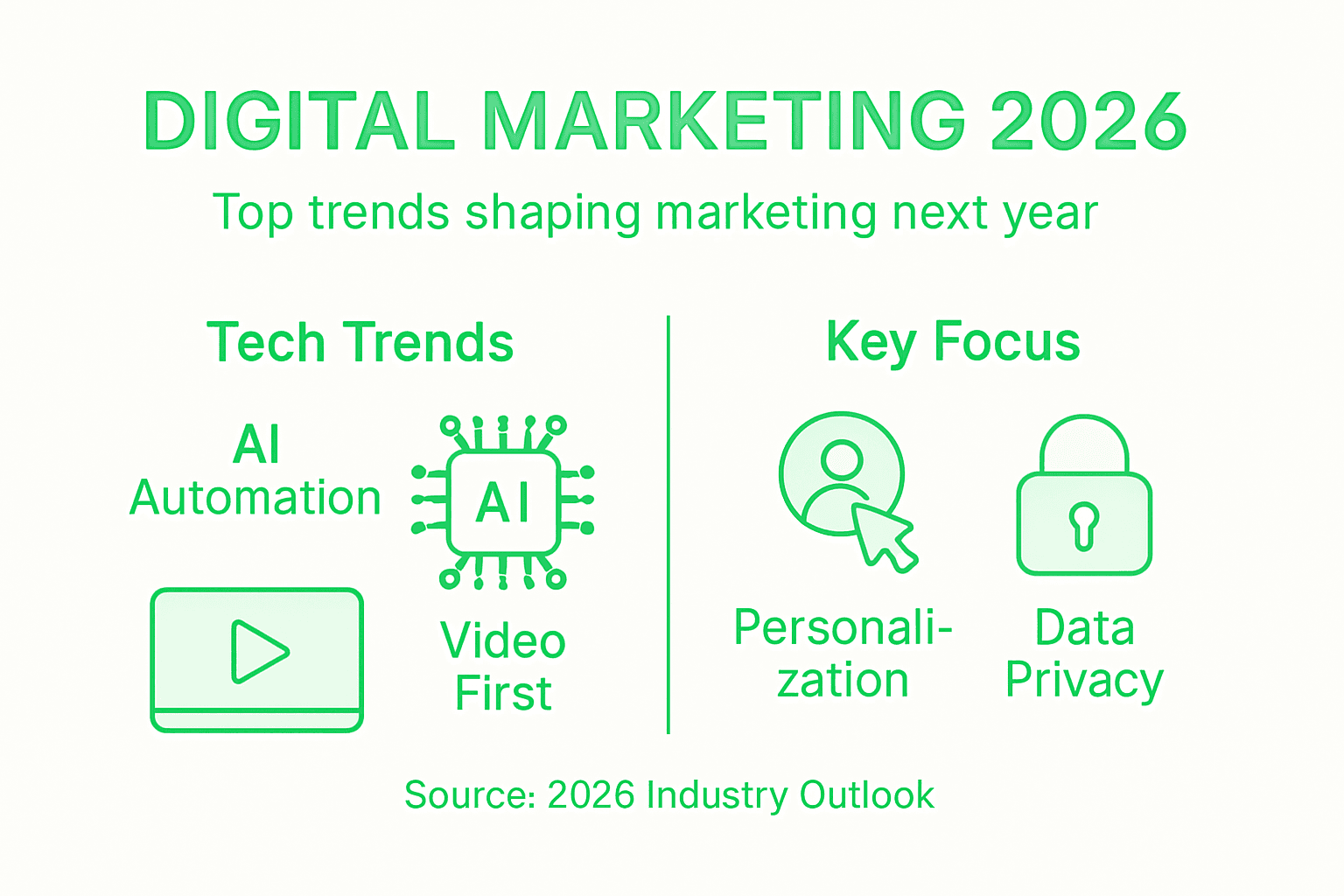
Here’s a summary of how top digital marketing trends impact business outcomes:
| Trend | Business Impact | Implementation Challenge |
|---|---|---|
| AI-powered Automation | Improves efficiency and targeting | Requires skilled personnel and data integrity |
| Short-Form Video | Boosts engagement and brand awareness | Demands ongoing creative content production |
| User-Generated Content | Builds trust and authenticity | Needs active moderation and community management |
| Hyper-Personalization | Drives customer loyalty and conversion | Relies on robust analytics and privacy protection |
Pro tip: Invest in continuous learning about emerging digital marketing technologies to stay ahead of rapidly evolving trends.
Types of Digital Marketing Trends Emerging Now
Digital marketing is rapidly evolving, with innovative approaches transforming how businesses connect with their audiences. Understanding the diverse types of emerging marketing trends becomes essential for companies seeking to maintain competitive advantage in an increasingly complex digital landscape.
Social media marketing trends reveal a multifaceted approach to digital engagement, highlighting several critical categories of marketing strategies:
- Content Marketing: Creating valuable, relevant information that attracts and retains audiences
- Video Marketing: Leveraging short-form and interactive video content across platforms
- AI-Driven Marketing: Utilizing artificial intelligence for personalization and predictive analytics
- Influencer Collaboration: Developing strategic partnerships with digital thought leaders
- Interactive Experiences: Designing immersive, engagement-focused digital interactions
Each marketing trend represents a sophisticated approach to audience connection. Multichannel strategies now demand integrated communication that seamlessly blends technological innovation with authentic human experience.
Advanced marketers recognize that these trends are not isolated tactics but interconnected elements of a holistic digital marketing ecosystem. Successful implementation requires deep understanding of technological capabilities, consumer psychology, and emerging platform dynamics.
Digital marketing in 2026 is less about broadcasting messages and more about creating meaningful, personalized conversations.
The most effective marketing approaches will combine data-driven insights with creative storytelling, enabling brands to build genuine connections in an increasingly fragmented digital environment.
Pro tip: Develop a flexible marketing strategy that can quickly adapt to emerging technological and consumer trends.
How AI and Automation Are Reshaping Marketing
The marketing landscape is undergoing a radical transformation driven by artificial intelligence and advanced automation technologies. These powerful tools are fundamentally reimagining how businesses interact with consumers, create content, and develop strategic campaigns.
Marketing communication technologies are creating an interactive ecosystem where AI enables unprecedented levels of personalization and efficiency. Key developments in AI and automation include:
- Predictive Customer Analytics: Anticipating consumer behaviors and preferences
- Automated Content Generation: Creating personalized marketing materials at scale
- Real-Time Personalization: Adapting marketing messages instantly based on user interactions
- Intelligent Campaign Optimization: Dynamically adjusting marketing strategies
- Advanced Targeting Mechanisms: Identifying and engaging most relevant audience segments
According to IEEE’s technology predictions, AI will dramatically reduce routine marketing tasks, allowing professionals to concentrate on higher-level strategic and creative work. This shift represents more than technological advancement – it’s a fundamental reimagining of marketing roles and capabilities.
AI is not replacing marketers; it’s empowering them to be more strategic, creative, and impactful.
The most successful marketing teams will integrate AI as a collaborative tool, using machine learning to enhance human creativity rather than replace it. Ethical considerations and responsible implementation will be crucial in developing these advanced marketing technologies.

Pro tip: Invest in continuous AI skills training to remain competitive and leverage emerging marketing automation technologies.
Personalization, Video, and Search Innovations
The digital marketing ecosystem is rapidly evolving, driven by unprecedented technological advancements that transform how brands connect with consumers. Marketing trends reveal a sophisticated landscape where personalization, video content, and search innovations are reshaping communication strategies.
Key innovations in these critical marketing domains include:
- Hyper-Personalized Experiences: Leveraging AI to create individualized consumer journeys
- Adaptive Content Strategies: Dynamically adjusting messaging based on real-time user interactions
- Immersive Video Engagement: Creating interactive, short-form video experiences
- Voice Search Optimization: Developing content compatible with conversational search technologies
- Visual Search Capabilities: Enabling image-based product discovery and recommendations
The convergence of these technologies represents a fundamental shift in marketing communication. Intelligent personalization now goes beyond simple demographic targeting, utilizing complex behavioral analytics to create deeply resonant consumer experiences.
Successful marketing in 2026 is about creating meaningful connections, not just delivering messages.
Advanced search and video technologies are breaking down traditional marketing barriers, enabling more intuitive, user-driven interactions. Brands that effectively integrate these innovations will create more authentic, engaging experiences that transcend conventional communication methods.
This table highlights essential differences between personalization, video, and search innovations:
| Innovation Area | Key Benefit | Technology Example |
|---|---|---|
| Personalization | Customized user journeys | AI-driven recommendation engines |
| Video | Enhanced interactive engagement | Shoppable short-form videos |
| Search | Improved content discoverability | Voice and image-based search tools |
Pro tip: Develop a flexible content strategy that can seamlessly adapt across personalization, video, and search platforms.
Data Privacy, Measurement, and Brand Trust Challenges
Digital marketing is entering a complex era where technological capabilities are increasingly constrained by ethical considerations and regulatory frameworks. Digital transformation challenges highlight the critical importance of navigating data privacy, measurement accuracy, and brand trust with unprecedented care and transparency.
Key challenges in this evolving landscape include:
- Consumer Data Protection: Implementing robust privacy safeguards
- Transparent Analytics: Developing measurement approaches that respect user privacy
- Consent-Driven Marketing: Creating strategies that prioritize user permissions
- Ethical AI Use: Ensuring algorithmic decisions maintain consumer trust
- Regulatory Compliance: Adapting to changing global data protection standards
According to emerging business research, marketers must fundamentally reimagine their approach to data collection and utilization. Consent-first strategies are no longer optional but essential for maintaining brand reputation and consumer relationships.
Trust is the most valuable currency in digital marketing – and it’s increasingly difficult to earn.
The most successful brands will distinguish themselves by transforming data privacy from a compliance requirement into a genuine commitment to consumer respect. This means developing transparent communication strategies, providing clear opt-out mechanisms, and demonstrating a genuine commitment to ethical data practices.
Pro tip: Create a comprehensive data governance framework that treats consumer privacy as a core brand value, not just a legal requirement.
Stay Ahead With Tailored Digital Marketing Solutions for 2026
The rise of AI-powered automation, hyper-personalized experiences, and evolving data privacy demands create real challenges for businesses aiming to thrive in 2026’s digital marketing landscape. If you feel overwhelmed by the need to integrate advanced technologies while maintaining authentic customer trust and compliance you are not alone. Key concepts like predictive customer analytics, interactive short-form videos, and consent-driven marketing require specialized skills and adaptive strategies to unlock their full potential.
At Done.lu, we understand that mastering these digital marketing trends is essential for sustained growth and engagement. Our expert team offers custom web development, SEO, SEM, and marketing automation services designed to boost your online presence with a growth-driven approach tailored for small and medium-sized enterprises across Luxembourg and Europe. Whether it is crafting responsive websites, managing social media, or building data-driven inbound marketing campaigns, we combine technology and creativity to make your brand stand out securely and authentically.
Ready to transform your digital marketing efforts and embrace the future with confidence?
Explore how our comprehensive services can help you navigate the complexities of digital transformation with ease. Visit Done.lu and start your journey towards impactful, compliant, and future-proof marketing today.
Frequently Asked Questions
What are the main digital marketing trends for 2026?
The main digital marketing trends for 2026 include AI-powered marketing automation, short-form video content, authentic user-generated content, and hyper-personalized experiences. These trends emphasize the importance of intelligent, personalized communication for consumer engagement.
How is AI impacting digital marketing strategies?
AI is transforming digital marketing strategies by enabling predictive customer analytics, automated content generation, real-time personalization, and intelligent campaign optimization, allowing marketers to improve targeting and efficiency while freeing them for more strategic tasks.
What is the significance of user-generated content in 2026?
User-generated content is significant in 2026 as it builds trust and authenticity between brands and consumers. With consumers increasingly seeking genuine interactions, brands must engage with and moderate user-generated content effectively to enhance their image and credibility.
What challenges do marketers face regarding data privacy in digital marketing?
Marketers face challenges related to data privacy, including implementing robust consumer data protection measures, ensuring transparency in analytics, and adhering to regulations that necessitate consent-driven marketing strategies. Building trust through ethical data use is crucial for brand reputation.